.webp)







Listen To Our Podcast🎧
Introduction
Automated KYC verification is the fastest way to cut onboarding delays without weakening your fraud controls, but only if you automate the right checks in the right order. Most teams try to automate everything at once, stall on integration work, and end up with a half-manual process that is slower than before.
This guide is a sequencing plan. It shows which checks to automate first, which to leave for later, and where deepfakes and fake identities break naive setups. It is written for compliance officers, CISOs, and the developers who build the flow.
- Which 5 KYC checks to automate first, and why the order matters
- How liveness detection stops deepfakes that fool a plain selfie match
- Where synthetic identities slip through document-only checks
- How manual and automated onboarding compare on speed and audit quality
- What to test before you commit to an identity verification API
- How zero trust principles protect the KYC stack itself
Onboard Customers in Seconds

What Is Automated KYC Verification?
Automated KYC verification is the use of software to confirm a customer's identity, screen them against watchlists, and record the decision without an analyst touching every file. Humans review only the exceptions the system cannot resolve on its own.
It replaces a queue of documents and emails with a pipeline: capture, check, decide, log. Each stage produces evidence you can show a regulator later.
How does automated KYC verification differ from e-KYC?
E-KYC usually means collecting documents digitally. Automation goes further: it reads the document, verifies it against authoritative data, matches the face, scores risk, and routes the case. If a human still retypes fields from a scanned passport, you have digitized KYC, not automated it.
Why sequencing matters for digital identity proofing
Digital identity proofing is the process of establishing that a claimed identity is real and belongs to the person presenting it. NIST SP 800-63A breaks this into resolution, validation, and verification. That split is a useful build order: automate what is cheap and deterministic first, then the steps that need judgment.
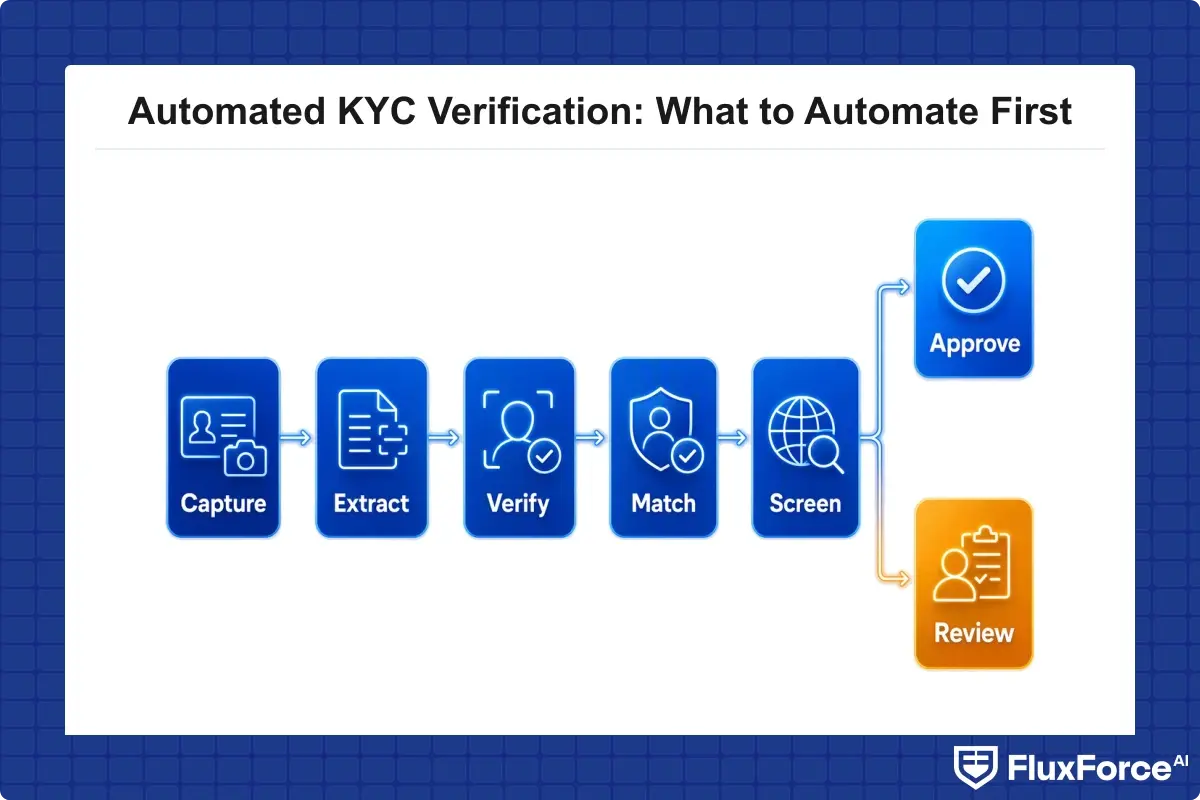
Automate deterministic checks before judgment calls. A check that returns the same answer every time (document format, checksum, watchlist hit) is the cheapest to automate and the safest to run unattended.
5 Checks to Automate First in Automated KYC Verification
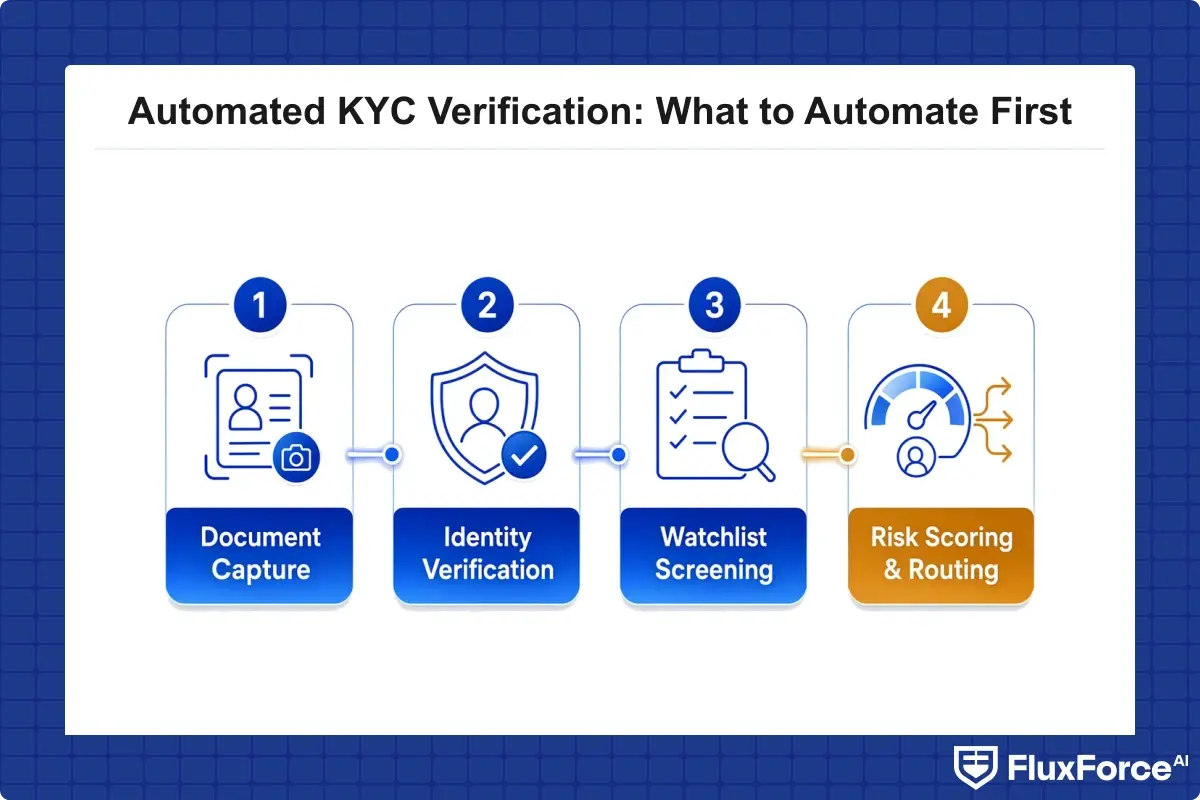
These five are ordered by effort against payoff. In our experience, teams that follow this order see the first working version in weeks rather than quarters, because each step reuses the output of the one before it.
1. Document Capture and Data Extraction
Start with reading the ID. Optical character recognition and machine-readable zone parsing pull name, date of birth, and document number into structured fields. This removes retyping, which is the single largest source of data-entry errors in manual onboarding.
Add basic quality gates here: blur, glare, cropping, and expiry date. Rejecting a bad photo in two seconds beats an analyst rejecting it two days later.
2. Document Authenticity Checks
Next, test whether the document is genuine. Check security features, font consistency, template match, and tampering signals. Cross-check the machine-readable zone against the printed text.
This step is deterministic enough to run unattended for most submissions. Route only low-confidence results to a person.
3. Biometric Match and Liveness
Compare the selfie to the ID photo, and confirm a live person is present. This is where biometric identity verification earns its place, and where most fraud attempts now concentrate. The next section covers why.
4. Sanctions and Watchlist Screening
Screening is rule-driven and repeatable, so it automates well. Run names and dates of birth against sanctions, PEP, and adverse media lists at onboarding and on a schedule afterward. Our guide to sanctions screening automation covers tuning to keep false positives manageable.
5. Risk Scoring and Case Routing
Automate this last. Combine signals from the first four steps into a score and route cases: auto-approve, step-up verification, or manual review. Do it last because the score is only as good as its inputs, and you need real data from steps one to four to calibrate thresholds.
How Does Biometric Identity Verification Stop Deepfakes?
Biometric identity verification stops deepfakes by proving that a live human is in front of the camera, not just that a face resembles the ID photo. A face match alone is easy to defeat with a stolen photo, a replayed video, or a generated face.
The defense has two parts: liveness checks at capture, and injection-attack detection at the device and stream level.
What does liveness detection fraud prevention actually check?
Liveness detection fraud controls look for signs of a real, present person. Passive liveness analyzes texture, depth cues, and reflections from a single capture. Active liveness asks for a random action, like turning the head.
Passive is friendlier and adds almost no friction. Active is harder to spoof with a prerecorded clip. Most regulated firms use passive by default and escalate to active when the risk score rises.
Deepfake detection in banking: what to test
Deepfake detection in banking has moved from theory to a live onboarding problem. Attackers can feed synthetic video straight into the capture pipeline, bypassing the camera altogether.
When you evaluate a vendor, ask for these tests:
- Presentation attacks: printed photos, screen replays, and masks
- Injection attacks: virtual cameras and emulators feeding fake streams
- Face-swap video: real-time generated faces during a live session
- Demographic performance: false reject rates across skin tones and ages
Be honest with yourself about the tradeoff. Tighter liveness thresholds catch more fakes and also reject more legitimate customers, especially on older phones in poor light. Set the threshold with your own traffic, not a vendor's demo.
How to Stop Synthetic Identity Fraud During Onboarding
Synthetic identity fraud combines real data, such as a stolen national ID number, with invented details to create a person who does not exist. The document may be real. The face may be real. The identity is not.
That is why document and selfie checks alone fall short. Each artifact passes individually, and the fabrication only shows up when you look at the whole.
Synthetic identity fraud detection: signals that work
Synthetic identity fraud detection works by finding inconsistencies across sources rather than inside one document. Useful signals include:
- A thin or brand-new data footprint for the claimed age
- One phone number, device, or address shared across unrelated applicants
- An email address created days before the application
- An ID number whose issue date does not fit the stated date of birth
We cover real-time approaches in more depth in detecting synthetic identity fraud in real time.
Link analysis beats single-document review
Graph-style checks connect applicants who share devices, addresses, or contact details. A single fake profile looks fine. Forty profiles on one device do not.
Synthetic identities are built to pass individual checks. Detect them by comparing applicants to each other, not just to their own documents.
Manual vs Automated KYC: Where Speed Comes From
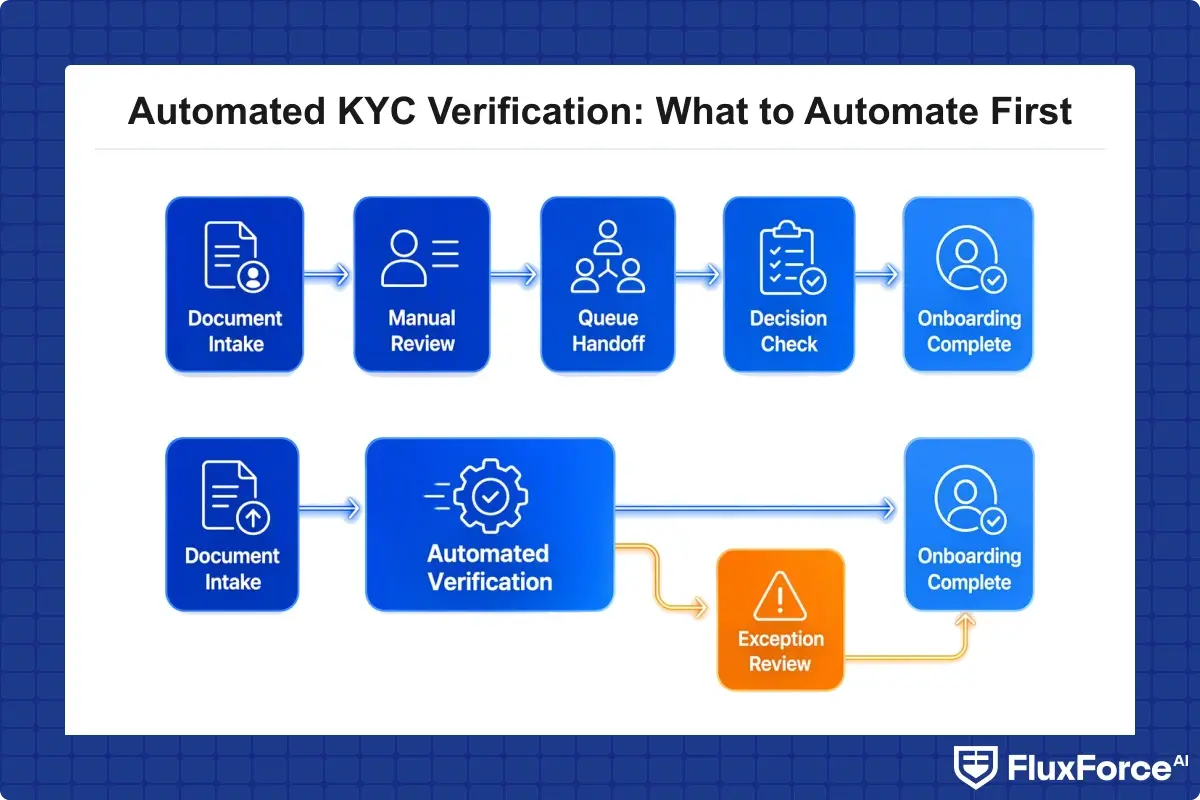
KYC onboarding speed depends less on how fast a single check runs and more on how many handoffs a case survives. Every queue between analysts adds hours or days.
Manual vs Automated KYC Onboarding
| Factor | Manual KYC | Automated KYC |
|---|---|---|
| Typical wait time | Hours to days per case, driven by queues | Seconds to minutes for most cases |
| Consistency | Varies by analyst and shift | Same rules applied to every case |
| Audit trail | Notes and email threads | Timestamped decision log per check |
| Scaling cost | Grows with headcount | Grows with usage, not staffing |
| Fraud exposure | Fatigue and copy-paste errors | Model drift and threshold errors |
The last row matters. Automation does not remove risk, it moves it. Instead of analyst fatigue, you now have to monitor model performance and threshold drift.
For a wider view of the tradeoffs, see manual compliance vs AI automation.
Choosing an Identity Verification API for Fintech Teams
An identity verification API is the interface your app calls to run document, biometric, and screening checks. For identity verification fintech teams, the API is the product surface: it decides how fast you can ship and how much you depend on one vendor.
What to test in an identity verification API
Run a pilot on your real traffic before signing. Measure:
- Pass rate on genuine customers, split by document type and country
- Fraud catch rate on a labelled set of known attacks
- Latency at your peak, not the vendor's average
- Fallback behavior when a check times out
- Data residency and retention controls for your regulators
The FATF guidance on digital identity is a good reference for how regulators view reliable digital ID systems in customer due diligence.
Build, buy, or orchestrate
Building every check yourself is rarely worth it. Buying one all-in-one vendor is fast but creates lock-in. Many teams settle on an orchestration layer that lets them swap vendors per check. Our note on AI-powered API gateways for fintech compliance explains how that layer fits in.
If you want the pipeline pre-assembled, a platform for kyc aml automation can combine identity checks, screening, and case management in one workflow.
Zero Trust Around Your KYC Stack
Your KYC system holds passports, faces, and addresses. That makes it a target, and automation increases the blast radius if one service is compromised.
Zero trust financial services: applying it to KYC data
Zero trust financial services architecture assumes no service or user is trusted by default. For KYC, that means:
- Short-lived credentials for every service calling the verification pipeline
- Least-privilege access, so analysts see only the cases they own
- Encryption of biometric templates and documents at rest and in transit
- Logging of every read of identity data, not just writes
Choosing a zero trust security framework
A zero trust security framework gives you a shared vocabulary for these controls. NIST SP 800-207 is the reference most auditors recognize. For how this connects to AI-driven workflows, read zero trust and agentic AI in banking security.
An automated KYC pipeline concentrates sensitive data in one place. Treat it as a high-value target from day one, not after the first incident.
- Automate deterministic checks first (extraction, authenticity, screening) and risk scoring last.
- A face match without liveness and injection-attack detection will not stop modern deepfakes.
- Synthetic identities pass single-document checks, so compare applicants across devices, addresses, and data sources.
- Faster onboarding comes from removing handoffs, but automation moves risk into thresholds and model monitoring.
- Pilot any identity verification API on your own traffic and measure pass rate, catch rate, and latency.
- Protect the KYC stack itself with zero trust controls, because it stores your most sensitive customer data.
Onboard Customers in Seconds
Conclusion
Automated KYC verification fails when teams automate everything at once and succeed when they follow a sequence. Manual queues add days to onboarding, and attackers now use deepfakes and synthetic identities that pass single-document checks.
Three things solve most of it: ordered automation that starts with deterministic checks, liveness and cross-applicant analysis to catch fakes, and zero trust controls around the data you collect. Our KYC strategy for insurers shows the same pattern applied to another regulated sector.
In practice, a first version covering document extraction and screening can ship in weeks, with liveness and risk routing added in the following release. Pick one check from the list above, pilot it on a month of real applications, and measure what changes.

Share this article