.webp)







Listen To Our Podcast🎧
Introduction
An AML compliance program is the thing examiners test first and forgive last. If you have sat across the table from an OCC or state examiner while they page through your BSA file looking for gaps, you already know that "we take AML seriously" doesn't survive contact with a transaction sample.
Most banks and fintechs don't fail exams because they lack effort. They fail because their program was built in pieces, by different people, at different times, and the pieces never quite lined up: a risk assessment that hasn't been touched in two years, a SAR narrative template nobody standardized, a KYC file with three different versions of "verified."
This guide walks through what an exam-ready aml compliance program actually looks like in 2026, including the specific documentation, filing rules, and technology decisions that separate institutions that pass clean from institutions that walk out with a Matter Requiring Attention.
- The five components examiners expect to see documented, not just described
- How to build an AML risk assessment that survives a follow-up question
- What changed in KYC automation and CDD/EDD expectations heading into 2026
- The SAR and CTR filing rules that generate the most citations
- Why community banks and small fintech teams get flagged more often, and what fixes it
- Where AI-based transaction monitoring actually outperforms rule-based systems, and where it doesn't
Onboard Customers in Seconds

What Is an AML Compliance Program (And Why Exams Fail Without One)?
An aml compliance program is the documented set of policies, people, and controls a financial institution uses to detect, prevent, and report money laundering and terrorist financing. It is not a policy binder. It is a live system that has to produce evidence: risk-rated customers, filed reports, trained staff, and an audit trail showing the program actually ran.
Regulators built the requirement around the Bank Secrecy Act (BSA), and the FFIEC BSA/AML Examination Manual is the actual rulebook examiners use, not a summary of one. If your compliance team hasn't read it cover to cover, that's usually the first sign an exam is going to be rough.
AML Compliance vs. Fraud Prevention: What's the Difference?
Fraud prevention stops a bad transaction before it happens. AML compliance is about pattern detection and reporting after funds move, tracing where money came from and where it's going. A transaction can be perfectly "not fraud" (the account holder authorized it) and still trigger a SAR because the pattern looks like structuring or layering.
We've seen fintechs conflate the two and build a fraud-only stack, then get surprised when examiners ask for suspicious activity monitoring reports that don't exist. AML compliance software and fraud tools overlap in data sources but answer different questions.
Who Enforces AML Compliance Program Rules?
In the US, FinCEN sets the rules, and your primary federal regulator (OCC, FDIC, Federal Reserve, or NCUA) examines against them using the FFIEC manual as the shared standard. State-chartered institutions also answer to state banking departments. Fintechs operating through a bank partner inherit the partner bank's BSA/AML obligations by contract, which is often the part nobody explains clearly at onboarding.
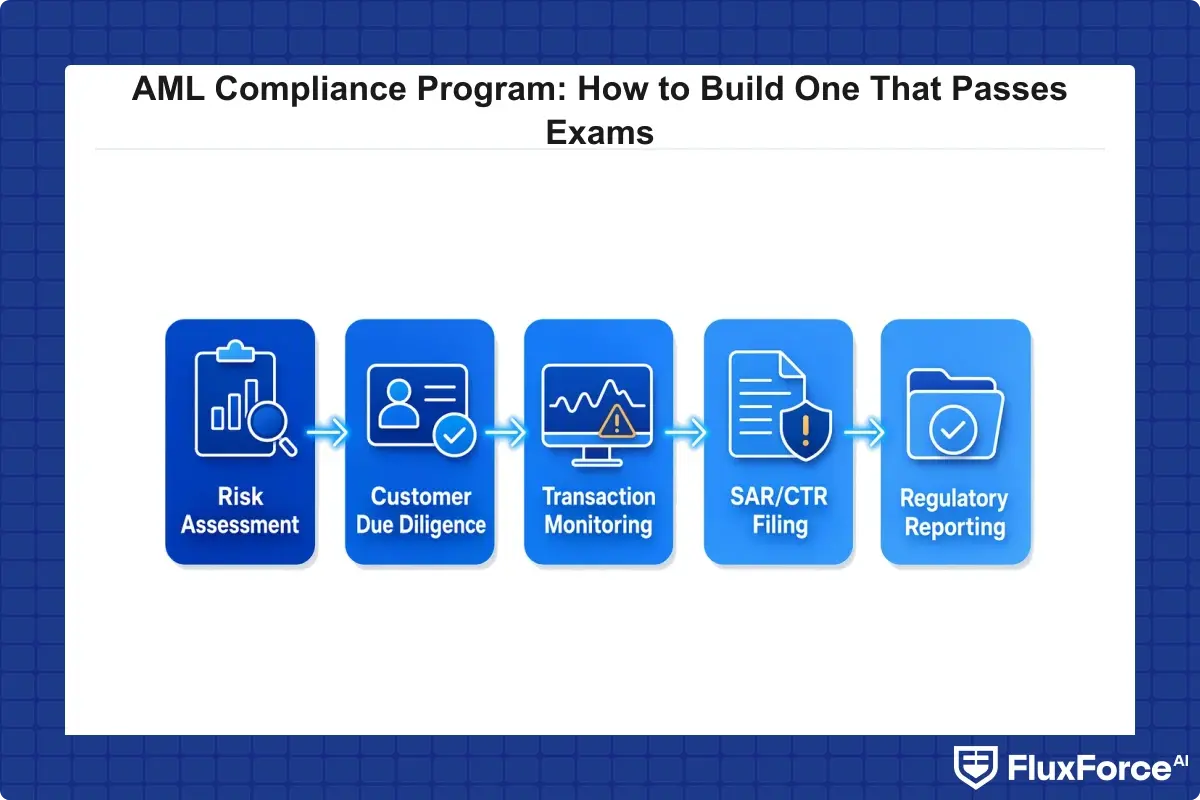
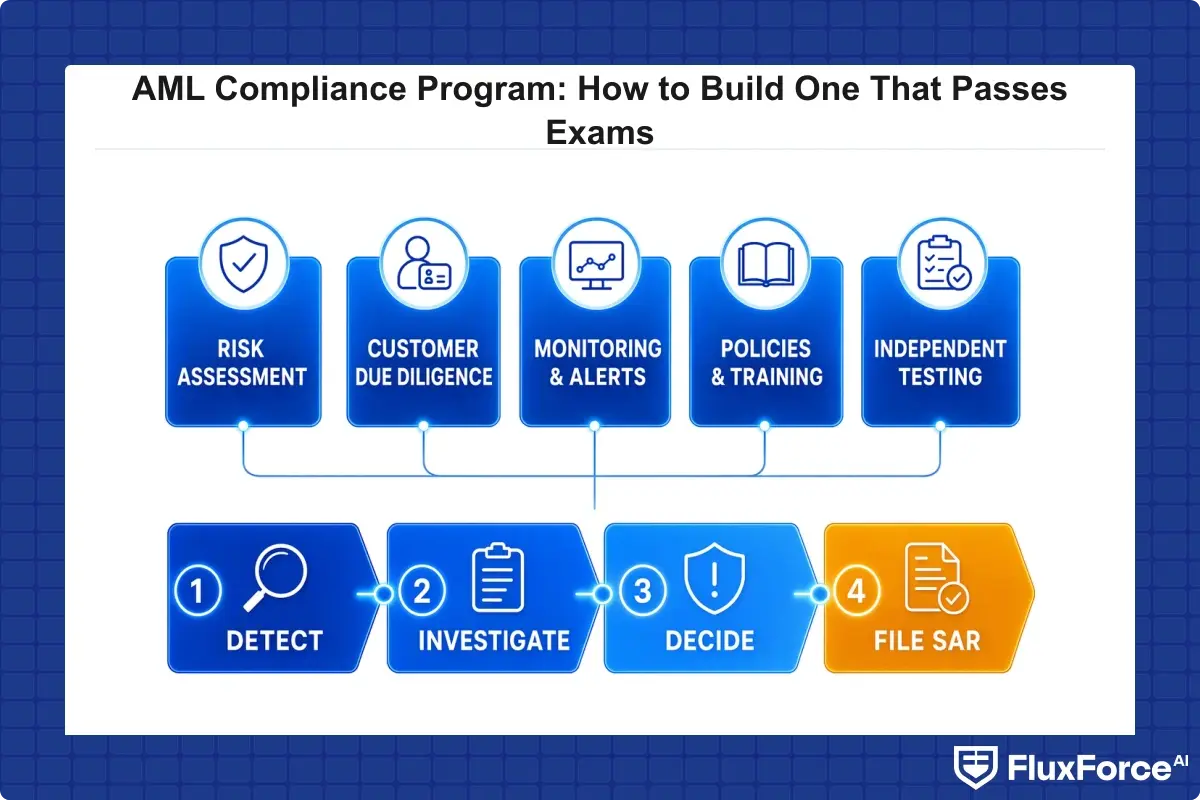
5 Pillars of a BSA AML Compliance Checklist
Every bsa aml compliance checklist we've reviewed during client engagements maps back to five statutory pillars. Miss one and the whole program is considered deficient, even if the other four are strong.
1. A Written AML Compliance Program
This is the actual document: policies, procedures, and controls, approved by the board, dated, and version-controlled. Undated or unsigned policies are an automatic finding.
2. A Designated BSA Officer
One named individual with real authority and a reporting line to the board, not a shared title. Examiners will ask this person questions directly and expect specific answers, not "I'd have to check."
3. Ongoing Employee Training
Annual, role-specific, and documented with attendance records and quiz scores. Generic slideshows for tellers and underwriters alike are a recurring finding.
4. Independent Testing and Audit
A review performed by someone outside the BSA function, internal audit or an external firm, on a set schedule. "We'll get to it" is not a testing cadence.
5. Customer Due Diligence and Beneficial Ownership Rules
The fifth pillar, added after the 2016 CDD Rule, requires identifying beneficial owners of legal entity customers at 25% ownership or more. This is the pillar most often left half-implemented in fast-growing fintechs.
A program that is strong on paper but weak on one pillar, most often independent testing, gets the same enforcement outcome as a program with no policy at all. Examiners score the weakest link, not the average.
How Do You Conduct an AML Risk Assessment?
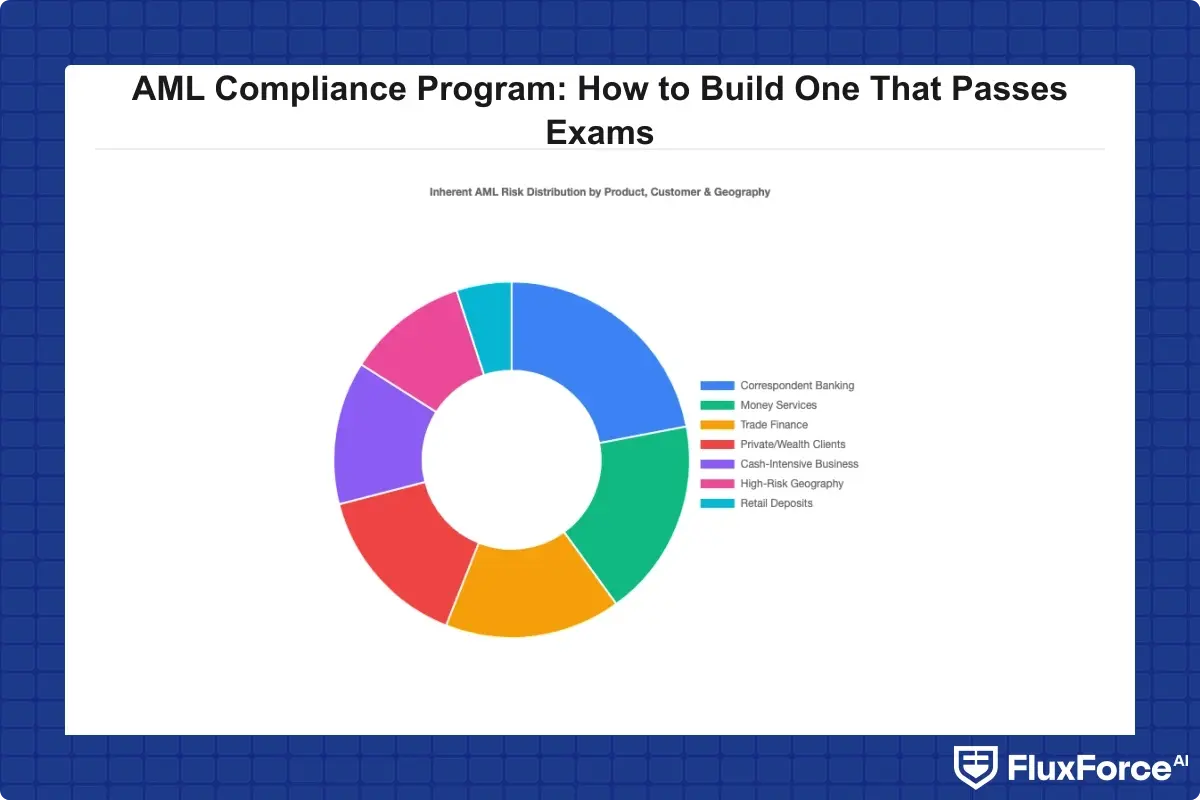
A credible aml risk assessment guide starts with three inputs: products and services, customer types, and geographic footprint. Score each on inherent risk, then again after controls, to produce a residual risk rating you can defend line by line.
The Inputs Your Risk Assessment Should Cover
- Products: wire transfers, correspondent banking, crypto on-ramps, and cash-intensive services carry higher inherent risk than standard deposit accounts
- Customers: money services businesses, cash-intensive retailers, and politically exposed persons need separate risk tiers
- Geography: transactions touching FATF-listed jurisdictions or OFAC sanctions program countries push the score up automatically
- Delivery channels: non-face-to-face onboarding, common in fintechs, is inherently higher risk than in-branch account opening
How Often to Refresh the Assessment
Annually at minimum, and immediately after a new product launch, an acquisition, or entry into a new market. An assessment that predates your current product lineup is functionally useless in an exam, because it doesn't describe the institution examiners are looking at.
For institutions managing this across multiple regulated business lines, regulatory compliance automation can keep the risk assessment synced to actual product and customer data instead of a static spreadsheet that's stale within a quarter.
KYC Automation in 2026: Meeting CDD and EDD Requirements
Kyc automation 2026 is less about replacing analysts and more about removing the manual document-matching that used to eat two days per file. The underlying CDD and EDD requirements haven't changed; the tooling that verifies them has.
KYC CDD Requirements Banks Must Document
Standard due diligence under the CDD Rule means verifying identity, understanding the nature of the customer relationship, and collecting beneficial ownership information for legal entities. Automated identity verification and document parsing now handle the first two steps in minutes rather than days, but the underlying documentation obligation is unchanged, you still need a file that proves it happened.
Enhanced Due Diligence Guide: When EDD Kicks In
Enhanced due diligence applies to higher-risk customers: PEPs, correspondent banking relationships, and businesses in cash-intensive or high-risk industries. An enhanced due diligence guide worth following requires source-of-funds verification, more frequent account reviews, and senior management sign-off, not just a higher risk score in a system that nobody revisits. We've watched EDD get reduced to a checkbox at onboarding with no ongoing review, which is precisely the gap examiners probe first.
Our guide to KYC/AML identity verification strategy covers how to structure the technical side of this without creating a compliance blind spot between onboarding and ongoing monitoring.
SAR and CTR Filing: The Rules Examiners Actually Check
Sar filing and ctr filing rules are where most citations happen, not because the rules are complicated, but because volume makes small process errors compound.
CTR Filing Rules: The $10,000 Threshold
A Currency Transaction Report is required for cash transactions exceeding $10,000 in a single business day, including structured transactions designed to stay just under it. FinCEN's CTR filing guidance is explicit that aggregation across related transactions in one day counts toward the threshold, a detail that trips up institutions relying on per-transaction rather than per-customer, per-day logic.
SAR Filing Best Practices: A Suspicious Activity Report Guide for 2026 Requirements
FinCEN requires SAR filing within 30 days of detecting suspicious activity, extendable to 60 days if no suspect is identified. Good sar filing best practices center on narrative quality: examiners consistently flag SARs where the narrative just restates the alert instead of explaining why the activity is actually suspicious. A solid suspicious activity report guide treats the narrative as the work product, not the filing itself.
The single most common SAR finding in our client reviews isn't a missed filing, it's a filed SAR with a narrative too thin to show the investigation actually happened. Examiners read narratives as a proxy for whether your analysts understood the risk, not just whether they clicked submit.
Sar filing requirements 2026 haven't shifted the deadlines, but examiners are increasingly checking whether SAR decisions are traceable back to the alert that generated them, an area where manual spreadsheets fall apart under scrutiny. Institutions handling high alert volume with thin staffing benefit from automated compliance workflows; our piece on sanctions screening automation walks through one version of that pipeline.
Why Community Banks and Fintechs Struggle with AML Compliance Programs
The struggle isn't intent, it's headcount versus alert volume. A community bank with two BSA analysts and a fintech with one compliance hire face the same regulatory bar as a money-center bank with a 200-person financial crimes unit.
BSA AML Compliance Community Banks Face Without Big Budgets
Bsa aml compliance community banks run typically shares one system across deposits, lending, and BSA, with the BSA officer wearing two or three other hats. That works until alert volume grows faster than staffing, which is exactly what happens after a growth year or a new digital product launch.
Fintech BSA AML Small Team Realities
A fintech bsa aml small team usually inherits BSA obligations through a partner bank agreement and has to satisfy that bank's compliance requirements on top of its own, often with software built for a five-person team monitoring the transaction volume of a mid-size bank. The mismatch between team size and monitoring scope is the single biggest driver of examiner findings we see in this segment.
If your organization is weighing where to draw the line between manual review and automated workflows, manual compliance vs. AI automation breaks down the tradeoffs by team size rather than by institution type, which is the more useful axis for smaller shops.
Manual Monitoring vs Anti-Money-Laundering Technology
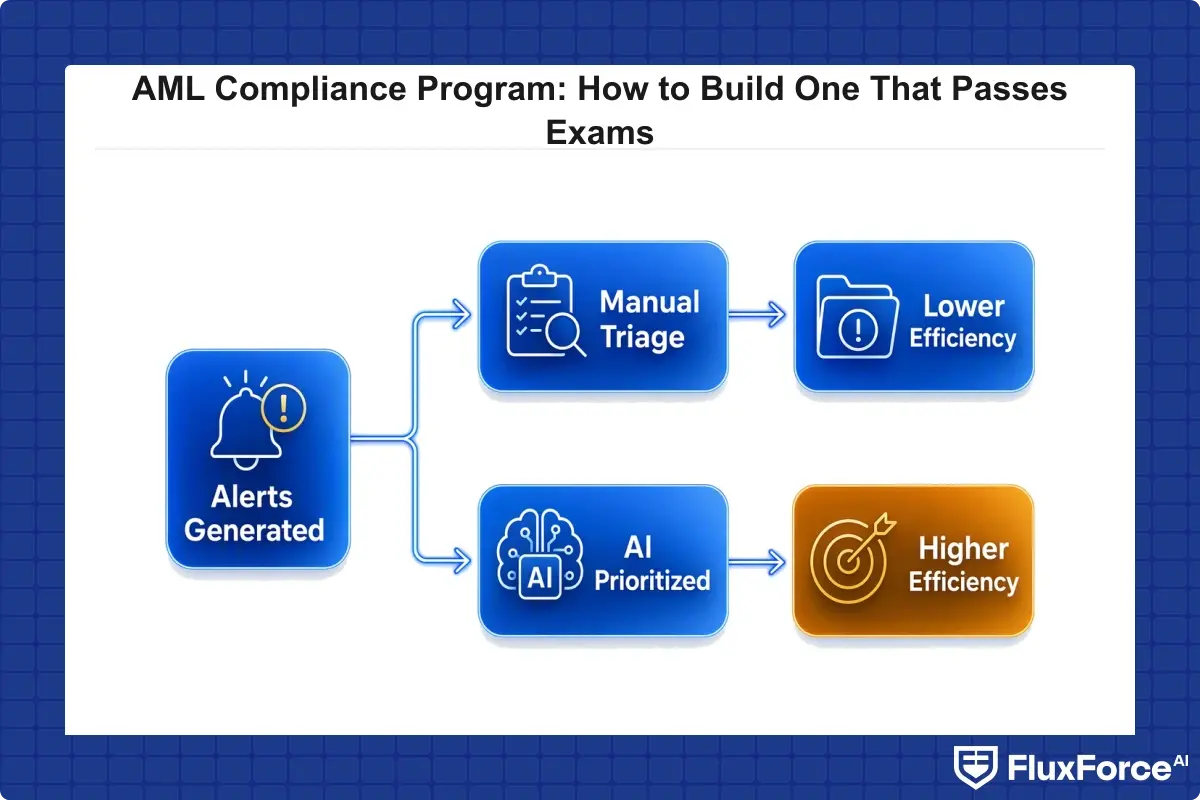
The honest answer on anti money laundering technology is that it doesn't replace judgment, it changes what your analysts spend judgment on. Rule-based systems generate volume; the newer generation of aml compliance software prioritizes it.
Manual Review vs AI-Powered AML Compliance Software
| Factor | Manual / Rule-Based Monitoring | AI-Powered AML Compliance Software |
|---|---|---|
| Alert volume per analyst | High, most alerts are false positives from static thresholds | Lower, alerts are risk-scored and prioritized before reaching a human |
| SAR narrative drafting | Manual, written from scratch each time | Draft-assisted from linked alert data, edited by an analyst |
| Risk assessment updates | Annual spreadsheet refresh | Continuously informed by live transaction and customer data |
| Audit trail | Scattered across email, spreadsheets, and case notes | Centralized, timestamped, examiner-exportable |
| Staffing model fit | Requires headcount to scale with volume | Scales alert triage without proportional headcount growth |
What Changes When You Automate Alert Triage First
The institutions getting the most out of anti money laundering technology 2026 aren't the ones that automated everything at once. They automated alert triage and SAR drafting first, kept a human decision-maker on every filing, and left the risk assessment framework itself under direct compliance ownership. Our analysis of rule-based systems vs. AI for false-positive reduction goes deeper into where automation earns its keep and where it just moves the bottleneck.
What Do Examiners Look for During an AML Compliance Program Exam?
Examiners request a defined document set before they arrive, and what they ask for tells you what they'll test.
The Documents Examiners Request First
- The current, board-approved BSA/AML policy, dated within the last review cycle
- The most recent risk assessment, matched against your actual product and customer list
- A sample of SARs and CTRs filed in the exam period, checked for timeliness and narrative quality
- Training records showing role-specific content and completion dates
- The most recent independent test report, plus evidence findings were remediated
Common Findings That Trigger a Consent Order
Repeat findings from a prior exam that weren't remediated are the fastest path to a consent order. A single missed SAR deadline is a finding; the same unaddressed gap showing up in back-to-back exams signals the institution isn't taking corrective action seriously, and regulators respond accordingly. If our core banking modernization coverage is any indication, the institutions that treat exam findings as a one-time fire drill rather than a system fix are the ones that see the same citation twice.
The EU AI Act and What It Means for AML Compliance Software
Institutions operating in or serving EU customers now have to factor eu ai act financial services rules into any AI-based compliance tool they buy or build.
What the EU AI Act Classifies as High-Risk
The EU AI Act's official text classifies AI systems used for creditworthiness evaluation and certain law-enforcement-adjacent risk scoring as high-risk, which pulls a lot of AML transaction-monitoring AI into scope for documentation, human oversight, and bias-testing obligations. This isn't a US requirement, but any AML compliance software vendor selling into European markets is already building to it, and US institutions with EU subsidiaries inherit the obligation.
How to Prepare Your AML Compliance Software Vendor Stack
Ask vendors directly whether their AI models are classified under the Act, what human-oversight controls exist in the workflow, and whether they can produce a model documentation package on request. A vendor that can't answer these questions clearly in 2026 is a vendor you'll be re-evaluating in 2027 anyway.
- An AML compliance program is judged on its weakest pillar, not its average strength across all five.
- A risk assessment older than one product cycle is treated by examiners as effectively absent.
- SAR narrative quality matters as much as filing timeliness, thin narratives are a top citation driver.
- Community banks and small fintech teams fail exams more often due to staffing mismatch than lack of policy.
- AI-based AML compliance software earns the most value automating alert triage and SAR drafting, not replacing human sign-off.
- The EU AI Act now shapes vendor selection for any institution with European exposure.
Onboard Customers in Seconds
Conclusion
Building an aml compliance program that survives an exam comes down to fixing the gap between what your policy says and what your evidence shows. Examiners we've watched work through a file spend most of their time on exactly two things: whether the risk assessment matches the real business, and whether SARs were filed on time with narratives that hold up.
The institutions that pass clean have three things in common: a documented, current risk assessment, automated alert triage that keeps a human on every filing decision, and an independent testing cadence that actually gets followed. None of these require a massive compliance department, just a program built as a working system instead of a binder.
Adopting this in practice means picking one gap first, usually the risk assessment or the SAR narrative process, and fixing it before the next exam cycle rather than trying to overhaul all five pillars simultaneously. Institutions that automated alert triage alone cut the volume reaching human analysts meaningfully within a single cycle, without touching headcount.
Start with your last exam's findings list. If the same gap appears twice, that's where to spend the next quarter.
Share this article