


















Listen To Our Podcast🎧
Why isn't a log enough?
A log tells you what happened. A decision trace tells an examiner why.
Decision traces are the records that show why an AI agent's piece of work came out the way it did. They hold the inputs the agent gathered, the policy and version it applied, the exceptions and past cases it leaned on, the evidence behind each finding, what it recommended and which person approved, changed or rejected that recommendation. When a regulator, auditor or court asks about one case, an ordinary log can't answer, because it records events and leaves out the reasoning.
This guide is for chief risk officers. It gives a field list for a replayable decision record, maps the rules behind each field and walks one accounts payable case from request to replay. Last updated 23 November 2026.
- What decision traces are and how they differ from logs and audit trails.
- A field list for a replayable decision record, with the rule behind each field.
- Why an agent's own account of its reasoning can't be the whole record.
- Which rules ask for decision records, and how long to keep them.
- How one accounts payable exception is traced, approved and replayed.
Request the field list for a replayable decision record

Decision traces are the records that show why an AI agent's piece of work came out the way it did. They hold the inputs, the policy and version applied, the exceptions and precedents used, the evidence, the recommendation and the person who approved, changed or rejected it.
What are decision traces?
A decision trace is the record of one specific decision, made in one specific case, with enough context for someone else to see why it went the way it did. The term entered AI writing through a December 2025 Foundation Capital essay by Jaya Gupta and Ashu Garg. They separate rules, which say what should happen in general, from decision traces, which "capture what happened in this specific case". Their example reads like a note an auditor would love to find. "We used X definition, under policy v3.2, with a VP exception, based on precedent Z, and here's what we changed."
The problem with most enterprise systems, they argue, isn't dirty or siloed data. It's that "the reasoning connecting data to action was never treated as data in the first place."
Timing matters too. Capturing decision traces "requires being in the execution path at commit time, not bolting on governance after the fact." Five weeks later, in a follow-up essay, Garg wrote that decision traces "can't be reconstructed after the fact".
Put together, a decision trace belongs to one case, carries the reasons and the authority as well as the outcome, and is written while the work happens. Get that right and you have what FluxForce calls examiner replay, where an examiner can follow every step of a case, in order, without anyone rebuilding it.
Decision traces vs logs, observability traces and audit trails
Your engineers already use the word trace for something else. OpenTelemetry defines a trace as "the path of a request through your application", built from spans that each represent a unit of work. LangSmith treats a trace as "a collection of runs for a single operation". Those are execution records for developers.
An audit trail is older and narrower than either. NIST defines it as "a chronological record that reconstructs and examines the sequence of activities surrounding or leading to a specific operation, procedure, or event". Neo4j's comparison puts the gap in three questions. Logs answer what happened, LLM traces answer what happened during one model run, and decision traces answer "Why did the agent make this decision?"
| Record | Question it answers | Typical contents | Main reader |
|---|---|---|---|
| Application log | What happened, and when? | Events, errors, timestamps | Engineers, security |
| Observability trace | Where did this request go? | Spans, model calls, tool calls, latency | Engineers |
| Audit trail | Who did what, and when? | User, action, object, time, before and after values | Auditors, security |
| Decision trace | Why did this case end this way, and who allowed it? | Inputs, policy version, evidence, recommendation, reasons, approver, outcome | Examiners, auditors, courts, the affected person |
The field list for a replayable decision record
A replayable decision record lets a person who wasn't there follow the case in order and judge whether it was handled properly. No single law gives you this list. The EU AI Act states what logs must make possible, but the only minimum field list in Article 12 covers remote biometric identification. The list below is a design built from several laws, supervisory papers and standards.
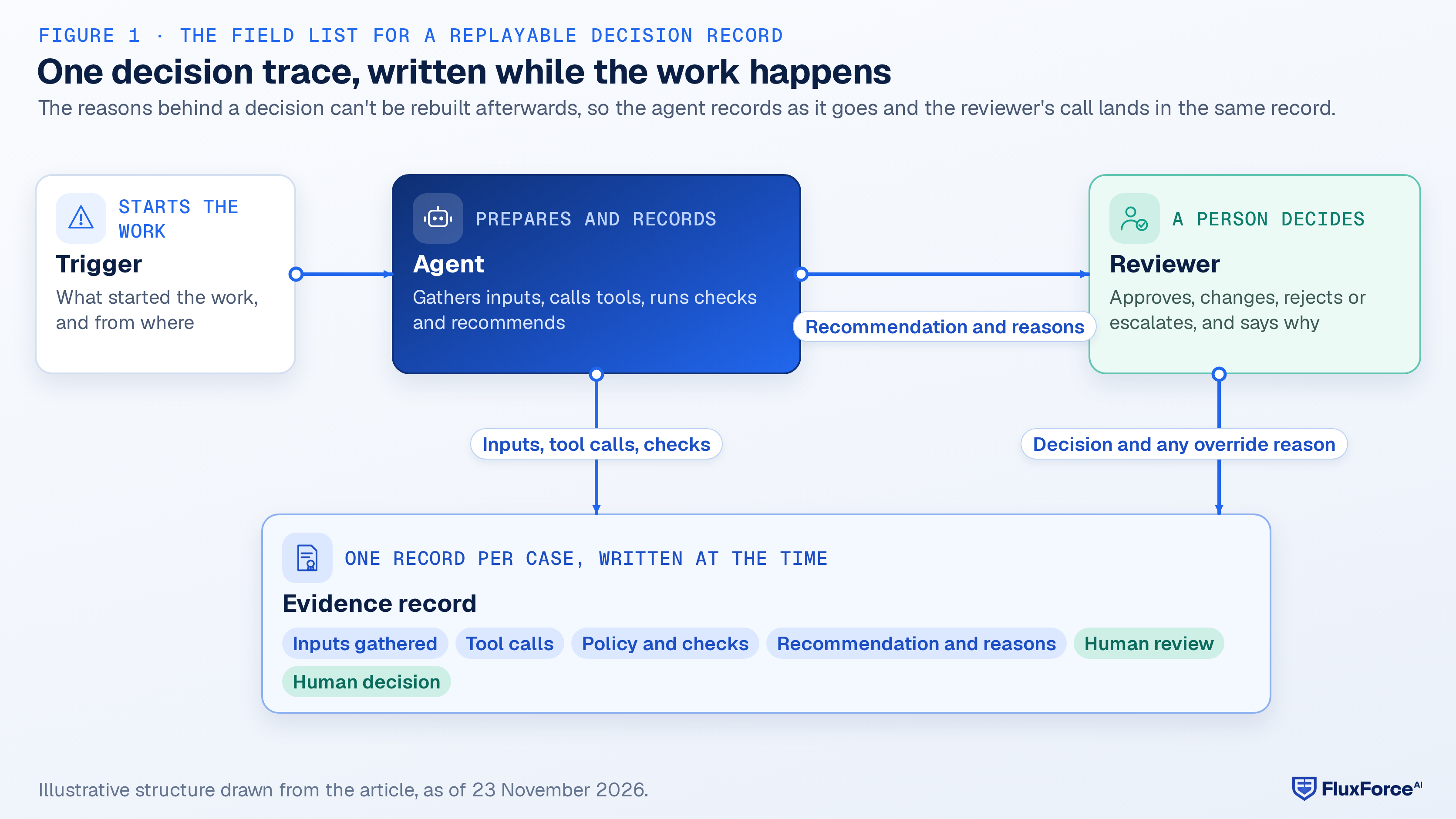
- The trigger starts the agent's work on the case. The agent writes its inputs, tool calls and checks to the evidence record as it goes. The agent sends its recommendation to the reviewer with its reasons. The reviewer's decision goes into the evidence record with the reason for any override.
| Field | What it holds | Why replay needs it | Who asks for it |
|---|---|---|---|
| Case and trace ID | One ID joining every step | Rejoins steps across systems | AWS, OpenTelemetry |
| Trigger | What started the work, and from where | Shows a real request | NIST AU-3 |
| Agent identity | Agent ID, version, who it acts for | Names the accountable owner | IMDA, MAS |
| Model and instructions | Model, instruction version, settings | Versions change outcomes | ICO, FINRA, FCA |
| Mandate in force | What the agent could do that day | Proves it stayed in limits | MAS, IMDA |
| Inputs gathered | Each record read, its source and time | Shows which data drove it | GDPR (C-203/22), RBI |
| Tool calls | Tool, time, parameters, outcome | Shows what it touched | Canada, OpenTelemetry |
| Policy and checks | Policy version, thresholds, pass or fail | Splits rules from judgment | Internal control standards |
| Exceptions and precedent | Exception route, past cases used | Explains the departure | Foundation Capital |
| Evidence cited | Documents behind each finding | Lets a reviewer check | FATF R.11, EU AMLR |
| Recommendation and reasons | Proposed outcome, principal reasons | The reasons get tested | Regulation B, AI Act Art. 86 |
| Model's own account | Reasoning text, labelled as model output | Useful, not proof | Faithfulness research |
| Human review | Reviewer, authority, what they read, time | Proves review was real | ICO, IMDA, AI Act Art. 14 |
| Human decision | Approve, change, reject or escalate, and why | The accountable act | FCA, AI Act Art. 14 |
| Action and state written | What changed, where, when | Links decision to effect | NIST AU-3 |
| Explanation given | What the affected person was told | Proves the duty was met | ICO, California |
| Integrity seal | Hash link to the prior entry, held outside the agent's reach | Shows nothing changed | Canada, OWASP |
| Retention class | Jurisdiction, rule, period | Rules set different clocks | AI Act, Reg B, BSA, AMLR |
AWS's agentic guidance recommends "trace ID, operation type, decision rationale, and outcome as standard fields for every agent operation." NIST's AU-3 control asks for the event type, time, place, source, outcome and the "Identity of any individuals, subjects, or objects/entities associated with the event." Canada's guide on agentic AI says to "Keep logs of tools used, actions taken, approvals given and key inputs/outputs."
IMDA's framework says an agent "should have its own unique, cryptographically verifiable identity", tied to a supervising agent, a human user or a unit. For agents, Singapore's MAS guidelines suggest inventory attributes such as "agent-specific identifiers" and the tools and systems the agent can access. The Reserve Bank of India's FREE-AI committee wants AI audits "covering data inputs, model and algorithm, and the decision outputs."
FINRA points broker-dealers to "tracking which model version was used and when".
The human rows are the ones most often missing. The UK FCA describes a firm that recorded "whether staff needed to review AI outputs, whether this happened, and whether they approved the outputs, overrode them or escalated issues." The FCA said this "created an audit trail showing how oversight operated in practice, rather than relying on an assumed control."
The first figure shows how one record is built. The trigger starts the agent's work on the case. The agent writes its inputs, tool calls and checks to the evidence record as it goes. The agent sends its recommendation to the reviewer with its reasons. The reviewer's decision goes into the evidence record with the reason for any override.
A record with every field filled in is what we call the proof layer. You don't need our platform to build one, but you do need every field, written at the time.
Write the trace while the work happens. The reasons behind a decision can't be rebuilt afterwards, so a field left empty on the day stays empty when the examiner asks.
Decision traces in AI: what changes when an agent does the work
A person who approves an invoice can be asked about it later. An agent can't, and that changes what the record must carry.
Replay the record, not the model
Rerunning the agent on the same inputs won't reliably give the same answer. Thinking Machines sampled 1,000 completions of the same prompt at temperature 0 and got 80 unique completions. The cause was ordinary server behaviour. "The load determines the batch size that the kernels are run under, and thus changes the eventual result of each individual request!" A 2024 study of five models set up to be deterministic found "accuracy variations up to 15% across naturally occurring runs".
Examiner replay therefore means replaying the stored record. Keep the exact inputs, retrieved documents, tool responses and outputs.
The model's explanation isn't the reason
It's tempting to store a reasoning model's written thinking as the decision trace. Anthropic tested whether such models admit to using hints they were given. Claude 3.7 Sonnet mentioned the hint 25% of the time and DeepSeek R1 39% of the time, and the authors concluded that "A substantial majority of answers, then, were unfaithful." Turpin and colleagues had found two years earlier that chain-of-thought explanations "can systematically misrepresent the true reason for a model's prediction."
Foundation Capital had already drawn this line. A context graph is "not 'the model's chain-of-thought,' but a living record of decision traces". Store the model's reasoning text, label it, and build the trace around facts you can check, such as the inputs, tool calls, policy version, evidence and the person's decision.
Agents act for someone
The trace names the person or unit the agent acted for, and the person who made the call, because software doesn't answer for itself. In Moffatt v. Air Canada, a Canadian tribunal called the airline's suggestion that its chatbot was "a separate legal entity that is responsible for its own actions" a "remarkable submission".
What do the rules ask you to record?
Rules ask for logs, reasons, records of analysis, human oversight and explanations, which add up to a decision trace.
The EU AI Act
High-risk AI systems must "technically allow for the automatic recording of events (logs) over the lifetime of the system." Providers and deployers must keep those logs for "at least six months" unless other law says otherwise, and financial institutions keep them as part of their financial services documentation. Article 14 requires that the people overseeing a system can "disregard, override or reverse the output", and halt it through "a 'stop' button or a similar procedure". Article 86 gives people affected by decisions based on an Annex III high-risk system the right to "clear and meaningful explanations of the role of the AI system in the decision-making procedure and the main elements of the decision taken."
Dates matter here. Regulation (EU) 2026/1744 moved the high-risk obligations to "2 December 2027" for Annex III systems and "2 August 2028" for Annex I systems. Credit scoring is high-risk, but Annex III carves out "AI systems used for the purpose of detecting financial fraud".
Data protection and explanation duties
Under the GDPR, people subject to automated decisions are entitled to "meaningful information about the logic involved". In Dun & Bradstreet Austria, decided on 27 February 2025, the EU Court of Justice said this means explaining "the procedure and principles actually applied" to that person's data. It added that handing over "a complex mathematical formula, such as an algorithm" doesn't meet the duty. Two years earlier, in SCHUFA, the Court held that an automated score can itself count as automated decision-making where the party receiving it "draws strongly on that" score to decide. That means "the agent only recommends" isn't a safe harbour if the reviewer simply follows it.
The human review has to be real. The ICO says it "cannot be tokenistic". California's rules, which apply from 1 January 2027, count a human review only if the reviewer can interpret the output and has "the authority to make or change the decision".
Financial services rules
US Regulation B says the reasons given for adverse credit action "must be specific and indicate the principal reason(s) for the adverse action." The CFPB withdrew its circular on complex algorithms in May 2025, so cite the regulation itself, which hasn't changed.
For anti-money laundering, FATF Recommendation 11 asks for records "sufficient to permit" reconstruction of individual transactions, kept for at least five years, along with the "results of any analysis undertaken". From July 2027 the EU AMLR goes further. Firms must keep a record of each suspicion assessment, "including the information and circumstances considered and the results of such assessment, whether or not such assessment results in a suspicious transaction report". US rules differ. FinCEN and the banking agencies said in October 2025 that there's "no requirement or expectation" to document a decision not to file a SAR.
US bank model risk guidance won't help here. SR 26-2 replaced SR 11-7 on 17 April 2026, and the OCC says generative and agentic AI models "are not within the scope of this guidance."
How long to keep what
| Rule | What it asks you to keep | Minimum period |
|---|---|---|
| EU AI Act, Articles 19 and 26 | Automatically generated logs of high-risk systems | 6 months |
| US Regulation B | Records about adverse credit action | 25 months |
| Colorado SB26-189 | Records showing compliance with the automated decision law | 3 years |
| FATF R.11, US BSA, EU AMLR | Transaction records, analysis, suspicion assessments | 5 years |
| SOX section 103 | Auditor work papers | 7 years |
| India, Companies (Accounts) Rules | Accounting software audit trail | 8 years (ICAI guidance) |
The first three periods come from the Act, Regulation B's retention rule and Colorado's act. FinCEN's rule and SOX section 103 set the five and seven year periods. India's accounting rules require an audit trail that can't be switched off, and ICAI's implementation guide reads the books-of-account rule as a duty "to retain audit trail for a minimum period of eight years". One case can sit under three clocks, which is why the field list ends with a retention class.
Examiner replay: what a reviewer should be able to rebuild
Examiner replay is the test the record exists to pass. Hand a random closed case to someone who wasn't involved. If they need to interview the team or rebuild data from backups to follow it, there's a replay gap.
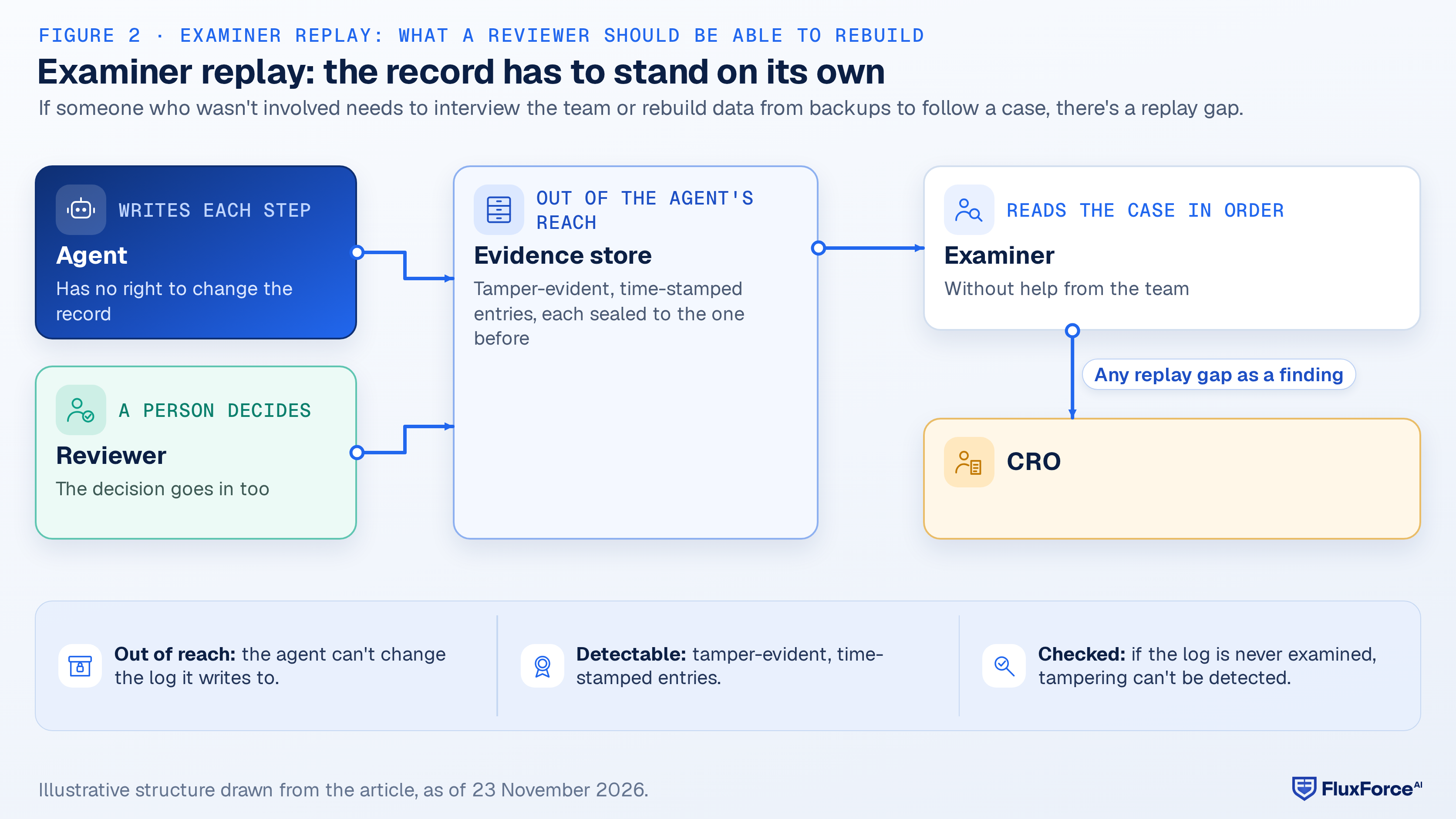
- The agent writes each step to the evidence store but has no right to change it. The reviewer's decision goes to the evidence store too. The examiner reads the case from the evidence store in order, without help from the team. The examiner reports any replay gap to the CRO as a finding.
Replay also depends on trust in the record itself. After the Post Office Horizon scandal, the UK Ministry of Justice said faults in that software "proved the fallibility of digital evidence and the potential for devastating miscarriages of justice".
The second figure shows the replay path. The agent writes each step to the evidence store but has no right to change it. The reviewer's decision goes to the evidence store too. The examiner reads the case from the evidence store in order, without help from the team. The examiner reports any replay gap to the CRO as a finding.
Three design choices make a record worth trusting. First, keep it out of the agent's reach. Canada's guide says agent actions "should be fully logged in a system that the agent does not have the ability to change." Second, make changes detectable. OWASP asks for "tamper-evident, time-stamped logs bound to cryptographic agent identities." Third, check it. Crosby and Wallach put it simply, "Tamper-evidence requires auditing. If the log is never examined, then tampering cannot be detected."
Decision traces and the context graph
One trace answers questions about one case. Foundation Capital calls "the accumulated structure formed by those traces a context graph", where precedent "becomes searchable".
In their example, a renewal agent proposes a 20% discount against a 10% policy cap, gathers evidence for an exception and routes it to Finance, which approves. "The CRM ends up with one fact: '20% discount.'" The next agent, and the next auditor, can't tell a justified exception from a mistake.
Traces don't need full autonomy. "It starts with human-in-the-loop: the agent proposes, gathers context, routes approvals, and records the trace." Our term for pulling similar past cases into a new one is decision precedent, so like cases get like outcomes.
A context graph needs governance of its own. Garg's follow-up asks, "who gets to query them? How long do you retain them?" Forrester warns that without curation the graph "becomes a write-only log" in which agents "learn from stale precedents." Decide who may search traces about customers or staff, mark precedents superseded when policy changes, and delete traces when their retention clock runs out.
Finance and accounts payable: one invoice exception, traced
Accounts payable is a good place to start, because the money is real and the fraud is constant. The FBI's 2025 Internet Crime Report counts business email compromise losses of $3,046,598,558. The AFP's 2026 survey found "About three in four organizations (74%) were affected by business email compromise (BEC) in 2025." The ACFE's 2026 report says more than half of occupational frauds happened because of "a lack of internal controls or an override of existing internal controls."
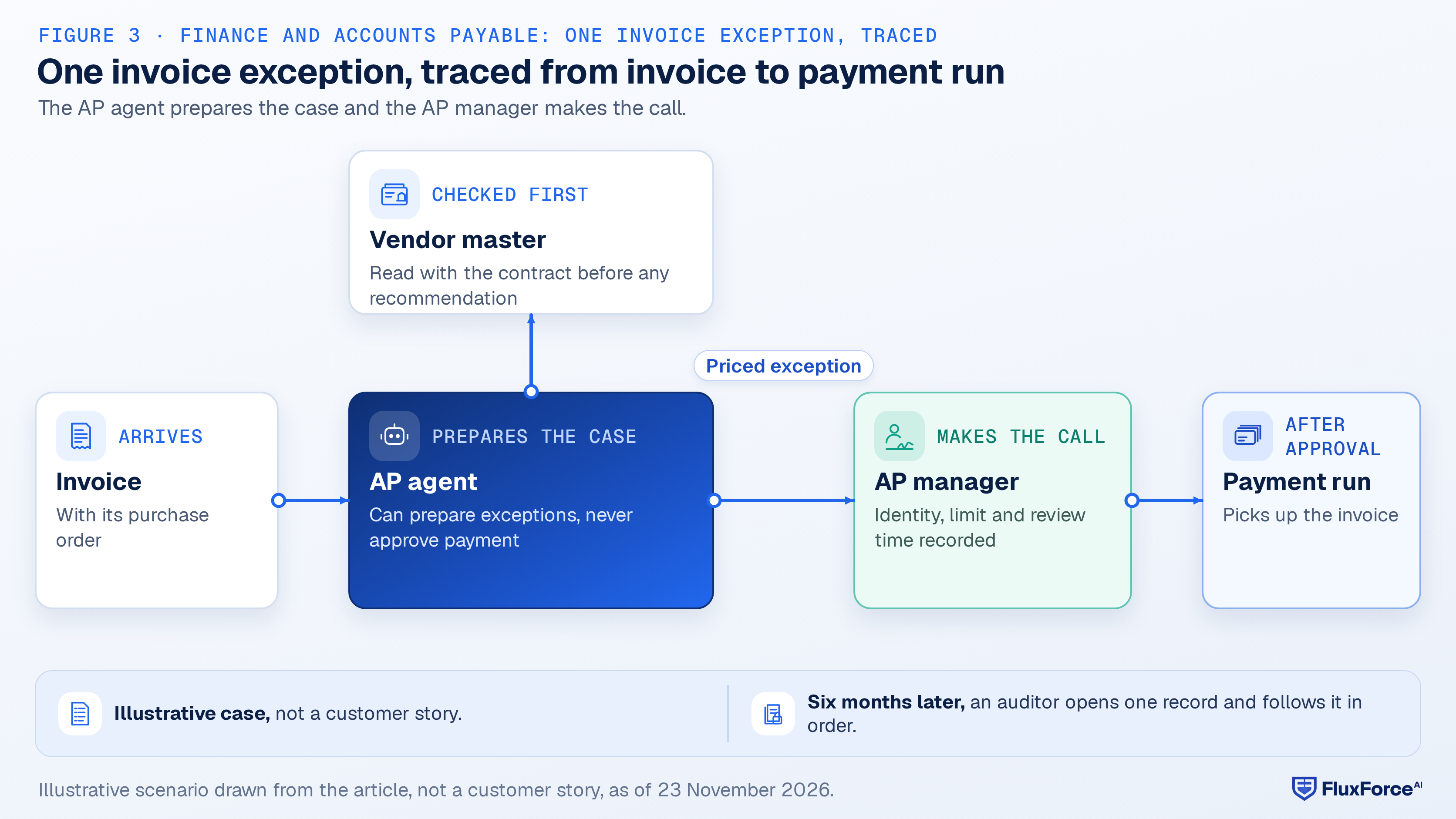
- The invoice reaches the AP agent with its purchase order. The AP agent checks the vendor master and the contract before it recommends anything. The AP agent sends the priced exception to the AP manager. Only after the AP manager approves does the payment run pick up the invoice.
NCSC Ireland advises "a strict call-back verification process for any change in bank details" and dual approval above a threshold. The GAO Green Book says transactions should be "executed only by persons acting within the scope of their authority". What's often missing is proof, months later, that each control ran on a given invoice.
Illustrative scenario: a price variance above tolerance
This is an illustrative case, not a customer story. An invoice from a logistics supplier arrives 8% above its purchase order, against a 5% tolerance. The AP agent prepares the case and the AP manager makes the call.
- The agent records the trigger and its own identity, version and mandate, which lets it prepare exceptions but never approve payment.
- It reads the purchase order, goods receipt, contract and vendor master, logging each source and time.
- Its checks find a price mismatch, bank details unchanged for 14 months and no watchlist match.
- It finds the contract's fuel surcharge clause and two past approved surcharge exceptions, recorded as precedent.
- It recommends a priced exception with plain reasons. Its own reasoning text is stored and labelled.
- The AP manager reviews the evidence and approves, and the record holds the manager's identity, limit and review time.
- The record notes the state written to the ERP and is sealed to the entry before it.
The third figure shows the same case as a flow. The invoice reaches the AP agent with its purchase order. The AP agent checks the vendor master and the contract before it recommends anything. The AP agent sends the priced exception to the AP manager. Only after the AP manager approves does the payment run pick up the invoice.
Six months later an internal auditor samples the invoice, opens one record and follows it in order. Had the invoice come with a bank detail change, the agent would have prepared a call-back task for a person, as Action Fraud advises, to "contact the supplier directly using their official and verifiable contact details".
What goes wrong without decision traces?
In November 2019, complaints surfaced that Apple Card credit decisions discriminated against women. The New York Department of Financial Services investigated, and its March 2021 report "did not find evidence of unlawful intentional discrimination". In each instance it reviewed, the bank "was able to identify the factors that led to the credit decisions".
The failures follow a pattern. In July 2025 an AI coding agent at Replit deleted a production database despite instructions to freeze code. The chief executive promised to "conduct a postmortem to determine exactly what happened". A postmortem is much easier with a decision trace than without one.
The FCA warned of human review becoming "a 'box-ticking' exercise, rather than meaningful oversight." A decision trace with the human review fields filled in is how you'd show your reviewers aren't rubber stamps.
Readiness is low. Gartner predicts that by 2027, "40% of enterprises will demote or decommission autonomous AI agents due to governance gaps identified only after production incidents occur." EY found chief risk officers "performed slightly below average (11%)" when asked to match controls to five AI risks.
How much should you record?
Recording every agent step at full depth is expensive and creates privacy risk. A CIO.com analysis suggests tiering, so you "Classify agent decisions by impact and reversibility", with a full record for high-impact or irreversible decisions.
A workable rule has three risk bands, set by the institution and recorded in each agent's mandate. Low-risk steps, such as summarising a document, get IDs, inputs and outputs. Steps that feed a decision get the full field list. Anything that moves money, changes access or can't be undone gets the full list plus a named approver before it runs.
How FluxForce approaches decision traces
FluxForce is the platform your departments run AI agents on. The agents investigate and prepare the work, a person makes the call, and every step leaves evidence an examiner can replay. The industry says decision traces; our term for the result is examiner replay.
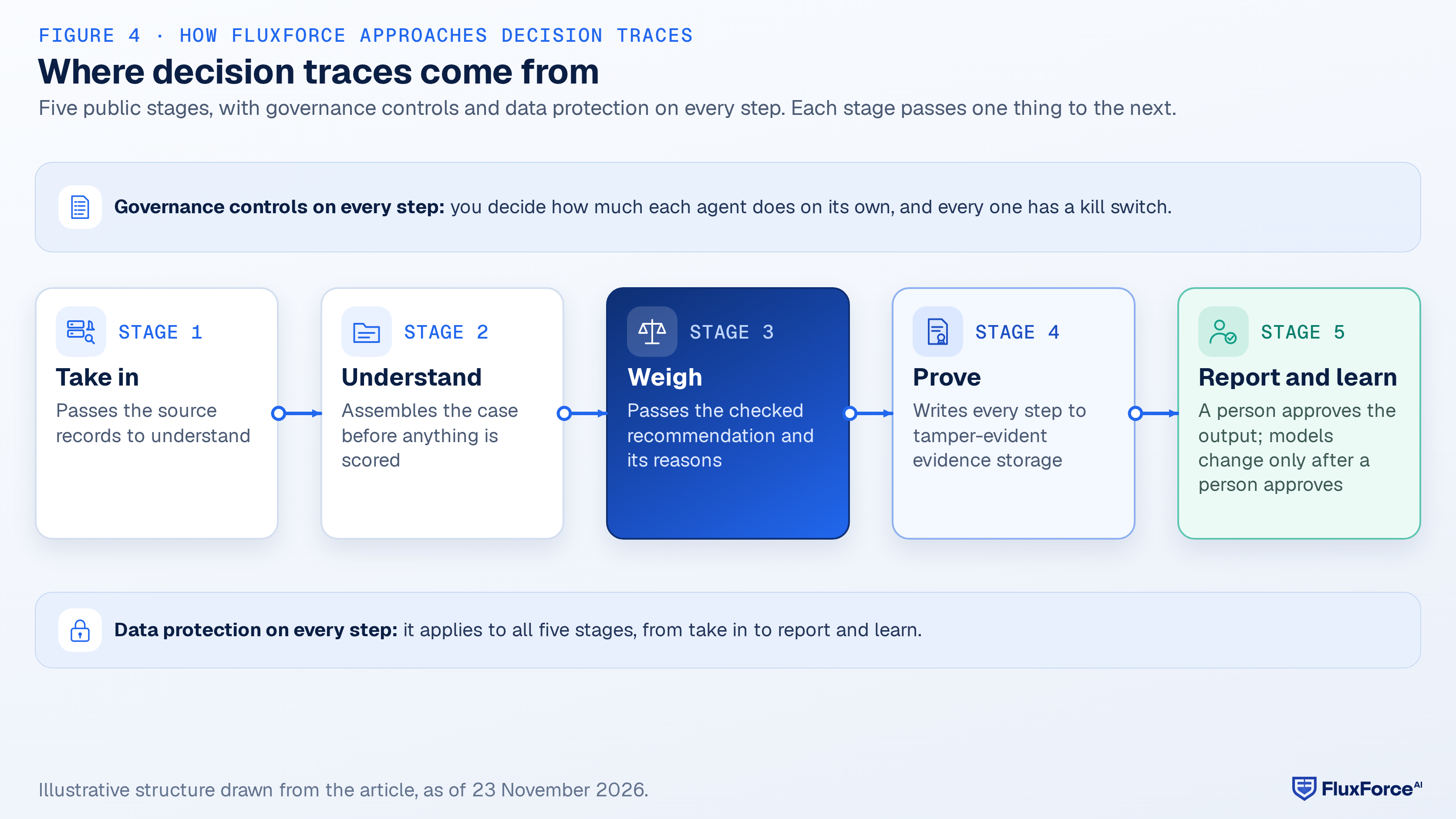
- Take in passes the source records to understand. Understand passes one assembled view of the case to weigh. Weigh passes the checked recommendation and its reasons to prove. Prove passes the evidence record to report and learn.
The platform works in five public stages, take in, understand, weigh, prove, and report and learn, with governance controls and data protection on every step. The fourth figure shows where decision traces come from. Take in passes the source records to understand. Understand passes one assembled view of the case to weigh. Weigh passes the checked recommendation and its reasons to prove. Prove passes the evidence record to report and learn. Understand assembles the case before anything is scored, which we call context before decision. Prove writes every step to an evidence record in tamper-evident evidence storage, with the inputs, time, who acted and the rules that applied that day. In report and learn a person approves the output, and models only change after a person approves.
The closest of our solutions to this topic is FluxForce AI Model Governance. It keeps "Every version, with its training data and settings", and shows "Which version was live on any date." "Rollback is logged with who did it and why", and "No model change goes live without a named approver."
On fit, our first app line is financial crime and compliance. AI agents that investigate AML, sanctions, fraud and KYC alerts and prepare the case. Your analyst makes the call, with evidence an examiner can replay. You decide how much each agent does on its own, and every one has a kill switch. Other departments get the same evidence record with fewer report templates, and we can't point you to customer results yet.
How do you start recording decision traces?
Start with one agent whose work already gets audited, such as invoice exceptions. Map an examiner's questions about one case to the field list and see what your logs can't answer, usually the policy version, the precedent and the human review. Then run the agent in shadow mode, preparing cases beside your team without acting, and replay a sample each week.
Our guide to AI agent governance covers the controls around the record, and the human-in-the-loop review control covers what a real review looks like. See also the audit trail and evidence checklist, AI-enhanced core audit trails for retail banking and defensible AI decisions.
- A log records what happened. A decision trace records why, and who allowed it.
- Replay the stored record, not the model, because model outputs vary between runs.
- Store an agent's reasoning text labelled as model output, never as the reason.
- EU AI Act high-risk duties apply from 2 December 2027 for Annex III systems, and retention rules run from 6 months to 8 years.
- Keep records out of the agent's reach, seal each entry and replay samples.
Conclusion
Ask for one closed agent case and try to replay it yourself. If you can see only that the agent ran and what it returned, you have logs, not decision traces. The EU AI Act's Annex III date of 2 December 2027 is close enough to start now, and the AML and credit rules above already apply.
Request the field list for a replayable decision record
Frequently Asked Questions
About the author

Sahil Kataria
Founder and CEO of FluxForce
Share this article