


















Listen To Our Podcast🎧
What does an AI agent audit trail record?
If an agent can't show its work, it doesn't get the work.
An AI agent audit trail lets someone who wasn't there rebuild an agent's work and the human decision on it later, a record of events "from inception to result", as the NIST glossary puts it.
We call that record the proof layer. This guide is for CISOs and heads of internal audit. It lists what a proof-layer record holds, field by field, and names the standard or regulator that asks for each field. Last updated 19 November 2026.
- What an AI agent audit trail is, and how it differs from the system logs you already keep.
- The fields a proof-layer record should hold, with the published source behind each one.
- An audit trail example, one illustrative agent case recorded and then replayed.
- How audit trail review works, who should do it and how often.
- What tamper-evident means in practice, and how long the record should be kept.
Request a proof-layer record walkthrough
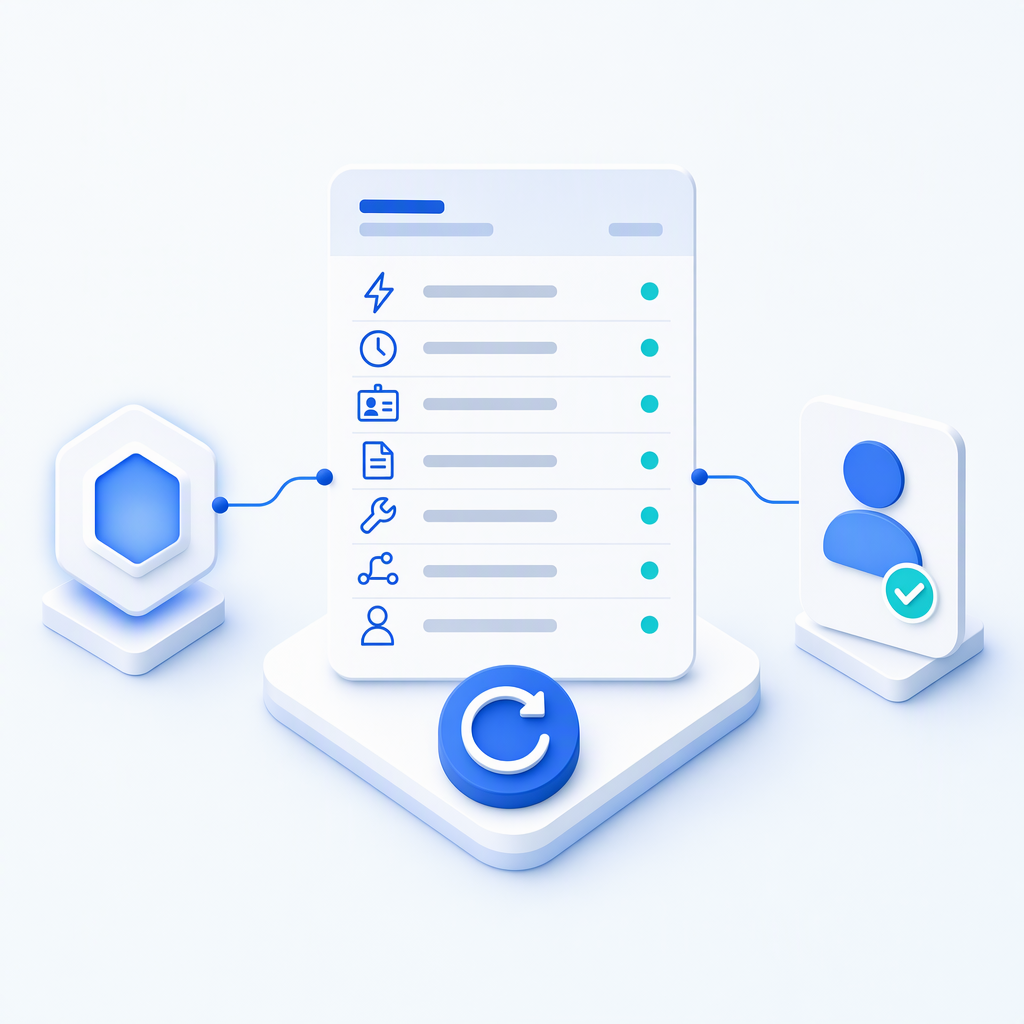
An AI agent audit trail is the time-stamped record of everything an agent did on a case: what it read, which tools it called, which model and rules were in force, what it recommended, and what the person who decided did with that recommendation.
What is an AI agent audit trail?
An AI agent audit trail is a chronological record of one agent's actions on one piece of work, tied to the person accountable for the outcome. Each line is an audit record, "an individual entry in an audit log related to an audited event".
Agents change what the trail carries. An agent works across several steps, reads outside data and calls tools, so the record has to capture its inputs as well as its actions. FINRA's 2026 oversight report warns that "multi-step agent reasoning tasks can make outcomes difficult to trace or explain, complicating auditability."
Most firms aren't there yet. Deloitte's State of AI in the Enterprise 2026 found that of the companies planning agentic AI, "only 21% of those companies report having a mature model for agent governance." In June 2025 Gartner predicted that over 40% of agentic AI projects will be cancelled by the end of 2027, citing "inadequate risk controls" among its reasons.
Audit trail for AI agents: what does a proof-layer record hold?
No single law lists every field for an AI agent. Article 12 of the EU AI Act requires "the automatic recording of events (logs)" for high-risk systems, but it states purposes rather than fields. So we built it from sources that get specific. The AU-3 control in NIST SP 800-53 Rev. 5 gives the base, and agent guidance from Canada, Singapore, Australia, the UK FCA, FINRA and OWASP adds the rest.
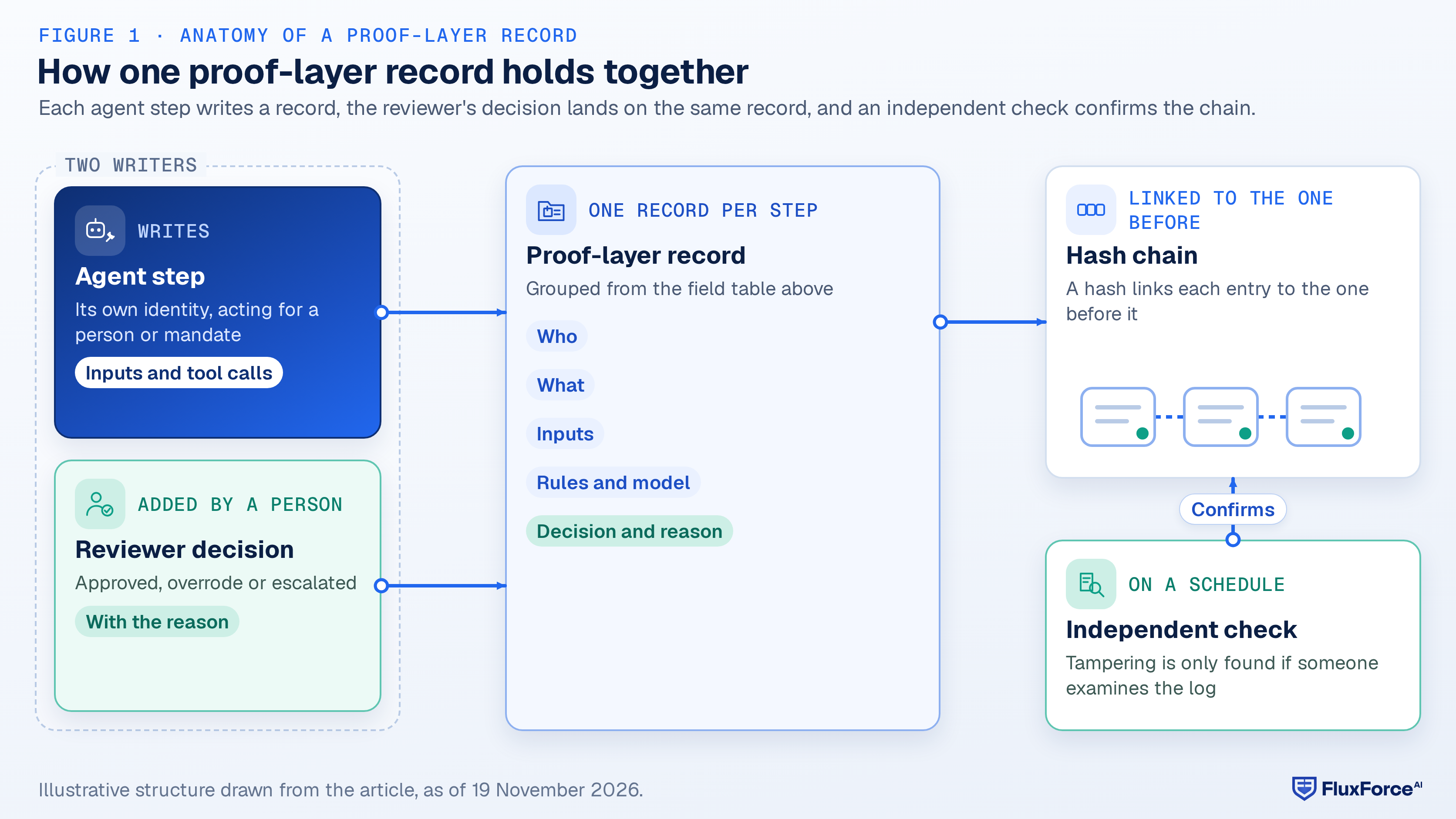
- Each agent step writes one proof-layer record. The reviewer decision is added to the same proof-layer record. Each proof-layer record is linked to the one before it in a hash chain. An independent check confirms the hash chain on a schedule.
| Field | What it records | Who asks for it |
|---|---|---|
| Event and action type | What the agent did at this step | NIST AU-3, "What type of event occurred"; Canada's guide, actions taken and tools used |
| Time | A UTC time stamp from a trusted clock | NIST AU-8, Coordinated Universal Time; 21 CFR 11.10(e), time-stamped trails |
| Agent identity | The agent's own identity, not a shared account | IMDA, a unique, cryptographically verifiable identity; OWASP, logs bound to agent identities |
| On whose behalf | The person or mandate the agent acted for | IMDA, the capacity the agent acts in "should be recorded for auditability"; NIST AU-10, a "process acting on behalf of an individual" |
| Inputs read | Records, documents and outside sources used, and prompts it created | Australia's agentic AI addendum, prompts created by agents plus inputs and outputs; UK FCA, prompts and outputs |
| Tool calls | Tool name, time, outcome and the type of parameters passed | Canada's guide, tool name, time, outcome and parameter type; OWASP, logs of all tool invocations |
| Model and version | Which model version produced the output | FINRA, which model version was used and when; UK FCA, model versions |
| Rules in force | The thresholds, policies and filters that applied that day | UK FCA, applied filters; MHRA, the reason for any change |
| Recommendation | What the agent recommended and the evidence it attached | Canada's guide, key inputs and outputs; IIA Standard 14.1, evidence another auditor can repeat |
| Human decision | Who decided, whether they approved, overrode or escalated, and why | UK FCA, approved, overrode or escalated; MHRA, "who, what, when and why"; EU AI Act Article 14, override or reverse |
| Changes | Every edit, with time and editor, without hiding the original | 21 CFR 11.10(e), changes "shall not obscure previously recorded information"; SEC Rule 17a-4, modifications and deletions |
| Stops | Every pause, stop or kill-switch use, and who triggered it | EU AI Act Article 14, a "stop" button; Canada's guide, agents paused or stopped |
| Integrity proof | A hash or signature linking each entry to the one before | NIST AU-9(3), cryptographic integrity protection; RFC 9162, append-only Merkle tree logs |
| Retention | How long the record is kept | EU AI Act Articles 19 and 26(6), at least six months; NIST AU-11, retention set by records policy |
The first figure shows how the record holds together. Each agent step writes one proof-layer record. The reviewer decision is added to the same proof-layer record. Each proof-layer record is linked to the one before it in a hash chain. An independent check confirms the hash chain on a schedule.
Identity is the hardest field. A February 2026 NIST NCCoE concept paper still asks how to ensure "non-repudiation for agent actions and binding back to human authorization". Inputs carry privacy risk, so the Government of Canada's guide on agentic AI says "Raw parameter values should be logged only when required for oversight, security or program integrity". ISO/IEC 24970, a standard for logging in AI systems, is still listed as "under publication".
Audit trail in software: what do agents add to the log?
In software, NIST SP 800-12 says audit trails cover activity "both by system and application processes and by user activity".
Agents add a third actor that acts for a person but chooses its own steps. NIST AU-10 covers it, asking for evidence that "an individual (or process acting on behalf of an individual)" performed an action. OpenTelemetry's agent span conventions are still in Development status.
A trace tells an engineer how a request flowed. A proof-layer record tells an auditor who decided, on what evidence, under which rules.
Audit trail in accounting: what carries over to agents?
Accounting law already asks for this kind of record. Since 1 April 2023, under India's 2021 amendment to the Companies (Accounts) Rules, companies must use software that keeps an edit log of each change, "ensuring that the audit trail cannot be disabled".
Under Sarbanes-Oxley section 103, audit firms keep work papers "for a period of not less than 7 years". An agent that prepares a journal adjustment creates part of that evidence and inherits the same clock. Banks apply the same thinking to their core systems, as our piece on AI-enhanced core audit trails for retail banking describes.
Audit trail example: one agent case, recorded and replayed
This audit trail example is illustrative, not a real company. An accounts payable team runs an agent on supplier bank detail changes, and an emailed request asks to change a supplier's bank account before the next payment run.
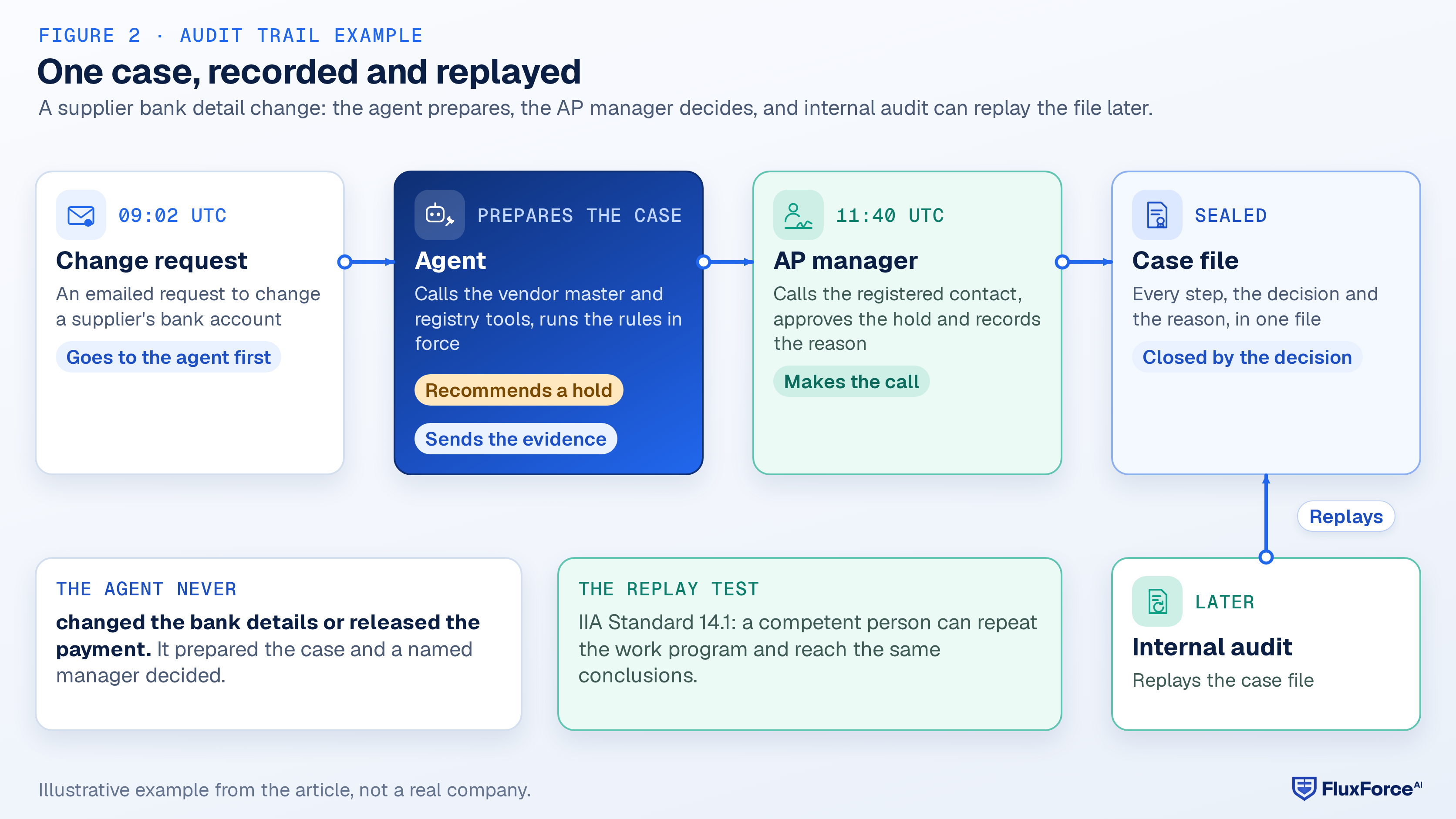
- The change request goes to the agent first. The agent sends its recommendation and evidence to the AP manager. The AP manager's decision and reason close the case file. Internal audit replays the case file later.
| Time (UTC) | Actor | Entry |
|---|---|---|
| 09:02:11 | Agent (own identity), acting for the AP team's mandate | Read the change request and the attached letter |
| 09:02:40 | Agent | Called the vendor master tool, found the existing account and the supplier's registered contact |
| 09:03:05 | Agent | Called the company registry tool, confirmed the supplier is active |
| 09:03:31 | Agent | Ran the team's rules in force that day, version recorded, which require a call-back for any bank change |
| 09:03:58 | Agent | Recommended a hold, with the reason, the evidence and the model version |
| 11:40:17 | AP manager (named) | Called the registered contact, who denied making the request; approved the hold and recorded the reason |
| 11:40:20 | System | Sealed the case file and linked its hash to the previous entry |
The second figure shows the same case as a flow. The change request goes to the agent first. The agent sends its recommendation and evidence to the AP manager. The AP manager's decision and reason close the case file. Internal audit replays the case file later.
The replay is the test in Standard 14.1 of the IIA's Global Internal Audit Standards, that a competent person can "repeat the engagement work program and reach the same conclusions".
The agent never changed the bank details or released the payment. It prepared the case and a named manager decided, the split we describe for defensible audit evidence.
Audit trail review: who checks the record, and how often?
Audit trail review is the regular check that the record is complete, unaltered and shows nothing that needs action. NIST AU-6 asks for review at a frequency you define, with findings reported to named roles. NIST SP 800-12 calls daily or weekly review monitoring, and a look back over several months an audit.
Life sciences regulators give the most detailed guidance, and it transfers well. The US FDA's data integrity questions and answers say "Audit trail review is similar to assessing cross-outs on paper when reviewing data." PIC/S guidance PI 041-1 wants reviews that are "both random (selected based on chance) and targeted (selected based on criticality or risk)", done before the data is relied on for a critical decision, and recorded.
For agents, regulators add one more target, the human review itself. The MAS guidelines on AI risk management expect regular review of "human oversight decisions and interventions", and Singapore's IMDA framework for agentic AI suggests "auditing the effectiveness of human approvals". The UK FCA flagged the risk of human review becoming "a 'box-ticking' exercise, rather than meaningful oversight".
For a first gap review, our audit trail and evidence checklist works as a starting template.
Who does what in an AI agent audit trail?
Security and internal audit split the review, and the business owner keeps the decision. The third figure shows the split. Security monitors the audit trail for gaps, failed writes and changes to logging settings. Internal audit samples the audit trail at random and by risk. Internal audit checks that reviewers really review. Findings go to a named owner. A reviewer who approves every recommendation in four seconds is a finding.
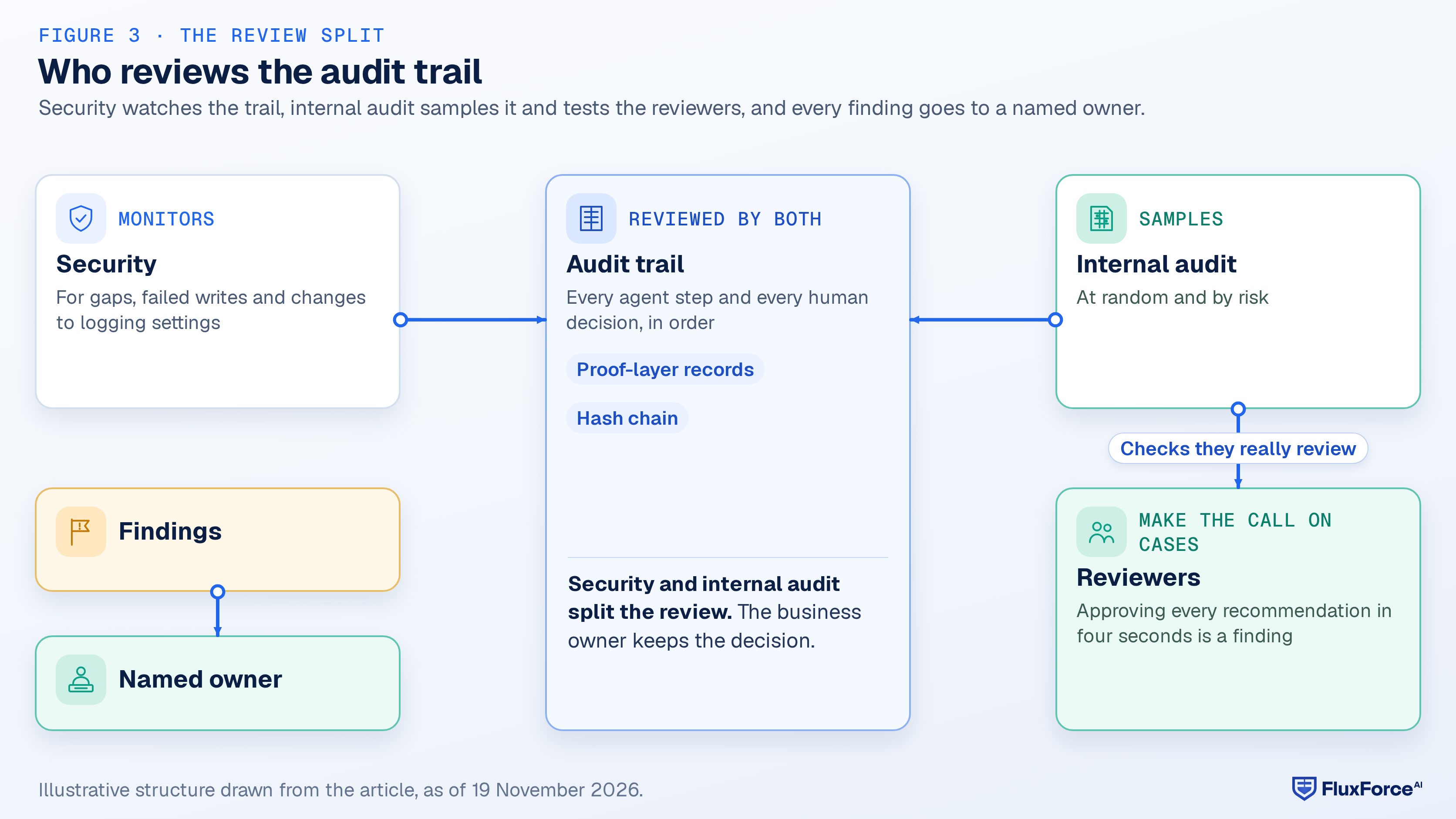
- Security monitors the audit trail for gaps, failed writes and changes to logging settings. Internal audit samples the audit trail at random and by risk. Internal audit checks that reviewers really review. Findings go to a named owner.
Tamper-evident records: how do you protect the trail?
No log can be made impossible to alter, and a vendor who claims that is overselling. Crosby and Wallach's 2009 paper on tamper-evident logging puts it in one line, "Tamper-evidence requires auditing. If the log is never examined, then tampering cannot be detected." Certificate Transparency logs (RFC 9162) work the same way. What works is a set of controls that make changes visible.
- Link each entry to the hash of the one before, and sign it (NIST AU-9(3)).
- Log agent actions "in a system that the agent does not have the ability to change", as Canada's guide puts it.
- Alert a named person when anyone tries to change or delete audit data (NIST AU-9).
- Record administrator changes, since users "should not be able to amend or switch off the audit trail", in the words of the UK MHRA's data integrity guidance.
- Have someone independent check the chain on a schedule. Without that, the first four prove little.
Retention follows the record's purpose. The EU AI Act asks for high-risk system logs to be kept at least six months, inside financial services documentation for financial institutions. Those duties apply from 2 December 2027 for Annex III systems, after the 2026 amendment the European Parliament approved in June. Six months is a floor. Where the agent's work feeds a regulated record, the longer clock applies. The audit-trail option in SEC Rule 17a-4, for instance, requires "a complete time-stamped audit trail" of every change to a broker-dealer record.
For US banks, the April 2026 model risk guidance, OCC Bulletin 2026-13, says "Generative AI and agentic AI models are novel and rapidly evolving. As such, they are not within the scope of this guidance." Don't wait for it to tell you what to log for agents.
How does FluxForce approach the proof layer?
FluxForce is the platform your departments run AI agents on. The agents investigate and prepare the work, a person makes the call, and every step leaves evidence an examiner can replay. The general industry term for this is an agentic AI platform. Our term for the part that records the work is the proof layer.
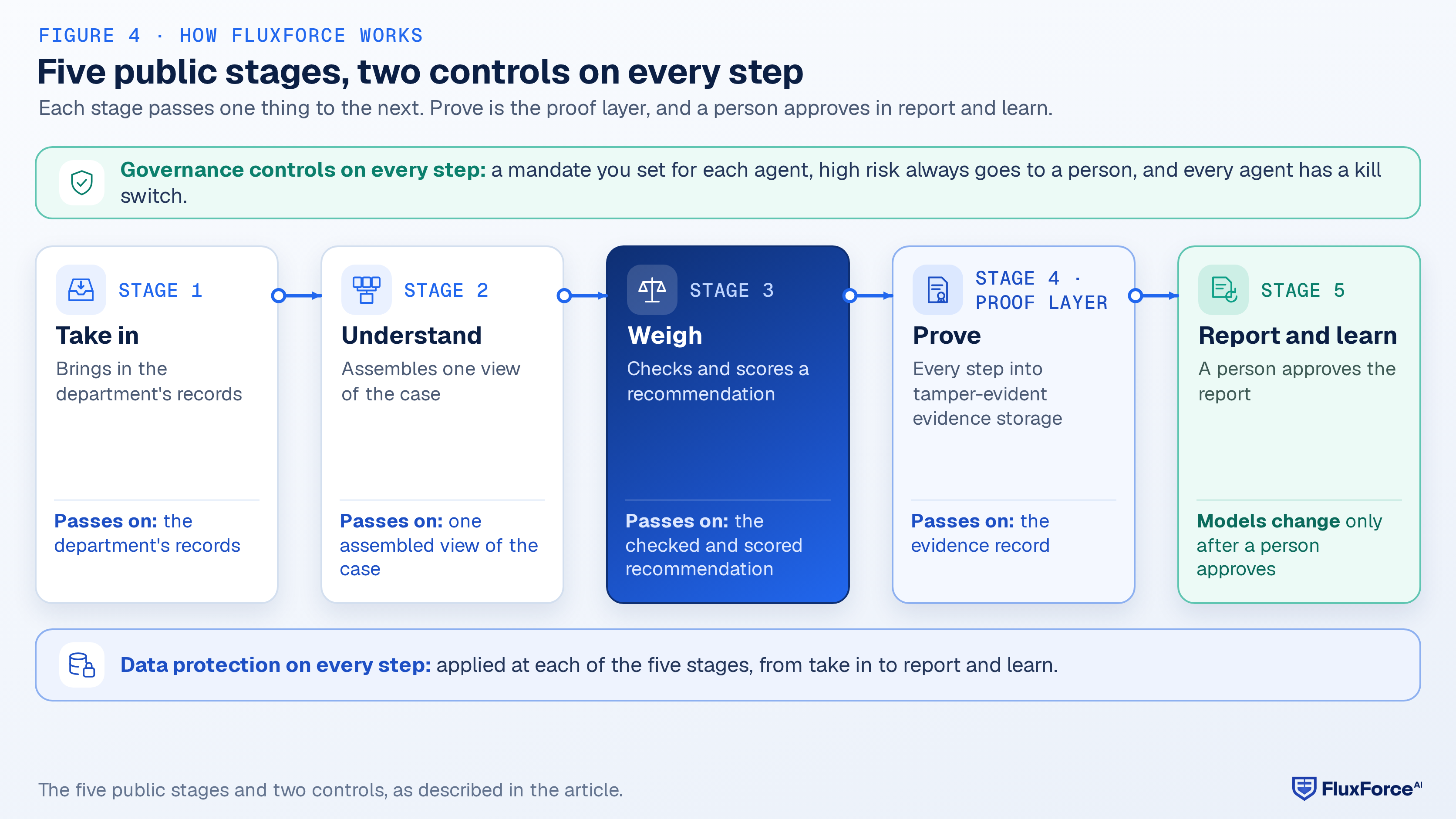
- Take in passes the department's records to understand. Understand passes one assembled view of the case to weigh. Weigh passes the checked and scored recommendation to prove. Prove passes the evidence record to report and learn.
The platform works in five public stages, take in, understand, weigh, prove, and report and learn, with governance controls and data protection on every step.
The fourth figure shows them in order. Take in passes the department's records to understand. Understand passes one assembled view of the case to weigh. Weigh passes the checked and scored recommendation to prove. Prove passes the evidence record to report and learn. Prove is the proof layer, writing every step into tamper-evident evidence storage with inputs, time, who acted and the rules that applied that day, in one case file. In report and learn a person approves the report, and models only change after a person approves.
Each agent works inside a mandate you set, high risk always goes to a person, and every agent has a kill switch. The closest of our solutions is AI Model Governance, and recommendations reach a person through human-in-the-loop review.
Be clear about fit. Our first app line is financial crime and compliance. AI agents that investigate AML, sanctions, fraud and KYC alerts and prepare the case. Your analyst makes the call, with evidence an examiner can replay. You decide how much each agent does on its own, and every one has a kill switch. If you only need a record for one team's spreadsheet macros, your existing tools are probably enough.
- An AI agent audit trail records inputs, tool calls, model version and rules in force as well as actions, plus the human decision and its reason.
- Give each agent its own identity and keep the log out of the agent's reach.
- Tamper-evident means changes show and someone independent checks the chain. No log is impossible to alter.
Conclusion
In KPMG's Q1 2026 AI pulse survey, 63% of organisations required human validation of AI agent outputs, up from 22% in Q1 2025. Its Q3 2026 pulse found that 49% of leaders have defined high-risk use cases where they don't allow agents to decide on their own. Only an audit trail can prove either policy is working. IBM's 2026 breach study found that one in four malicious breaches were AI-enabled, and those breaches cost an average of $6 million.
Our view is that the audit trail earns an agent more autonomy. Teams that can replay any case will widen what their agents do, one risk band at a time.
Request a proof-layer record walkthrough
Frequently Asked Questions
About the author

Sahil Kataria
Founder and CEO of FluxForce
Share this article