


















Listen To Our Podcast🎧
What are agentic AI architecture patterns?
Agentic AI architecture patterns describe how an AI agent is put together. They cover how it plans, which tools it calls, how it hands work to other agents and where a person steps in. Most published catalogs stop at the model and its tools, but for a CIO or CTO at a regulated firm, the pattern that decides whether an agent survives review is the one around them.
Every governed agent does five things in order. It takes in the case, understands it, weighs it, proves what it did and reports for a person to approve. Skip one and the decision can't be defended.
This guide maps the known patterns onto those stages and ends with a production checklist. Last updated 19 November 2026.
- Which agentic AI architecture patterns exist, in plain terms.
- How those patterns fit five stages of a governed agent.
- When one agent is enough and when several are worth the cost.
- Where a person must be able to pause, override or stop an agent.
- What to check before an agent goes into production.
Request the five-stage diagram with the two wraps
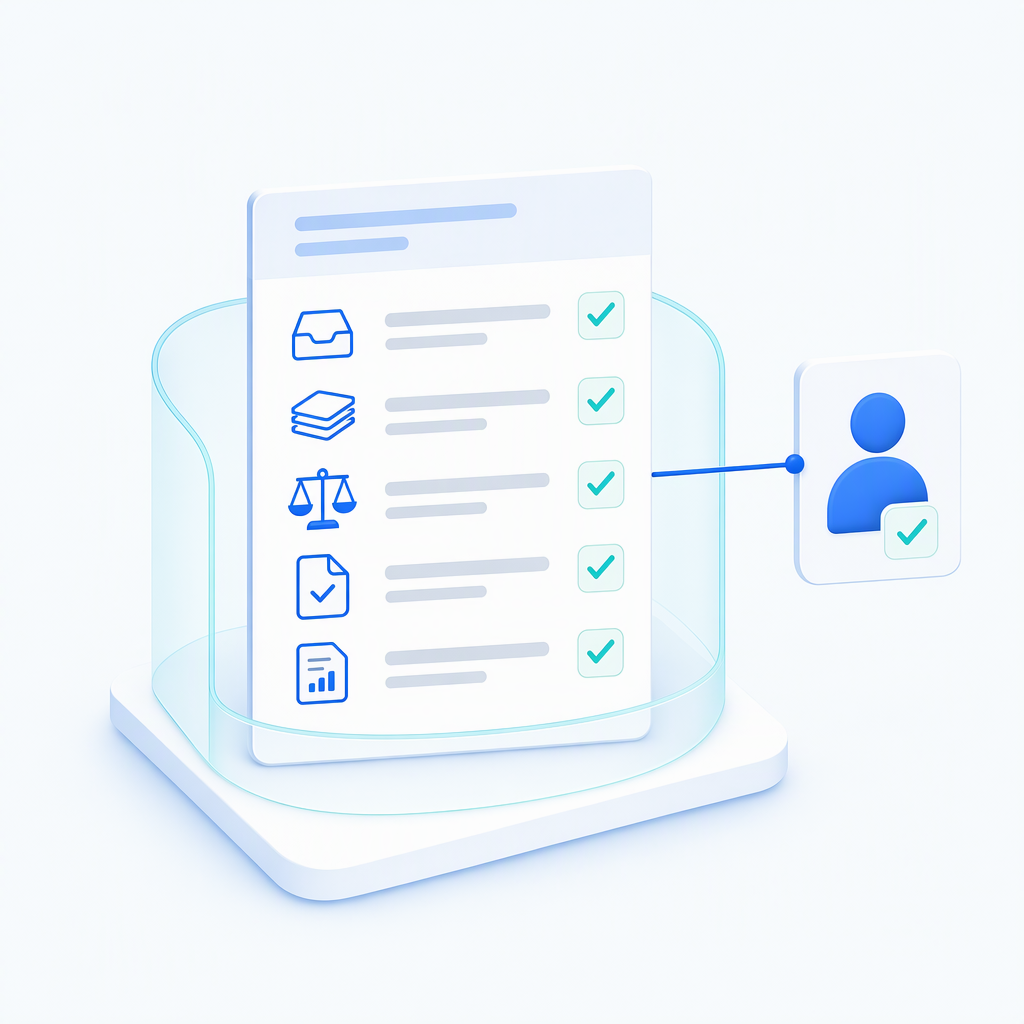
Agentic AI architecture patterns describe how an AI agent is put together: how it plans, which tools it calls, how it hands work to other agents and where a person steps in. A governed agent runs them inside five stages in order, take in, understand, weigh, prove, and report and learn, with governance controls and data protection on every step.
Agentic AI architecture diagram: five stages and two wraps
The diagram most teams draw is a model in the middle with tools around it. That leaves out what a reviewer, an internal auditor or a supervisor will ask about. In the governed version, five stages run in order and two controls wrap every one of them.
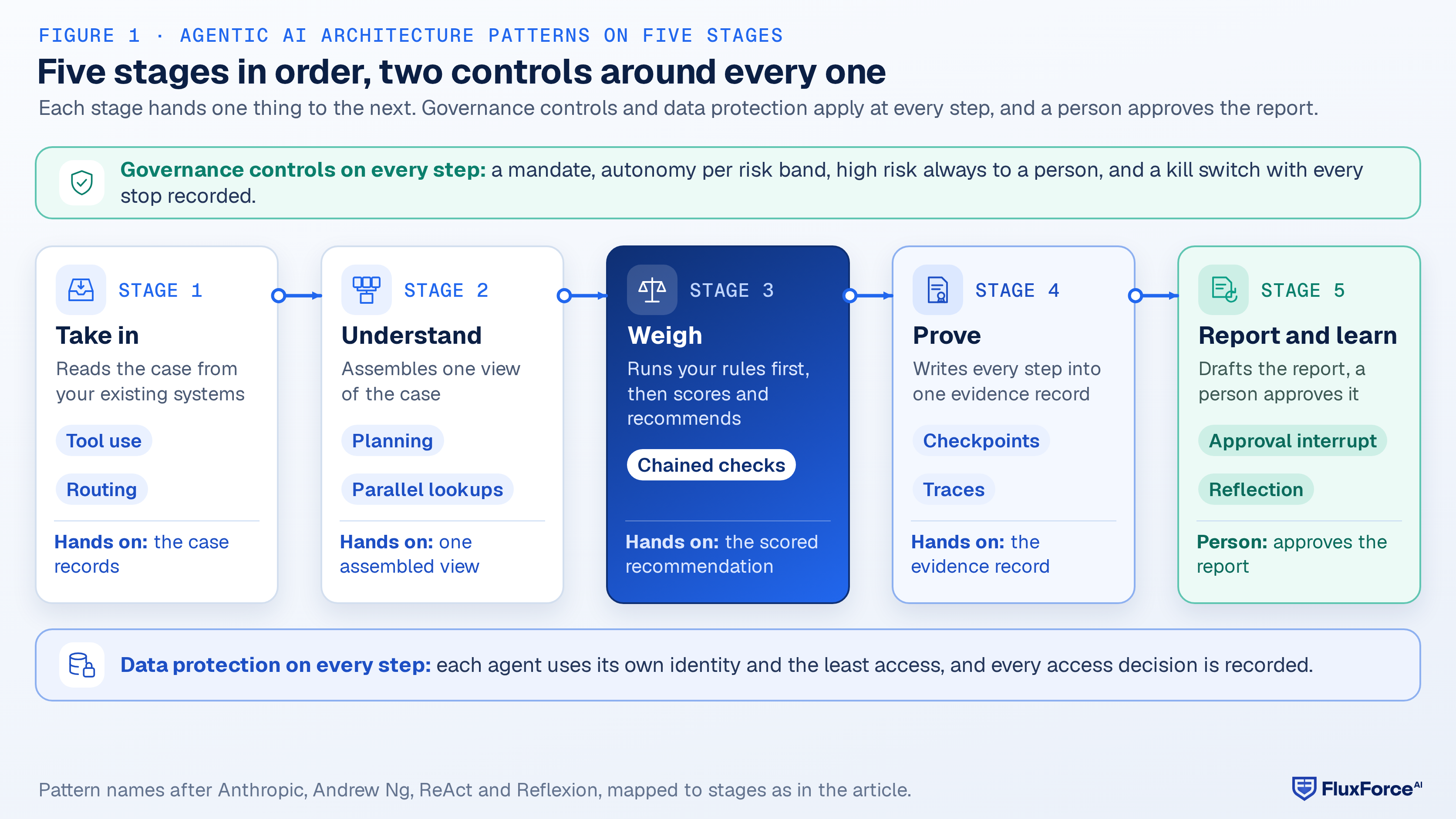
- Take in passes the case records to understand. Understand passes one assembled view of the case to weigh. Weigh passes the checked and scored recommendation to prove. Prove passes the evidence record to report and learn.
| Stage | What the agent does | Patterns you'll use here | What a person owns | What gets recorded |
|---|---|---|---|---|
| Take in | Reads the case from your existing systems | Tool use, MCP, routing | Which systems and fields it may read | Every source read, with identity |
| Understand | Assembles the customer, supplier or claim into one view | Planning, ReAct loops, parallel lookups | What "enough context" means for each case type | The assembled view as it stood |
| Weigh | Runs your rules first, then scores and recommends | Prompt chaining with gates, evaluator loops | The rules, thresholds and risk bands | Checks that ran, score, reasons |
| Prove | Writes every step into one evidence record | Checkpoints, traces | Retention and who may read the record | Inputs, time, actor, rules in force |
| Report and learn | Drafts the report, learns from feedback | Approval interrupts, reflection | Approving the report and model changes | The approval and the reviewer |
| Governance controls (every step) | Works inside a mandate | Guardrails, kill switch | The mandate and autonomy budget per risk band | Every stop and override |
| Data protection (every step) | Uses its own identity and the least access | Scoped tool permissions | Access approval and where data lives | Every access decision |
The first figure shows the five stages in order. Take in passes the case records to understand. Understand passes one assembled view of the case to weigh. Weigh passes the checked and scored recommendation to prove. Prove passes the evidence record to report and learn. Governance controls and data protection wrap all five.
The order matters more than the tools. An agent that weighs before it understands scores half a picture. The gap between what was decided and what you can show later is the replay gap, and the prove stage closes it.
Key insight: an auditor won't ask which pattern you used. They'll ask who approved the outcome and what was recorded, and no pattern in the catalogs answers either question. The five stages and the two wraps do.
Agentic AI architecture patterns: the catalog in plain terms
The patterns have settled into a small, shared vocabulary. Anthropic's guide to building effective agents separates workflows, where models and tools follow predefined code paths, from agents, where the model directs its own process and tool use. Its catalog of workflows is prompt chaining, routing, parallelization, orchestrator-workers and evaluator-optimizer.
| Pattern | Stage where it fits |
|---|---|
| Routing, tool use | Take in |
| Planning, parallelization, orchestrator-workers | Understand |
| Prompt chaining with checks, reflection | Weigh |
| Checkpoints and traces | Prove |
| Approval interrupt, evaluator-optimizer | Report and learn |
Prompt chaining breaks a task into steps where each call processes the output of the previous one, and you can add programmatic checks on any step in between. Routing classifies an input and sends it to a specialised follow-up task. In the orchestrator-workers workflow, a central model breaks down tasks, delegates them to worker models and combines their results. In the evaluator-optimizer workflow, one call generates a response while another provides evaluation and feedback in a loop.
Andrew Ng's four agent strategies cover the same ground from the model's side, with reflection, tool use, planning and multi-agent collaboration. Two research papers sit under most agent loops. The first, ReAct, has the model produce reasoning traces and task-specific actions in an interleaved way. The second, Reflexion, reinforces language agents through linguistic feedback instead of updating model weights.
None of these patterns says who approves the outcome or what gets kept, which is why the wraps sit outside all of them.
Anthropic's advice is to find the simplest solution possible, which might mean not building an agentic system at all. Microsoft's guidance on agent orchestration patterns tells teams to use the lowest level of complexity that reliably meets their requirements.
How do you pick between one agent and several?
Start with one agent, and add more only when the work splits cleanly. Google Cloud's guide to choosing a design pattern recommends that teams early in agent development start with a single agent.
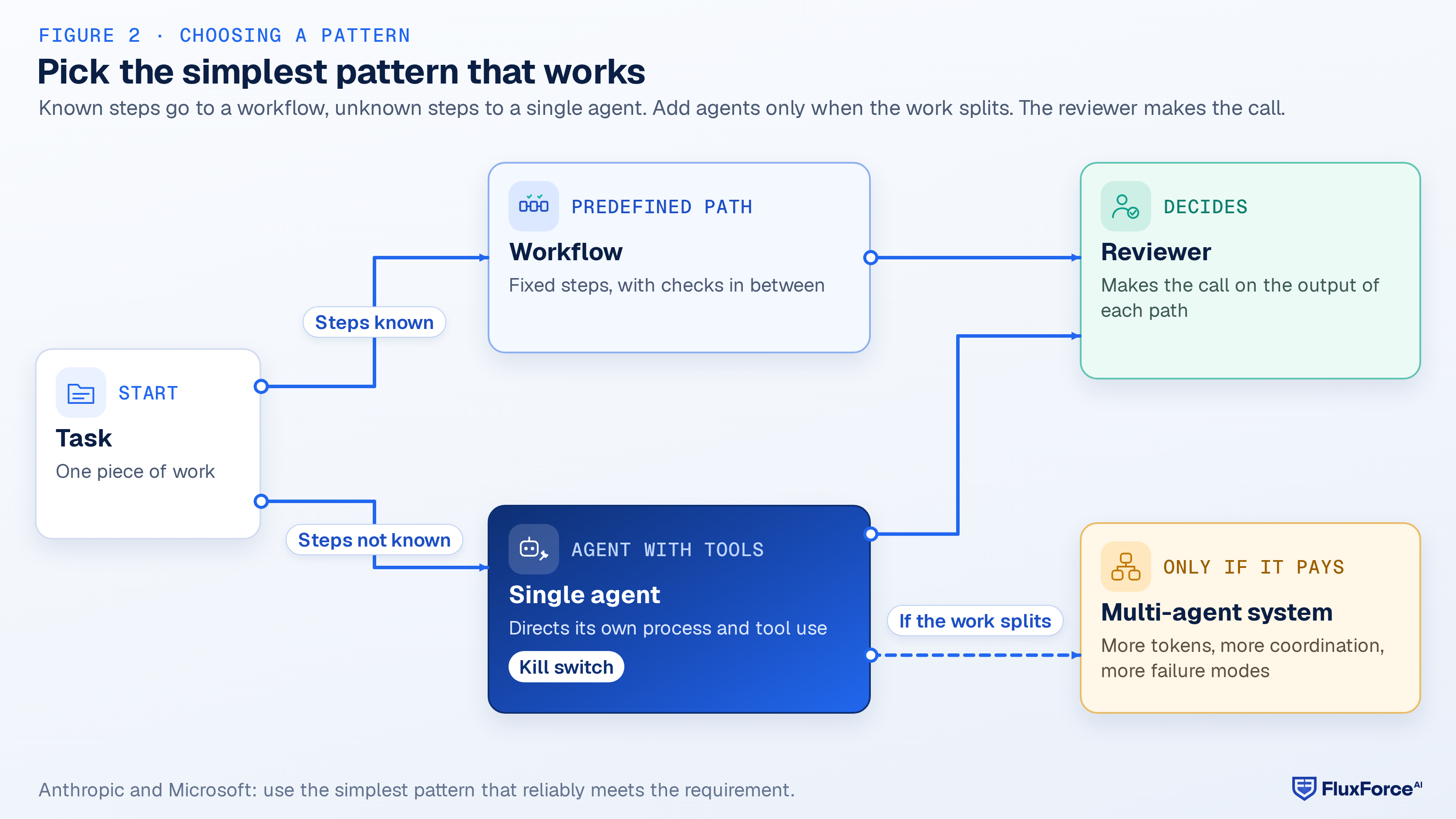
- If the steps of a task are known in advance, the task goes to a workflow with fixed steps and checks between them. If the steps of a task can't be known in advance, the task goes to a single agent with tools. A single agent becomes a multi-agent system only when the work splits into independent parts that justify the extra cost. The workflow and the single agent both send their output to the reviewer, who makes the call.
The second figure shows how to pick a pattern. If the steps of a task are known in advance, the task goes to a workflow with fixed steps and checks between them. If the steps of a task can't be known in advance, the task goes to a single agent with tools. A single agent becomes a multi-agent system only when the work splits into independent parts that justify the extra cost. The workflow and the single agent both send their output to the reviewer, who makes the call.
Microsoft notes that multi-agent orchestration adds coordination overhead, latency and failure modes. The cost is measurable. In its write-up of its multi-agent research system, Anthropic reported that its agents typically use about 4 times more tokens than chat interactions, and multi-agent systems about 15 times more. The same team found its multi-agent research system beat a single agent by 90.2% on an internal research evaluation, especially on breadth-first questions that pursue several independent directions at once.
Multi-agent designs earn their cost on wide research tasks like that. They're harder to justify for a case that needs one consistent judgment.
Failures multiply too. In Don't Build Multi-Agents, Cognition argues that agents should share full context and traces, because actions carry implicit decisions and conflicting decisions carry bad results. A 2025 study of more than 1,600 annotated traces across 7 multi-agent frameworks identified 14 distinct failure modes. For a regulated case, two agents reaching different conclusions on the same file is a finding for the reviewer to resolve.
Our post on multi-agent AI systems in finance covers where several agents do help. For the head term and a bank rollout plan, see our guide to agentic AI architecture for regulated firms.
Where does a person step in?
A person steps in wherever the outcome is high risk, irreversible or legally significant.
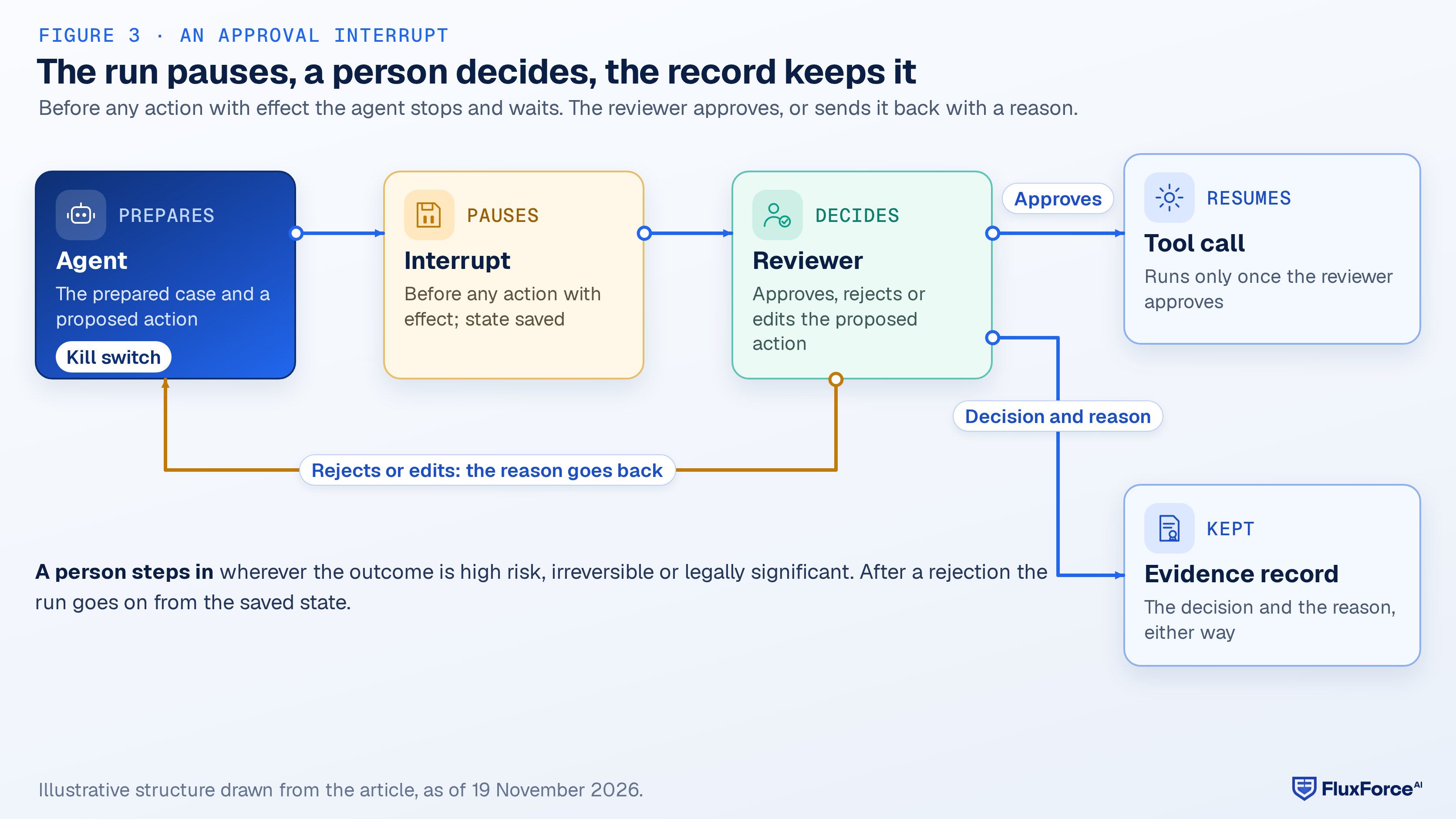
- Before any action with effect, the agent hits an interrupt and the run pauses with its state saved. The interrupt sends the prepared case and the proposed action to the reviewer. If the reviewer approves, the run resumes and the tool call goes ahead. If the reviewer rejects or edits, the agent gets the reason back and the run goes on from the saved state. Either way, the reviewer's decision and reason go into the evidence record.
The frameworks now build this in. LangGraph's interrupts pause the graph at a chosen point, save its state and wait for outside input before going on. Microsoft's Agent Framework lets workflow steps send a request to a human operator and wait for the response before going on. OpenAI's Agents SDK runs guardrails on the input, on the final output and on each guarded tool call.
The third figure shows an approval interrupt. Before any action with effect, the agent hits an interrupt and the run pauses with its state saved. The interrupt sends the prepared case and the proposed action to the reviewer. If the reviewer approves, the run resumes and the tool call goes ahead. If the reviewer rejects or edits, the agent gets the reason back and the run goes on from the saved state. Either way, the reviewer's decision and reason go into the evidence record.
Regulators describe the same controls. Singapore's IMDA framework for agentic AI calls for significant checkpoints in the workflow that require human approval. The EU AI Act requires high-risk AI systems to be designed so natural persons can effectively oversee them. The people overseeing must be enabled to override or reverse the output and to interrupt the system through a "stop" button or a similar procedure.
The Financial Stability Board's October 2026 sound practices on AI and agentic AI describe a kill switch as a mechanism enabling human intervention to halt or constrain AI operations. The Monetary Authority of Singapore's AI risk management guidelines describe kill switches as mechanisms to deactivate AI quickly if it exceeds risk tolerances.
Our human-in-the-loop review control sets out the review requirements, and our kill switch definition covers how stopping works.
How do agents connect to tools and to each other?
Two open protocols now carry most connections, and both need identity and permissions designed around them.
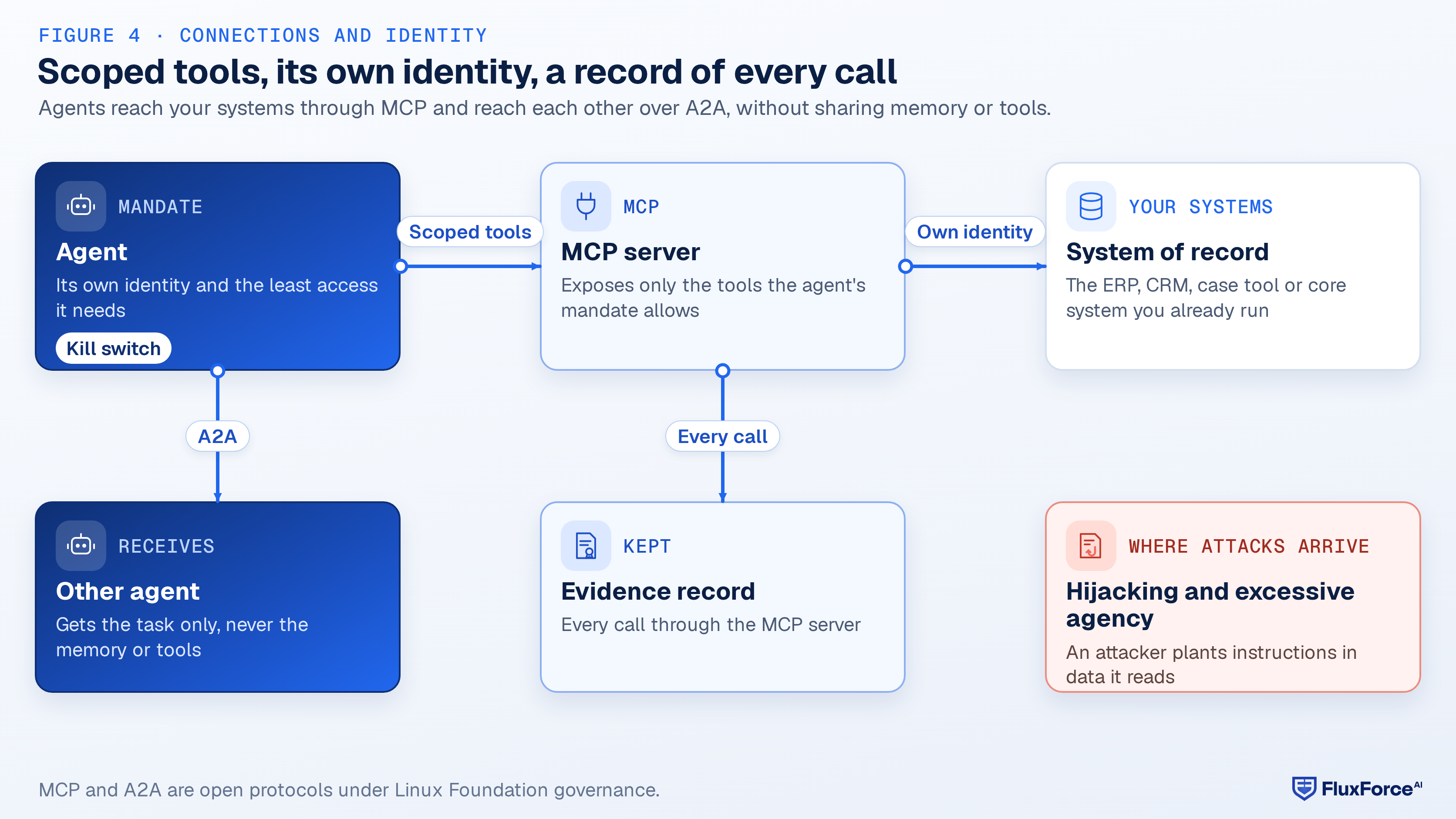
- Each agent connects to your systems through an MCP server that exposes only the tools its mandate allows. The MCP server calls the system of record with the agent's own identity, not a shared login. When one agent needs another, it sends the task over A2A to the other agent without sharing its memory or tools. Every call through the MCP server lands in the evidence record.
MCP, the Model Context Protocol, is an open-source standard for connecting AI applications to external systems. In December 2025 Anthropic announced it was donating MCP to the Agentic AI Foundation, a directed fund under the Linux Foundation. A2A, the Agent2Agent protocol, is an open protocol created by Google for agent-to-agent communication, and it launched as a Linux Foundation project in June 2025. A2A lets agents interact without sharing internal memory, tools or proprietary logic.
The fourth figure shows the connections. Each agent connects to your systems through an MCP server that exposes only the tools its mandate allows. The MCP server calls the system of record with the agent's own identity, not a shared login. When one agent needs another, it sends the task over A2A to the other agent without sharing its memory or tools. Every call through the MCP server lands in the evidence record.
Connections are also where attacks arrive. NIST's Center for AI Standards and Innovation says many AI agents are vulnerable to agent hijacking, where an attacker plants instructions in data the agent reads. OWASP traces excessive agency to excessive functionality, excessive permissions or excessive autonomy. The FSB's sound practices describe giving each AI agent a unique identifier, so a firm can see which actions it took and which humans configured and oversaw it.
Agentic AI architecture examples
These examples show how one set of stages fits different departments. They're patterns we recommend, not customer deployments.
| Department and case | Weigh | Who decides |
|---|---|---|
| Compliance: a transaction monitoring alert | Rules and thresholds first, then a score with reasons | The analyst, with compliance sign-off on any report |
| Finance and AP: a supplier bank-detail change | Callback and hold rules first, then a risk note | The approver, after a callback |
| Claims: a new motor claim | Coverage rules first, then a fraud and severity view | The claims handler |
| IT and security: a privileged access request | Access policy first, then a risk view | The access owner |
Each row follows the same three steps.
- Your rules run first as hard checks.
- The agent weighs what passes and prepares a recommendation with its reasons.
- A named person decides, and the decision goes into the evidence record.
Checks before judgment is our name for that order, and it's the FluxForce version of what the industry calls decision intelligence.
What do regulators expect from the architecture?
Regulators ask what the agent did, who could stop it and who was accountable.
Under the EU AI Act, high-risk AI systems must technically allow automatic recording of events over the system's lifetime. Deployers must keep those logs for at least six months, and financial institutions keep them in the documentation their financial services law already requires. Regulation (EU) 2026/1744 moved the high-risk duties for Annex III systems to 2 December 2027.
In the US, the April 2026 interagency model risk guidance from the OCC, the Federal Reserve and the FDIC puts generative and agentic AI outside its scope. In our view that leaves the architecture to carry controls the guidance doesn't spell out.
The FSB says firms should set a risk tolerance for each agentic AI use case at the start, which informs how much autonomy and access they grant.
Most firms aren't there yet. Deloitte's 2026 State of AI in the Enterprise found only 21% of companies report a mature model for agent governance. KPMG's third-quarter 2026 AI pulse survey found 49% of leaders have defined high-risk use cases where they don't allow autonomous decision-making by agents. Gartner expects 40% of enterprise applications to include task-specific AI agents by the end of 2026, up from less than 5% in 2025. In June 2025 it also predicted that over 40% of agentic AI projects will be canceled by the end of 2027, citing escalating costs, unclear business value or inadequate risk controls.
What does this look like in practice?
The scenario below is invented to show the process, not drawn from a real customer. A 600-person payments firm's CTO has a demo agent that reviews new merchant applications. The head of compliance won't let it near live cases until the team can show how it's governed.
The model didn't change between demo and production. The stages, the record and the person at the end did.
How does FluxForce approach agentic AI architecture?
FluxForce is the platform your departments run AI agents on. The agents investigate and prepare the work, a person makes the call, and every step leaves evidence an examiner can replay.
In take in, agents connect beside the ERP, CRM, case tool or core system you already run, and nothing is migrated. In understand, the agent assembles one view of the case before anything is scored. In weigh, your rules run first as hard checks, then the agent scores the case against your own history and recommends. In prove, every step goes into a tamper-evident evidence record. In report and learn, the agent drafts the report, a person approves it, and models change only after a person approves.
Governance controls apply on every step. Each agent works inside a mandate you set, you decide how much it does on its own in each risk band, high risk always goes to a person, and every agent has a kill switch with every stop recorded. Data protection applies on every step too, in SaaS, on-premise or hybrid deployments.
The proof layer is our name for the prove stage. It's the part of the platform that records every step an agent takes, with its inputs, time, actor and the rules in force, so any decision can be shown later. It's what we add to what the industry calls an agentic AI platform.
Financial crime and compliance is the first app line on the platform. AI agents that investigate AML, sanctions, fraud and KYC alerts and prepare the case. Your analyst makes the call, with evidence an examiner can replay. You decide how much each agent does on its own, and every one has a kill switch.
For the model side of the record, FluxForce AI Model Governance tracks which model version was live on any date. You can browse the AI agents on the platform, and our guide to AI agents in finance shows where autonomy stops inside a regulated firm.
- Patterns describe how an agent works. The five stages describe how it gets defended.
- Start with the simplest pattern, usually one agent with tools, and add agents only when the work splits cleanly.
- Put an approval interrupt before every action with effect, and record the decision either way.
- Give each agent its own identity, the least access it needs and a tested kill switch.
- An evidence record of every step closes the replay gap.
Conclusion
Patterns are how an agent works. Stages are how it gets defended. Pick the simplest pattern that does the job, run it inside the five stages, and keep a person on every call your firm will be asked to explain.
We think the agents that reach production at regulated firms will be the ones whose records an internal auditor can replay without calling the team that built them. Our audit trail evidence checklist lists what each record should hold.
Request the five-stage diagram with the two wraps
Frequently Asked Questions
About the author

Sahil Kataria
Founder and CEO of FluxForce

Share this article