


















Listen To Our Podcast🎧
What is an agentic AI platform?
Most agentic AI platforms show you agents. Ask what they show your auditor.
An agentic AI platform is the software your departments build, run and govern AI agents on. The agents are the apps. The platform is what makes them safe to switch on, because it records every step an agent takes so a person can check the work and defend the decision later.
Most buyer's guides stop at a feature list. This one gives Chief AI Officers and CIOs a platform capability checklist mapped to the five stages every agent's work passes through, with a test you can run in a demo for each line. Last updated 19 November 2026.
- What an agentic AI platform is, and how it differs from a single agent, an assistant or a script.
- The platform capability checklist, stage by stage, with the evidence test for each line.
- What the adoption and failure data say about agentic AI platforms in 2026.
- How agentic AI platform architecture fits together, and which open standards matter.
- What the proof layer records, who decides, and how to shortlist without a vendor ranking.
Request the platform capability checklist
An agentic AI platform is the software your departments build, run and govern AI agents on. It gives each agent its tools, data, identity and limits, and it records every step the agent takes so a person can check the work and defend the decision later.
How is an agentic AI platform different from a single agent?
An agentic AI platform is the shared foundation that many agents run on, across departments. The platform gives every agent the same connectors, identity, permissions, monitoring and records, so a firm doesn't rebuild those controls for each new use.
Anthropic's guide to building effective agents draws the line between workflows and agents. Workflows are systems where models and tools follow predefined code paths. Agents direct their own processes and tool use, and keep control over how they get the task done.
An assistant answers a person's question. A script follows fixed steps. An agent plans its own steps toward a goal, which is exactly why it needs a platform around it. Our glossary has short definitions of agentic AI and of an AI agent.
In June 2025 Gartner warned about "agent washing", which it defined as the rebranding of AI assistants, robotic process automation and chatbots without substantial agentic capabilities. It estimated that only about 130 of the thousands of agentic AI vendors are real. A platform that only wraps a chatbot fails the first stage of the checklist below. For how agents behave inside banks and insurers, and where they fail, see our guide to AI agents in finance.
Our own term for the part buyers most often miss is the proof layer. The market calls it the audit trail or decision trace. We define the proof layer as the part of the platform that records every step an agent takes, with its inputs, time, actor and the rules in force, so any decision can be shown later.
An audit trail you can read isn't the same as one an examiner can replay.
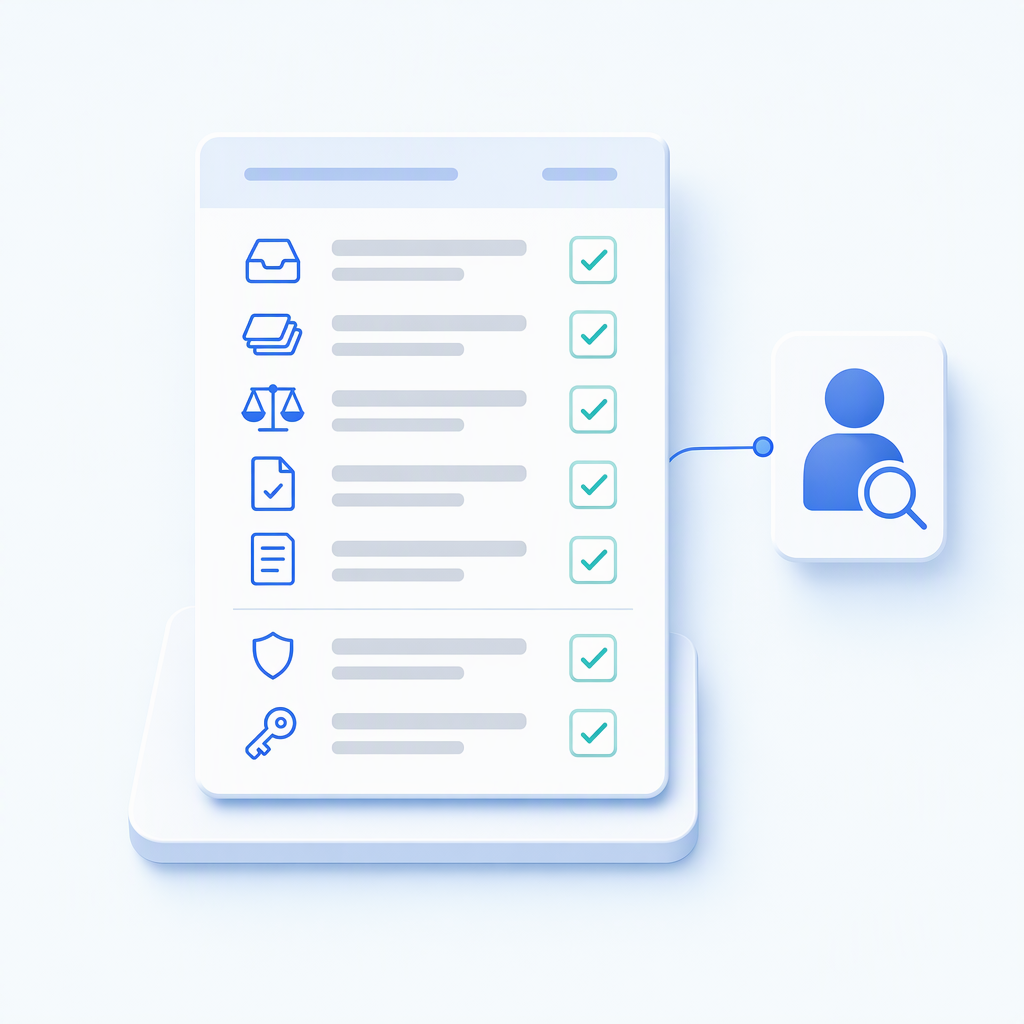
The platform capability checklist: what should you test at each stage?
Every piece of agent work passes through the same five stages, whatever the department: take in, understand, weigh, prove, and report and learn. Two controls wrap all five, governance on every step and data protection on every step. Each line has a test you can ask a vendor to run live, and a red flag that should end the conversation.
| Stage | Capability to look for | Test to run in the demo | Red flag |
|---|---|---|---|
| Take in | Connectors beside the systems you already run (ERP, CRM, case tool, core platform), with nothing migrated | Connect to a test copy of one of your systems and show what the agent can read | "We'll need to move your data into our store first" |
| Understand | The agent assembles the full case (customer, supplier, claim or application, linked records, outside sources) before scoring anything | Open one case and show every source the agent pulled, with timestamps | The agent answers from memory with no list of what it read |
| Weigh | Your thresholds, policies and rules run first as hard checks, then the agent scores and recommends with reasons | Change one threshold and show which cases now route differently | The model "decides" with no rule check in front of it |
| Prove | A tamper-evident evidence record of each step, joined into one case file | Pick a case closed last month and replay it without help from the vendor | Logs exist but only an engineer can read them |
| Report and learn | The agent drafts the report, a person approves it, and model changes wait for a person's approval | Show the approval step, and the record of the last model change and who approved it | Models retrain and go live on their own |
| Governance on every step | Each agent has a mandate, an autonomy budget per risk band and a kill switch | Stop one agent mid-run, then show the recorded stop | The off switch is a support ticket |
| Data protection on every step | Each agent has its own identity, least-privilege access and a deployment choice (SaaS, on-premise or hybrid) | Show the agent's identity, what it may touch, and a denied request | Agents share one service account |
Score each line pass, partial or fail in the demo itself, not from a slide. A platform that passes the first three stages and fails "prove" will run agents you can't defend. Run the replay test and the stop test first, because they're the hardest to fake in a demo.
Why do agentic AI platforms matter in 2026?
McKinsey's 2026 State of AI survey found that 40 percent of respondents from organizations with more than $1 billion in revenue report scaling AI agents, up from 27 percent a year earlier. KPMG's Q3 2026 AI pulse survey found 62% of organizations building, deploying or developing AI agents, up from 53% the quarter before.
Deloitte's State of AI in the Enterprise 2026 found close to three-quarters of companies planning to deploy agentic AI within two years. Only 21% of those companies report having a mature model for agent governance.
Actual use is earlier than the headlines suggest. Stanford's 2026 AI Index reports that AI agent deployment was in the single digits across nearly all business functions.
The failure data matter more for a buyer. Gartner expects over 40% of agentic AI projects to be canceled by the end of 2027, citing escalating costs, unclear business value or inadequate risk controls. KPMG found the share of organizations building controls into their agents alongside monitoring and evaluation fell to 30% from 43% two quarters earlier.
Agentic AI platform architecture: what sits inside?
We break agentic AI platform architecture into six parts, whatever the vendor calls them. Bain described modern AI platforms in April 2026 as converging around a shared architecture built for orchestration, visibility and governed data access.
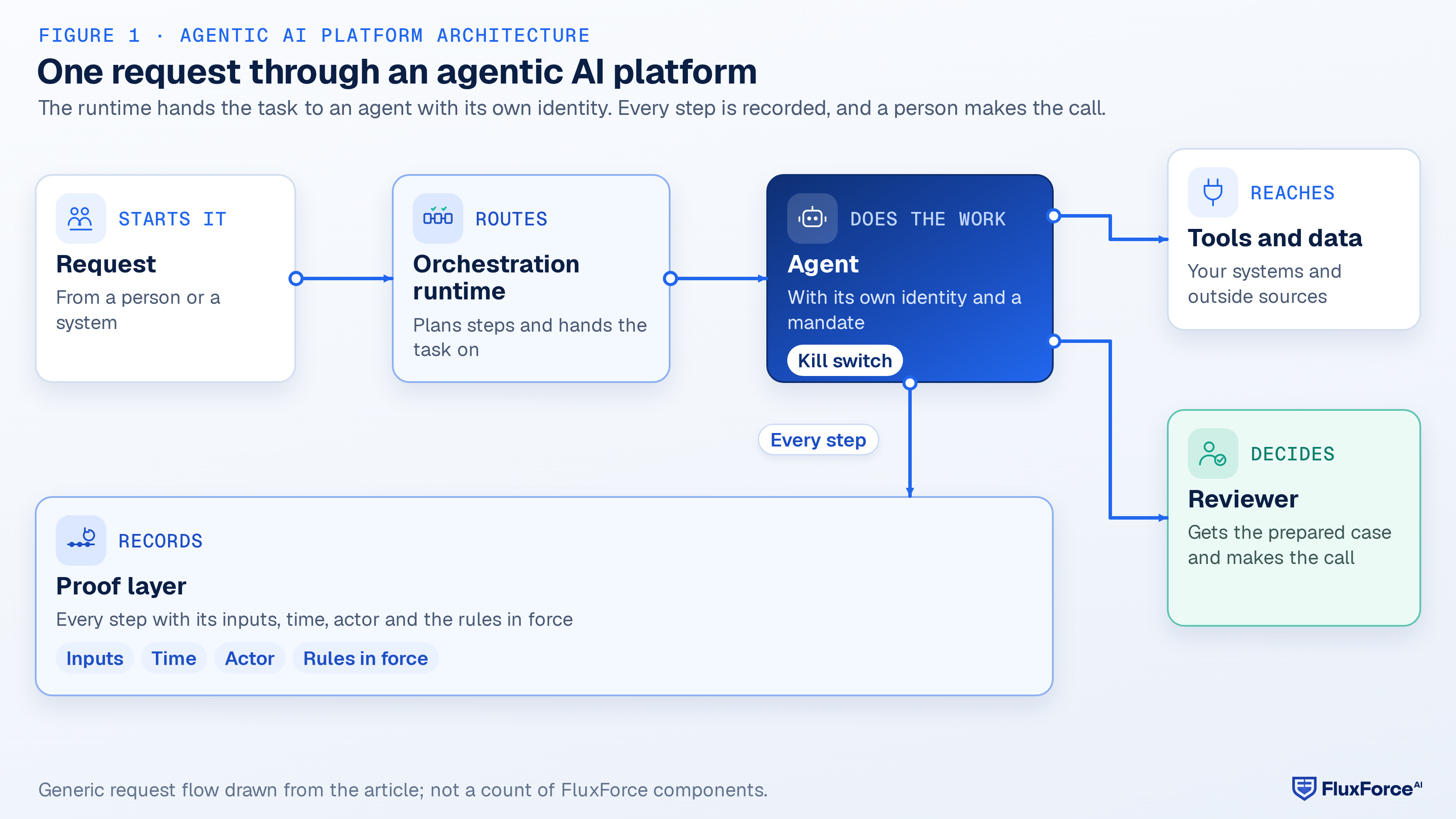
- A request from a person or a system reaches the orchestration runtime. The orchestration runtime hands the task to an agent with its own identity. The agent calls tools and data through governed connectors. Every step the agent takes is written to the proof layer. The agent sends its prepared case to the reviewer, who makes the call.
| Part | What it does | What to check |
|---|---|---|
| Models | Language models and scored models that read, draft, classify and predict | Which model each agent runs, and who approved the version |
| Agents | The apps: one agent per kind of work, each with a mandate | Each agent's identity, scope and owner |
| Tools and data connectors | How agents reach your systems and outside sources | Open protocols, least-privilege access, a denied-request log |
| Orchestration runtime | Plans steps, hands tasks between agents, retries and routes to people | Where a person is pulled in, and what the runtime does when a step fails |
| Proof layer | Records every step with inputs, time, actor and rules in force | Whether a closed case can be replayed by someone outside IT |
| Controls | Mandates, autonomy budgets by risk band, kill switch, monitoring | Whether a business owner can see and change them, as well as IT |
The first figure shows how a request moves through the platform. A request from a person or a system reaches the orchestration runtime. The orchestration runtime hands the task to an agent with its own identity. The agent calls tools and data through governed connectors. Every step the agent takes is written to the proof layer. The agent sends its prepared case to the reviewer, who makes the call.
Which open standards should the platform support?
Open protocols keep you from rebuilding connectors when you change vendor.
The Model Context Protocol (MCP) connects agents to tools and data, and its current version is 2026-07-28. Its authorization rules make an MCP client act as an OAuth 2.1 client. The Linux Foundation formed the Agentic AI Foundation in December 2025 with MCP among its founding projects. Agent2Agent (A2A), the open standard for communication between agents, joined that foundation as a hosted project in August 2026.
For records, OpenTelemetry has semantic conventions for generative AI agent and framework spans, which give agent steps a shared trace format. They're still marked as in development. For identity, NIST's National Cybersecurity Center of Excellence published a concept paper on software and AI agent identity and authorization in February 2026. An agent that borrows a person's login can't be told apart from that person in the record.
What does the proof layer need to record?
The proof layer has to record enough that someone outside the team can rebuild any decision, in order, without asking the people who made it.
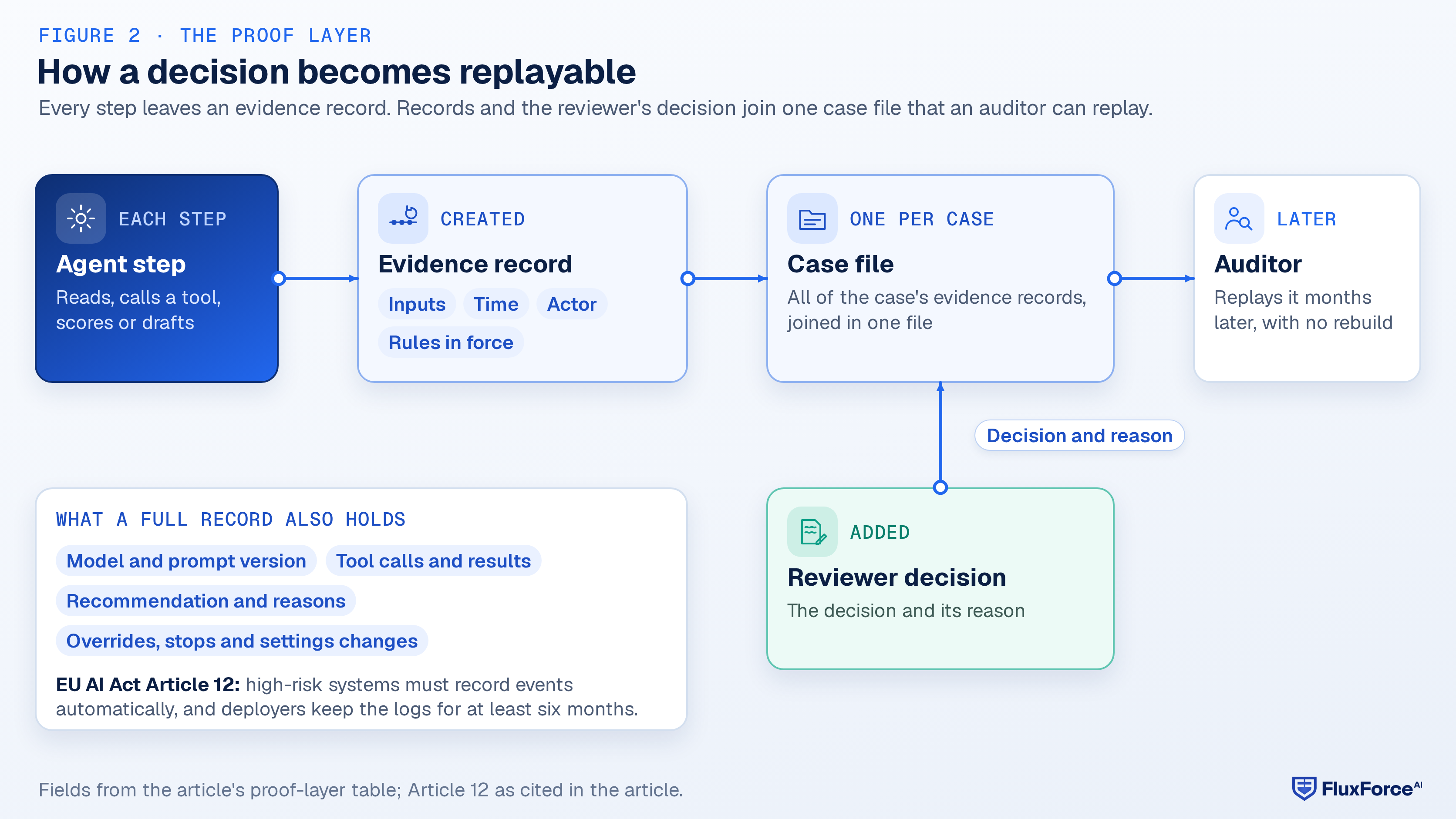
- Each agent step creates an evidence record with its inputs, time, actor and the rules in force. Evidence records for one case are joined into one case file. The reviewer decision and reason are added to the case file. The auditor replays the case file months later without asking anyone to rebuild it.
The second figure shows how a decision becomes replayable. Each agent step creates an evidence record with its inputs, time, actor and the rules in force. Evidence records for one case are joined into one case file. The reviewer decision and reason are added to the case file. The auditor replays the case file months later without asking anyone to rebuild it.
| Field | Why it's needed |
|---|---|
| Inputs and sources | Shows what the agent saw and what it missed |
| Rules and thresholds in force that day | Settings change over time |
| Model and prompt version | Ties an outcome to a version |
| Tool calls and results | Shows what the agent did as well as what it said |
| Recommendation and reasons | Explains the call |
| The person's decision, reason and time | Shows who was accountable |
| Overrides, stops and settings changes | Shows who changed what, and when |
Article 12 of the EU AI Act says high-risk AI systems "shall technically allow for the automatic recording of events (logs) over the lifetime of the system." Under the consolidated text, deployers of high-risk systems must keep the logs under their control for a period appropriate to the system's purpose, of at least six months unless other law says otherwise. Regulation (EU) 2026/1744 moved the application date for Annex III high-risk systems to 2 December 2027, and to 2 August 2028 for high-risk systems under Annex I.
A tribunal has already treated a chatbot's words as the company's own words. In Moffatt v. Air Canada (2024), the British Columbia Civil Resolution Tribunal rejected the airline's suggestion that its chatbot was "a separate legal entity that is responsible for its own actions." The tribunal held that the airline is responsible for all the information on its website. What your agent says is yours to defend, and so is its record.
Who decides when agents run on an agentic AI platform?
A person decides, and the platform has to make that easy to prove. The firm sets how much each agent may do on its own, in each risk band, and every agent can be stopped at once.
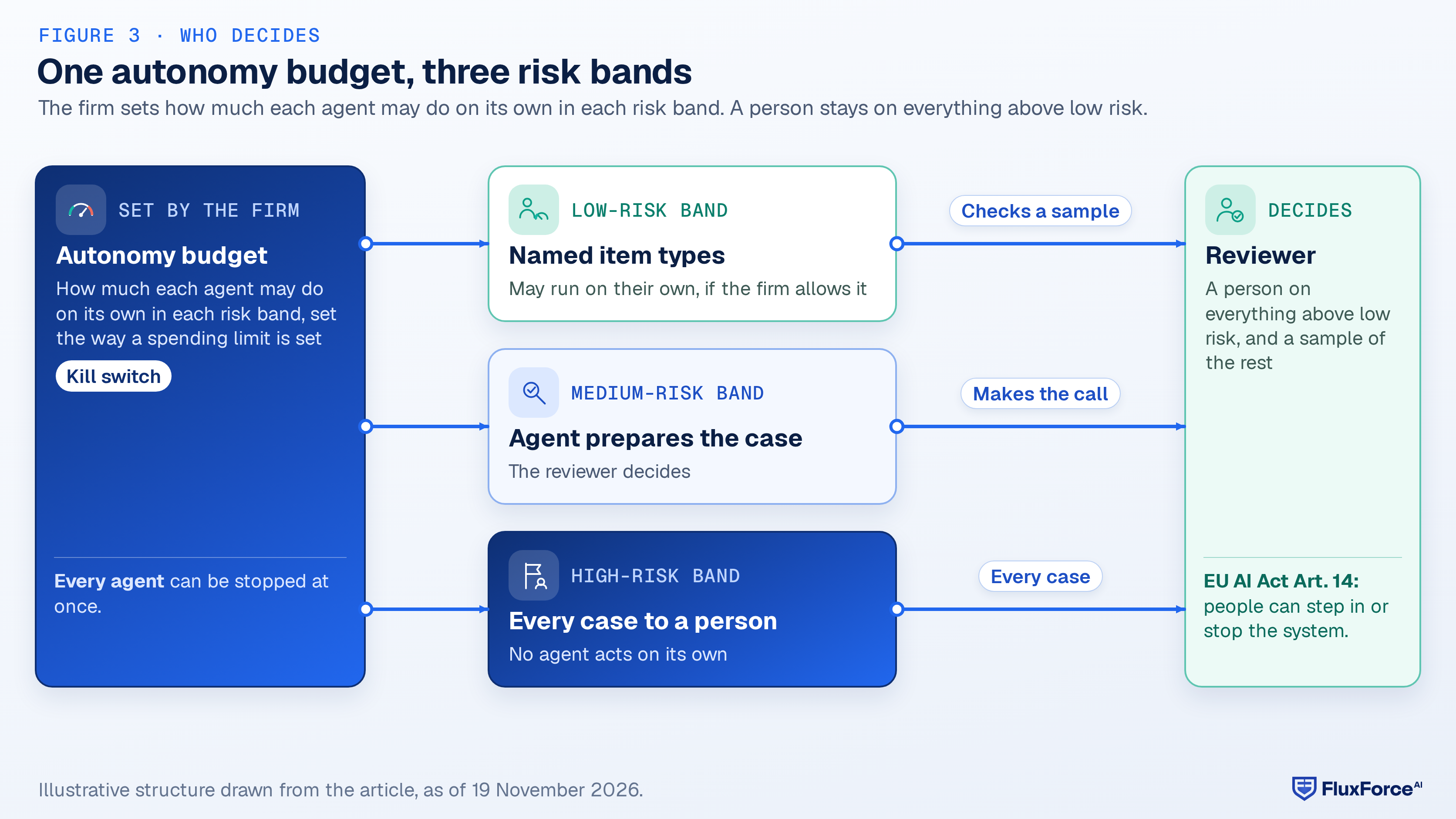
- The autonomy budget sets what the agent may do in the low-risk band, the medium-risk band and the high-risk band. In the low-risk band, named item types can run on their own if the firm allows it, and the reviewer checks a sample. In the medium-risk band, the agent prepares the case and the reviewer makes the call. In the high-risk band, every case goes to the reviewer.
The EU AI Act puts this in law for high-risk systems. Article 14 requires that they "can be effectively overseen by natural persons during the period in which they are in use." The people assigned to oversight must be able to intervene in the operation of the system or interrupt it through a "stop" button or a similar procedure.
Singapore's Model AI Governance Framework for Agentic AI, launched in January 2026, says it plainly: "As deployers, organisations and humans remain accountable for the decisions and actions of agents." It recommends defining significant checkpoints that require human approval, such as high-stakes or irreversible actions, and auditing that oversight over time.
Our page on human-in-the-loop review covers how to set those checkpoints in practice. KPMG found that nearly half of leaders (49%) have defined high-risk use cases where they don't allow autonomous decision-making by agents.
We call the setting an autonomy budget: how much each agent may do on its own in each risk band, set by the firm the way a spending limit is set. The third figure shows how it works. The autonomy budget sets what the agent may do in the low-risk band, the medium-risk band and the high-risk band. In the low-risk band, named item types can run on their own if the firm allows it, and the reviewer checks a sample. In the medium-risk band, the agent prepares the case and the reviewer makes the call. In the high-risk band, every case goes to the reviewer.
Agentic AI platform for enterprise: which security and governance tests matter?
An agentic AI platform for enterprise has to survive attacks that target agents specifically, and it has to fit the governance frameworks your auditors already use.
Agents read untrusted content and then act, which opens a new attack path. NIST's Center for AI Standards and Innovation describes agent hijacking as a type of indirect prompt injection, where an attacker plants instructions in data the agent reads and causes it to take unintended, harmful actions. In its January 2025 tests, the attack success rate rose from 11% for the strongest baseline attack to 81% for the strongest new attack. The OWASP Top 10 for Agentic Applications for 2026 lists agent goal hijack as its first risk and tool misuse and exploitation as its second. Shipped products have already been hit. The US National Vulnerability Database records CVE-2025-32711, an AI command injection in Microsoft 365 Copilot that let an unauthorized attacker disclose information over a network.
Ask the vendor to run a hijack test on your own sample documents, show each agent's least-privilege access, and show a denied action landing in the record.
On governance, ask how the platform's records map to ISO/IEC 42001, which specifies requirements for an AI management system, or to the voluntary NIST AI Risk Management Framework. Our AI governance control page lists what auditors usually test, and our AI governance policy template for financial services gives the policy those tests check against.
The US banking agencies' model risk guidance issued with SR 26-2 in April 2026 says generative AI and agentic AI models are novel and rapidly evolving, and are not within its scope. In our view the platform has to supply those controls, because the old model validation playbook won't map cleanly. The Monetary Authority of Singapore's AI risk management guidelines, issued in October 2026, ask firms to review their controls as agentic AI systems that operate autonomously and access tools come into wider use.
Agentic AI platform examples: which types will you meet?
Agentic AI platform examples fall into five types. Most buyers end up with more than one, so the question is which type governs the work you'll have to defend.
| Type | What it's built for | What to check first |
|---|---|---|
| Cloud provider agent services | Developers building on one cloud's models and services | Whether the record is readable outside that cloud |
| Agents inside business suites (CRM, ERP, HR, service desk) | Work on one suite's data | What happens to work that crosses into other systems |
| Automation suites adding agents | Firms with existing scripted automation | Whether it's real agent work or agent washing of old scripts |
| Developer frameworks | Teams building their own platform | Who builds the proof layer, identity and kill switch |
| Governed platforms for regulated work | Decisions someone must defend to an auditor, regulator or court | Department coverage beyond the first use |
We don't rank vendors in this guide. A ranking only means something against your own decisions and your own data.
Agentic AI platforms list: how do you shortlist without a ranking?
Build your own agentic AI platforms list from your use, not from a ranking.
- Write down the first three decisions you want agents to prepare, and who has to defend each one later.
- Remove any vendor that can't show agent work on those decisions in a live demo, which filters out most agent washing.
- Run the platform capability checklist on the rest, stage by stage, with your own sample data.
- Ask for the replay test and the stop test in front of your auditor or model risk lead.
In March 2024 the US Securities and Exchange Commission settled charges against two investment advisers over false and misleading statements about their use of AI, with $400,000 in total civil penalties. Your own disclosures will repeat what your vendor told you, so ask for proof of each claim you plan to repeat.
What does this look like in practice?
The scenario below follows one insurer from its shortlist to its second department, using the checklist, the autonomy budget and the proof layer described above.
How does FluxForce approach agentic AI platforms?
FluxForce is the platform your departments run AI agents on. The agents investigate and prepare the work, a person makes the call, and every step leaves evidence an examiner can replay. We call it an Agentic OS for Regulated Industries.
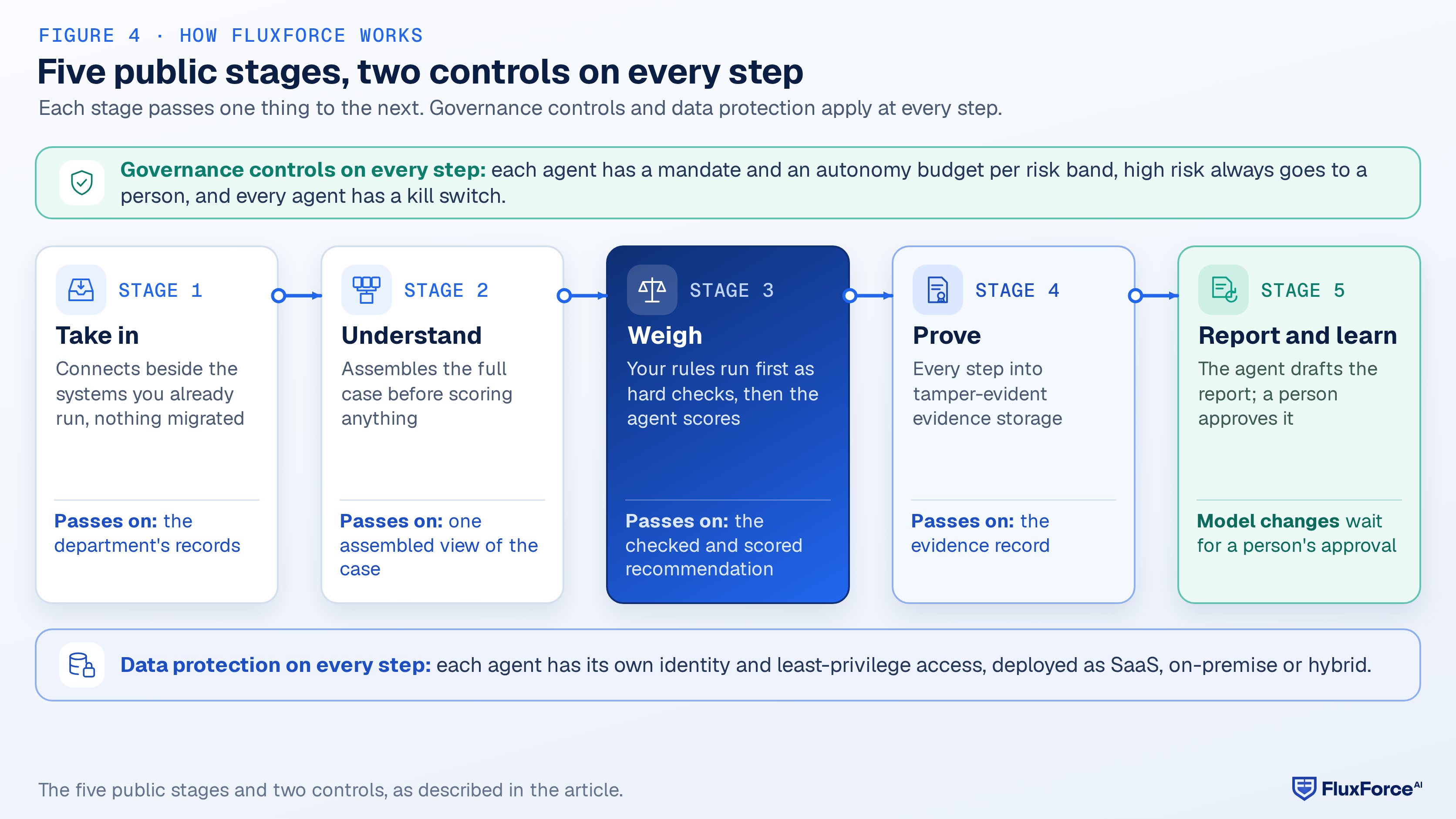
- Take in passes the department's records to understand. Understand passes one assembled view of the case to weigh. Weigh passes the checked and scored recommendation to prove. Prove passes the evidence record to report and learn.
The platform works in five public stages: take in, understand, weigh, prove, and report and learn, with governance controls and data protection on every step. The fourth figure shows them in order. Take in passes the department's records to understand. Understand passes one assembled view of the case to weigh. Weigh passes the checked and scored recommendation to prove. Prove passes the evidence record to report and learn.
Agents connect beside the systems you already run, so nothing is migrated. Your rules run first as hard checks, then an agent scores the case and recommends, with full decision explanations. Every step goes into tamper-evident evidence storage, the proof layer. High risk always goes to a person, and every agent has a kill switch.
Financial crime and compliance is the first app line on the platform: AI agents that investigate AML, sanctions, fraud and KYC alerts and prepare the case. Your analyst makes the call, with evidence an examiner can replay. You decide how much each agent does on its own, and every one has a kill switch. You can see the AI agents on the platform today, and how AI Model Governance keeps the model side of the record.
How do you roll out an agentic AI platform in the first 90 days?
Prove the platform on one department before you widen it. The fifth figure shows the path from shadow mode to controlled autonomy. In shadow mode the agent works live cases without acting, and its calls feed a weekly comparison. The comparison goes to the approver, who decides whether to widen the autonomy budget. Only the approver can move one item type into controlled autonomy. The kill switch stops controlled autonomy at once, and every stop is recorded.
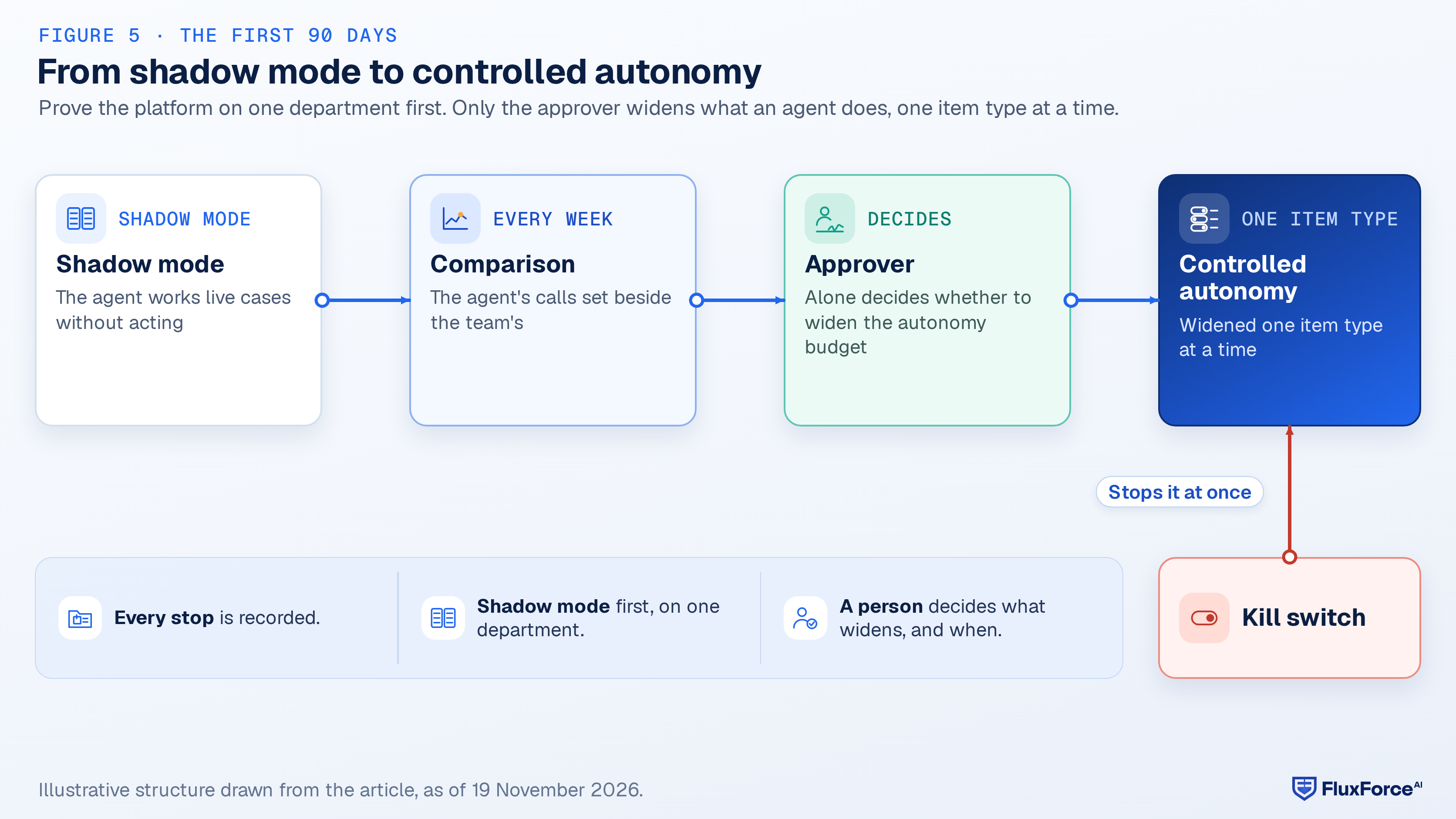
- In shadow mode the agent works live cases without acting, and its calls feed a weekly comparison. The comparison goes to the approver, who decides whether to widen the autonomy budget. Only the approver can move one item type into controlled autonomy. The kill switch stops controlled autonomy at once, and every stop is recorded.
- An agentic AI platform gives every agent the same connectors, identity, permissions, monitoring and records.
- Test it stage by stage in a live demo, across take in, understand, weigh, prove, and report and learn, plus governance and data protection.
- Run the replay test and the stop test first. Replay a case closed last month, and stop an agent mid-run.
- The proof layer records inputs, rules in force, model version, tool calls and the person's decision for every case.
- Gartner expects over 40% of agentic AI projects to be canceled by the end of 2027, with inadequate risk controls among the reasons.
Conclusion
A platform that can't replay a closed case in front of your auditor isn't ready for work you'll have to defend, however good its agents look in a demo.
Buy the proof layer first and the agents second. Start in one department, in shadow mode, keep high risk with a person, and widen autonomy one item type at a time when the comparison earns it.
Request the platform capability checklist
Frequently Asked Questions
About the author

Sahil Kataria
Founder and CEO of FluxForce

Share this article