


















Listen To Our Podcast🎧
Why does one bank-detail email still work?
One email asking to update bank details is the oldest trick in accounts payable, and it still works.
Vendor bank account change fraud is when a criminal posing as a real supplier gets your team to switch that supplier's bank details, so the next genuine invoice is paid to the criminal. The control that stops it is a callback to a number you already held, made before the change goes live, by someone other than the person paying. Most losses happen because that callback was skipped, went to the wrong number or was treated as optional. This guide for CFOs sets out a callback-verification control checklist, shows where ERP approvals and payee name checks fall short, and explains who carries the loss. Last updated 25 November 2026.
- What vendor bank account change fraud is and what it costs.
- A callback-verification control checklist, with the evidence to keep at each step.
- Why callbacks fail, and what ERP dual control does and doesn't stop.
- Who pays when the money reaches the wrong account.
- How a retail AP team can record each change as a decision trace.
Request a checklist walkthrough
Vendor bank account change fraud is a criminal posing as a supplier to switch its bank details; the control is a callback to a number you already held, by someone other than the payer, before the change goes live.
What is vendor bank account change fraud?
Vendor bank account change fraud is a payment diversion scam. You owe a real supplier real money, and a criminal convinces you to send it somewhere else. UK Finance describes criminals "posing as a supplier, and claiming that the bank account details have changed", often after "intercepting emails or compromising an email account." UK police call it "Mandate Fraud, also known as Payment Diversion Fraud (PDF) and Business Email Compromise (BEC)".
The request arrives in one of three ways. One is a lookalike domain. Nacha's summary of the Association for Financial Professionals (AFP) 2026 survey says more than half of the organisations it asked got emails from domains "that looked almost identical to legitimate ones". Another is the supplier's own mailbox, taken over. An Australian business paid AUD 190,000 after a hacked supplier account sent invoices with the real email trail attached, and "The change in bank details was the only sign that this was a scam." The third is your own staff. Victoria's Auditor-General recorded "one case where an employee substituted their bank account details in place of a supplier's".
In 2018 the US Securities and Exchange Commission (SEC) reported on nine companies that lost "nearly $100 million" to spoofed executive and vendor emails. One paid "eight invoices totaling $1.5 million over several months" against a fake banking change, and found out only "when the real vendor complained about past due invoices."
How big is supplier bank details change fraud?
Supplier bank details change fraud costs businesses billions a year, and most of the money isn't recovered. Each figure below measures something different, so read them separately.
| Source | What it counts | Latest figure |
|---|---|---|
| FBI Internet Crime Complaint Center (IC3) | US business email compromise complaints, 2025 | 24,768 complaints, $3.05 billion lost |
| AFP 2026 Payments Fraud and Control Survey | US organisations hit by BEC in 2025 | 74% of 465 |
| UK Finance Annual Fraud Report 2026 | UK invoice and mandate scam losses, 2025 | £41.3 million, 2,305 cases |
| National Anti-Scam Centre, Australia | Payment redirection losses, 2025 | A$166.8 million, up 9.3% |
In the UK, 68% of these losses were on business accounts, because "businesses make genuine higher-value payments more regularly, making it harder to spot and stop a fraudulent one." Only "48% of all losses related to invoice & mandate scams were returned to the victim in 2025." The FBI's Recovery Asset Team froze $679 million of the $1.16 billion in attempted theft it handled in 2025, across all fraud types. The FBI says that team can only help if victims report immediately.
The callback-verification control checklist
Each step names the independent source, who acts, the evidence to keep and how fraudsters get around it. If you can't show the callback happened, an auditor will treat it as if it didn't.
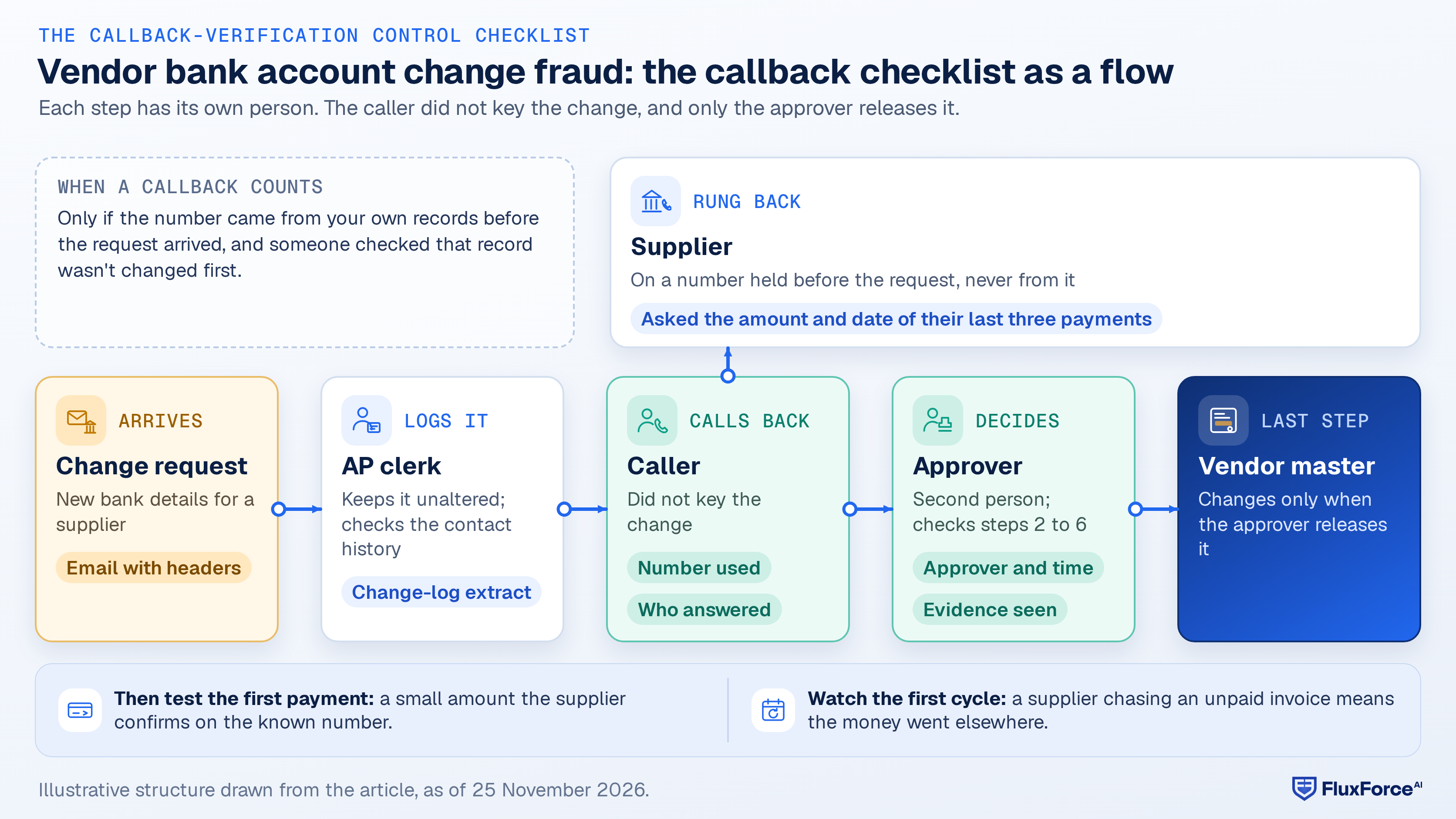
- The change request goes to the AP clerk, who logs it unaltered. The AP clerk passes the contact history to a caller who did not key the change. The caller rings the supplier on a number held before the request. The caller records the answers and sends them to the approver. Only the approver releases the change into the vendor master.
| Step | What to check | Independent source | Who | Evidence to keep | How fraudsters beat it |
|---|---|---|---|---|---|
| 1. Log the request | Channel, sender, what's changing | The request, kept unaltered | Whoever receives it | Original email with headers | Hacked mailbox sends from the genuine address |
| 2. Check contact history | Did the supplier's phone or email on file change recently? | Vendor master change log | AP, before any call | Change-log extract | Change the contact details first |
| 3. Call back | The supplier asked for the change | Number held before the request, never from it | Not the person who keys the change | Number used, who answered, outcome | Put their own number in the email |
| 4. Ask what only the supplier knows | Amount and date of their last three payments | Your payment history | Caller | Answers against history | Months of mailbox monitoring |
| 5. Get the written form | Amendment form signed by their finance director or company secretary | Supplier's signatory | AP | Signed form | Forged letterhead and stamps |
| 6. Run a payee name check | Account name matches the supplier | Confirmation or Verification of Payee | AP | Match result | Account opened in the same name |
| 7. Approve separately | Steps 2 to 6 were done | Segregation of duties | Second person | Approver, time, evidence seen | One clerk keys and approves |
| 8. Test the first payment | Supplier confirms a small test payment | The supplier, on the known number | AP and treasury | Test amount and confirmation | Urgency and a "late payment" story |
| 9. Watch the first cycle | Supplier chasing an unpaid invoice | Supplier queries | AP | Exception log | Chasing often raises the first alarm |
The sources behind each row are linked in the sections below.
The first figure shows the checklist as a flow. The change request goes to the AP clerk, who logs it unaltered. The AP clerk passes the contact history to a caller who did not key the change. The caller rings the supplier on a number held before the request. The caller records the answers and sends them to the approver. Only the approver releases the change into the vendor master.
NHS Counter Fraud Authority guidance from July 2026 tells staff to use "the established contact details already held on file" and to "ensure these details have not been subject to recent change". It also suggests asking the supplier for "the amount and date of their last three transactions" and for an amendment form "signed by their finance director or company secretary". In the AFP survey, a call to the payee "using a phone number from official records, not from email" was the BEC control most often rated very effective, by 63% of the organisations using it. The supplier-knowledge question in step 4 has a weakness too. Commonwealth Bank warns that fraudsters "might monitor invoices for months before acting".
A callback only counts if the number came from your own records before the request arrived, and if someone checked that record wasn't changed first.
Why do callbacks fail?
Most callback failures come down to where the number came from.
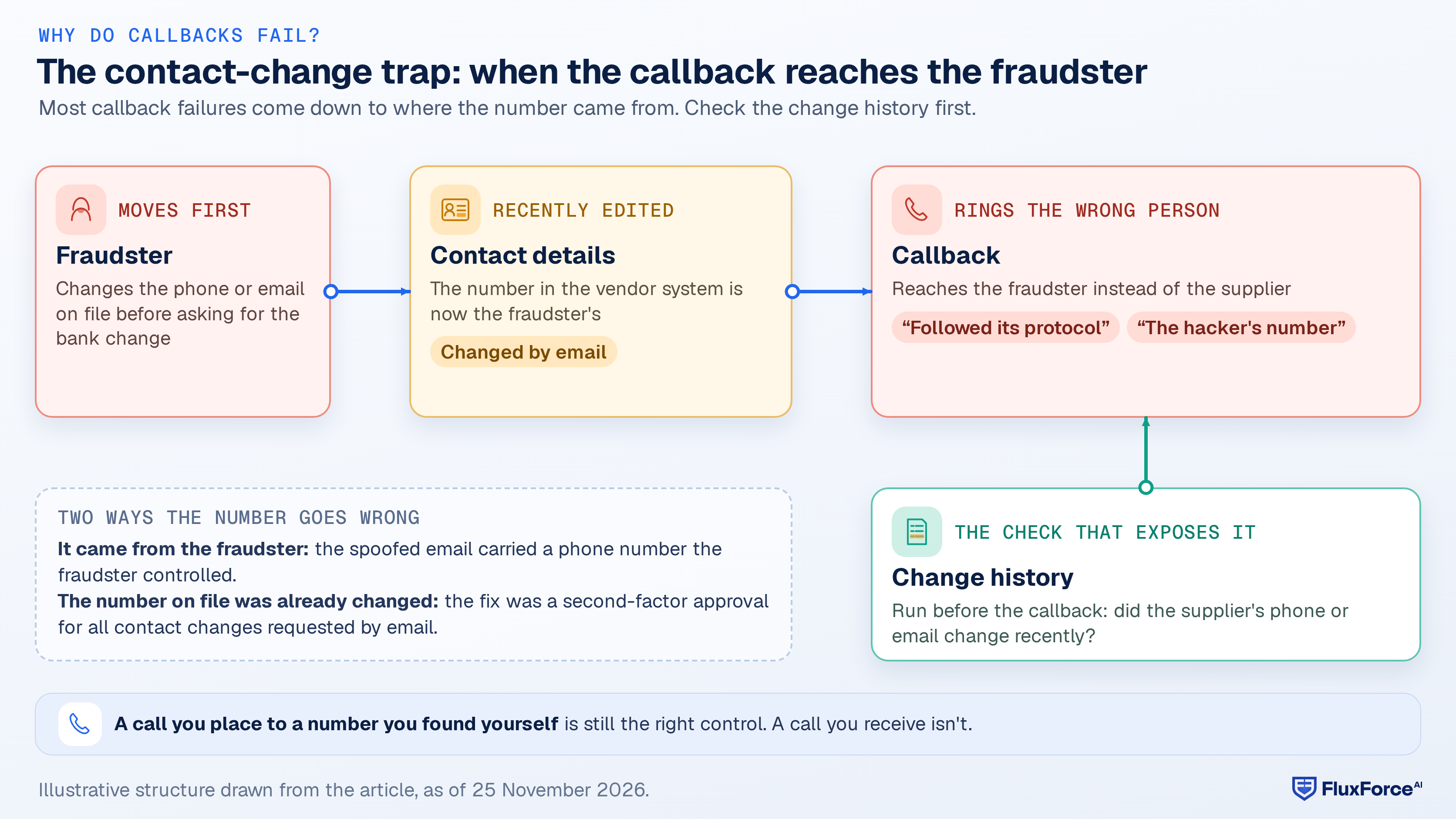
- The fraudster changes the contact details on file first. A callback to those contact details reaches the fraudster. Checking the change history before the callback exposes the switch.
The number came from the fraudster. Bernalillo County, New Mexico, got a spoofed vendor email "containing falsified payment information and a phone number controlled by" the fraudster, and paid $447,372.89 over several months.
The number on file had already been changed. In a Washington case the agency "followed its protocol to call the phone number in the vendor system to confirm, but of course this was the hacker's number." The auditor's fix was "a second-factor approval for all contact changes requested by email".
The second figure shows that trap. The fraudster changes the contact details on file first. A callback to those contact details reaches the fraudster. Checking the change history before the callback exposes the switch.
The voice can be faked. The FBI warned in May 2025 that a call or voice message from a known contact and AI-generated voice cloning "can sound nearly identical", and told people to "independently identify a phone number for the person and call to verify". A call you place to a number you found yourself is still the right control. A call you receive isn't.
Change of bank details scam: the red flags AP sees
A change of bank details scam rarely looks unusual. The UK's National Crime Agency lists the signs AP staff should watch for.
- "Messages stating a regular supplier's bank details have changed".
- "Invoice details that do not match previous genuine invoices, such as amounts, reference numbers or contact names".
- "Minor changes to your suppliers email address".
Singapore Police also say to treat requests to change a vendor's bank details, "which are generally uncommon, as a red flag".
What does your ERP's dual control stop?
SAP's dual control marks bank fields as sensitive, so a second person must confirm a change before the account is paid in a payment run. SAP's own support note says this "only blocks the changed account for automatic payment run but not for manual payments." In SAP S/4HANA Cloud, an unconfirmed IBAN change gets a valid-from date of 31.12.9999 until someone confirms it. Microsoft Dynamics 365 Finance has a workflow in which "The new bank account record isn't available for use until an approver approves it", but data imports can be set to "Allow changes without approval".
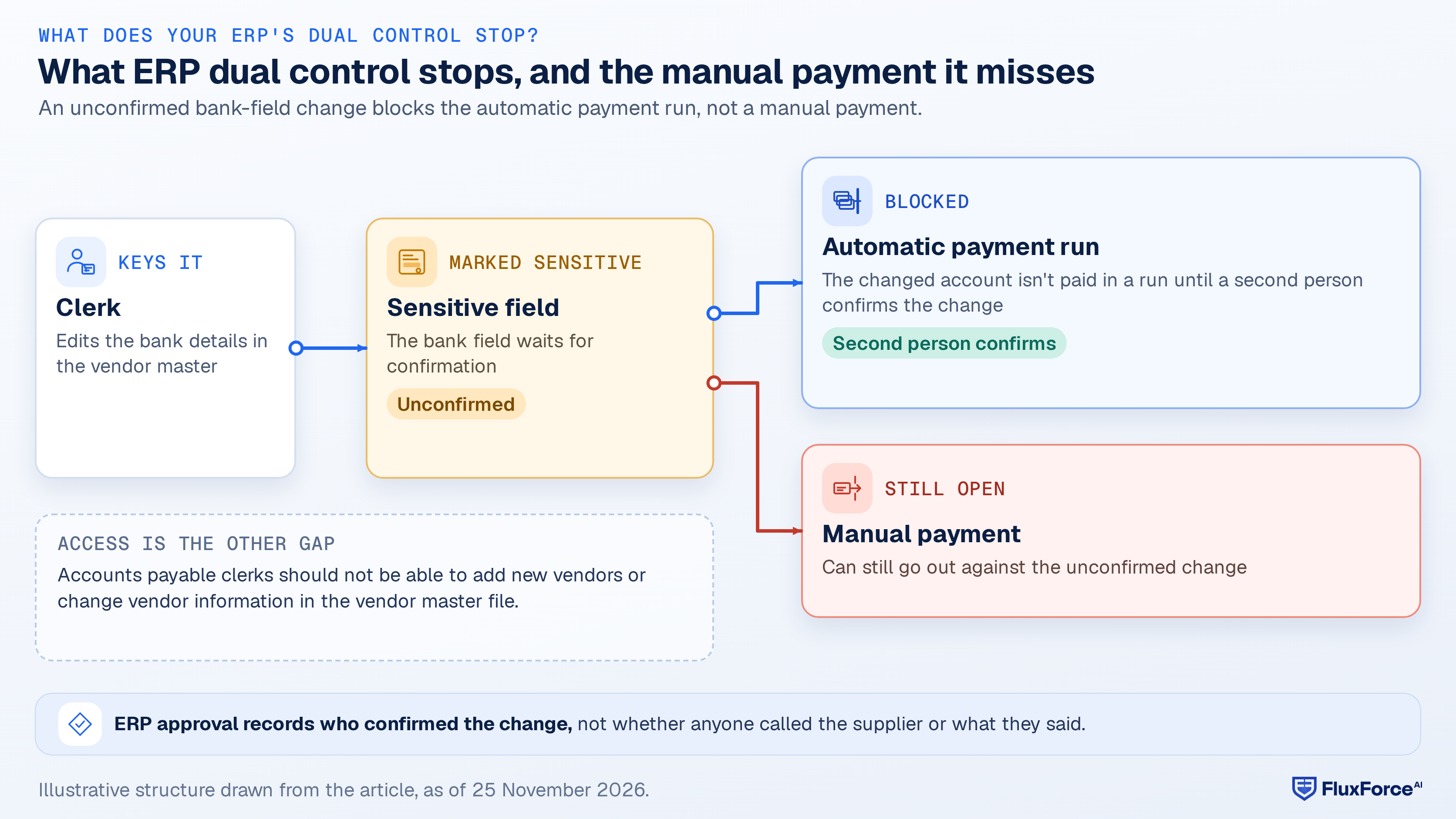
- The clerk changes a sensitive field in the vendor master. The unconfirmed sensitive field change blocks the automatic payment run until a second person confirms it. A manual payment can still go out against the unconfirmed sensitive field change.
The third figure shows the SAP gap. The clerk changes a sensitive field in the vendor master. The unconfirmed sensitive field change blocks the automatic payment run until a second person confirms it. A manual payment can still go out against the unconfirmed sensitive field change.
Access is the other gap. The Washington State Auditor says "accounts payable clerks should not be able to add new vendors or change vendor information in the vendor master file."
ERP approval records who confirmed the change, not whether anyone called the supplier, which number they used or what the supplier said. Check your own configuration against these notes.
Do payee name checks stop it?
Payee name checks catch some diversions, but a name match doesn't prove the request was genuine. Australia's banks call their version "an advisory checkpoint, not a hard block".
| Market | Check | Limit |
|---|---|---|
| UK | Confirmation of Payee on Faster Payments and CHAPS, over 2 million checks a day | Bulk payments and accounts outside the UK are exempt |
| EU | Verification of Payee, mandatory in the euro area since 9 October 2025 | Business payers sending batches can opt out |
| Australia | Confirmation of Payee on name, BSB and account number | Advisory only, domestic accounts only |
| India | RBI-mandated beneficiary name look-up on RTGS and NEFT, offered by 1 April 2025 | If no name shows, the payer can still proceed |
| US | No general name check on wires or ACH credits | Under UCC 4A-207 the beneficiary's bank "may rely on the number" |
A name match proves less than it seems. Evaldas Rimasauskas took over $120 million from two US companies after registering a company that "bore the same name as an Asian-based computer hardware manufacturer". AP payment runs are also batch payments, the very case some schemes exempt. Ask your bank whether a name check runs on your payment files at all.
Who pays when the money goes to the wrong account?
Usually the business that paid. Banks carry out authorised instructions, reimbursement schemes mostly protect consumers and small firms, and, as NHS Scotland's counter fraud team puts it, "the genuine contractor still has to be paid."
The UK Supreme Court held in Philipp v Barclays that a bank's ordinary duty is "to carry out the instruction and make the payment". Northern Ireland's police say the same for businesses: "If a duly authorised transaction is made the loss will remain with the organisation making the payment." The UK's mandatory reimbursement covers "individuals, microenterprises and charities". Australia's Scams Prevention Framework Act 2025 extends its consumer protections to small business operators with fewer than 100 employees and turnover under A$10 million.
Between buyer and supplier, a court may move the loss. In Beau Townsend Ford v. Don Hinds Ford, a hacker in the seller's mailbox redirected $736,225, and the Sixth Circuit sent the case back for a factfinder to decide which party was best placed to prevent the loss. A 2026 Australian case shows the retail version. According to a MinterEllison summary, Pandora Jewellery agreed to buy a franchisee's store assets for A$467,378, paid a fraudster after a compromised email, and the court entered judgment for the franchisee for the full amount.
If you're hit, call your bank at once and ask for a recall. The FBI says "time is of the essence".
Retail accounts payable: one bank change, traced
This scenario is illustrative, not a FluxForce customer case.
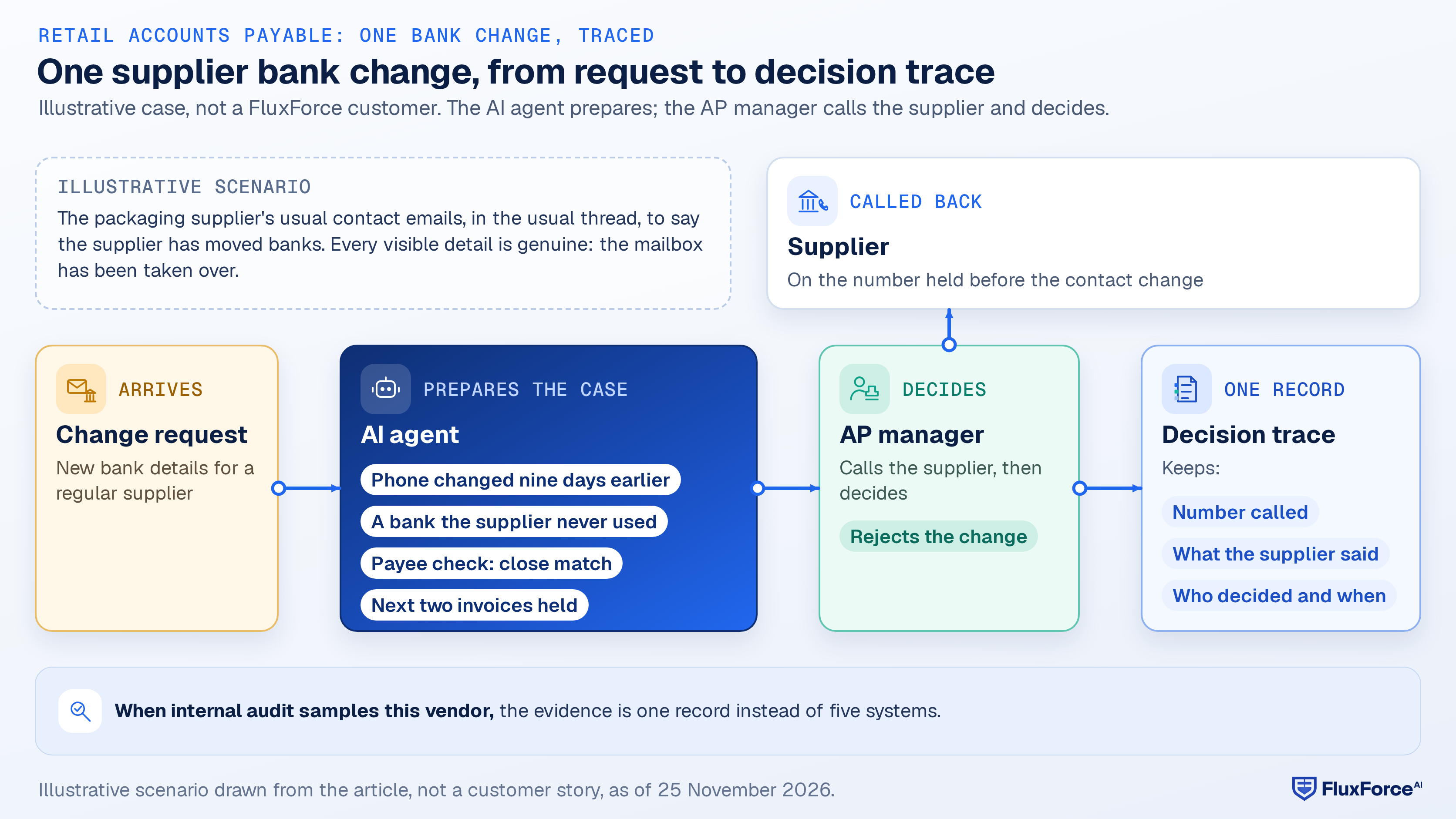
- The change request reaches the AI agent, which prepares the case. The AI agent sends its findings and the callback task to the AP manager. The AP manager calls the supplier on the number held before the contact change. The AP manager's decision and the callback result go into the decision trace.
Illustrative scenario: a packaging supplier "changes banks" in October
A mid-sized retailer gets an email from its packaging supplier's usual contact, in the usual thread, saying the supplier has moved banks. Every visible detail is genuine, because the supplier's mailbox has been taken over.
An AI agent working inside the AP team's mandate prepares the case. It finds the supplier's phone number in the vendor master was changed nine days earlier, by email. It pulls the last three payments, notes the new account is at a bank the supplier has never used, and flags that the payee name check returned a close match. It drafts a callback task and holds the next two invoices for review.
The fourth figure shows this case. The change request reaches the AI agent, which prepares the case. The AI agent sends its findings and the callback task to the AP manager. The AP manager calls the supplier on the number held before the contact change. The AP manager's decision and the callback result go into the decision trace.
The supplier hasn't changed banks. The AP manager rejects the change, reverses the contact change and tells the bank. What's left is a decision trace covering the request, the contact history the agent read, the payee check result, the number called, what the supplier said, who decided and when. When internal audit samples this vendor, the evidence is one record instead of five systems.
How FluxForce approaches vendor bank account changes
FluxForce is the platform your departments run AI agents on. The agents investigate and prepare the work, a person makes the call, and every step leaves evidence an examiner can replay. For AP, an agent prepares each bank-detail change for a person to decide. The closest of our 12 solutions is Fraud Prevention, where "High-risk payments always go to a person." Fraud belongs to our first app line, financial crime, where the promise reads: "AI agents that investigate AML, sanctions, fraud and KYC alerts and prepare the case. Your analyst makes the call, with evidence an examiner can replay. You decide how much each agent does on its own, and every one has a kill switch."
The work follows five public stages, with governance and data protection on every step.
- Take in. The agent receives the request, its headers and the vendor master record.
- Understand. It assembles contact history, payment history, prior bank details and the payee check result.
- Weigh. It checks the request against your checklist and applies the risk band you set.
- Prove. It prepares the callback task and evidence pack. A person makes the call and approves or rejects the change.
- Report and learn. Every step is kept as a decision trace, and the person's decision feeds the next case.
The decision trace records what happened. The agent mandate, our term for what each agent may see and do in each risk band, set by you and recorded, fixes what it was allowed to do. For bank-detail changes, a sensible mandate lets the agent read the vendor master, mailbox metadata and payment history, draft the callback task and hold a payment for review. It doesn't let the agent change bank details or release a payment. The kill switch stops it at once, and Fraud Prevention starts in shadow mode, "scoring beside your current rules".
The honest limit is that an agent can't make the call or tell a cloned voice from a real one. We won't quote detection rates; we'd rather show you on your own data.
The human-in-the-loop review control covers how the decision is recorded, and AI-enhanced core audit trails for retail banking covers the banking side. See also invoice fraud detection with AI agents, decision traces for AI agents and business email compromise.
- Call back on a number held before the request.
- Check the contact details did not change first.
- Split keying a bank change from approving it.
- Payee name checks help but prove little.
- The paying business usually bears the loss.
Conclusion
I'd put one question to your AP lead this week. For the last five bank-detail changes, show me the number you called and where it came from. If the answer is a shrug or an email thread, you've found your gap, and it isn't a technology gap.
Make the callback a recorded step with a named owner, check contact history first, separate keying from approval, and test the first payment. None of that needs new software, only evidence that exists when someone asks.
Request a checklist walkthrough
Frequently Asked Questions
About the author

Sahil Kataria
Founder and CEO of FluxForce
Share this article