


















Listen To Our Podcast🎧
What do AI agents in accounts payable change?
The agent reads the invoice and prepares the match. Your AP lead approves the payment. With AI agents in accounts payable, an agent reads each invoice however it arrives, checks the supplier, matches the invoice to the purchase order and goods receipt, proposes the coding and investigates any exception. A named person approves anything outside tolerance, every new supplier, every bank detail change and every payment run. Each step leaves a record your auditor can follow.
The work is worth taking on. Ardent Partners surveyed 204 AP professionals for its 2025 State of ePayables report, distributed by Bottomline, and found one invoice cost $9.84 to process on average. Average processing time was 8.2 days, and 18.4% of invoices hit an exception.
This guide is for heads of finance operations who run AP. Last updated 26 November 2026.
- What accounts payable automation already does, and where it stops.
- An AP workflow map that shows where the agent prepares and where a person approves.
- One manufacturing invoice with a short delivery and a price variance, from arrival to payment.
- Which e-invoicing and payment-term rules put a clock on AP in your markets.
- How to start in shadow mode without touching a single payment.
Request the AP workflow map
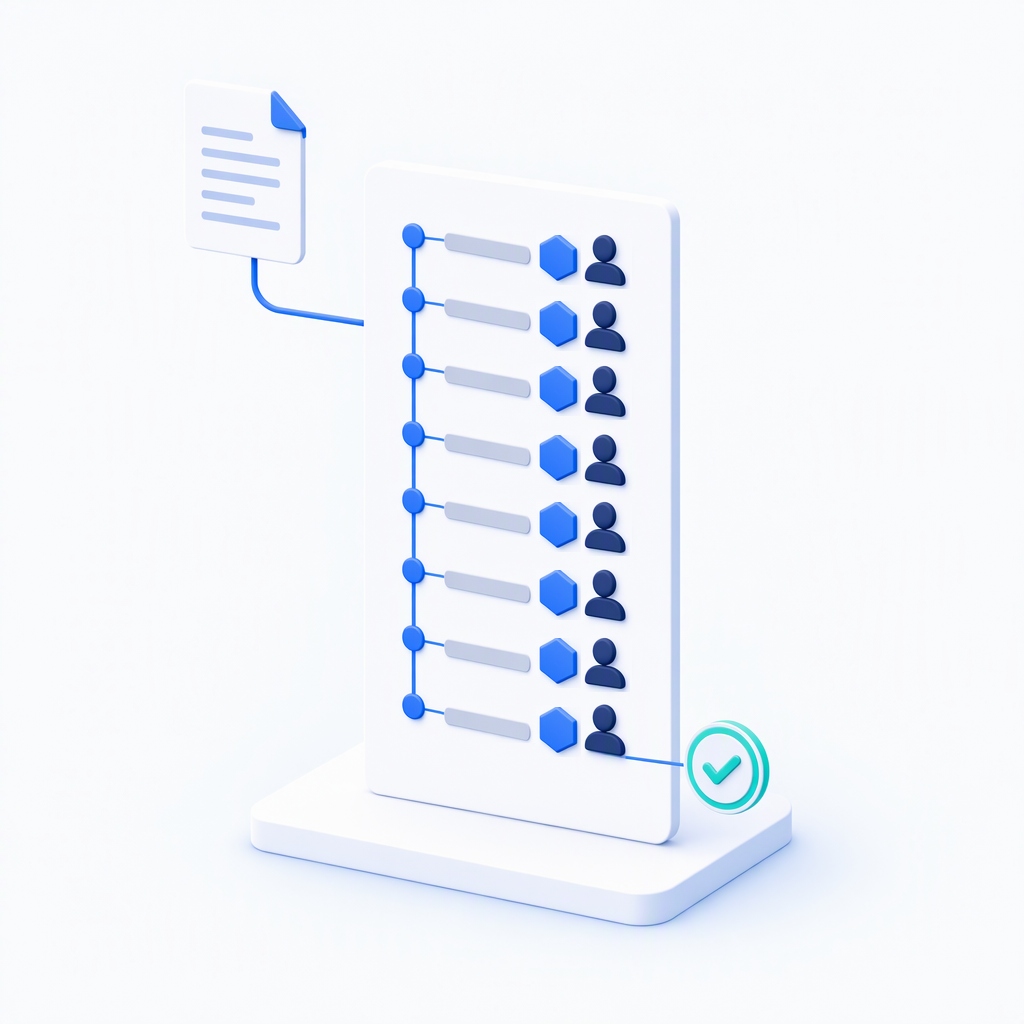
AI agents in accounts payable read each invoice, check the supplier, run the match, propose coding and investigate exceptions; a named person approves exceptions, new suppliers, bank changes and every payment run.
Accounts payable automation: what rules and OCR already do
Accounts payable automation is software that captures invoices, matches them to orders and receipts, and routes them for approval with less keying.
Matching runs on tolerances you set. In Microsoft's Dynamics 365 Finance, matching discrepancies are compared with the tolerances that are specified. Its worked example uses a 5% price tolerance, where "A price of 1.05 would be acceptable, but 1.10 is not." Oracle Payables puts a hold on an invoice outside tolerance, and you can't pay the invoice until the hold is released.
Rules handle clean invoices well. In the Ardent report, the Best-in-Class group, the 20% of enterprises with the lowest processing costs and shortest cycle times, processed an invoice for $2.65 against $12.42 for everyone else.
Ardent calls exceptions "the biggest single reason" AP costs and cycle times aren't lower, and ties them to the 21.9% of staff time spent dealing with suppliers. Slow approvals were the top challenge for 49% of AP executives in the 2025 report, with exceptions close behind at 48%.
An exception is a short delivery, a price that moved, a missing PO number or a supplier who says its bank account changed. SAP's guidance tells the AP clerk to find the reason by contacting purchasing, goods receipt or the vendor. That investigation is the part fixed rules can't do, and it's the part AI agents can prepare.
IOFM's benchmarking slides from May 2026 warn that exception rates can rise after automation. Strict tolerances replace a person's judgement on close-enough invoices, and the invoices left for people are the most complex ones.
AI agents for accounts payable: the AP workflow map
The map follows one invoice through eight steps. It's our design, built from the sources cited in this guide, and no regulator prescribes it.
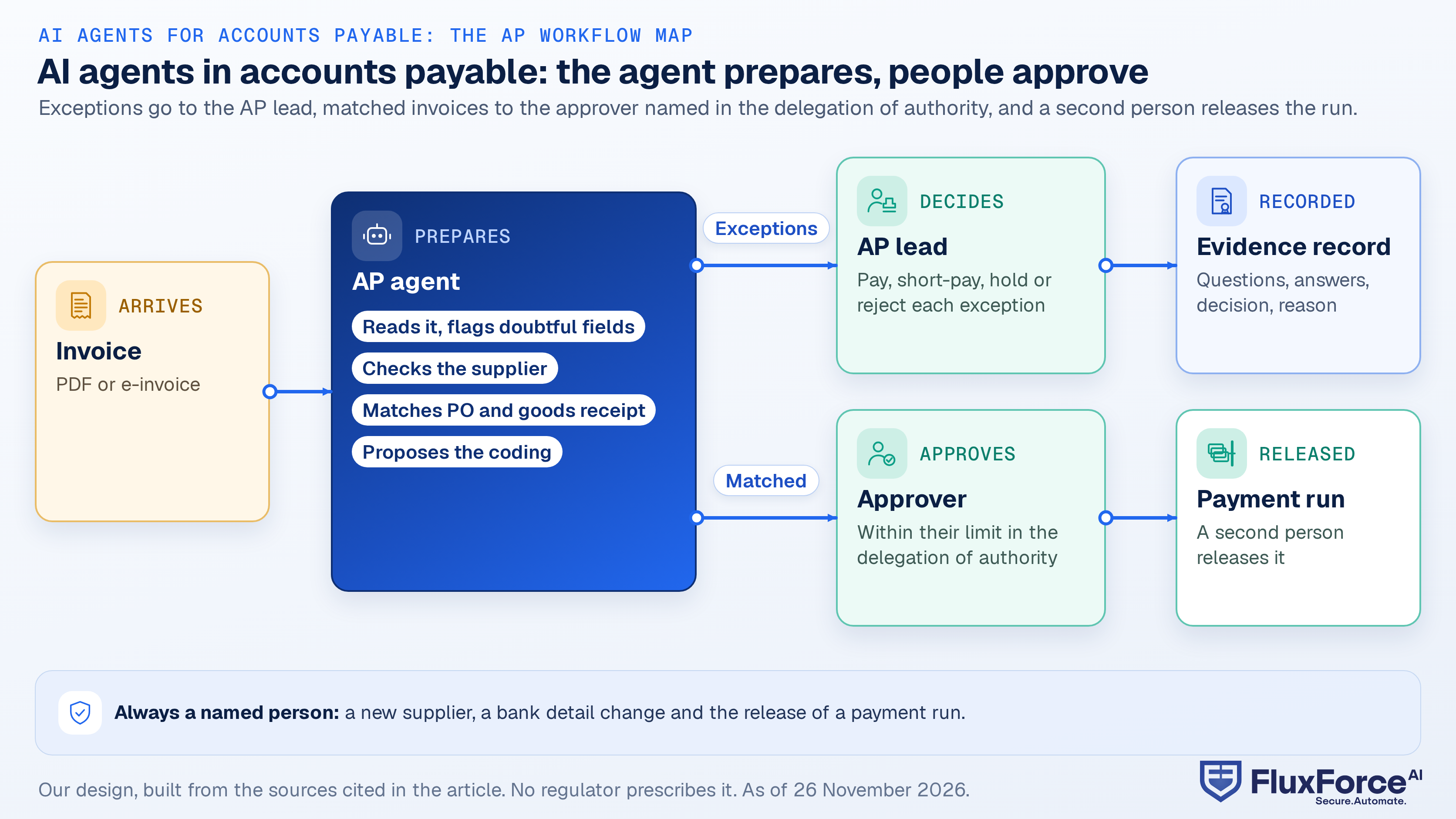
- The invoice reaches the AP agent, which reads it and prepares the match. The AP agent sends each exception to the AP lead with its findings. The AP agent routes each matched invoice to the approver named in the delegation of authority. Invoices the approver signs off join the payment run, which a second person releases. The AP lead's decision on each exception goes into the evidence record.
| Step | What the agent prepares | Who approves | What goes on the record |
|---|---|---|---|
| 1. Invoice arrives | Reads the PDF or e-invoice and flags fields it's unsure of | AP clerk confirms flagged fields | Source file, extracted fields, flags |
| 2. Supplier check | Matches the supplier to the vendor master and compares bank details with those on file | Vendor master owner approves a new supplier; a second person approves a bank change after a callback | Match result, callback result, approver |
| 3. Match | Matches against the PO and goods receipt, within your tolerances | Nobody inside tolerance; the buyer or receiving confirms a variance | Result and the tolerance in force |
| 4. Coding | Proposes the GL account, cost centre and tax code | AP clerk accepts or changes it | Proposal, any change and its reason |
| 5. Exception | Asks receiving, the buyer or the supplier and gathers replies | AP lead decides to pay, short-pay, hold or reject | Questions, answers, decision and reason |
| 6. Approval | Routes the invoice with a one-page case summary | Budget holder, within their limit | Approver, limit in force, time |
| 7. Payment run | Prepares the run and flags changed accounts, duplicates and discount dates | Treasury or the AP lead releases the run | Run contents, flags, who released it |
| 8. Posting and close | Proposes clearing entries for leftover differences | Accountant approves the journal | Entry, reason, approver |
Approval limits come from your delegation of authority, and the Washington State Auditor's AP guide says "There should be a list of approvers and a corresponding approval dollar limit for those who process payments."
Three rows never go to the agent alone (a new supplier, a bank detail change and the release of a payment run). Singapore's framework for agentic AI says an agent should need "human approval at significant steps, such as before writing to a database or making a payment."
The agent prepares all eight steps. A new supplier, a bank detail change and the release of a payment run always wait for a named person.
Segregation of duties carries over to agents. ISACA's principle is that no employee or group should be able both to perpetrate and to conceal errors or fraud. An agent that prepares the payment run can't also release it, and its service account shouldn't be able to edit the vendor master.
The first figure shows the map as a flow. The invoice reaches the AP agent, which reads it and prepares the match. The AP agent sends each exception to the AP lead with its findings. The AP agent routes each matched invoice to the approver named in the delegation of authority. Invoices the approver signs off join the payment run, which a second person releases. The AP lead's decision on each exception goes into the evidence record.
AI agents in accounts payable: one manufacturing invoice, start to finish
The case below is made up to show the method and isn't a customer story.
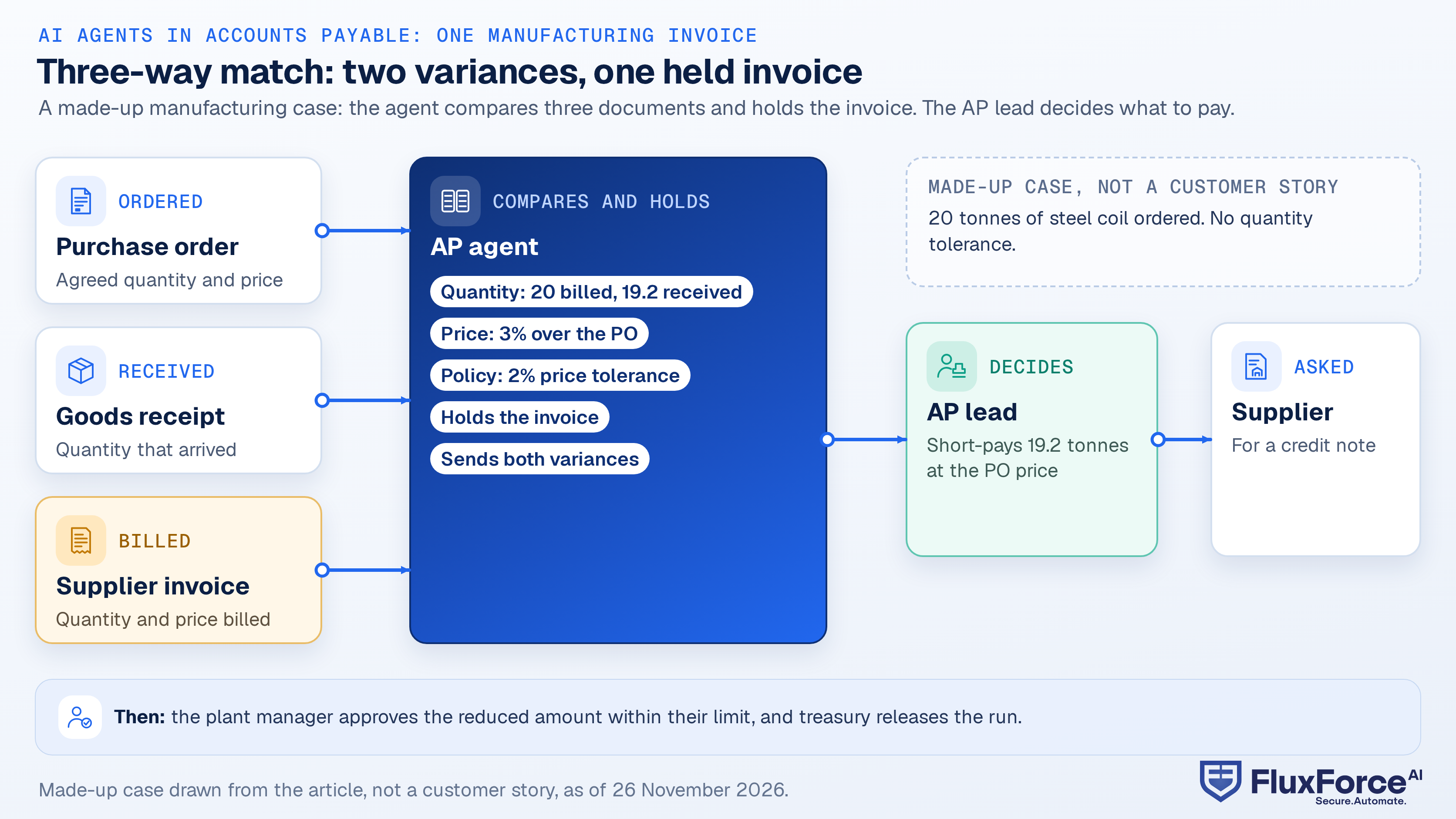
- The purchase order gives the AP agent the agreed quantity and price. The goods receipt gives the AP agent the quantity that arrived. The supplier invoice gives the AP agent the quantity and price billed. The AP agent holds the invoice and sends both variances to the AP lead. The AP lead decides to short-pay and asks the supplier for a credit note.
A mid-sized manufacturer orders 20 tonnes of steel coil on a purchase order. Receiving books 19.2 tonnes on the goods receipt. The supplier's PDF invoice bills 20 tonnes at a unit price 3% above the PO price. The company's policy allows a 2% price tolerance on direct materials and no quantity tolerance.
- The agent reads the PDF. Reading the page image works better than parsing text, and a 2025 benchmark of eight multimodal models found 92.71% accuracy on scanned invoices against 64.03% for parsed text. Even on clean invoices the best models scored just over 96%, so a few fields in every hundred can still be wrong. The agent flags its low-confidence fields instead of guessing.
- The agent checks the supplier. Name, tax number and bank details match the vendor master.
- The agent runs the three-way match and finds two variances, a quantity of 20 billed against 19.2 received and a price 3% over the PO. Paying without receipt matching means paying for goods that arrived short or not at all, which is the failure Microsoft's three-way matching guidance describes. The agent holds the invoice for review.
- The agent investigates. Receiving confirms no second delivery is due, and the PO shows no agreed price change. It also checks payment terms and volume discounts against the contract, because the three-way match only verifies price and unit numbers. It drafts a query asking the supplier for a credit note.
- The AP lead reads the case file and decides to short-pay for 19.2 tonnes at the PO price and send the query.
- The plant manager approves the reduced amount within their limit.
- The terms are 2/10 net 30, so the agent flags the discount date on the proposed run. Canada's development bank works out that a 2% discount for paying 20 days early equals about a 37% annual return. Treasury releases the run.
- When the credit note arrives, the agent proposes clearing the 0.8-tonne difference on the goods received, invoice received (GR/IR) account. SAP notes that a quantity variance leaves a GR/IR balance that must be cleared manually if no further receipt or invoice arrives. The accountant approves the entry.
The second figure shows the match. The purchase order gives the AP agent the agreed quantity and price. The goods receipt gives the AP agent the quantity that arrived. The supplier invoice gives the AP agent the quantity and price billed. The AP agent holds the invoice and sends both variances to the AP lead. The AP lead decides to short-pay and asks the supplier for a credit note.
Where an AI agent in accounts payable must stop
Vendors draw the line in their own documentation, and we describe it here without ranking anyone.
Microsoft says its Business Central Payables Agent prepares purchase document drafts and "doesn't post either document type." According to Microsoft's FAQ, a vendor the agent creates "is blocked until a relevant user reviews and unblocks it", and the agent stops and asks for help when it meets an unidentified vendor or an unclear line. Microsoft is also clear that the agent's review step isn't an approval, because the "Payables Agent doesn't provide vendor approval or purchase invoice approval workflows." Whatever you buy, keep your ERP approval workflow, and don't count an agent's review screen as one.
The bank detail change is the step where fraud enters AP. In the 2026 AFP Payments Fraud and Control Survey of 465 corporate practitioners, business email compromise affected 74% of organisations in 2025. Calling an authorised contact at the payee on a phone number from official records was the BEC control most often rated very effective, by 63%. Only 17% of organisations used AI to fight payments fraud.
An agent can spot that the account on an invoice differs from the vendor master and hold it, and a person makes the callback and approves the change. Our guides on vendor bank account change fraud and invoice fraud detection go deeper, and duplicate invoice detection covers the repeat payments a payment run should catch.
Extraction errors are the other reason a person stays in the loop. NIST's generative AI profile defines confabulation as the production of confidently stated but erroneous or false content, and a wrong bank digit read with confidence is exactly that.
Sidecar integration: agents beside the ERP you already run
You don't need a new ERP to put AI agents in AP, and our term for that is sidecar integration. The agents connect beside the ERP, the AP inbox and the payment platform you already run, and nothing is migrated.
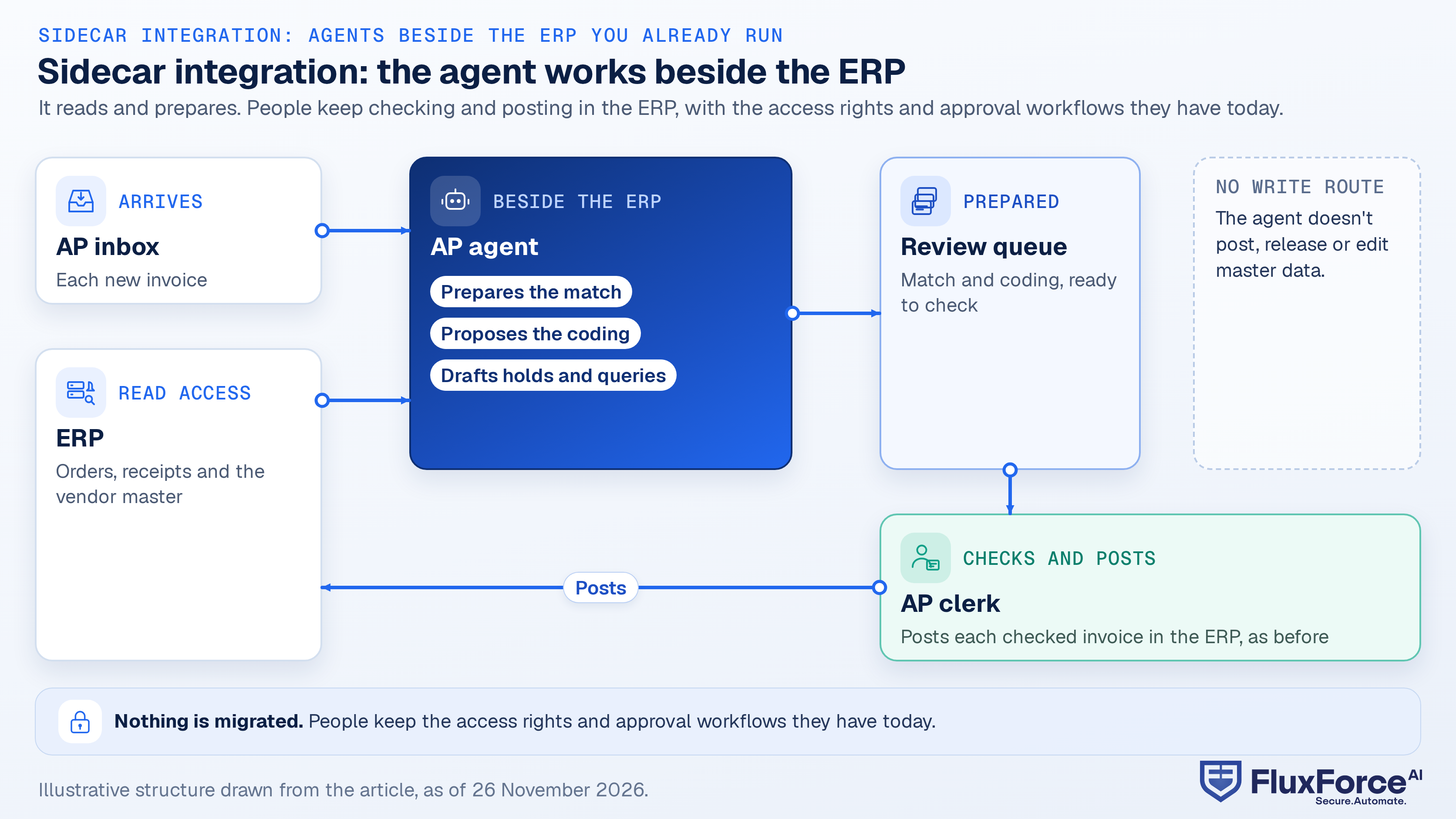
- The ERP gives the AP agent read access to orders, receipts and the vendor master. The AP inbox passes each new invoice to the AP agent. The AP agent writes its prepared match and coding to the review queue. The AP clerk works the review queue and checks each prepared invoice. The AP clerk posts each checked invoice in the ERP, as before.
The agent reads orders, receipts, the vendor master and incoming invoices, and writes drafts, holds, queries and case notes. It doesn't post, release or edit master data, and people keep doing those in the ERP, under the access rights and approval workflows they have today.
The third figure shows the arrangement. The ERP gives the AP agent read access to orders, receipts and the vendor master. The AP inbox passes each new invoice to the AP agent. The AP agent writes its prepared match and coding to the review queue. The AP clerk works the review queue and checks each prepared invoice. The AP clerk posts each checked invoice in the ERP, as before.
In a 2026 Gartner survey of 160 senior finance leaders, accounts payable and receivable automation, data extraction and report creation generally delivered returns within nine to 10 months.
The rules that put a clock on AP
E-invoicing and payment-term rules decide how invoices reach AP and how long approval may take. The table summarises the cited rules for FluxForce's markets.
| Market | Rule | What it means for AP |
|---|---|---|
| India | From 1 April 2025, taxpayers with turnover of Rs 10 crore or more can't report an e-invoice more than 30 days after its date (GSTN advisory) | Large suppliers' late e-invoices get refused at the portal |
| India | Payment to micro and small suppliers due within 45 days of acceptance under the MSMED Act, as summarised by Taxmann | Approval delays on MSME invoices carry a deadline |
| UAE | Businesses with revenue of AED 50 million or more implement e-invoicing by 1 January 2027 (Ministerial Decision 244) | Buyers must also process e-invoices through the system (Decision 243) |
| Kenya | Since 1 January 2024, costs without an eTIMS invoice aren't deductible (KRA notice) | From 2026 KRA checks expenses in returns against eTIMS data (EY) |
| Philippines | Covered taxpayers, except micro taxpayers, issue e-invoices by 31 December 2026 (RMC 98-2026) | More supplier invoices arrive as structured data (Daily Tribune) |
| UK | VAT-registered businesses must be able to issue and receive e-invoices from 1 April 2029, on Peppol (HMRC roadmap) | A bill, not yet law, would cap payment terms at 60 days (Commercial Payments Bill) |
| EU | E-invoicing for cross-border B2B transactions from 1 July 2030 (ViDA) | Cross-border invoices become structured data |
In the UAE the buyer is in scope, because "The Recipient shall process Electronic Invoices" through the system. The system runs on the OpenPeppol standard.
E-invoicing makes reading easier, but a structured invoice still has to match the order and receipt, and someone still approves a price variance.
Keep the record for as long as the longest rule your invoice falls under. HMRC says to keep VAT records for at least 6 years. The IRS asks for 3 years in most cases and 7 years for a bad debt deduction.
Boards are looking at the same controls. Provision 29 of the UK Corporate Governance Code, on material internal controls, has applied since 1 January 2026.
What the evidence record holds for each invoice
The general term for this record is a decision trace, and some teams call the full set a decision ledger. For each step it holds the inputs as they stood that day, the check and result, the limit in force, the agent's proposal and reasons, and who decided, when and why.
The record has to be tamper-evident, so any later change shows. ICAEW notes that, whatever an agent's degree of autonomy, the deploying organisation remains legally responsible for compliance.
Our pillar on decision traces for AI agents lists the fields in full. The human-in-the-loop review control covers how the person's decision is recorded, and AI-enhanced core audit trails for retail banking shows the same idea in a bank's core systems.
How FluxForce approaches accounts payable
FluxForce is the platform your departments run AI agents on. The agents investigate and prepare the work, a person makes the call, and every step leaves evidence an examiner can replay.
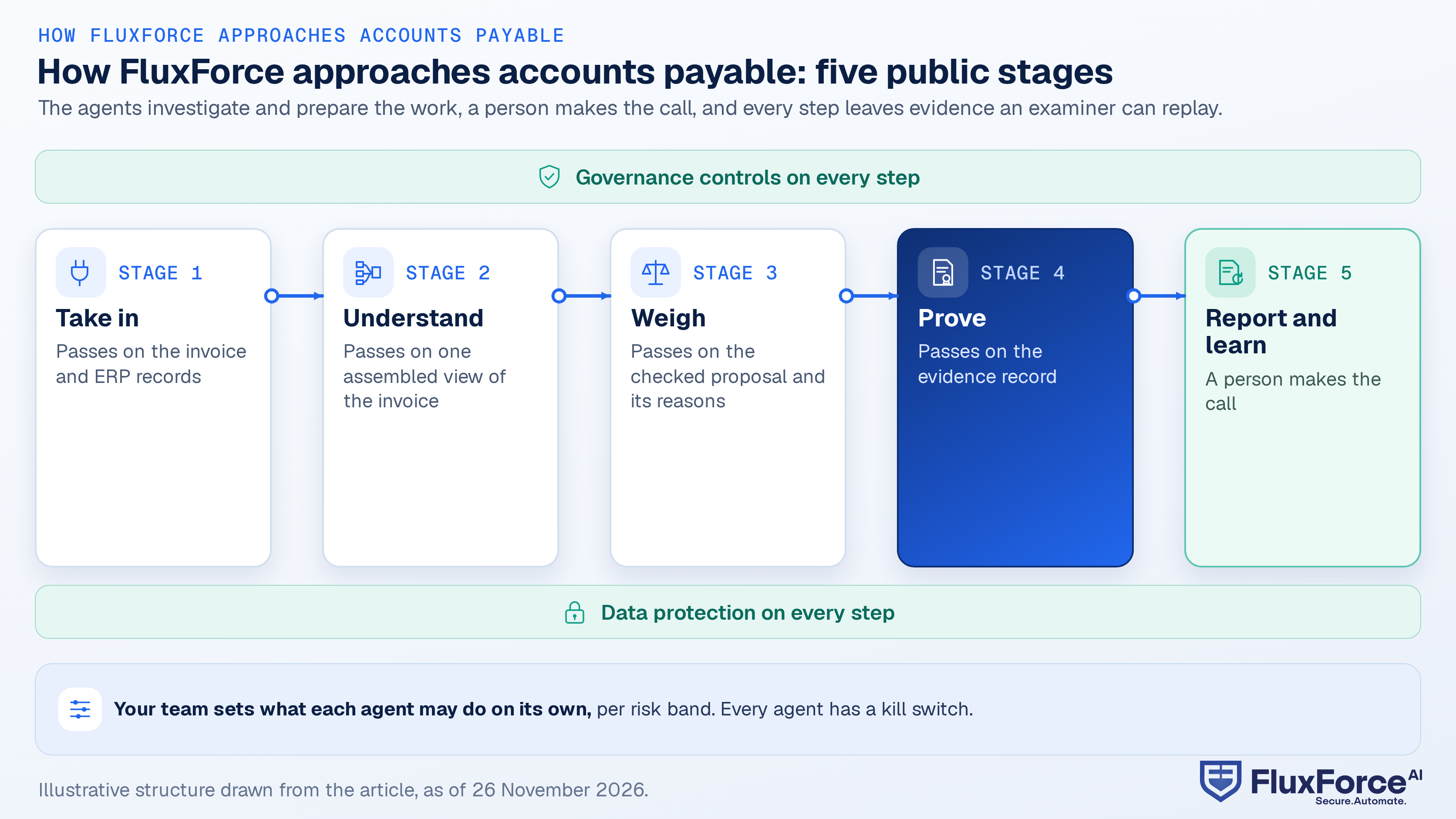
- Take in passes the invoice and ERP records to understand. Understand passes one assembled view of the invoice to weigh. Weigh passes the checked proposal and its reasons to prove. Prove passes the evidence record to report and learn.
The platform works in five public stages, take in, understand, weigh, prove, and report and learn, with governance controls and data protection on every step. The fourth figure shows the stages in order. Take in passes the invoice and ERP records to understand. Understand passes one assembled view of the invoice to weigh. Weigh passes the checked proposal and its reasons to prove. Prove passes the evidence record to report and learn. What each agent may do on its own is set per risk band by your team, and every agent has a kill switch.
The closest of our solutions is Fraud Prevention, written for banks, fintechs and insurers, and its pattern meets AP at the payment run and the bank change. On the Fraud Prevention page, "High-risk payments always go to a person", and "You set the score bands for pass, review and hold." It "Starts in shadow mode, scoring beside your current rules."
On fit, our first app line is financial crime and compliance. AI agents that investigate AML, sanctions, fraud and KYC alerts and prepare the case. Your analyst makes the call, with evidence an examiner can replay. You decide how much each agent does on its own, and every one has a kill switch. Finance and AP teams run on the same platform, and we can't point you to customer results in AP yet. An agent can't verify a callback nobody made or fix a vendor master full of duplicates, and tolerances stay your policy.
Where to start: one month of invoices in shadow mode
Pick one spend category, such as direct materials at one plant. Run the agent in shadow mode for a month, preparing matches, coding and exception notes beside your team without touching the ERP, then compare its work with what your team did.
Measure the exception rate and the straight-through rate with IOFM's definitions, plus approval cycle time. Widen what the agent prepares only where the comparison supports it, and keep the three human approvals however good the numbers look.
- The agent prepares; a named person approves.
- Exceptions drive AP cost, and rules stop there.
- New suppliers, bank changes and payment runs stay human.
- Sidecar integration leaves the ERP in place.
- Start with one month in shadow mode.
Conclusion
We think AP is one of the best first departments for AI agents, because the work is document-heavy and the approvals are written down. The teams that do well won't be the ones that automate the most. They'll be the ones that can show, for any invoice, who approved it and why. For the wider picture, see AI agents vs automation and the controls in AI agent governance.
Request the AP workflow map
Frequently Asked Questions
About the author

Sahil Kataria
Founder and CEO of FluxForce
Share this article