


















Listen To Our Podcast🎧
Introduction
By 2025, approximately 87% of global financial institutions had implemented AI-powered fraud detection systems, up from 72% in early 2024. The global AI in fraud management market was valued at $12.42 billion in 2024 and is projected to reach $65.35 billion by 2034, growing at a CAGR of 18.06%.
The question risk leaders ask now is not whether to use AI fraud detection. It is how fraud detection AI actually works, where it fits into existing controls, and how much visibility and control it gives the risk team when a decision is challenged.
This guide answers all three. It covers what a fraud detection AI agent is, how it detects fraud in real time, how it compares to rule-based systems, and what risk leaders need to know to govern it effectively.
The Rise of the Fraud Detection AI Agent
This shift has led to the rise of the fraud detection AI agent.
An AI agent is not just another tool added to a fraud detection system. It is an autonomous decision layer that can:
- Monitor transactions continuously
- Detect anomalies as they happen
- Support real time fraud detection
- Trigger actions automatically through AI automation
In banking fraud detection, this means stopping suspicious payments before money leaves the system. In fintech, it means preventing account abuse without harming customer experience.
So the real question for risk leaders is not whether AI fraud detection works. The question is how it works, where it fits, and how much control and visibility it gives you.
In this guide, we will break down how AI agents detect fraud, how they differ from rule-based systems, and how risk leaders can use fraud prevention AI to strengthen governance without adding complexity.

What Is AI Fraud Detection and How Do AI Agents Detect Fraud ?
What is AI fraud detection is one of the most searched questions in risk and compliance technology. The direct answer: AI fraud detection uses machine learning models and automated decision systems to identify, assess, and stop fraudulent activity across financial transactions, user accounts, and digital interactions continuously, at machine speed, across millions of data points simultaneously.
Unlike traditional fraud detection software that relies on fixed rules written by humans, fraud detection using machine learning learns from data. It evaluates transaction behavior, device signals, location patterns, and historical fraud cases to identify risks that rules miss entirely.
Machine learning algorithms analyze both past and current data streams to identify patterns of fraud, improving detection speed, accuracy, and reducing false positives.
What Is a Fraud Detection AI Agent Specifically?
An AI agent is not a chatbot or a reporting dashboard. In fraud detection, an AI agent is an autonomous decision layer that monitors behavior, evaluates risk signals, and triggers responses without waiting for a human to review a queue of alerts.
Fraud detection agents represent nearly 25% of all AI agent deployments in financial services in 2025, with AI agents analyzing millions of transactions per second enabling automated fraud detection and real-time compliance monitoring.
Where traditional fraud detection software produces an alert for a human to review, a fraud detection AI agent completes a three-step loop automatically:
Step 1 — Signal collection: The agent pulls data from transaction systems, device fingerprints, behavioral baselines, identity signals, and historical fraud records simultaneously. This is the foundation of anomaly detection in finance.
Step 2 — Machine learning risk scoring: Using fraud detection machine learning, the agent compares current activity against learned behavioral patterns, known fraud typologies, and peer group baselines. The model scores each event within milliseconds.
Step 3 — Automated decision and action: Based on the risk score and configured thresholds, the agent allows, challenges with step-up verification, or blocks the activity through AI automation .
For banks running AML transaction monitoring alongside fraud detection, the same AI agent architecture handles both functions from a unified signal stream rather than parallel siloed systems.
Why Machine Learning Matters in Fraud Detection ?
AI-based fraud detection has reduced financial losses by 40% for major platforms, according to fintech AI adoption data. The mechanism behind this improvement is machine learning's ability to retrain on new fraud patterns as they emerge, rather than waiting for a human analyst to write a new rule.
Rule-based systems have a fixed knowledge horizon, as they only know about fraud patterns their creators anticipated. Fraud detection machine learning has no such limit. When fraudsters change tactics, models detect the behavioral shift in live data and adjust scoring logic automatically.
For risk leaders, this creates three measurable operational outcomes: false positive rates decrease as models distinguish noise from genuine signals more accurately, new fraud typologies are caught before rules could be written to address them and explainable AI for fraud detection produces the decision reasoning that regulators require for every blocked transaction.
Fraud Detection AI vs Rule-Based Systems
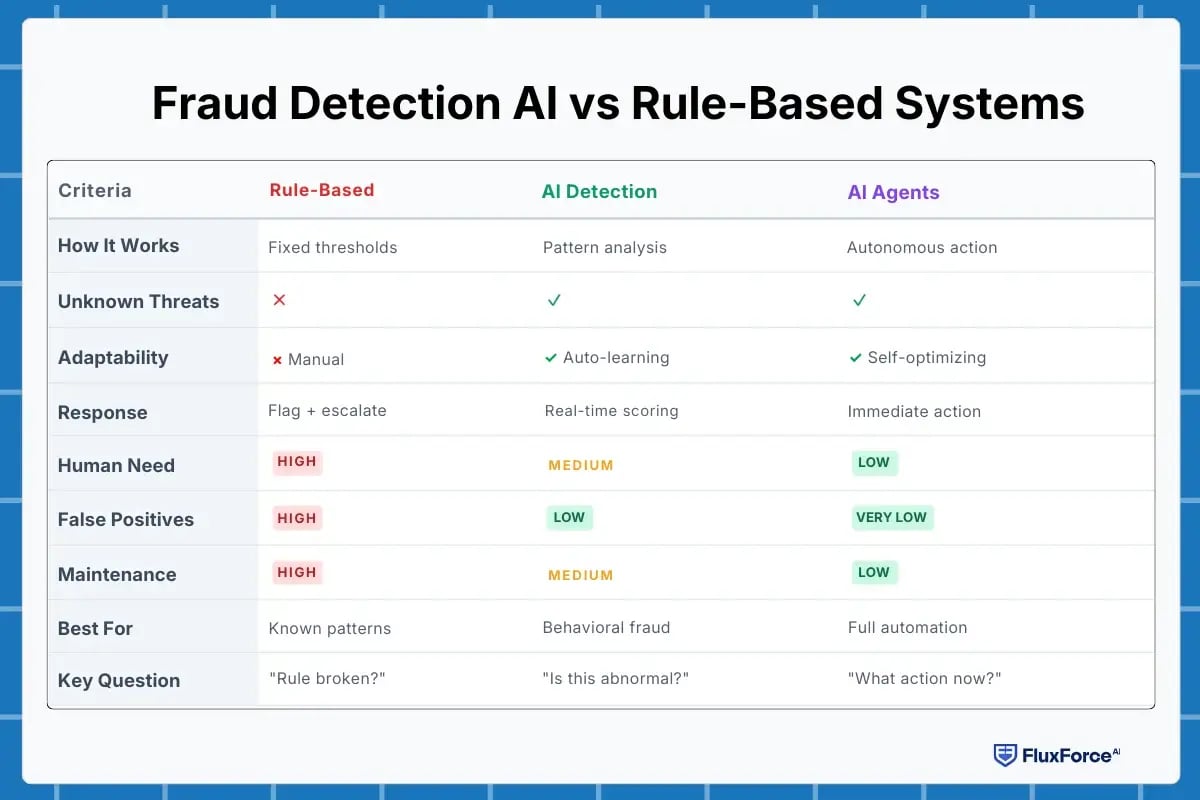
At first glance, both rule-based systems and fraud detection AI exist for the same reason: to stop fraud. This often leads to a fair question from risk leaders:
If the goal is the same, why do we even differentiate between them?
The answer lies in how risk decisions are made, not in what outcome is desired.
How Rule-Based Fraud Detection Actually Works ?
Rule-based fraud detection systems operate on predefined logic. Each rule represents a known risk assumption such as transaction limits, country blocks, or historical fraud patterns.
For example:
- Block transactions above a certain amount
- Flag logins from new locations
- Stop payments after multiple failed attempts
These rules are effective for known and repeatable fraud. They provide clear thresholds, predictable behavior, and easy auditability. This is why fraud detection software based on rules still plays a role in banking fraud detection and compliance-driven controls.
However, rule-based systems depend on past knowledge. They cannot identify risks that were not anticipated when the rules were written.
From a risk perspective, rules answer one question well: Did this transaction break a predefined condition?
They do not answer a more important one: Does this behavior make sense in context?
How Fraud Detection AI Operates at a Different Layer ?
AI in fraud detection does not start with assumptions. It starts with patterns.
Using fraud detection machine learning, AI systems analyze how users normally behave across transactions, devices, sessions, and time. They build a baseline of expected behavior and continuously compare new activity against it. Instead of relying on fixed limits, AI fraud detection evaluates:
- Behavioral consistency
- Sequence of actions
- Velocity and timing patterns
- Identity and device relationships
This enables financial fraud detection even when no explicit rule has been broken.
From a risk standpoint, AI answers a different question: Is this behavior statistically and contextually abnormal right now?
This is why real time fraud detection is possible with AI but limited with rules.
Why AI Agents Change the Control Model Entirely ?
The real separation between rules and AI agents is not detection method. It is execution model.
A fraud detection AI agent does not stop at identifying risk. It responds to it through AI automation: the agent monitors activity continuously, evaluates risk signals, and triggers controls — block, challenge, or approve — without waiting for a human reviewer.
The agentic AI in fraud detection and prevention market is expected to grow from $4.8 billion in 2024 to $206.9 billion by 2034, at a CAGR of 45.70%. This growth reflects what risk leaders are discovering operationally: autonomous agents close the speed gap that lets fraud execute before manual review can respond.
For synthetic identity fraud detection specifically, AI agents are essential — synthetic identities are designed to evade rules, and only behavioral AI that evaluates absence of normal signals catches them during the build phase rather than after losses occur.
How AI Agents Detect Fraud in Real Time ?
When people hear real time fraud detection, they often imagine faster alerts. In reality, speed is only the outcome. The real change is how risk is evaluated while an action is still in progress.
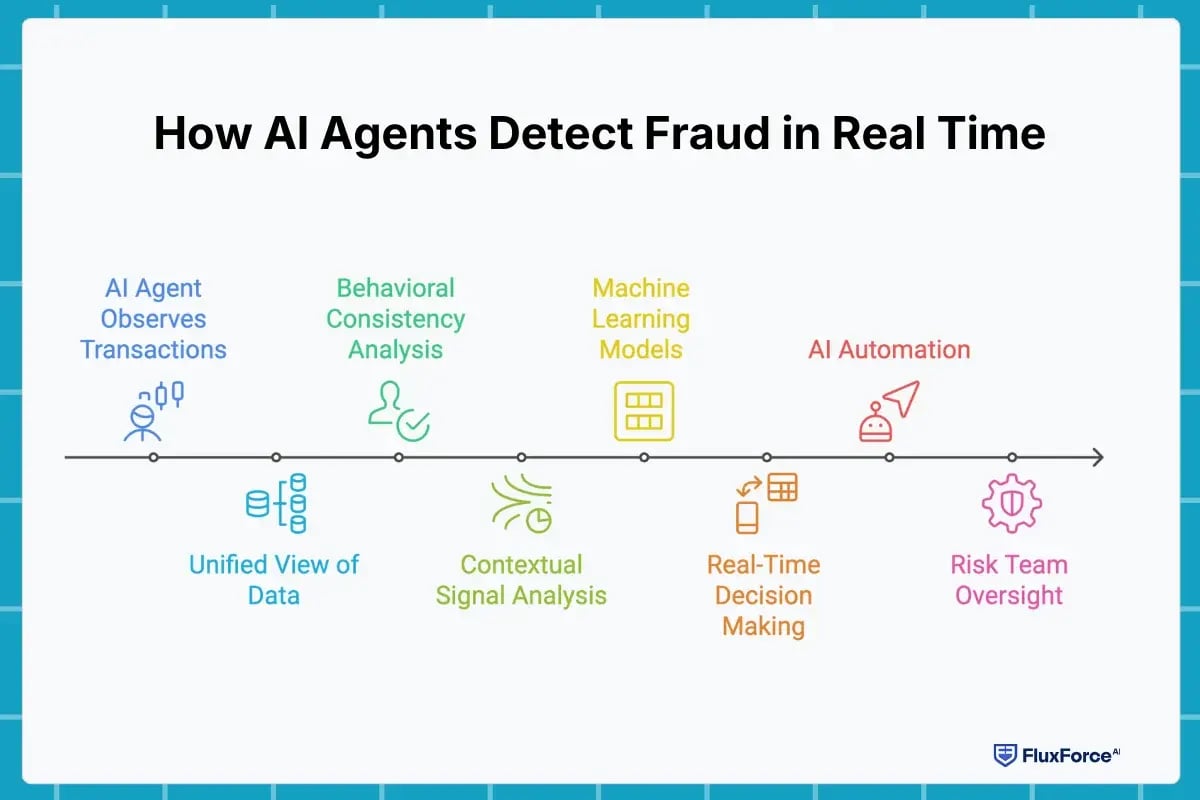
A fraud detection AI agent operates continuously in the background of a fraud detection system, observing transactions, user behavior, and identity signals as a single stream rather than separate events. This unified view is what allows AI in fraud detection to identify risk before losses occur.
Traditional systems check conditions. AI agents assess behavioral consistency.
From Isolated Signals to Behavioral Context
Fraud rarely appears as a single red flag. It shows up as small deviations across many signals. A slight change in transaction timing, an unfamiliar device, a different navigation pattern. On their own, none of these justify a block.
Fraud detection AI connects these signals in context.
By analyzing transaction flows, session behavior, device identity, and historical patterns together, the system builds a live understanding of what “normal” looks like for each user. This is where anomaly detection in finance becomes effective.
This approach is critical for financial fraud detection, especially in digital channels where fraudsters mimic legitimate behavior to avoid static controls.
Why Machine Learning Enables Real-Time Decisions ?
At the core of this capability is fraud detection machine learning. Machine learning models do not rely on predefined assumptions. They learn how users behave over time and measure how current actions differ from that baseline. This allows AI fraud detection to spot risk even when no explicit rule has been broken.
Because models evaluate behavior instantly, decisions can be made before a transaction is finalized. This is what enables true real time fraud detection in high-volume environments such as payments and banking fraud detection systems. As fraud patterns evolve, models retrain, allowing detection logic to improve without manual intervention.
Where AI Agents Differ From Traditional Detection ?
"The defining difference is autonomy "
A fraud detection AI agent does not stop at identifying risk. It responds to it. Through AI automation, the agent can trigger controls such as transaction blocking, step-up verification, or temporary restrictions without waiting for human review.
This matters for transaction fraud detection, account takeover prevention, and phishing detection, where delays directly translate into losses.
For risk leaders, this creates a system that operates continuously, consistently, and at scale. Decisions are logged, actions are traceable, and outcomes can be reviewed for governance and audit purposes.
Why This Matters for Risk Leadership ?
This architecture changes the role of risk teams. Instead of chasing alerts, teams focus on oversight, tuning, and governance. Fraud prevention AI becomes a control system rather than a detection tool. It reduces dependence on manual intervention while improving coverage across channels.
As one senior risk leader explained it:
“Real-time fraud detection is not about speed. It is about making the right decision before damage happens.”
Fraud at the Front Door: Account Opening and Applications
Most of this guide is about payments and account activity. A growing share of fraud starts earlier, when someone opens an account or applies for a policy or loan with an identity that is partly or wholly fake. In its November 2024 alert on deepfake media (FIN-2024-Alert004), FinCEN said that beginning in 2023 and continuing in 2024 it saw an increase in suspicious activity reports describing the suspected use of deepfake media in fraud schemes. These schemes often involve criminals altering or creating identity documents to get past identity verification.
The same alert lists red flags that an onboarding check can test for. They include:
- a customer photo that shows signs of being altered, or does not fit other details such as the date of birth
- several identity documents that are inconsistent with each other
- a third-party webcam plugin used during a live verification check
- geographic or device data that does not match the customer's identity documents
FinCEN adds that no single red flag is necessarily a sign of suspicious activity, and that institutions should consider the surrounding facts before deciding. That describes the work an AI agent is suited to at onboarding. It gathers the signals, checks documents and declared details against each other and against outside records, and sets out each inconsistency with the evidence behind it. A person then decides whether the application goes ahead.
The Same Pattern in Insurance Underwriting
Insurers meet this problem at the application stage. An applicant may understate mileage or past claims, give an address that appears on other applications, or declare income or medical details that other records do not support. An agent can compare each application with the data the insurer is permitted to use, such as credit bureau records, public registries and the insurer's own claims history, and send the applications with mismatches to an underwriter with the evidence attached. The underwriter makes the decision, and the reason for the referral stays on file if a customer or regulator later asks why a policy was declined or priced as it was.
What to Get Right Before a Fraud Detection AI Agent Goes Live
The detection model is rarely where deployments go wrong. The trouble usually sits in the setup around it. Before go-live, check each of these:
- Transaction, device and behaviour data sit together and stay current. If each channel or region keeps its own rules and its own data, the agent sees fragments, and a fraud ring working across channels stays hidden.
- Thresholds change only under change control. Adaptive thresholds cut noise as customer behaviour shifts, but each change should be logged with who approved it and why, so you can explain later why an alert did or did not fire.
- Payments, mobile apps, partner APIs and card systems feed one case per customer, so an analyst does not have to rebuild the story from four screens.
- Every signal checked, score given and action taken is recorded as it happens, not pieced together before an audit.
- Alerts are ranked by risk and context so analysts work the cases that need judgement first. Agree in advance which actions, if any, may run without a person, and how to switch them off.
- Model retraining goes through testing and sign-off like any other change to a control, with a way to roll back.
- Every data feed the agent reads from is protected: encrypted, behind multifactor authentication and included in regular security testing.
FluxForceAI empowers risk leaders to detect threats faster
Enhance security today!
Conclusion
Fraud is faster and harder to predict than ever. Traditional controls alone are no longer enough to keep organizations safe. Fraud detection AI is more than an upgrade to old fraud detection systems. It changes the way risks are identified and handled. Using AI in fraud detection, companies can move from reacting to fraud to stopping it before it happens.
Real time fraud detection is especially important for banks and fintech firms. It lets risk teams act immediately, reducing losses and protecting customers. Modern AI fraud detection tools also provide clear reasons for every decision. This makes it easier to stay compliant and explain actions to regulators.
For risk leaders, the key is not whether to use AI but how to use it safely and effectively. With fraud prevention AI, you get control, visibility, and trust in your systems.
The future of fraud detection is smart, fast, and proactive. Organizations that adopt intelligent AI fraud detection will protect trust, reduce risk, and stay ahead of threats. To better understand the risks and solutions in high-speed payment environments, read Fraud Detection in Real-Time Payments: Challenges and Solutions.


Share this article