.webp)







Listen To Our Podcast🎧

Financial comfort is no longer about holding stable assets or maintaining fixed wealth. It’s about how quickly organizations can adapt to change. In today’s dynamic economy, financial comfort with AI defines confidence, flexibility, and security in a data-driven world.
According to Deloitte's "Global CFO Signals" survey, a significant majority of CFOs believe that AI-assisted decisions enhance financial confidence during uncertain market conditions — with adoption rates accelerating across global finance functions.
But what’s driving this transformation? The answer lies in agentic artificial intelligence—a new class of self-directed systems that act, reason, and learn on their own. These systems bring artificial intelligence insights that evolve over time and align with human financial goals.
As digital transformation in banking continues, businesses are learning to trust AI systems that provide transparency and faster responses. This shift redefines comfort. It’s not about static reports anymore but about continuous intelligence.
The Rise of Agentic Artificial Intelligence
Have you ever noticed how slow manual checks or traditional automation can be when markets move fast? That delay often costs businesses time, money, and valuable insights. This is where agentic artificial intelligence steps in.
Unlike conventional AI that waits for commands, Agentic AI makes its own decisions. It sets goals, carries out tasks, and keeps learning from what works or fails — all with minimal human intervention rather than no human control.
This shift has opened the door to autonomous AI in finance, where systems no longer just report data but act on it. They track transactions, watch market signals, and flag or remediate errors in near real time. Imagine a system that adjusts your risk strategy before an issue appears — that’s the power businesses are beginning to trust.
For banks, the shift toward AI‑driven and increasingly agentic operating models is reshaping core operations. McKinsey’s 2023 research on AI in financial services shows that leading institutions deploying advanced AI‑enabled automation have achieved 20–30% reductions in operational costs, alongside measurable improvements in fraud detection effectiveness and compliance outcomes. These gains are strongest when AI is embedded across end‑to‑end workflows rather than applied as isolated tools.
The global adoption of agentic AI is growing quickly. According to PwC's 2024 Global Financial Services Technology Survey, a significant share of leading banks plan to launch autonomous AI projects within the next two years.
Global Adoption of Agentic AI in Finance: Trends and Insights
Why are so many global financial institutions suddenly investing in agentic AI in finance? The answer is simple — efficiency, accuracy, and speed are no longer optional; they’re essential for survival.
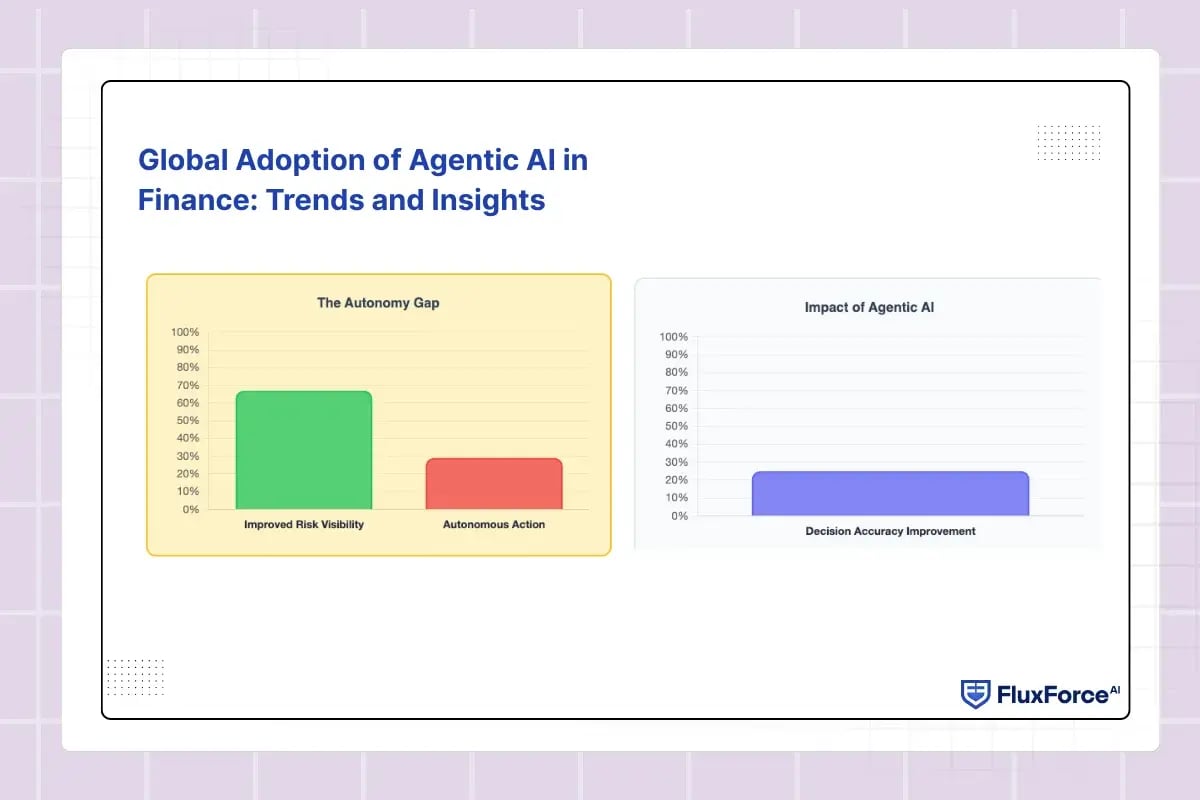
The impact of agentic AI on global finance is already visible. Companies deploying autonomous AI systems report measurable improvements in decision accuracy and faster audit turnaround.
This move toward AI-driven financial strategies is creating a wave of change across every market. From the US to Singapore, banks are using AI agents to monitor trades, assess risks, and even manage regulatory compliance in real time. These agents help avoid costly delays and human bottlenecks.
The impact of agentic AI on global finance is already visible. Companies using autonomous systems have seen a 25% improvement in decision accuracy and faster turnaround during audits. As adoption grows, financial comfort is becoming about agility — not just assurance.
However, this global turn also brings new questions. How do you balance autonomy with control? How do you ensure systems act ethically while managing billions in transactions? These challenges push firms to rethink governance with AI governance in financial systems and build trust around automation.

Redefining Financial Strategies with Agentic Artificial Intelligence
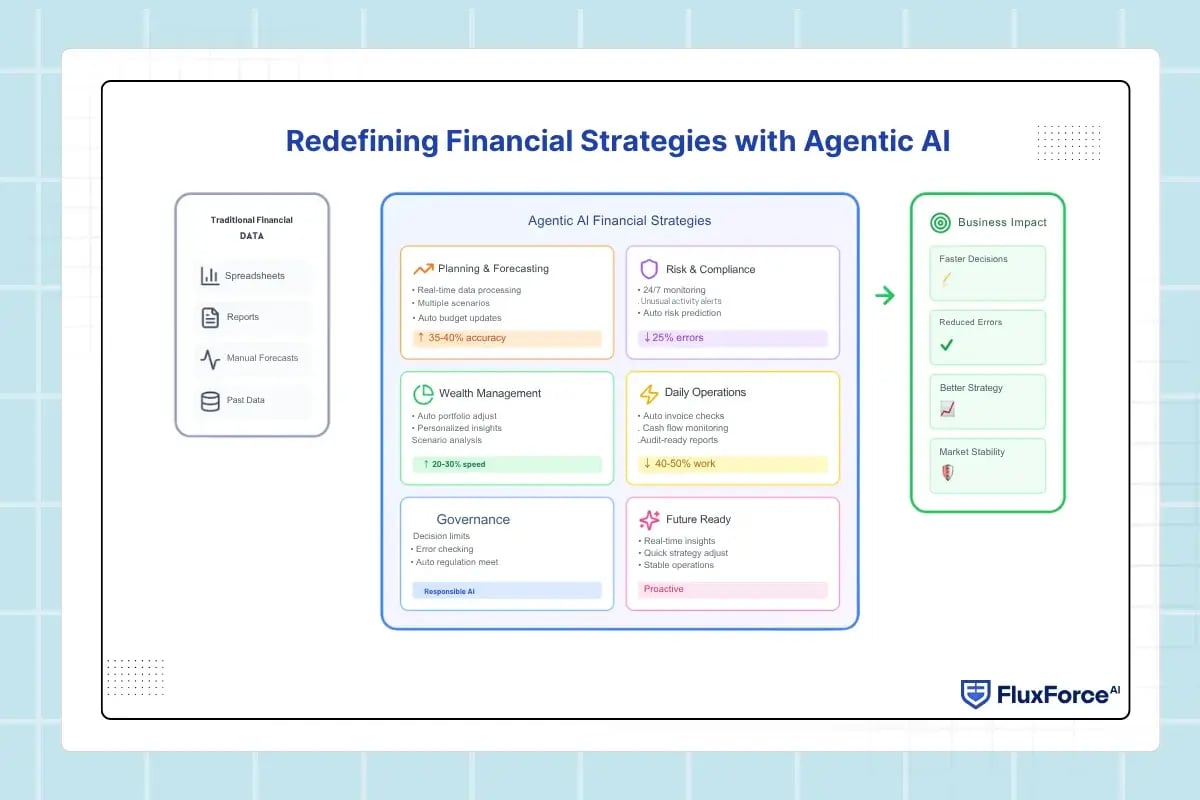
Financial strategies are changing. Companies can no longer rely only on spreadsheets, reports, or manual forecasts. Agentic artificial intelligence now helps organizations make faster, smarter, and more accurate decisions across key financial operations.
1. Better Financial Planning and Forecasting
Traditional planning depends on past data and manual calculations. This can delay decisions and lead to errors.
With AI-driven financial strategies, companies can process real-time data and create accurate forecasts. Agentic AI can run multiple scenarios, predict cash flow changes, and suggest budget updates automatically. This helps finance teams make quick and informed decisions.
Companies using Agentic AI for financial planning report measurable improvements in forecasting accuracy and reductions in unexpected budget gaps.
Using artificial intelligence insights, finance teams can spot opportunities early, plan investments better, and use resources more efficiently.
2. Stronger Risk Management and Compliance
Managing risk and staying compliant is challenging. Traditional methods often spot problems only after they happen.
Agentic AI in finance monitors transactions, market changes, and regulations all the time. It finds unusual activity, predicts risks, and sends alerts automatically.
Financial institutions deploying AI for risk monitoring report measurable reductions in compliance errors.
This approach ensures financial comfort with AI, keeps operations secure, and helps meet regulatory requirements consistently.
3. Smarter Investment and Wealth Management
The role of agentic AI in wealth management goes beyond analyzing data. AI agents can track client portfolios, assess risks, and suggest investment changes automatically.
Benefits include:
- Automatic portfolio adjustments based on market trends
- Personalized insights for high-value clients
- Scenario analysis to prepare for market changes
Firms using AI agents report measurable improvements in portfolio adjustment speed, client outcomes, and error reduction.
Using the best AI agent allows financial advisors to focus on strategy and clients while AI handles routine monitoring and predictions.
4. More Efficient Daily Finance Operations
Agentic AI improves everyday financial tasks, making them faster and more accurate:
- Accounts Payable/Receivable: Checks invoices and automates approvals
- Treasury Operations: Monitors cash flow and payments continuously
- Financial Reporting: Generates audit-ready reports automatically
Companies using AI in daily finance operations report significant reductions in manual workload.
5. Governance and Responsible AI
Autonomous AI needs oversight. Using responsible AI for financial services ensures AI acts correctly and follows rules.
AI governance in financial systems includes:
- Setting limits for AI decisions
- Checking outputs for errors or bias
- Ensuring AI systems meet regulatory requirements through continuous monitoring
Strong governance helps organizations get financial comfort with AI while keeping operations reliable and transparent.
6. Preparing for the Future of Finance
The future of finance with agentic AI includes systems that manage planning, risk, compliance, and investments all at once.
Companies can:
- Get real-time insights across operations
- Adjust strategies quickly
- Keep financial operations stable even in volatile markets
Agentic AI supports finance teams to act faster, reduce mistakes, and make better decisions. It moves companies from reactive management to proactive financial leadership.
Onboard Customers in Seconds

Building Financial Comfort with Agentic AI and Intelligent Autonomy
Finance is entering a new era. Beyond automation, organizations are embracing Agentic artificial intelligence to drive intelligent autonomy across operations. This shift ensures faster decisions, stronger compliance, and long-term financial stability.
.webp?width=725&height=483&name=_%20Building%20Financial%20Comfort%20with%20Agentic%20AI%20and%20Intelligent%20Autonomy%20%20(1).webp)
1. Strategic Decision-Making at Speed
In the future, finance leaders will rely on AI not just for data, but for actionable insights. AI-driven financial strategies will continuously analyze market conditions, internal performance, and global trends. This enables executives to make timely, informed decisions that align with company objectives.
Firms leveraging Agentic AI can respond to market changes in real time, reducing missed opportunities and improving capital allocation.
2. Resilience and Risk Mitigation
Global finance is increasingly volatile. Agentic AI provides a proactive approach to managing risk. Systems anticipate potential issues, assess exposure, and adjust strategies — reducing dependence on manual intervention.
With responsible AI for financial services, organizations maintain regulatory compliance while strengthening operational resilience. This allows firms to navigate uncertainty with confidence, protecting both capital and reputation.
3. Redefining Operational Leadership
Intelligent autonomy shifts finance from reactive to proactive operations. Leaders can focus on strategy, growth, and innovation, while AI manages repetitive and data-intensive tasks.
Key transformations include:
- Continuous monitoring of financial health across regions
- Early detection of inefficiencies or anomalies
- AI-assisted scenario planning for mergers, acquisitions, or investments
This enables finance teams to provide strategic guidance to the board and stakeholders, enhancing their role as business leaders rather than process managers.
4. Unlocking Competitive Advantage
The future of finance with Agentic AI is closely tied to competitive differentiation. Organizations adopting intelligent AI gain:
- Faster, more confident investment and risk decisions
- Reduced operational costs and error rates
- Greater agility in responding to market disruptions
Using the best AI agent solutions, firms can create a flexible financial architecture that adapts to changing conditions while maintaining stability and control.
5. Governance and Long-Term Trust
As autonomy grows, AI governance in financial systems becomes crucial. Companies must ensure that Agentic AI remains aligned with ethical standards, internal policies, and regulatory requirements.
A strong governance framework builds stakeholder trust, ensures transparency, and allows finance teams to scale operations without compromising compliance or integrity.
6. A Vision for the Next Decade
Over the next 5–10 years, autonomous AI in finance will evolve from operational support to strategic leadership. Companies integrating Agentic AI effectively will:
- Make faster, smarter financial decisions
- Maintain stability even in volatile markets
- Free teams to focus on innovation and growth
- Achieve higher confidence in long-term planning
Conclusion
The global shift to Agentic AI is transforming finance from a reactive function into a strategic powerhouse. Companies making use of autonomous AI in finance can manage risks proactively and make more accurate decisions. Integrating AI agent into core operations creates financial comfort with AI while ensuring compliance and operational reliability.
For business leaders, adopting Agentic AI is become a strategic necessity. Organizations that implement responsible AI for financial services and strong AI governance in financial systems gain a competitive edge through smarter operations. In short, Agentic AI doesn’t just support finance, it redefines it as a tool for leadership, strategy, and long-term business success.
To better understand how organizations ensure transparency in autonomous systems, read our guide on explainability dashboards for agentic AI decisions.



Share this article