


















Listen To Our Podcast🎧
Can AI platforms automate customer onboarding checks?
KYC and AML are usually run by different teams with different systems. Onboarding checks who the customer is. Monitoring and investigations look at what the customer does afterwards. The gap between them is where most of the pain sits: an account opened on a thin file carries that gap into every alert and review that follows.
AI agents can now do much of the checking on both sides. They read documents, run identity and screening checks, trace who owns a company and put the results in one file. The question compliance leaders ask us is less about whether that works and more about where the agent has to stop and a person has to decide.
We rewrote this page on November 8, 2026. The earlier version said AI agents could approve customers without manual intervention, which contradicts how we build FluxForce and a coming EU rule. It presented an HSBC result from a Google Cloud transaction-monitoring model as an agentic onboarding outcome, and it repeated a Commonwealth Bank figure we couldn't trace to any source, so that case is gone. Several speed and accuracy figures with no source were removed as well. This version is written for AML, KYC and onboarding leads at banks and fintechs.
- How KYC onboarding and AML investigation work fit together
- Which onboarding checks AI agents can run, and what they hand to your team
- What AI can flag about onboarding fraud, and what it can't
- What the HSBC AML AI result shows and what it doesn't
- What US and EU rules say about automated onboarding decisions
- How to test a KYC and AML agent platform on your own files
Request a demo of KYC / KYB Onboarding

Yes, most of the checks, but not the decision. An AI platform can collect and read identity documents, run document and liveness checks, pull company registry data, trace beneficial owners through layers of companies and trusts, screen every connected person against sanctions, PEP and adverse-media sources, and propose a risk rating on the factors in your policy. What it should hand over is one file with the evidence and the gaps marked. Whether the account opens, is declined or goes to enhanced due diligence is a decision for a person with the authority to make it. From 10 July 2027, the EU's AML Regulation requires that kind of decision to be subject to meaningful human intervention when automated processes or AI are involved.
How KYC and AML fit together
KYC is the front of an AML program. The customer due diligence done at onboarding decides what "normal" looks like for that customer, and every later alert is judged against it. If the file is wrong or thin, monitoring rules fire on the wrong things and investigators start each case by redoing onboarding work.
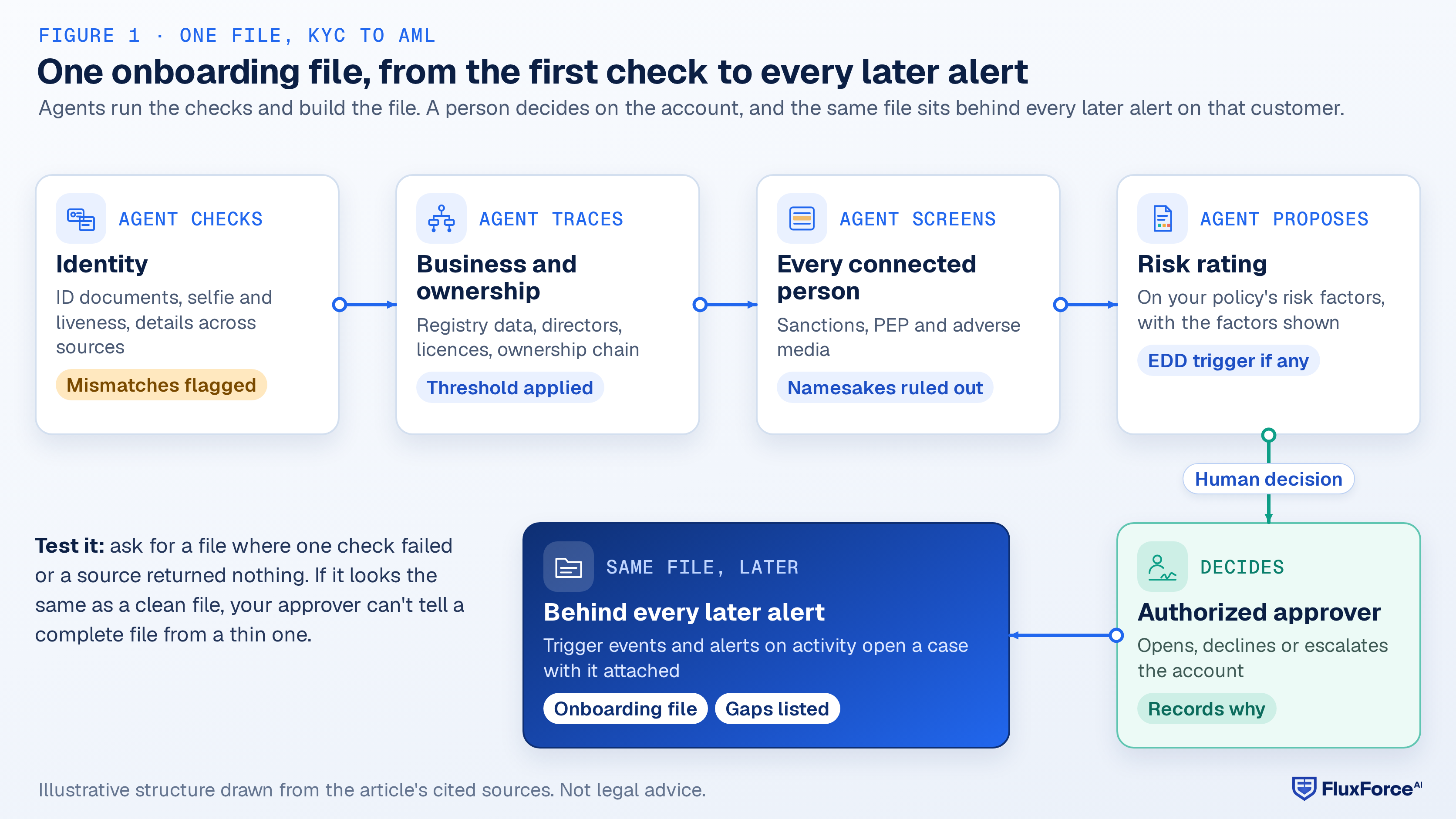
- Identity checks, business and ownership checks, screening of every connected person and a proposed risk rating build one file. An authorized approver decides on the account, and the same file is attached to every later alert case on that customer.
| Stage | What gets checked | What an agent prepares | Who decides |
|---|---|---|---|
| Identity | ID documents, selfie and liveness, consistency across sources | Verification results with mismatches flagged | Onboarding analyst |
| Business and ownership | Registry data, directors, licences, ownership chain | Ownership chart with controllers and the threshold applied | Onboarding analyst or KYB reviewer |
| Screening | Applicant, directors, owners and signatories against sanctions, PEP and adverse media | Hits with match reasoning; namesakes ruled out with verified data | Analyst for every true or unclear match |
| Risk rating | Your policy's risk factors | Proposed rating, the factors behind it, EDD trigger if any | Compliance team approves the rating |
| Account decision | The whole file | A complete file with gaps listed | Authorized approver |
| After onboarding | Trigger events, alerts on activity | A review or case with the onboarding file attached | Analyst, then MLRO for escalations |
Our page on customer due diligence sets out what examiners look for in each element. The point of the table is the last column. Agents can do most of the work in the middle columns, and none of the decisions in the right one.
Ask a vendor to show you an onboarding file where one check failed or a source returned nothing. If it looks the same as a clean file, your approver can't tell a complete file from a thin one.
Rule-based, generative and agentic AI in KYC and AML
The earlier version of this page compared three kinds of AI. The comparison is still useful, with one correction: none of them should be the one deciding.
| Type | What it does in KYC and AML | Main limit |
|---|---|---|
| Rule-based systems | Check IDs, documents and transactions against fixed rules and flag matches | Produce many false positives and don't adapt when typologies change |
| Generative AI | Reads documents and drafts summaries, reports and explanations for a reviewer | Doesn't act on a case and can state things confidently that aren't in the evidence |
| AI agents | Run multi-step checks across sources, gather evidence, propose an outcome and record each step | Need good data and clear governance, and act only within the authority you give them |
Agents are the right fit for onboarding because the work is multi-step: read the document, check it, look up the company, find the owners, screen each one, then rate the risk. Each step depends on the last. That's also why the record of each step matters as much as the result.
What AI agents can automate in KYC onboarding
The checks a KYC AI agent can run fall into six groups. Each produces evidence for the file rather than a decision.
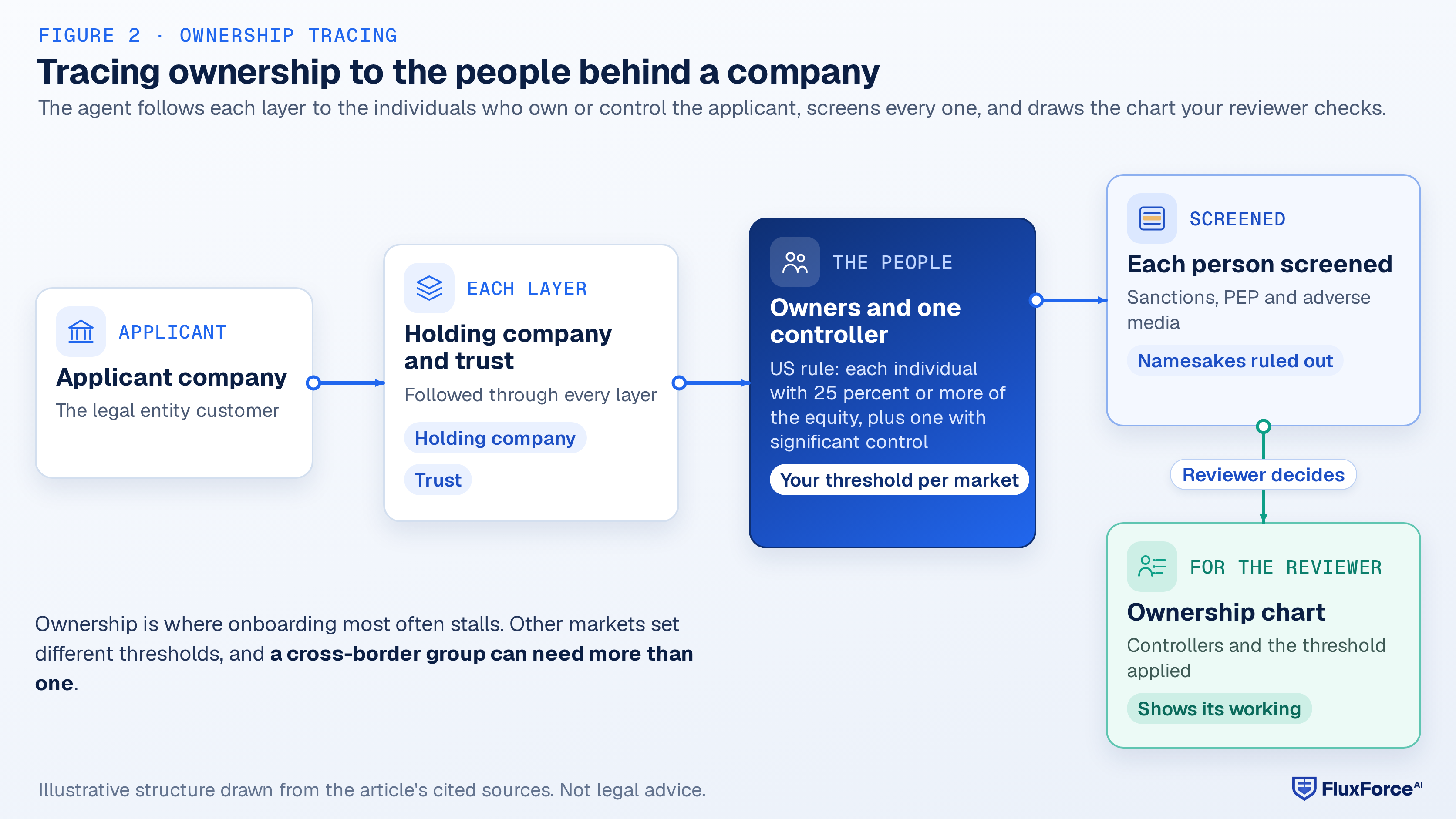
- The agent follows the applicant company through its holding company and trust to the individuals who own it at the threshold you configure, plus the one person who controls it. Each person is screened, and the reviewer gets an ownership chart.
- Identity verification: checking ID documents for tampering and expiry, running selfie and liveness checks, extracting data from documents with OCR and matching the applicant's details across sources.
- Business verification: pulling company registry data where it's available, checking directors, licences and the registered address, and flagging shell-company indicators.
- Ownership tracing: following ownership through layers of companies and trusts to the people who control the company, applying the threshold your market requires and drawing the chart for your reviewer.
- Screening every connected person: checking applicants, directors, owners and signatories against sanctions, PEP and adverse-media sources, and ruling out namesakes with verified identity data.
- Risk rating: proposing a rating on the factors in your risk policy, sending high-risk applicants to enhanced due diligence and prompting for source of wealth and funds where your policy requires it.
- Ongoing review: keeping the file linked to the customer, so an expiring document, a new screening hit or an ownership change opens a review instead of waiting for the next scheduled one.
Ownership is where onboarding most often stalls. Under the US customer due diligence rule a beneficial owner is each individual who owns 25 percent or more of a legal entity customer's equity, plus one individual with significant responsibility to control it. Other markets set different thresholds, and a cross-border group can need more than one. An agent that applies the threshold you configure for each market, and shows its working, saves the reviewer the slowest part of the job.
Speed depends on your products, your markets and your data sources. We don't quote onboarding times from demos. Measure turnaround on your own applications, side by side with your current process, before you change anything.
What AI can flag about onboarding fraud
Search interest in KYC onboarding fraud detection with AI is about whether the software can catch a fake applicant at the door. It can help with several signals:
- Altered, expired or reused identity documents
- A selfie or liveness result that doesn't match the document
- Synthetic or borrowed identities, where details are real but don't belong together
- Details that disagree across the application, the document and outside sources
- Companies with shell indicators, such as no trading footprint or a registered address shared by many entities
What AI can't do is decide intent. A mismatch might be fraud or a data-entry error, and a shell indicator might be a new holding company with a sound reason to exist. The agent's job is to surface the signal with its evidence and make the reviewer's decision faster. For the identity side in more depth, see our guide to KYC and digital identity verification.
From onboarding to agentic AML investigations
The onboarding file pays off later. When a transaction-monitoring or screening alert fires on a customer six months after the account opened, the investigator's first questions are who this customer is, who owns them, what they said they'd do with the account and what risk rating they were given. If that file sits in a different system, or was never completed, each case starts with a rebuild.
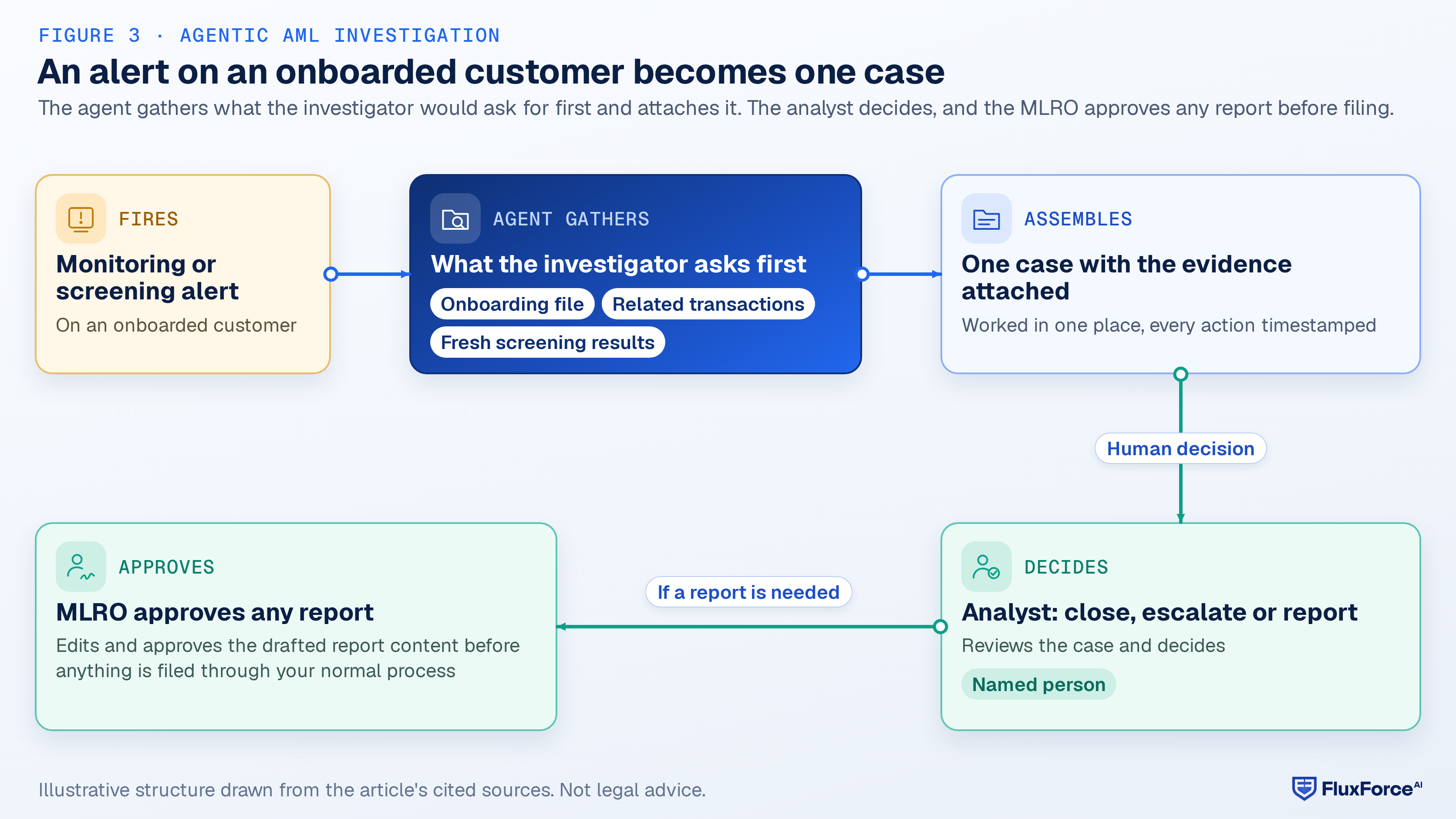
- An alert fires on an onboarded customer. The agent gathers the onboarding file, related transactions and fresh screening results into one case. The analyst decides whether to close, escalate or report, and the MLRO approves any report before it is filed.
Agentic AML investigation means an agent picks up the alert, pulls the onboarding file, the related transactions and fresh screening results, and assembles a case with the evidence attached. The analyst reviews it and decides whether to close, escalate or report. Where the case points to suspicion, the agent can draft the report content for the MLRO, who edits and approves it before anything is filed through your normal process.
Our AI KYC AML analyst, Rhea Ledger, is the agent profile for this work: screening, ownership tracing and the first risk rating, then draft reports for the MLRO to approve. Cases are worked in Case Management and Investigations, where every action is timestamped. Keeping the file current between reviews is covered in our piece on perpetual KYC.
What the HSBC result shows, and what it doesn't
The earlier version of this page cited HSBC as an agentic onboarding success. The result is real, but it comes from somewhere else.
HSBC used Google Cloud's Anti Money Laundering AI, a transaction-monitoring model. In a post on the Google Cloud blog, HSBC reports that "AML AI identifies two to four times as much suspicious activity as the previous system, while reducing the number of alerts by 60%". Google's June 2023 launch release explains the measure: it was based on the number of Suspicious Activity Reports filed with AML AI against a similar period under rules-based transaction monitoring at HSBC.
So it's a monitoring result at one bank, measured by reports filed. It isn't an onboarding result, it isn't an AI agent, and it says nothing about FluxForce. It does show that better detection models can cut alert volume while finding more of what matters, which is worth knowing when you weigh the monitoring side of an AML and KYC program.
The page also described a Commonwealth Bank of Australia case with a 60% alert reduction and faster onboarding. We couldn't find a source for those figures, so the case is removed.
What the rules say about automated onboarding decisions
In the US, the customer due diligence rule at 31 CFR 1010.230 says covered financial institutions "are required to establish and maintain written procedures that are reasonably designed to identify and verify beneficial owners of legal entity customers". Owners are identified when a new account is opened and verified using risk-based procedures. The section was last amended in September 2017. The rule doesn't say who presses approve, but the institution answers for the procedures and for each file, so the decision record matters.
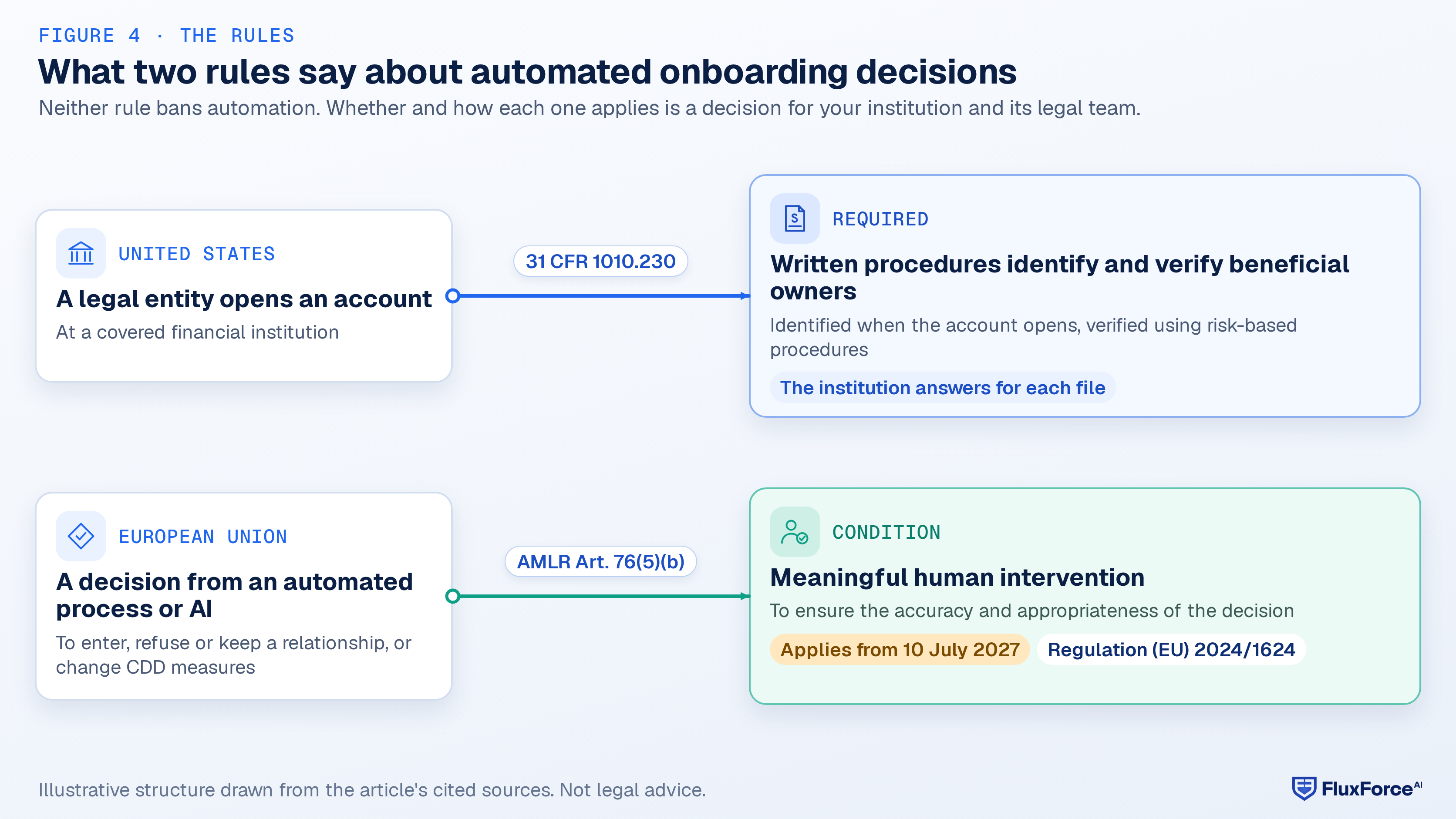
- In the US, when a legal entity opens an account, written procedures must identify and verify its beneficial owners. In the EU, from 10 July 2027, a decision made with automated processes or AI to enter, refuse or maintain a customer relationship needs meaningful human intervention.
In the EU, the AML Regulation, Regulation (EU) 2024/1624, addresses automation directly. Article 76(5) lets obliged entities adopt decisions resulting from automated processes or AI systems, on conditions. One is that any decision to enter, refuse or maintain a business relationship, or to increase or decrease customer due diligence measures, "is subject to meaningful human intervention to ensure the accuracy and appropriateness of such a decision". The regulation applies from 10 July 2027 for most obliged entities, so this is a rule to design for now, not one in force today.
International standards point the same way. Our summary of FATF Recommendation 10 covers its four core CDD measures and what to do when full CDD can't be completed. None of these frameworks bans automation. They expect the institution to stay accountable for each customer decision, which is easier to show when a person made it and the record says why. Our page on human-in-the-loop review sets out how to design that review so it is more than a checkbox.
How to test a KYC and AML agent platform
Once you know platforms can automate customer onboarding checks, the next questions are which AI agent platforms have the fastest KYC turnaround, and who integrates KYC and AML workflows. Speed only counts on a complete file, so test both together. Ask each vendor to show the following on real files, ideally your own applications in a trial:
- Take a legal entity with layered ownership and show the ownership chart, the controllers and the threshold applied.
- Show a file where a document check failed or a source returned nothing, and where that gap appears.
- Show a screening hit on a director that was ruled out, with the data used to rule it out.
- Show the proposed risk rating and which factors from your policy drove it.
- Show who approved the account, and where the agent's autonomy setting that day is recorded.
- Fire a monitoring alert on an onboarded customer and show the onboarding file attached to the case.
- Turn an agent off with its kill switch and show what happens to work in progress.
Then measure turnaround in shadow mode: time from application to a file a person can decide on, and how often files reach the approver complete the first time. A fast answer on an incomplete file is a slower answer later. Our CDD readiness assessment scores your current program across six CDD pillars and is a useful baseline before a trial.
- AI agents can run most KYC onboarding checks and hand over one file with the evidence and gaps marked.
- The account decision stays with a person who has the authority to make it, and the record should say who and why.
- Ownership tracing and screening every connected person are where AI saves the most review time.
- The HSBC result is a Google Cloud AML AI transaction-monitoring result, measured by reports filed, not an agentic onboarding outcome.
- The US CDD rule requires written procedures to identify and verify beneficial owners when an account opens.
- From 10 July 2027, the EU AML Regulation requires meaningful human intervention in automated decisions to enter, refuse or maintain a customer relationship.
Conclusion
Agentic AI for KYC and AML works best when it's judged by the file it hands over, not by how few people touch it. A complete file shows the identity checks, the ownership chain, every screened person, the factors behind the rating and the gaps, and it reaches a person who decides and records why. The same file then sits behind every alert on that customer, which is where AML investigation time is won or lost.
The rules don't ban automation. They expect the institution to stay accountable, and from July 2027 the EU will expect a person in the loop on onboarding decisions made with AI. Build for that now and the audit trail comes with it. If you want to see that file built on your own applications, request a FluxForce demo.
Request a demo of KYC / KYB Onboarding
Frequently Asked Questions
About the author

Sahil Kataria
Founder and CEO of FluxForce
Share this article