.webp)




.webp)



Listen To Our Podcast🎧
-1.png)
According to the Association of Certified Fraud Examiners (ACFE) 2024 Report to the Nations, organizations worldwide lose an estimated 5% of annual revenues to fraud — translating to trillions in projected global losses each year. As KYC/AML compliance requirements intensify globally, organizations are turning to open source intelligence (OSINT) and advanced AI tools to go beyond the limitations of traditional fraud detection methods.
What makes Agentic AI a game-Changer
Agentic AI fraud prevention systems act autonomously, analyzing transaction patterns and behavioral anomalies in real time. Unlike conventional AI, which relies on static historical data, AI for financial fraud detection can adapt to emerging fraud tactics without manual intervention.
According to McKinsey & Company's report on AI in financial services, institutions that deploy AI-driven fraud detection systems report measurable reductions in fraud losses and investigation costs compared to legacy rule-based approaches.
This demonstrates how AI in OSINT security is becoming central to modern risk mitigation strategies.
Why OSINT is the backbone of Intelligence-driven decisions
Understanding what OSINT is — and how it works — is essential for any organization building a modern fraud prevention strategy. Open source intelligence refers to data collected from publicly available sources such as corporate registries, social media feeds, court records, and dark web monitoring tools open source.
When combined with agentic AI fraud prevention, OSINT technical capabilities allow organizations to:
- Detect fraudulent identities using OSINT-based identity verification
- Analyze transaction networks using osint investigation tools
- Identify high-risk entities through recorded future threat intelligence
By integrating open-source intelligence fraud prevention into automated workflows, organizations can:
- Reduce false positives and improve alert quality
- Accelerate intelligence-driven decisions with real-time data synthesis
- Strengthen AI-powered intelligence for compliance and security
Organizations can also implement intelligence-driven risk mitigation strategies, enabling proactive risk assessment rather than reactive fraud response.
So, how can enterprises ensure their and open source intelligence software keep pace with the ever-evolving tactics of modern fraudsters?
By addressing this question, companies can transform AI applications in fraud detection and OSINT into a competitive advantage, protecting their customers and reputation.
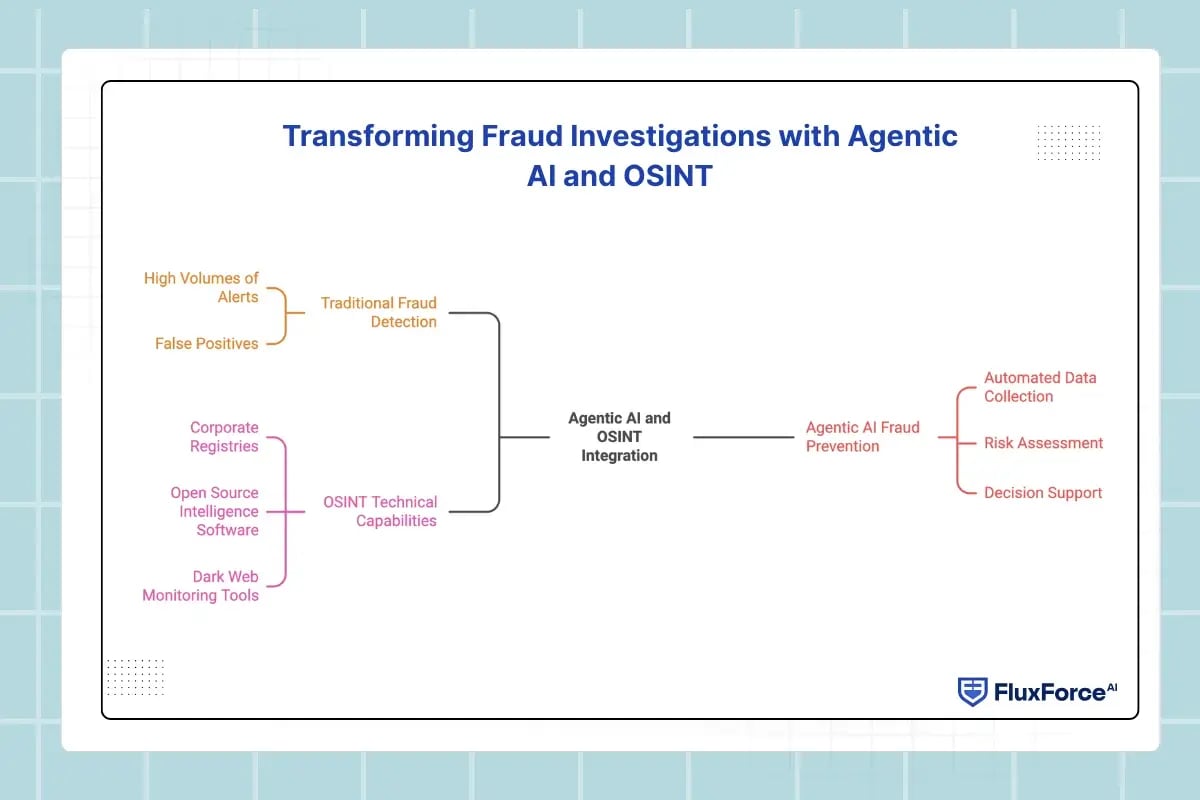
Transforming Fraud Investigations with Agentic AI and OSINT
Traditional fraud detection often overwhelms analysts with high volumes of alerts and false positives. Integrating agentic AI fraud prevention with OSINT technical capabilities allows professionals to focus on high-value decisions, rather than manual data collation.
The business case for AI governance is no longer theoretical. Gartner projects that by 2028, enterprises that adopt AI governance platforms will materially outperform their peers in both trust and compliance outcomes.
How Agentic AI Complements OSINT Tools
By combining OSINT tools and techniques with autonomous AI agents, enterprises can:
- Automate the collection of OSINT data from sources like corporate registries, open source intelligence software, and
- Map transactional networks and flag high-risk behavioral patterns using intelligence-driven fraud prevention rules and anomaly detection models
- Continuously learn from investigative feedback, refining detection thresholds and progressively reducing false positive rates
OSINT methodology ensures structured analysis, while OSINT investigation tools and OSINT platforms provide the data foundation for AI-powered intelligence for compliance and security.
Practical Workflow in Action
An example workflow for a financial institution:
1. Data Gathering: Agentic AI agents automatically retrieve and synthesize information from open source intelligence gathering sources and platforms such as Recorded Future for threat intelligence enrichment.2. Risk Assessment: The system evaluates transactions against OSINT-based identity verification and prior fraud patterns.
3. Decision Support: Analysts receive prioritized alerts, reducing investigation time and enabling faster, intelligence-driven risk mitigation strategies.
By integrating AI applications in fraud detection and OSINT, organizations can ensure that suspicious activities are detected and addressed proactively.

Real-World Applications of Agentic AI and OSINT in Fraud Investigations
Fraud prevention is no longer reactive. Organizations now rely on Agentic AI and OSINT to actively detect and prevent fraudulent activities. The question arises: how are leading global institutions leveraging these technologies to protect billions of dollars in transactions annually?
Agentic AI Fraud Prevention in Action
PayPal: Real-Time Transaction Monitoring
PayPal deploys AI-driven systems to monitor millions of transactions daily, automatically flagging suspicious activities, analyzing behavioral patterns, and helping prevent payment fraud and account takeovers. By automating manual review processes, PayPal has reported reductions in false positive rates and improvements in overall fraud detection performance.
Bank of America: AML Investigations
AI‑driven automation in AML workflows has been associated with faster alert resolution and reduced analyst workload across the financial‑services industry, according to Deloitte research on financial crime investigations and compliance modernization. Major banks, including Bank of America, have disclosed significant technology investment in AI‑enabled compliance operations, reflecting these broader industry trends.
European Banks: KYC and Sanctions Screening
Major European banks deploy agentic AI for Know Your Customer (KYC) and sanctions list monitoring. AI performs identity verification, document extraction, adverse media scanning, and checks on politically exposed persons (PEPs) and ultimate beneficial owners (UBOs). The result: faster onboarding, enhanced compliance, and a detailed audit trail.
OSINT in Action
First American Financial Corp: Data Breach Discovery
In 2019, OSINT techniques uncovered a vulnerability exposing 885 million sensitive documents at First American Financial Corp. Investigators used open-source intelligence like public URLs and cloud-exposed records to identify risks before malicious actors could exploit them.
U.S. Central Command (CENTCOM): Social Media Reconnaissance
AI‑driven automation in AML workflows has been associated with faster alert resolution and reduced analyst workload across the financial‑services industry, according to Deloitte research on financial crime investigations and compliance modernization. Major banks, including Bank of America, have disclosed significant technology investment in AI‑enabled compliance operations, reflecting these broader industry trends.
Global Banks: Corporate & Domain Registry Analysis
Financial institutions increasingly use open source intelligence tools to uncover shell companies, synthetic identity fraud, and money laundering networks. By analyzing government registries, WHOIS domain data, and social platforms, compliance teams can link previously disparate entities and reveal hidden ownership networks — improving detection and mitigation of complex fraud schemes. According to the Financial Action Task Force (FATF), beneficial ownership transparency enabled by OSINT methods is now considered a critical layer in effective AML frameworks globally.
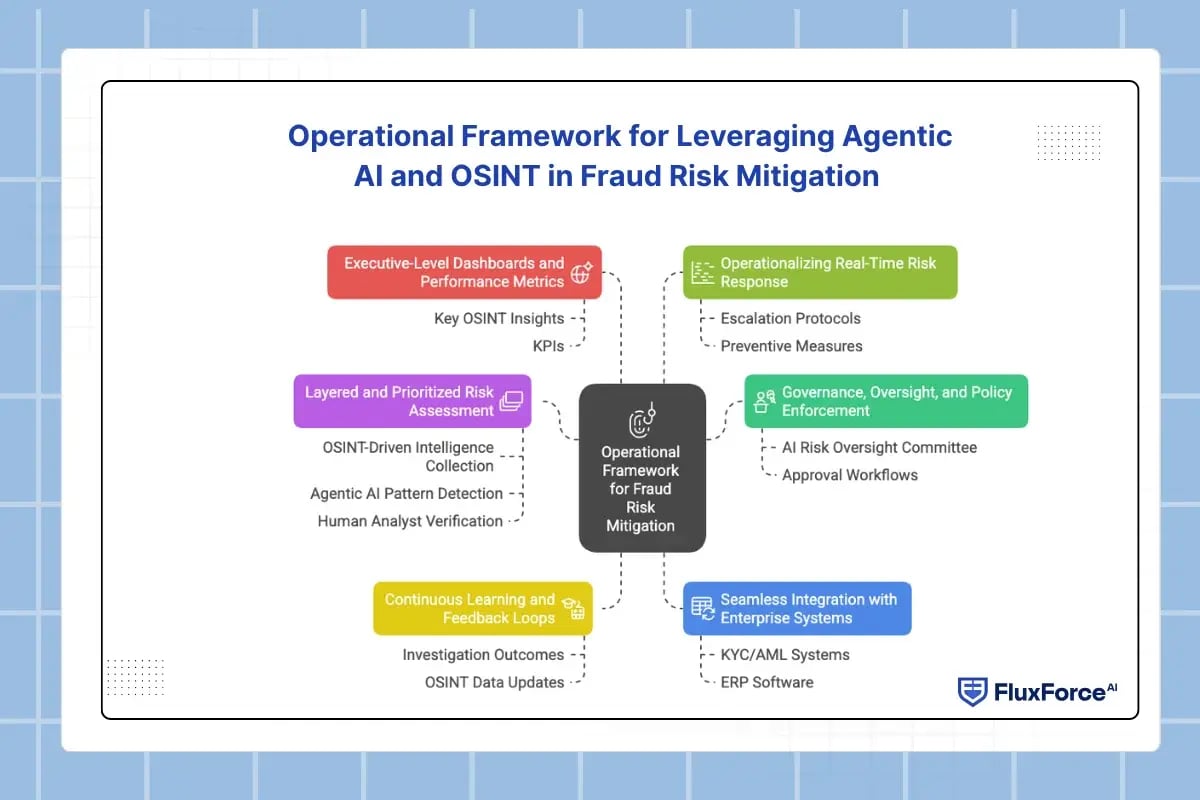
Operational Framework for Leveraging Agentic AI and OSINT in Fraud Risk Mitigation
Fraud detection and risk mitigation require structured processes, technology integration, and continuous improvement. Agentic AI combined with OSINT offers a practical approach, but organizations need a clear operational framework to capture value.
Step 1: Governance, Oversight, and Policy Enforcement
A robust framework begins with governance. Organizations must define roles, responsibilities, and accountability mechanisms for AI-driven fraud systems. This includes forming an AI Risk Oversight Committee composed of representatives from compliance, IT security, fraud operations, and risk management.
Operational Actions:
- Validate AI models before deployment to prevent bias or errors.
- Define approval workflows for agentic AI fraud prevention actions, such as automatic flagging of high-risk transactions.
- Maintain an audit trail of AI in OSINT security and open source intelligence fraud prevention decisions for regulatory reporting and compliance audits.
Step 2: Layered and Prioritized Risk Assessment
Fraud risks are not uniform, and an operationally layered assessment ensures resources are allocated efficiently.
Tier 1: OSINT-Driven Intelligence Collection
- Utilize OSINT investigation tools, open-source intelligence software, and dark web monitoring tools open source to gather data from public sources.
- Assign risk scores to entities based on anomalies, adverse media, or suspicious activity flags.
Tier 2: Agentic AI Pattern Detection
- Deploy AI agents to monitor transaction networks, behavioral anomalies, and multi-channel activity patterns.
- Automatically prioritize cases with the highest potential fraud impact.
Tier 3: Human Analyst Verification
- Investigators focus only on high-risk alerts, providing contextual validation and final decision-making.
Operational Benefits: Reduces alert fatigue, improves investigator productivity, and focuses human judgment where it is most needed.
According to Deloitte's 2024 Financial Services AI report, layered AI and OSINT systems have been associated with false positive reductions of 30–40% in financial crime compliance workflows.
Step 3: Continuous Learning and Feedback Loops
Core Operations:
- Capture outcomes from every investigation, including resolved and escalated cases.
- Feed updates into agentic AI workflows to refine thresholds, scoring mechanisms, and alert prioritization.
- Incorporate OSINT data updates from regulatory filings, social media, corporate registries, and threat intelligence platforms.
Example: Bank of America updates AI in OSINT security models weekly, resulting in 40% faster SAR filing.
Step 4: Seamless Integration with Enterprise Systems
For operational efficiency, agentic AI and OSINT platforms should complement existing workflows:
- Integrate agentic AI fraud prevention workflows into KYC/AML systems, ERP software, or fraud case management platforms.
- Enable real-time data synchronization across internal and external sources.
- Automate report generation for both compliance audits and internal decision-making.
Example: PayPal integrated agentic AI with current fraud operations, cutting manual review workloads by 50%.
Step 5: Executive-Level Dashboards and Performance Metrics
Leadership teams need visibility into the impact of AI-driven fraud operations:
- Create dashboards displaying key OSINT insights, fraud alerts, investigation throughput, and AI agent performance.
- Track KPIs such as false positive reduction, alert response time, and cost savings from automation.
- Use dashboards to allocate resources dynamically and adjust investigation protocols.
Gartner 2023 reports AI-driven OSINT dashboards increase actionable insights by 2–3x
Step 6: Operationalizing Real-Time Risk Response
A mature framework extends beyond monitoring:
- Automatically escalate high-risk cases identified by agentic AI and OSINT platforms to response teams.
- Enable analysts to trigger preventive measures such as transaction holds or account freezes.
- Maintain a continuous improvement cycle where operational feedback is used to update AI in OSINT security models and OSINT data sources.
Outcome: Organizations move from reactive fraud detection to proactive, intelligence-driven fraud prevention, improving both efficiency and customer trust.
Onboard Customers in Seconds

Conclusion
Companies using Agentic AI with OSINT are moving beyond reactive fraud checks. This approach helps teams reduce false alerts, speed up case resolution, and stay compliant with regulations, while allowing investigators to focus on more important, high-value tasks.
By following a clear framework with governance and oversight, layered risk assessment, continuous learning, and real-time dashboards, organizations can strengthen their fraud prevention efforts in a systematic way. The results are tangible: faster detection, less manual work, better decisions, and stronger protection of both company assets and customer trust.
In short, organizations leveraging AI for financial fraud detection, agentic AI fraud prevention, and OSINT technical tools are turning fraud risk management from a reactive process into a strategic advantage improving efficiency, safeguarding reputation, and generating better returns in a complex risk environment.


Share this article