.webp)




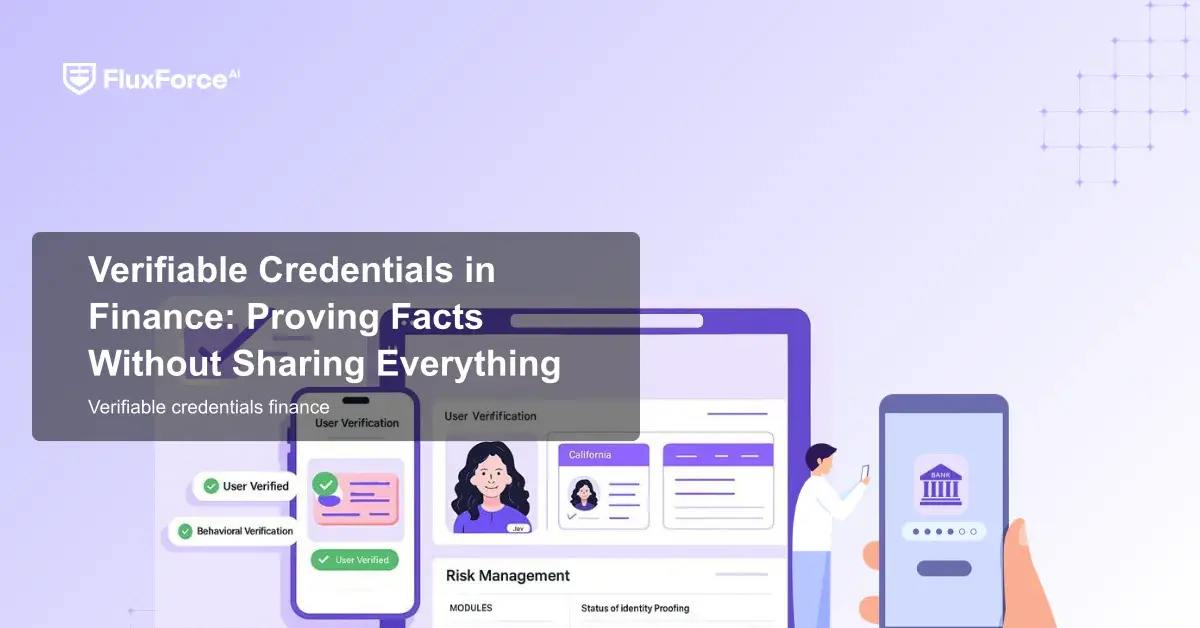



Verifiable credentials in finance are changing the way institutions prove customer facts without demanding access to every underlying document. Banks, fintechs, and insurers have spent decades asking applicants to surrender passports, pay stubs, and utility bills, then storing all of it in databases that attract attackers like a lighthouse in the dark. The smarter approach asks a different question: can you prove this specific fact, cryptographically, without handing over the document itself? That is exactly what verifiable credentials deliver, and the financial sector is starting to take notice.
For CISOs managing sprawling identity stacks, compliance officers navigating GDPR and PSD2, and product teams trying to cut onboarding drop-off rates, this shift matters on three dimensions: speed, security, and regulatory defensibility.
What Are Verifiable Credentials and Why Finance Needs Them Now
Verifiable credentials are digitally signed, tamper-evident claims about a subject, issued by a trusted authority, held by the individual, and presented to a verifier on demand. The W3C Verifiable Credentials Data Model provides the open standard that identity providers, governments, and regulators are converging on globally.
The financial sector's specific problem is that identity verification fintech teams are simultaneously dealing with regulatory pressure to know their customers, fraud pressure pushing attackers to fabricate those customers, and competitive pressure to onboard faster than rivals. Traditional document-centric KYC fails on all three fronts: it is slow, it creates liability when those documents are breached, and it cannot verify claims that do not yet exist in a standard document format.
The Document-Sharing Problem in Traditional KYC
Traditional onboarding asks customers to share everything so that institutions can extract a few specific facts. A bank needs to confirm that an applicant is over 18, resident in a given country, and not on a sanctions list. To confirm those three facts, it collects a passport, a utility bill, and a name match against watchlists, then retains all of it indefinitely.
That retained data is a liability. According to IBM's Cost of a Data Breach Report, the average cost of a breach in financial services exceeded $5.9 million in 2023, making it the second most expensive industry globally. The more you hold, the more attractive a target you become.
How Cryptographic Attestation Changes the Risk Equation
With verifiable credentials in finance, an issuer, such as a government identity agency or an accredited bank that has already completed identity verification, signs a credential attesting to specific facts. The customer holds that credential in a digital wallet. When a new institution needs to verify those facts, the customer presents just the relevant claims, not the underlying document. The verifier checks the cryptographic signature without ever seeing or storing the raw source material.
This is selective disclosure in practice. Age verification becomes over 21: confirmed rather than a full birthdate. Address verification becomes a country code rather than a utility statement copy. Digital identity proofing at this level of precision reduces both breach exposure and data minimization compliance overhead at the same time.
Regulatory Momentum Behind Digital Identity Proofing
The EU's eIDAS 2.0 regulation mandates digital identity wallets for EU citizens, directly enabling verifiable credential exchanges across member states. The UK's Data Protection and Digital Information Bill creates pathways for trusted digital identity services. NIST's Digital Identity Guidelines (SP 800-63) in the US provide the assurance level framework that many financial regulators reference when evaluating digital identity proofing claims. The regulatory direction is clear: document-heavy KYC is not the long-term answer.
How Verifiable Credentials Work in Financial Services
Understanding the mechanics helps product and compliance teams assess what verifiable credentials in finance actually require to implement, and where they fit relative to existing infrastructure.
Issuers, Holders, and Verifiers: The Three-Party Model
Every verifiable credential exchange involves three roles. The issuer is an authoritative body, such as a government, accredited KYC processor, or a regulated bank that has completed identity verification, that creates and cryptographically signs the credential. The holder is the customer, who stores the credential in a digital identity wallet on their device. The verifier is the institution that needs to confirm the claim, typically during onboarding or a high-value transaction.
The critical point for risk teams: the verifier never contacts the issuer directly during verification. The proof is in the cryptographic signature. This decentralized architecture removes the point-to-point data flows that create both privacy risks and identity verification api attack surfaces.
Selective Disclosure: Proving Age Without Revealing a Birthdate
Modern credential formats, specifically W3C VC-JWT and the IETF SD-JWT format, support selective disclosure. A credential might contain a full date of birth, address, nationality, and document number, but when the holder presents it to a verifier, they reveal only the fields the verifier actually needs. For an age check: the claim is over 21: true. For residency: the country code only. The underlying document data never leaves the customer's wallet. Digital identity proofing at this level of granularity is what data protection authorities under GDPR are increasingly expecting institutions to demonstrate.
Integration with Existing Identity Verification APIs
Most financial institutions have existing identity verification api infrastructure, KYC vendors, and case management systems already in place. Verifiable credentials slot in as a verification layer above these systems rather than a rip-and-replace. An institution can continue using biometric checks and document verification for first-time onboarding, then issue a reusable credential once that verification is complete. Subsequent interactions at the same or affiliated institutions use that credential, cutting repeat processing costs significantly.
Onboard Customers in Seconds

How Verifiable Credentials Improve KYC Onboarding Speed
KYC onboarding speed is one of the most commercially sensitive metrics in retail banking and fintech. Conversion rates drop sharply when onboarding exceeds ten minutes. For business accounts and investment products, multi-day delays for document review and AML screening are routine, and most teams have accepted this as unavoidable.
Why Traditional KYC Bottlenecks Cost Banks Customers
In our client engagements, retail bank KYC processes for full account opening, including document verification and AML screening, often stretch across several days. Drop-off rates during this window are commonly significant, representing direct revenue loss. As explored in our coverage of AML risk checks and KYC identity verification strategy for insurance claims directors, the manual review component of this delay is both the most expensive part and the most automatable part of the process.
Reusable Identity Credentials Across Institutions
With verifiable credentials in finance, a customer who has completed full KYC at Bank A can present their verified credential to Bank B. Bank B checks the cryptographic signature, confirms it was issued by an accredited institution, and completes onboarding in minutes rather than days. The customer's raw data is not re-collected; only the proof transfers.
The commercial case is direct: an institution that accepts pre-verified credentials can offer near-instant account opening to qualified applicants. This transforms kyc onboarding speed from a structural bottleneck into a differentiating product feature, particularly for mobile-first propositions targeting customers who expect same-session activation.
Reducing Manual Review Time with Pre-Verified Attributes
When verifiable credentials carry specific pre-verified attributes, such as AML-cleared status, accredited investor classification, or confirmed sanctions screening results, compliance teams do not re-run those checks from scratch. The credential attests that the check was done, by whom, and when. Compliance work shifts from re-executing verification to reviewing attestations, which is significantly faster and generates a cleaner audit trail. For institutions under DORA or PSD2 audit requirements, the cryptographic proof of each credential presentation satisfies regulatory reporting requirements without manual log review.
Stopping Synthetic Identity Fraud with Verifiable Credentials
Synthetic identity fraud is the fastest-growing category of financial crime by value. It works precisely because traditional KYC is built around matching documents, not confirming that a real, live person is behind them.
How Synthetic Identity Fraud Bypasses Conventional Checks
A synthetic identity typically combines a real identification number, often belonging to a child or deceased person, with fabricated name and address data. The profile builds credit history over months before being used to exhaust credit lines and disappear. Standard KYC document checks often pass synthetic profiles because the documents themselves appear coherent: a real number, a plausible name, a manufactured address with a matching postcode. The piece on detecting synthetic identity fraud in real time covers the detection mechanics in depth, including how behavioral signals layer on top of document checks to catch profiles that pass initial review.
Cryptographic Binding Eliminates Synthetic Profiles
Verifiable credentials in finance close the synthetic identity fraud detection gap at a structural level. A credential issued by a government identity authority cryptographically binds identity attributes to a verified biometric, typically a live selfie matched against a government document at issuance. A synthetic profile cannot produce this credential because there is no real person to provide biometric verification for. The combination of credential and biometric liveness check makes synthetic construction dramatically harder to execute at scale.
Combining Credential Verification with Behavioral Signals
The most resilient synthetic identity fraud detection systems layer verifiable credentials with behavioral analytics. The credential confirms static facts; behavioral signals such as device fingerprinting, typing cadence, and transaction velocity confirm that the credential holder behaves consistently with their claimed profile. Neither layer alone is sufficient. Together, they raise the fraud cost high enough to make most synthetic operations economically unviable for organized fraud groups.
Biometric Identity Verification and Deepfake Detection in Banking
Biometric identity verification has moved from a premium add-on to a regulatory expectation in many jurisdictions. But biometrics introduce a specific attack vector that verifiable credentials help neutralize: deepfake and spoofing attacks on the liveness check itself.
Why Liveness Detection Fraud Is a Growing Threat
Liveness detection fraud involves presenting a spoofed biometric, either a printed photo, a video replay, or an AI-generated deepfake, to defeat a face recognition check. As deepfake tools have become accessible to non-technical actors, attack volume has risen sharply. The threat extends beyond onboarding: account takeover attempts using AI-generated video in customer service calls are an emerging and documented pattern across European and North American banks.
For biometric identity verification to hold up under this pressure, liveness detection must distinguish a live human face from a fabricated representation. Passive liveness techniques analyze micro-movements and 3D depth data captured in a single frame. Active liveness adds challenge-response steps that a static image or basic video cannot replicate.
Binding Biometric Data to Verifiable Credentials
The durable solution is binding biometric verification results to verifiable credentials at issuance. When an accredited identity provider completes biometric identity verification with active liveness detection, they issue a credential that attests: the holder's biometric was verified against their government document, liveness was confirmed, at a specific date and time, using a specified assurance level. Subsequent presentations of that credential at other institutions carry that assurance forward without requiring the customer to repeat the full biometric process.
How Deepfake Detection in Banking Closes the Visual Spoofing Gap
Deepfake detection in banking is evolving from pixel-level analysis to multimodal detection, combining visual checks with audio-visual synchronization analysis, behavioral anomaly scoring, and device integrity verification. When these results are encoded in a verifiable credential alongside the liveness result, institutions accepting the credential inherit the full detection assurance of the original check. This prevents credential shopping, where a fraudster seeks out weaker-check institutions to obtain a credential they then present elsewhere.
Teams building zero trust security architecture for banking operations are treating biometric credential assurance levels as a core access control input, not just an onboarding artifact stored in a compliance file.
Zero Trust Financial Services and Credential-Based Access
Zero trust financial services architecture rejects the assumption that anything inside the network perimeter is safe. Every access request is verified based on identity claims, device posture, and behavioral context. Verifiable credentials are a natural fit for this model because they provide portable, cryptographically verifiable identity claims that can be evaluated at every access decision point without re-running full KYC each time.
Zero Trust Security Framework Applied to Identity Claims
The zero trust security framework applied to identity means continuous re-verification rather than session-based trust. A customer who authenticated three hours ago is not automatically trusted for a high-value transfer now. Verifiable credentials support this by enabling lightweight credential checks that do not require re-running document verification: the credential proves the identity assurance level, and a fresh liveness check confirms the current session holder. This architecture is examined in depth in our analysis of zero trust and agentic AI as the new standard for banking security.
Continuous Verification Instead of One-Time Checks
Static onboarding verification creates a known gap: the institution knows who the customer was at account opening but has limited assurance about who is transacting now. Credential-based continuous verification closes this gap by treating each high-value transaction or privileged access event as an opportunity to re-confirm relevant claims at an appropriate assurance level.
For institutions building zero trust in financial services across mobile channels, this pattern is particularly important. Mobile credentials combined with device binding and biometric confirmation create a continuous verification chain that addresses the session-based weaknesses of password-only authentication. The specifics of the mobile implementation are covered in our post on zero trust security for mobile-first banks.
What Credential-Based Zero Trust Looks Like in Practice
A practical implementation looks like this: at account opening, the customer presents a government-issued verifiable credential plus a biometric liveness check. The institution's KYC and AML automation layer validates the credential signature, checks the assurance level against the required threshold for that product, and runs AML screening against the attested attributes rather than raw document copies. For high-value transactions, the system requests a fresh credential presentation. Audit logs capture every credential check with cryptographic proofs, satisfying regulatory reporting requirements without manual review of individual log entries.
Building Your Identity Verification API Stack for Verifiable Credentials
Practical implementation of verifiable credentials in finance requires deliberate decisions across four layers: credential formats, wallet infrastructure, identity verification api integration, and governance.
What to Look for in an Identity Verification API
The identity verification api layer sits between the raw credential and your core banking or onboarding system. It needs to handle multiple credential formats (VC-JWT, SD-JWT, mdoc/mDL), validate against distributed trust registries, and return a structured response your system can act on without manual interpretation. Key evaluation criteria include support for selective disclosure, compliance with the eIDAS 2.0 trust framework for European operations, and clean integration with existing AML screening workflows.
For cross-border use cases involving supplier due diligence, institutions also need to evaluate how the API handles credentials from non-EU and non-US issuers. Our coverage of KYC and AML identity verification strategy for CISOs in high-risk supply chains walks through the cross-border validation problem in detail, including how issuance authority gaps create compliance blind spots.
Orchestrating Multiple Credential Sources
Most real-world deployments will accept credentials from multiple issuers: national identity providers, accredited KYC processors, open banking account verification services, and professional certification bodies. The orchestration layer must map assurance levels across issuers, handle cases where a presented credential's assurance level falls short of the threshold for a requested action, and fall back to a full KYC flow when no credential is available. This orchestration layer is where most implementation complexity concentrates, and where vendor capability differences matter most for compliance teams.
Compliance, Audit Trails, and Explainability
Verifiable credentials generate a naturally auditable record. Every credential presentation includes the issuer's signature, the specific claims revealed, and a timestamp. These records satisfy GDPR's data minimization requirement (only the shared claim was processed), PSD2's strong customer authentication audit requirements, and FATF guidance on documented identity verification. The honest limitation worth flagging: cross-border recognition of specific issuers is still inconsistent. A credential from an EU-accredited issuer may not be automatically recognized by a US institution's compliance team without additional configuration. That gap is narrowing as international frameworks converge, but it is a real planning constraint for implementations that span jurisdictions today.
Onboard Customers in Seconds
Conclusion
Verifiable credentials in finance are not a future concept: the standards are finalized, regulatory frameworks are catching up fast, and early adopters are already cutting onboarding time and reducing fraud losses in production. The case for moving from document-heavy KYC to cryptographic attestation rests on three measurable wins: faster kyc onboarding speed that reduces drop-off at the point of conversion, structural resistance to synthetic identity fraud that document checks cannot match, and a data minimization posture that simplifies GDPR and PSD2 compliance instead of adding to it.
For CISOs and compliance teams, the entry point is often more straightforward than it appears. Start with credential acceptance at onboarding alongside existing document checks, measure the improvement in verification time and fraud rate, and build from there. The zero trust financial services architecture to support this already exists in most mature institutions. Connecting it to a portable credential layer is the next logical step. If your institution is ready to reduce verification friction without reducing security standards, the infrastructure to do it is available today.
Share this article