










Listen To Our Podcast🎧
What will you learn?
The best fraud detection software for real-time payments is the product that can make a useful risk decision inside your payment window, explain that decision, and route uncertain cases to the right human control. A long feature list is secondary. Start with your payment rails, fraud types, latency budget, available data and authority model, then test vendors against the same replayable cases.
No vendor is best for every institution. A bank dealing with authorised push payment scams has a different problem from a fintech trying to stop account takeover at login, or a payment processor scoring card and account-to-account traffic through one API. The shortlist should follow the use case.
This buyer guide compares six vendors whose public materials describe relevant real-time fraud capabilities. It also gives you a scorecard, proof-of-concept plan and operating model. Vendor information is current as of October 6, 2026. Public product pages can change, so confirm scope, deployment, geography and commercial terms in writing before you buy.
- Build a source-bound vendor scorecard.
- Compare six vendors by best-fit use case.
- Test scams, account takeover and mule cases.
- Preserve replayable evidence and human authority.
Request the fraud vendor scorecard
Choose fraud detection software by payment-rail fit, latency, context, evidence, operations and human authority, then test every vendor against the same cases.
What will you learn?
This guide covers the evaluation criteria, vendor fit, proof-of-concept measures and human control points used in the comparison.
- How real-time payment fraud changes the software requirement
- Which objective criteria belong in a vendor scorecard
- Where FluxForce, Featurespace, Feedzai, FICO, NICE Actimize and BioCatch may fit
- How to test decision latency, scam detection, evidence quality and analyst control
- Which metrics expose weak performance during a proof of concept
- Where automation should stop and a fraud analyst should decide
The seven-part real-time fraud fit model
A useful evaluation separates seven questions that sales demonstrations often blur together.
- Payment coverage. Which rails, channels, message types and fraud patterns are supported today?
- Decision speed. Can the system score within your real production budget at the required percentile, rather than just at the average?
- Context. Does the decision use customer behaviour, device, account, beneficiary, network and transaction history where those data are lawful and available?
- Action control. Can your institution define pass, step-up, hold, reject and manual-review routes without giving a vendor uncontrolled authority?
- Evidence. Can an investigator replay the inputs, model or rule output, prior cases and final human decision?
- Operations. Does the workflow support queues, case ownership, feedback, quality review and change control?
- Economics. Does the expected reduction in fraud loss and manual work justify data, integration, tuning and operating cost?
This is an editorial evaluation model, not a certification. Change the weights to match your risk appetite and operating model.
Why real-time payments need a different fraud decision
Real-time payment infrastructure leaves little room for a slow fraud stack. The Federal Reserve says FedNow lets participating institutions send and receive instant payments in real time, around the clock, every day of the year. The Clearing House says its RTP network is available 24/7/365, supports transactions up to $10 million and settles payments finally.
- The visible article text explains every node, direction and human decision point.
That speed changes the job. A nightly model can find suspicious activity after settlement, but it cannot support a pre-payment control. A manual queue can help with selected high-risk cases, but it cannot become the default route for every payment without damaging customer experience and operating cost.
The loss environment is also getting harder to ignore. The Federal Trade Commission reported more than $12.5 billion in consumer fraud losses for 2024, up 25% from 2023. The FBI's Internet Crime Complaint Center reported $16.6 billion in losses in 2024 across complaints it received. These figures cover broader fraud rather than real-time payments alone. They still show why a buyer should demand measured loss prevention rather than vague claims about artificial intelligence.
Authorised push payment scams need another layer of control. The customer is authenticated, but the payment instruction may have been manipulated by a scammer. The UK's Payment Systems Regulator has made reimbursement and prevention central to its APP scam work, which raises the value of beneficiary, behavioural and scam-specific evidence before payment.
A real-time fraud decision should therefore answer four questions quickly:
- Is the payer behaving as expected?
- Is the device, session or account showing signs of takeover or manipulation?
- Is the beneficiary or connected network linked to mule or scam risk?
- Does the institution have enough evidence to pass, interrupt, hold or route the payment under its approved policy?
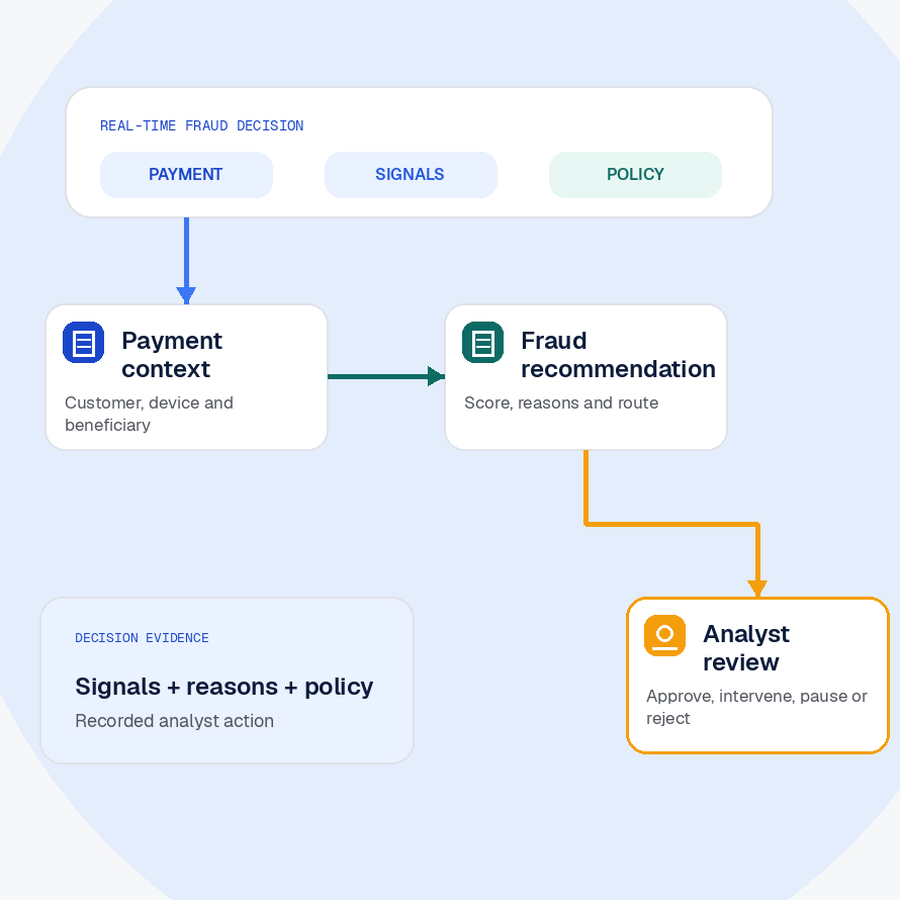
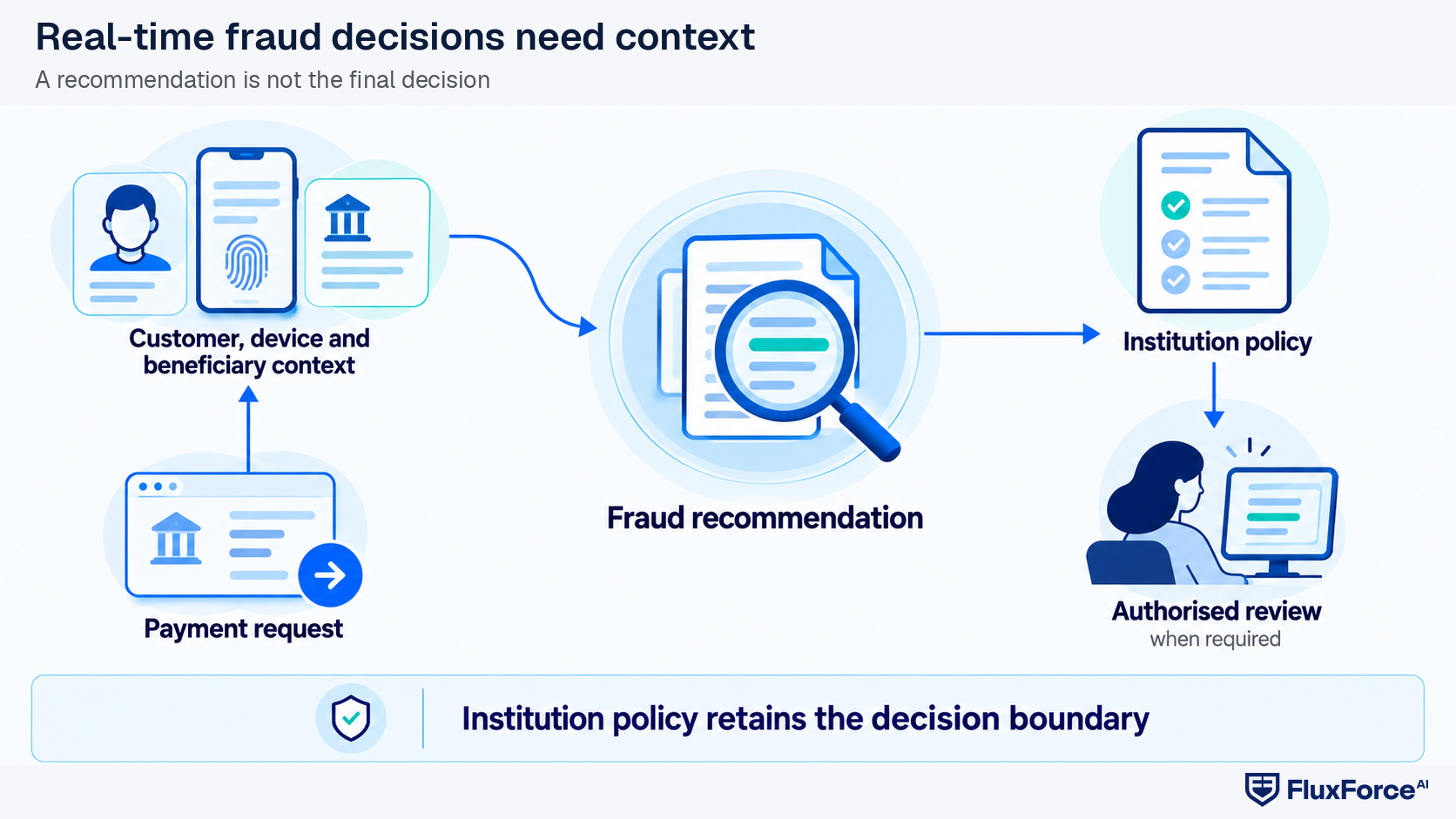
The software prepares a recommendation and evidence. Your authorised control or analyst owns the action defined by policy.
The path starts when the payment request brings customer, device and beneficiary context into a fraud recommendation. The fraud recommendation reaches institution policy, and institution policy sends the case to authorised review when required.
How were vendors included?
The shortlist uses objective inclusion criteria set before reviewing vendors.
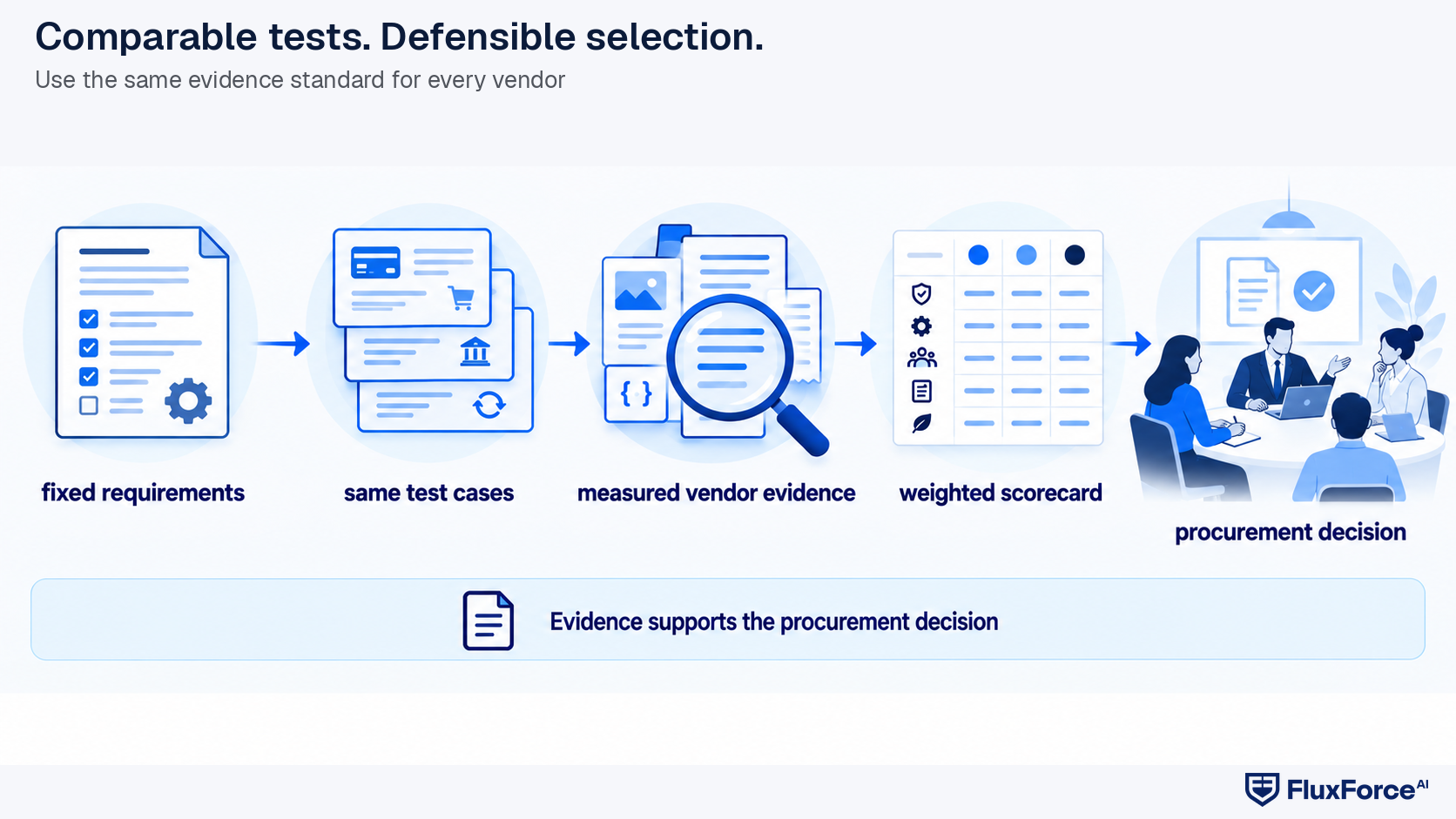
- The visible article text explains every node, direction and human decision point.
A vendor had to meet all of these conditions:
- Its current official material describes fraud detection for payments, banking or financial institutions.
- Its public material refers to real-time analysis, point-of-payment intervention or a comparable low-latency decision.
- There is enough public information to identify a plausible best-fit use case.
- The vendor has official material available for review as of October 6, 2026.
This is not a market ranking. It does not assess private product functions, contract terms, implementation quality or results that a vendor has not published. Silence on a public page is not treated as a weakness.
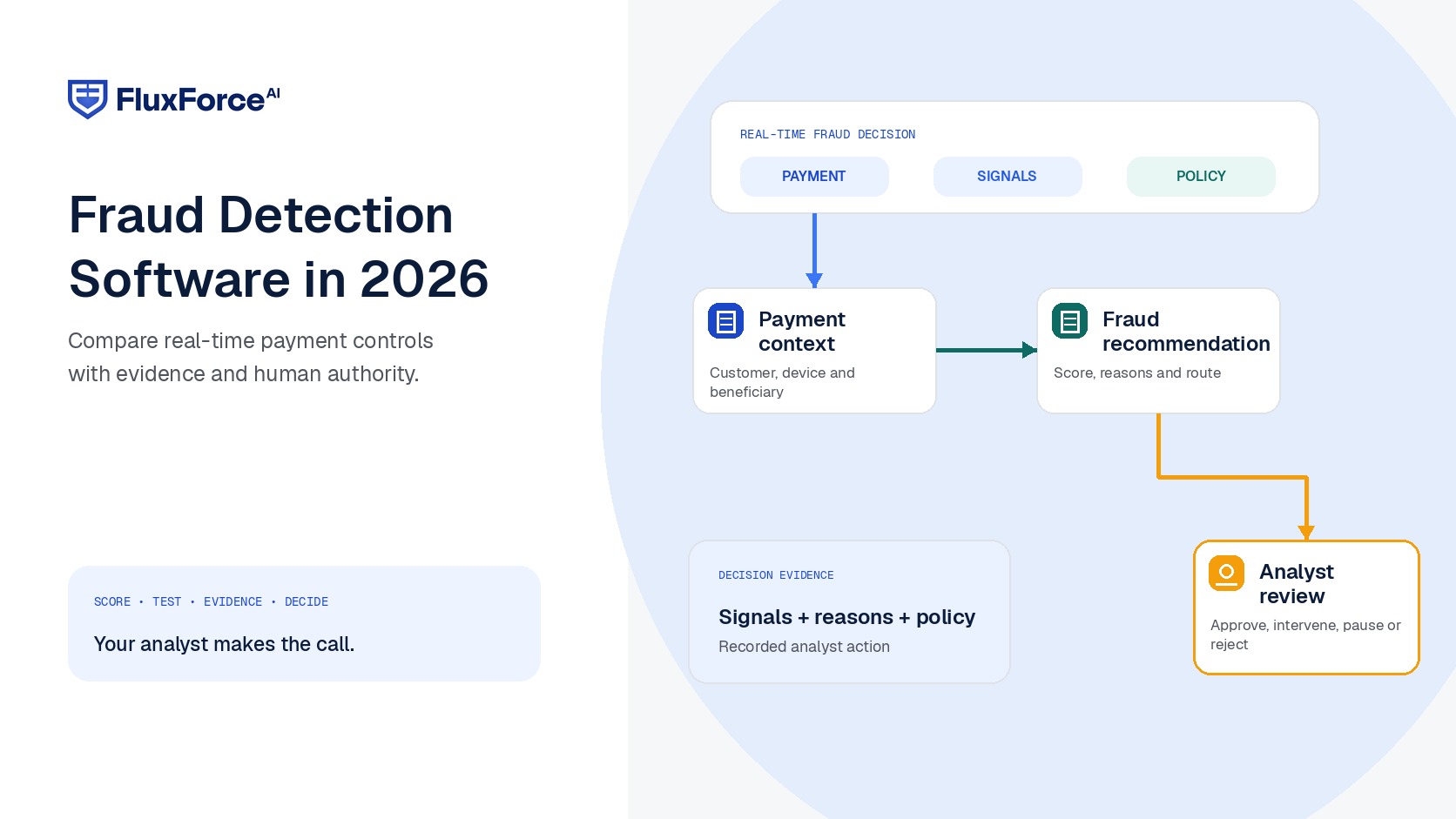
During evaluation, fixed requirements define the same test cases. The same test cases produce measured vendor evidence. The measured vendor evidence feeds a weighted scorecard, and the weighted scorecard supports the procurement decision.
Fraud detection software shortlist for real-time payments
| Vendor | Best fit to investigate | Publicly described strength | What to verify in an RFP |
|---|---|---|---|
| FluxForce | Institutions that want fraud alert investigation and evidence preparation tied to human control | Real-time payment scoring under institution-approved policy, with evidence prepared for review | Exact rail coverage, data connectors, production latency and deployment scope |
| Featurespace | Banks prioritising scam and APP fraud intervention at the point of payment | Public material describes real-time scam-risk detection using behavioural and transactional data. | Supported scam types, intervention workflow, local rail coverage and case feedback |
| Feedzai | Large payment estates that want transaction, device and scam signals in one fraud programme | Public material describes scam detection, behavioural biometrics, device profiling and secure customer intervention. | Data residency, rail-specific models, operational ownership and explainability for each action |
| FICO Falcon Fraud Manager | Institutions seeking a mature fraud decision system across payment channels | FICO describes real-time behavioural profiling and machine-learning fraud assessment for payments. | Which modules and models cover your rails, change process, hosting and analyst evidence |
| NICE Actimize | Complex institutions that want fraud prevention connected to enterprise investigation operations | NICE Actimize describes real-time fraud prevention across products, channels and payment methods. | Implementation boundaries, case integration, model governance, operating effort and local support |
| BioCatch | Banks where account takeover, scam manipulation and digital-session behaviour are central | BioCatch describes behavioural profiles based on digital interactions to distinguish legitimate and criminal activity. | Coverage outside digital channels, payment-decision integration, consent, retention and false-positive control |
The table is a starting point. Do not award points for a capability until the vendor shows it using your data, message format and decision window.
Where FluxForce may fit
FluxForce's approved Fraud Prevention workflow scores payments using institution-approved rules, velocity and customer behaviour. The agent explains the signals and recommends the next action under the institution's policy. Authorised controls and people retain responsibility for pass, hold and block decisions.
That makes FluxForce worth investigating when your main problem is not merely generating a score. It is useful when your fraud team also needs the alert investigated, the relevant evidence assembled and the case prepared for an accountable reviewer.
The buyer still needs to validate exact payment-rail coverage, available connectors, production latency, resilience, data requirements and deployment scope. Do not assume that a public solution description proves fit for a specific architecture. Use the fraud detection API integration guide to structure the technical questions, then test the real interface.
Where Featurespace may fit
Featurespace is a plausible shortlist candidate for banks focused on APP scams and scam intervention. Its official material describes scam-risk detection in real time at the point of payment, using behavioural and transactional data.
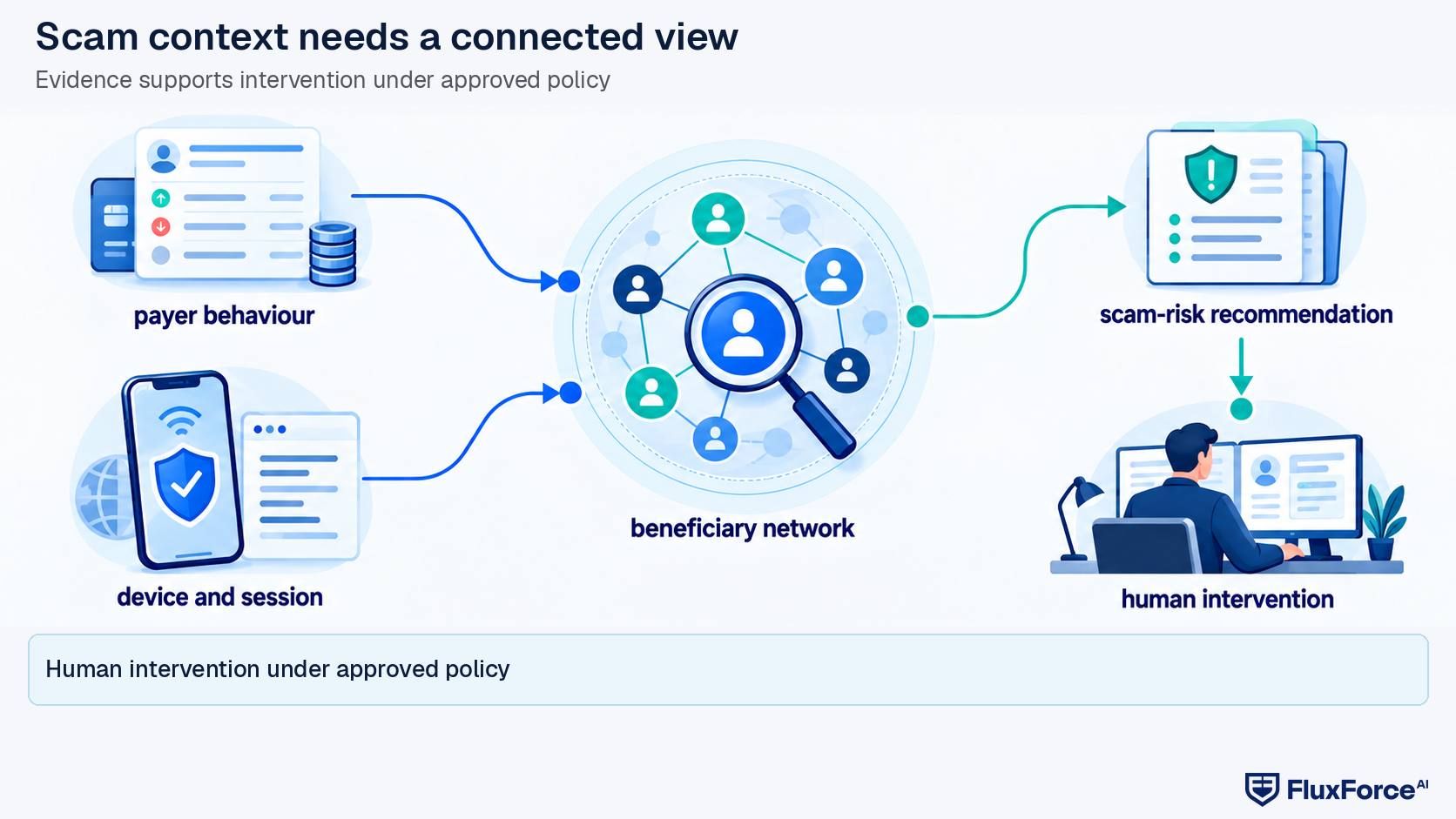
- The visible article text explains every node, direction and human decision point.
That positioning matters because an APP scam often looks different from unauthorised account takeover. The payer may use the usual device and pass authentication. The useful signals may sit in changes to payment behaviour, beneficiary relationships, session activity and the context surrounding the transfer.
Ask Featurespace to demonstrate:
- how it distinguishes scam risk from ordinary unusual spending;
- which payer and beneficiary signals are required;
- what happens when data arrive late or are unavailable;
- how an intervention is explained to the customer and analyst; and
- how confirmed outcomes update future decisions.
Do not infer geographic or rail coverage from a general scam-prevention statement. Put each required scheme and country in the contract schedule.
For scam review, payer behaviour and device and session evidence help reveal beneficiary network risk. The beneficiary network supports a scam-risk recommendation, which can trigger human intervention under approved policy.
Where Feedzai may fit
Feedzai is a sensible candidate for institutions that want transaction fraud, scam signals, device information and behavioural analysis inside one fraud programme. Its official Trusted Transactions material describes scam detection, behavioural biometrics, device profiling and secure messaging for customer intervention.
The breadth can help a bank that currently runs separate tools for account access, transaction scoring and scam operations. It can also make implementation more demanding because identity, device, customer, transaction and outcome data must be connected cleanly.
Ask Feedzai to show the full decision path for one payment:
- the source and age of every input;
- the rules and models that contributed to the recommendation;
- the latency added by enrichment;
- the action returned to the payment system;
- the evidence available to the investigator; and
- the feedback route after confirmation, reimbursement or customer challenge.
A broad product set is useful only if your team can govern it without creating an opaque fraud stack.
Where FICO Falcon Fraud Manager may fit
FICO Falcon Fraud Manager belongs on many bank shortlists because FICO publicly describes payment fraud assessment in real time using behavioural profiling and machine learning. It may suit institutions that want a fraud decision system spanning established payment channels and existing bank operations.
The important RFP question is not whether Falcon is well known. It is whether the exact package being proposed covers your real-time rail, message type, intervention model and evidence requirement.
Request a live demonstration using representative cases:
- a new beneficiary with ordinary customer behaviour;
- an account-takeover payment from a new device;
- a scam payment from the customer's normal device;
- a mule beneficiary connected to prior confirmed cases; and
- a legitimate high-value payment that should not be stopped.
Measure the result, reason code, response time and analyst evidence for every case. A brand name is not a substitute for that test.
Where NICE Actimize may fit
NICE Actimize may fit a large or complex institution that wants fraud prevention connected to wider enterprise investigation operations. Its official material describes real-time fraud prevention across products, channels and payment methods.
That enterprise scope can be useful when the same customer, device or beneficiary appears across several business lines. It can also create a large change programme. The buyer should separate the fraud decision from the wider platform promise and test the minimum production path first.
Ask for a phased design that identifies:
- the first payment rail and fraud type;
- required upstream and downstream systems;
- the case-management boundary;
- model and rule ownership;
- release, rollback and outage procedures; and
- the operating team needed after go-live.
If the proposal cannot identify a small first decision path, implementation risk is probably being hidden inside the word platform.
Where BioCatch may fit
BioCatch is relevant when digital behaviour is a major part of the fraud problem. Its public material describes building behavioural profiles from digital interactions and using them to distinguish legitimate activity from criminal activity.
That can add context for account takeover and scam manipulation that a transaction-only model may miss. It does not remove the need for beneficiary, network, transaction and customer-history controls.
A proof of concept should test where behavioural data changes the decision and where it does not. Ask how the system handles accessibility tools, shared devices, new customers, legitimate travel, device replacement and sparse histories. Confirm consent, retention, cross-border data handling and access controls with your legal and privacy teams.
What should the decision architecture look like?
The safest design keeps payment execution, fraud analysis and human accountability separate.
| Component | Responsibility | Boundary |
|---|---|---|
| Payment channel | Captures the payment and required context | Does not invent missing fraud evidence |
| Fraud decision service | Returns a score, reason and recommended route within the latency budget | Does not override the institution's approved action policy |
| Policy control | Maps the recommendation to pass, step-up, hold, reject or review | Uses institution-approved thresholds and authority |
| Investigation workflow | Connects customer, device, beneficiary, transaction and prior-case evidence | Does not decide beyond the reviewer's delegated authority |
| Fraud analyst or authorised control owner | Reviews uncertain or escalated cases and records the reason | Retains accountability for the final human decision |
| Model and control governance | Approves changes, tests outcomes and can roll back | Does not accept unexplained performance drift |
Keep a kill switch that can disable an agent or automated route without disabling the entire payment service. Define what happens during vendor outage, enrichment failure, data delay and model rollback before production.
Illustrative scenario: a first payment to a new beneficiary
This example is illustrative. It is not a customer result or a benchmark.
A long-standing customer initiates a high-value instant payment to a new beneficiary. The login uses the customer's normal device, so a simple account-takeover rule stays quiet. The amount, timing and beneficiary relationship are unusual, and the beneficiary has a network link to accounts involved in prior confirmed scam cases.
The fraud service returns a high-risk recommendation with the contributing signals. The institution's policy routes the payment to a short intervention rather than allowing an agent to make an unrestricted decision. The customer response and available evidence go to an authorised fraud reviewer where policy requires it. The reviewer records the final decision and reason.
The test is not whether the software produced a high score. The test is whether it connected the right evidence quickly enough, supported the approved action and preserved a record that can be reviewed later.
How should you score vendors?
Use a 100-point model and change the weights before demonstrations begin.
| Category | Suggested weight | Evidence to request |
|---|---|---|
| Payment and fraud coverage | 20 | Contracted rail, message and fraud-type matrix |
| Decision latency and resilience | 15 | P50, P95 and P99 under representative load, plus outage test |
| Customer, device and beneficiary context | 20 | Field-level data map and case replay |
| Explainability and evidence | 15 | Investigator view, reason history and decision audit |
| Integration and change control | 10 | API events, versioning, rollback and release process |
| Operations and feedback | 10 | Queue design, quality review and confirmed-outcome loop |
| Governance, privacy and security | 10 | Access controls, retention, data location and model-control evidence |
Score only observed evidence. A roadmap statement gets zero until it becomes contracted and testable. A slide describing a connector gets zero until data move through it.
The fraud loss ROI calculator can help structure the cost side of the decision, but use your own verified loss, workload and intervention data.
What should a proof of concept measure?
A proof of concept should test the decision path, not produce a polished dashboard.
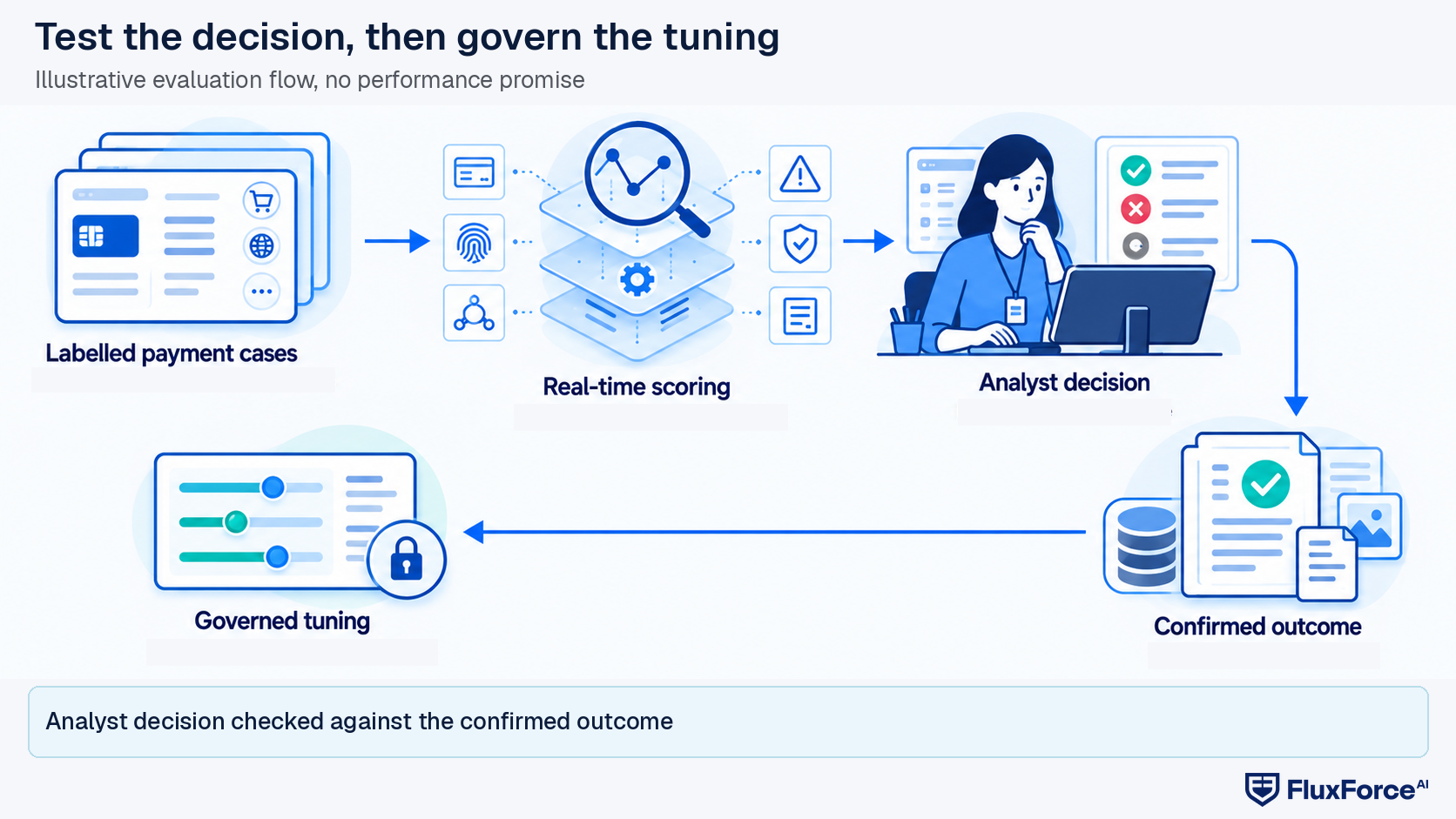
- The visible article text explains every node, direction and human decision point.
Detection and customer impact
- Fraud value detection rate: confirmed fraud value identified before the relevant action point, divided by total confirmed fraud value in the test set.
- False-positive rate: legitimate payments sent to an adverse or manual route, divided by legitimate payments tested.
- Customer intervention success: scam-risk cases where the approved intervention prevented or changed the payment outcome, with the definition fixed before testing.
Speed and reliability
- P95 and P99 decision latency: elapsed time from complete request receipt to usable response at the stated percentile.
- Timeout rate: requests that did not return a usable response inside the production budget.
- Degraded-mode coverage: share of required controls that still operate when an enrichment or vendor service is unavailable.
Investigation and governance
- Evidence completeness: sampled cases with the required inputs, reasons, prior history and decision record.
- Analyst handling time: active review time for comparable case types, measured without hiding work in another queue.
- Decision consistency: comparable cases receiving materially different outcomes without a documented reason.
- Change rollback time: time needed to return to the last approved rule, model or routing version.
Do not combine these into one unexamined accuracy number. Fraud value, customer friction, latency and operational effort can move in different directions.
During testing, labelled payment cases enter real-time scoring. The real-time scoring supports the analyst decision. The analyst decision is checked against the confirmed outcome, and the confirmed outcome informs governed tuning.
How FluxForce fits a real-time fraud operating model
FluxForce is an Agentic OS for Regulated Industries. AI agents that investigate AML, sanctions, fraud and KYC alerts and prepare the case. Your analyst makes the call, with evidence an examiner can replay. You decide how much each agent does on its own, and every one has a kill switch.
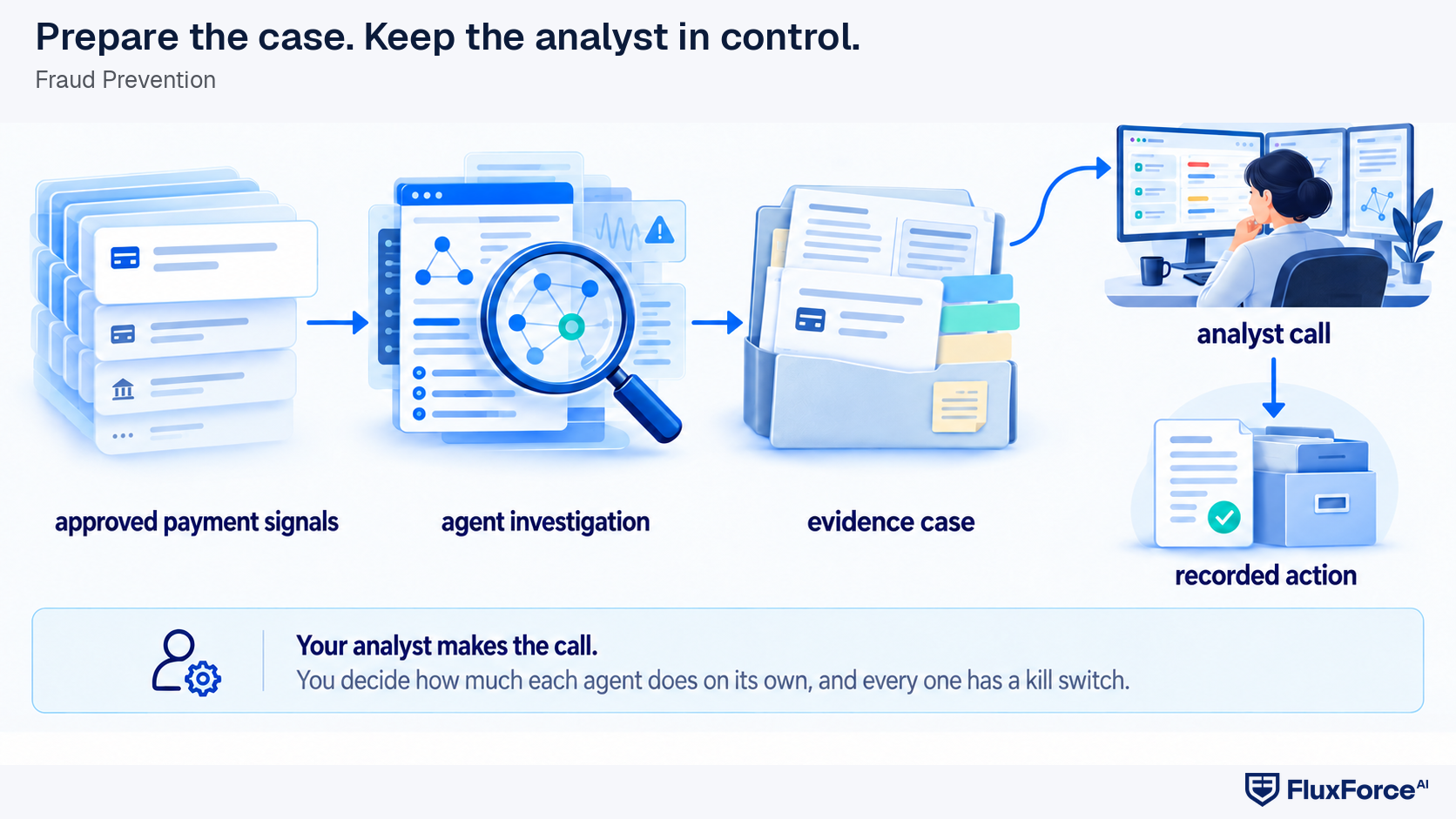
- The visible article text explains every node, direction and human decision point.
For the Fraud Prevention solution, that means an agent can collect approved transaction, customer, device and behavioural signals, apply institution-approved logic, explain why an alert fired and prepare the evidence for review. The institution defines which low-risk routes may proceed automatically, which payments receive an intervention, and which cases need an authorised person.
FluxForce is not a substitute for your payment switch, scheme rules, fraud policy, legal judgement or accountable control owner. It does not prove suitability for a rail or latency target until that path is tested with your data and architecture.
Within FluxForce, approved payment signals enter agent investigation. The agent investigation prepares the evidence case. The evidence case goes to the analyst call, and the analyst call produces the recorded action.
What should happen before rollout?
- Define one payment rail, one fraud type and one decision point.
- Freeze the test population, labels and loss definition.
- Document every required input and its permitted use.
- Set P95 and P99 latency budgets and timeout behaviour.
- Define pass, intervention, hold, reject and manual-review authority.
- Test ordinary, attack, scam, mule, data-loss and outage cases.
- Review false positives by customer segment, channel and payment type.
- Confirm evidence retention, access, privacy and model-change controls.
- Run in observation mode before increasing automated authority.
- Require an approved rollback and kill-switch test.
The Head of Fraud should own the operating outcome. The CTO should own technical fit and resilience. Compliance, privacy, security and model-risk reviewers should sign off the parts within their mandates.
Key takeaways
- Pick software against your payment rail, fraud type and decision window.
- Score observed evidence, not brand recognition or roadmap slides.
- Test scam, account-takeover, mule and legitimate high-value cases separately.
- Measure latency at P95 and P99, along with fraud loss and customer friction.
- Keep action policy, escalation and accountable decisions under institutional control.
- Match the vendor to the payment rail and fraud type.
- Measure P95 and P99 latency.
- Score observed evidence, not roadmap slides.
- Keep action policy and accountable decisions under institutional control.
Conclusion
A useful shortlist can be built without pretending one vendor is number one. Define the payment, fraud event, latency budget, available evidence and human authority first. Then make each vendor process the same cases and explain the result.
The winner is the product that fits your operating model and survives the hard cases. If the evidence is weak, the response is late or the action boundary is unclear, keep testing.
Request the fraud vendor scorecard
Compare vendors with the same evidence
Do not let each vendor choose its own success metric. Download the fraud vendor scorecard and run one source-bound evaluation across every shortlisted product.
Frequently Asked Questions
About the author
Sahil Kataria is the Founder and CEO of FluxForce.
Related articles and tools
- AI fraud detection for banking, a wider guide to bank fraud controls
- Fraud loss ROI calculator, a planning tool for loss and workload assumptions
- Fraud detection API integration, technical questions for a real-time decision path
About the author

Sahil Kataria
Founder and CEO of FluxForce


Share this article