.webp)




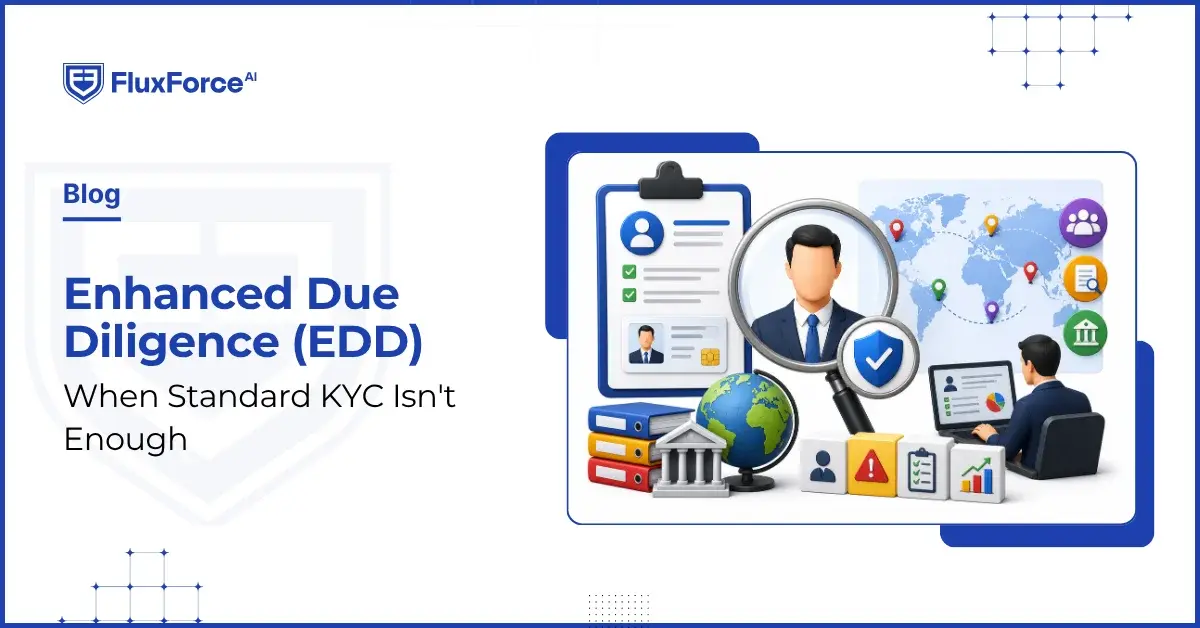



Enhanced due diligence (EDD) activates when standard KYC processes can't adequately assess customer risk. Financial institutions face a critical decision point: when does routine customer verification become insufficient, and what additional steps must you take to satisfy regulators? This enhanced due diligence EDD guide explains the triggers, requirements, and implementation strategies that keep compliance teams out of regulatory trouble.
Banks, fintechs, and insurers all face the same pressure. Customer onboarding must be fast enough to compete while remaining thorough enough to satisfy examiners. The balance tips toward enhanced due diligence when risk indicators exceed standard thresholds. Understanding those thresholds and the documentation they require separates compliant institutions from enforcement actions.
This guide covers when EDD applies, what information you must collect, how to verify high-risk customers, and the technology that makes ongoing monitoring sustainable. You'll learn the specific triggers that mandate enhanced scrutiny, the documentation standards examiners expect, and the automation tools that reduce manual burden without sacrificing compliance quality.
What Triggers Enhanced Due Diligence Requirements?
Enhanced due diligence isn't optional for certain customer categories. Regulators mandate EDD when risk factors exceed baseline thresholds. Understanding these triggers helps compliance teams apply the right level of scrutiny from onboarding.
High-Risk Customer Categories
Certain customer types automatically trigger EDD requirements under BSA AML compliance rules:
- Politically Exposed Persons (PEPs): Foreign government officials, their families, and close associates require enhanced scrutiny due to corruption risk
- High-risk jurisdictions: Customers from countries with weak AML controls, sanctions exposure, or elevated corruption indices
- Cash-intensive businesses: Casinos, money services businesses, and dealers in precious metals face higher money laundering risk
- Complex ownership structures: Entities with layered ownership that obscures beneficial owners
- Non-resident customers: Cross-border relationships without physical presence increase verification difficulty
For bsa aml compliance community banks, identifying these categories early prevents costly remediation later. The bsa aml compliance checklist should flag these customers during initial onboarding so EDD processes activate automatically.
Transaction-Based Risk Indicators
Customer behavior can trigger EDD even when initial onboarding used standard due diligence. Transaction monitoring systems should flag:
- Unusual transaction volumes inconsistent with customer profile
- Rapid movement of funds with no clear business purpose
- Structuring patterns that suggest deliberate avoidance of reporting thresholds
- Transactions with high-risk jurisdictions not explained by customer business
- Frequent large cash deposits or withdrawals
When these patterns emerge, you must revisit the customer relationship and apply enhanced due diligence to understand the activity. This ongoing monitoring requirement means EDD isn't a one-time onboarding step but a continuous obligation.
Regulatory Expectations for EDD Documentation
Examiners don't just want EDD performed. They want it documented in ways that demonstrate thoughtful risk assessment. Your aml compliance documentation should include:
- Source of wealth verification with supporting documentation
- Source of funds for specific transactions when warranted
- Beneficial ownership identification down to natural persons
- Business relationship rationale explaining why the customer makes sense for your institution
- Enhanced ongoing monitoring plans with specific review frequencies
The FinCEN Customer Due Diligence Rule specifies minimum requirements, but examiners expect documentation that shows genuine understanding of customer risk, not checkbox compliance.
How Does EDD Differ from Standard CDD?
Customer Due Diligence (CDD) and Enhanced Due Diligence (EDD) exist on a risk continuum. Understanding the differences helps compliance teams apply appropriate scrutiny levels without over-documenting low-risk relationships.
Information Collection Requirements
Standard CDD requires basic customer identification, beneficial ownership information, and understanding of expected account activity. EDD adds layers:
| Standard CDD | Enhanced Due Diligence |
|---|---|
| Government-issued ID | Multiple independent ID sources |
| Basic business registration | Corporate structure documentation with ownership chain |
| Expected transaction ranges | Source of wealth documentation |
| Beneficial owner names | Beneficial owner verification with net worth documentation |
| Business purpose statement | Independent verification of business activities |
For aml compliance fintech operations, this distinction matters because digital onboarding must collect additional documentation without creating unacceptable friction. The kyc automation 2026 tools that handle EDD must verify documents, not just collect them.
Verification Depth and Independence
Standard CDD often accepts customer-provided documentation at face value. EDD requires independent verification:
- Cross-reference business registration with tax filings
- Verify source of wealth through third-party sources (property records, business filings, employment verification)
- Confirm beneficial ownership through multiple databases
- Validate business activities through website review, customer references, or site visits for highest-risk relationships
This verification requirement creates significant manual work for compliance teams. Aml compliance software that automates document verification and third-party database checks reduces the burden while maintaining audit trails examiners expect.
Ongoing Monitoring Intensity
Standard CDD relationships receive periodic review, typically annually or biannually. EDD relationships require more frequent scrutiny:
- Quarterly or semi-annual relationship reviews instead of annual
- Transaction monitoring with lower alert thresholds
- Periodic re-verification of source of wealth for highest-risk customers
- Enhanced scrutiny of transactions with new counterparties
For fintech bsa aml small team operations, this monitoring intensity creates resource challenges. A single compliance officer managing hundreds of EDD relationships needs automation to track review schedules and document findings consistently.
What Technology Supports EDD at Scale?
Manual EDD processes don't scale. Compliance teams managing hundreds of high-risk relationships need anti money laundering technology that automates verification, monitoring, and documentation without sacrificing thoroughness.
Automated Document Verification
Modern aml compliance software uses computer vision and database integration to verify documents automatically:
- ID document authentication detecting forgery indicators
- Business registration cross-check with government databases
- Utility bill verification confirming address authenticity
- Corporate document analysis extracting beneficial ownership information
This automation reduces manual review time by 60-80% while improving accuracy. The technology flags documents requiring human review, letting compliance staff focus on genuine risk assessment instead of basic verification.
Risk Scoring and Trigger Automation
Anti money laundering technology 2026 systems use machine learning to score customer risk and trigger EDD automatically:
- Initial risk scoring during onboarding based on customer type, jurisdiction, and business activity
- Ongoing risk recalibration based on transaction behavior
- Automatic EDD workflow activation when risk scores exceed thresholds
- Periodic risk re-assessment scheduling based on risk level
For bsa aml compliance community banks with limited compliance staff, this automation ensures EDD triggers consistently without relying on individual analyst judgment. The system applies the same standards across all relationships.
Integrated Screening and Monitoring
EDD requires ongoing screening against sanctions lists, PEP databases, and adverse media. Integrated platforms combine:
- Real-time sanctions screening at onboarding and ongoing
- PEP identification with relationship mapping to detect indirect exposure
- Adverse media monitoring with natural language processing to filter relevant news
- Transaction monitoring with EDD-specific alert scenarios
The FFIEC BSA/AML Examination Manual emphasizes integrated monitoring that connects customer information with transaction behavior. Siloed systems create gaps examiners find during examinations.
Onboard Customers in Seconds

How Do You Document EDD for Examiners?
Examination readiness separates compliant institutions from those facing enforcement. Your EDD documentation must demonstrate thoughtful risk assessment, not just completed checklists.
EDD File Structure Requirements
Each EDD relationship needs a complete file containing:
- Initial risk assessment: Documentation of why EDD was triggered
- Source of wealth verification: Tax returns, business financials, property records, or employment verification
- Beneficial ownership documentation: Corporate charts, ownership agreements, and identification for all beneficial owners
- Business relationship rationale: Written explanation of why this customer fits your institution's risk appetite
- Enhanced monitoring plan: Specific review frequency and transaction monitoring parameters
- Periodic review records: Documentation of all subsequent reviews with updated risk assessments
For aml compliance teams, maintaining this documentation requires disciplined processes. Missing documentation during examinations creates findings even when EDD was actually performed.
Quality Standards for EDD Narratives
Examiners read EDD narratives to assess whether analysts understood customer risk. Strong narratives include:
- Specific details about customer business activities, not generic descriptions
- Explanation of why source of wealth documentation supports stated net worth
- Analysis of whether transaction activity aligns with expected profile
- Clear rationale for continuing the relationship despite elevated risk
- Identification of residual risks and mitigating controls
Weak narratives use boilerplate language that could apply to any customer. Examiners interpret this as checkbox compliance, not genuine risk understanding. Training analysts to write specific, customer-specific narratives improves examination outcomes.
SAR Filing Integration with EDD
When EDD reveals suspicious activity, sar filing becomes necessary. Your EDD documentation should support SAR narratives:
- Transaction details that triggered suspicion
- Customer explanation and why it was deemed inadequate
- Additional research performed during EDD review
- Decision rationale for filing or not filing
Sar filing best practices require connecting EDD findings to suspicious activity determinations. The suspicious activity report guide from FinCEN emphasizes documenting the investigative process, not just the conclusion.
What Are Common EDD Implementation Mistakes?
Compliance teams make predictable errors when implementing EDD programs. Understanding these mistakes helps you avoid examination findings and enforcement actions.
Treating EDD as a One-Time Event
The most common mistake: performing EDD during onboarding then reverting to standard monitoring. EDD relationships require enhanced ongoing monitoring:
- More frequent periodic reviews (quarterly vs. annual)
- Lower transaction monitoring thresholds
- Periodic re-verification of source of wealth
- Enhanced scrutiny of new counterparties or business activities
Examiners check whether EDD relationships actually receive enhanced treatment throughout the relationship, not just at onboarding. Your aml risk assessment guide should specify ongoing requirements, not just initial collection.
Inadequate Source of Wealth Verification
Collecting source of wealth statements without verification creates examination risk. Common gaps:
- Accepting customer statements without supporting documentation
- Failing to corroborate stated wealth with external sources
- Not updating source of wealth when customer activity changes significantly
- Missing beneficial owner source of wealth for entity customers
For bsa aml compliance community banks, resource constraints sometimes drive inadequate verification. But examiners expect verification proportional to risk, not proportional to available staff.
Poor Escalation Procedures
EDD findings sometimes reveal information requiring escalation: new sanctions exposure, adverse media, or suspicious activity. Weak escalation procedures create gaps:
- Analysts lack clear guidance on when to escalate
- Escalation paths are unclear or require too many approval layers
- Documentation of escalation decisions is incomplete
- Sar filing requirements 2026 aren't integrated with EDD workflows
Your EDD procedures should specify escalation triggers, approval chains, and documentation requirements. Testing these procedures through scenario exercises reveals gaps before examinations do.
How Does EDD Apply Across Different Institution Types?
EDD requirements vary by institution type and business model. Banks, fintechs, and insurers all face EDD obligations but implement them differently.
Community Banks and EDD
Bsa aml compliance community banks face specific challenges:
- Limited compliance staff requiring efficient EDD processes
- Relationship banking model creating pressure to onboard despite risk concerns
- Less sophisticated technology requiring more manual verification
- Examiner expectations calibrated to institution size and complexity
Community banks can't match large banks' EDD technology investments, but examiners expect risk-appropriate processes. The key is documenting thoughtful risk assessment, not matching large bank procedures.
Fintech EDD Implementation
Aml compliance fintech operations face different pressures:
- Digital onboarding requiring remote document verification
- High transaction volumes demanding automation
- Novel business models without clear EDD precedents
- Regulatory scrutiny of fintech partnerships with banks
Fintechs need kyc automation 2026 tools that handle EDD documentation digitally while maintaining verification quality. The KYC/AML & Identity Verification Strategy for CISOs article covers technology approaches that work for digital-first institutions.
Insurance and EDD
Insurance companies face EDD requirements for high-value policies and certain products:
- Large premium payments requiring source of wealth verification
- Annuity and life insurance products with investment components
- Cross-border policies with jurisdiction risk
- Beneficial ownership for entity policyholders
The AML Risk Checks in Policy Issuance: KYC/AML & Identity Verification Strategy for Claims Directors in Insurance article covers insurance-specific EDD considerations.
What Does EDD Cost in Resources and Time?
EDD requires significant compliance resources. Understanding the cost helps institutions budget appropriately and justify technology investments.
Staff Time Requirements
In our client engagements, EDD relationships typically require several times the staff time of standard CDD:
- Initial EDD onboarding: 4-8 hours vs. 1-2 hours for standard CDD
- Quarterly EDD reviews: 2-3 hours vs. 30 minutes for standard reviews
- Source of wealth verification: 2-4 hours of research and documentation
- Enhanced transaction monitoring alert review: 50-100% more time per alert
For fintech bsa aml small team operations, this resource requirement creates capacity constraints. A single compliance officer can manage perhaps 50-75 EDD relationships while maintaining other responsibilities.
Technology Investment Requirements
EDD automation requires technology investment:
- Aml compliance software with EDD workflow management: in our experience, a significant annual line item that scales with institution size
- Document verification services: typically priced per verification depending on document type
- Third-party database access for source of wealth: another recurring annual cost in our client engagements
- Training and procedure development: a meaningful investment of compliance staff time
The business case for EDD technology rests on examination findings avoidance and staff capacity. A single enforcement action costs far more than years of EDD technology investment.
Onboard Customers in Seconds
Conclusion
Enhanced due diligence separates compliant financial institutions from enforcement actions. When standard KYC can't adequately assess customer risk, EDD provides the additional scrutiny regulators require. The key is applying EDD consistently to high-risk relationships, documenting your risk assessment thoroughly, and maintaining enhanced monitoring throughout the relationship.
EDD implementation requires investment in staff training, technology, and procedures. But the cost pales against examination findings, enforcement actions, and reputational damage from inadequate due diligence. For aml compliance teams, EDD isn't optional. It's a core competency that defines institutional risk management quality.
Start by reviewing your bsa aml compliance checklist to ensure EDD triggers are clearly defined and automated where possible. Audit existing EDD relationships for documentation completeness. Then invest in aml compliance software that reduces manual burden while improving consistency. Your examiners will notice the difference.
Ready to strengthen your EDD program? Our team specializes in compliance automation that handles enhanced due diligence at scale. We've helped banks, fintechs, and insurers implement EDD workflows that satisfy examiners without overwhelming compliance staff.

Share this article