



















Listen To Our Podcast🎧
Introduction
Rule-based vs AI fraud detection is no longer an academic debate — it is the single most consequential technology decision facing fraud teams at financial institutions in 2026. Choose wrong, and you are either drowning in false positives or missing sophisticated fraud patterns entirely.
According to the Association of Certified Fraud Examiners (ACFE), financial institutions lost $4.7 trillion globally to fraud in 2025, a 12% increase from the prior year. Meanwhile, Gartner's 2025 Financial Crime Technology Survey found that 62% of mid-market banks still rely primarily on rule-based systems, even as fraud sophistication has outpaced their detection capabilities. The result? Detection rates stagnate, while false positive rates consume 70% or more of analyst time.
This article delivers an honest, data-backed comparison — not a vendor pitch. We examine detection rates, false positive rates, adaptation speed, cost structures, explainability, and regulatory acceptance across both approaches. The conclusion may surprise you.
In this article, you'll learn:
- How rule-based and AI fraud detection actually perform across 9 measurable dimensions
- Where rules still outperform AI (yes, there are areas)
- Why pure AI approaches create regulatory and explainability risks
- The hybrid architecture that leading institutions are deploying in 2026
- A decision framework for choosing the right approach for your institution

How Rule-Based Fraud Detection Works in 2026 ?
Rule-based fraud detection relies on predefined conditional logic — "if X happens, then flag Y" — to identify suspicious transactions. Despite being the oldest approach, it remains the backbone of fraud detection at most financial institutions.
How Do Rule-Based Fraud Detection Systems Work?
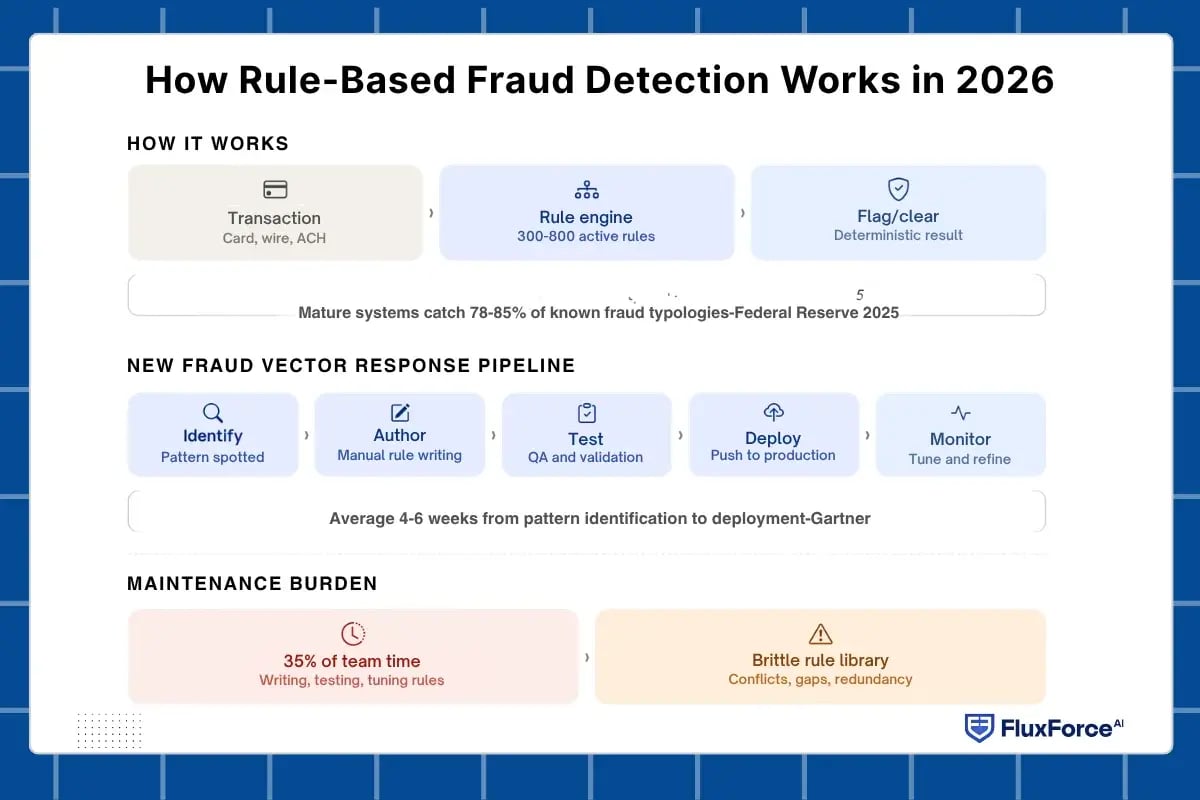
A typical rule-based fraud detection engine operates on a library of manually authored rules. For example: if a transaction exceeds $10,000 and originates from a new device in a high-risk country, flag for review. According to the FFIEC IT Examination Handbook (2024), the average mid-market bank maintains between 300 and 800 active fraud detection rules across card, wire, ACH, and account-level monitoring.
These rules are authored by fraud analysts based on known fraud patterns, regulatory requirements (such as BSA/AML thresholds), and institutional experience. They are deterministic: the same input always produces the same output.
Key insight: Rule-based systems are not "dumb." A well-maintained rule library, built by experienced fraud analysts, can be highly effective for known patterns. The Federal Reserve's 2025 Payments Study found that institutions with mature rule-based systems still catch 78–85% of known fraud typologies.
Why Is Rule Maintenance a Burden for Fraud Teams?
The challenge is maintenance. According to a 2025 Aite-Novarica survey of 120 financial institutions, the average fraud team spends 35% of its time writing, testing, and tuning rules. Each new fraud pattern requires a new rule. Each rule interaction creates potential for conflict or redundancy. Over time, the rule library becomes a brittle, interconnected web that no single analyst fully understands.
When a new fraud vector emerges — say, deepfake-assisted voice authorization fraud — the rule-based response requires:
(1) Identification of the pattern
(2) Manual rule authoring,
(3) Testing,
(4) Deployment
(5) Monitoring. According to Gartner, the average time from fraud pattern identification to rule deployment is 4–6 weeks for mid-market institutions.
How AI Fraud Detection Works: Beyond the Hype
AI fraud detection uses machine learning models — supervised, unsupervised, or hybrid — to identify fraudulent patterns in transaction data. For a deeper walkthrough of how these models work, see our fraud detection AI agent guide. Unlike rules, these models learn from data rather than being explicitly programmed.
Supervised Models: Learning from History
Supervised ML models (such as XGBoost, Random Forests, and gradient-boosted trees) train on labeled historical data — transactions tagged as "fraud" or "legitimate." According to a 2025 study published in the Journal of Financial Crime, supervised models achieve detection rates of 92–97% on known fraud patterns when trained on sufficient labeled data (typically 50,000+ labeled transactions).
Unsupervised Models: Finding the Unknown
Unsupervised models (such as Isolation Forests, autoencoders, and clustering algorithms) detect anomalies without labeled data. They identify transactions that deviate from established behavior patterns. This is where AI shows its greatest advantage: detecting novel fraud patterns that no rule anticipated.
According to McKinsey's 2025 Banking Technology Report, institutions using unsupervised anomaly detection caught 35–40% more novel fraud patterns than those relying solely on rules or supervised models.
Is AI Fraud Detection a Black Box for Regulators?
The primary concern with AI fraud detection is explainability. A neural network might flag a transaction with 95% confidence, but regulators and compliance officers need to know why. The OCC's 2024 guidance on model risk management (building on SR 11-7) explicitly requires that institutions using AI for fraud detection must be able to explain individual decisions in a manner that is "understandable to informed but non-technical stakeholders."
Key insight: AI fraud detection is not a single technology. It is a spectrum from highly explainable models (logistic regression, decision trees) to highly accurate but opaque models (deep neural networks). The model choice involves an explicit accuracy-vs-explainability tradeoff.
Rule-Based vs AI Fraud Detection: 9-Dimension Comparison
The following comparison is based on aggregated data from Gartner (2025), Aite-Novarica (2025), the Federal Reserve Payments Study (2025), and McKinsey's Banking Technology benchmarks. .webp?width=1200&height=800&name=AI%20fraud%20detection%20comparison%20(2).webp)
Our recommendation: The data clearly shows that neither approach alone is sufficient. The hybrid model delivers the best detection rates and the lowest false positive rates, at a cost that sits between the two pure approaches.
Where Rules Still Win (And Why That Matters)
The narrative that AI makes rules obsolete is factually wrong. There are specific, critical domains where rule-based systems remain superior.
Hard Regulatory Constraints
Certain fraud and compliance scenarios demand deterministic, zero-ambiguity enforcement. BSA/AML Currency Transaction Reports (CTRs) must be filed for every cash transaction over $10,000. This is not a probabilistic question. It is a binary regulatory requirement. A rule handles it perfectly. An ML model adds unnecessary complexity and risk.
According to FinCEN's 2025 enforcement data, 3 of the top 10 BSA/AML penalties were issued to institutions that failed to file CTRs on qualifying transactions — a failure that a simple threshold rule would have prevented.
Sanctions Screening
OFAC sanctions screening requires exact-match and fuzzy-match checks against government-maintained lists. According to the Treasury Department's 2025 OFAC guidance, sanctions checks must be deterministic and auditable. ML models are not appropriate for primary sanctions screening because a missed match carries unlimited regulatory liability.
Explainability in Enforcement Actions
When a financial institution files a SAR, regulators expect clear documentation of why the activity was deemed suspicious. Rule-based flags provide self-documenting explanations: "Transaction exceeded $5,000 international wire threshold from new payee in high-risk jurisdiction." According to the FFIEC BSA/AML Examination Manual, examiners specifically evaluate whether the institution can articulate the logic behind each alert.
Key insight: Rules are not outdated — they are essential for hard constraints where the cost of a miss is regulatory penalty, not just financial loss. The institutions that remove rules in favor of pure AI create unacceptable compliance risk.
Where AI Pulls Ahead (With Real Numbers)
In domains where patterns are complex, evolving, and contextual, AI delivers measurably superior results.
Novel Fraud Detection
The most compelling AI advantage is detecting fraud patterns that no one has seen before. According to McKinsey's 2025 analysis, synthetic identity fraud increased 85% between 2023 and 2025, with new variants emerging monthly. Rule-based systems detected only 18% of synthetic identity cases, while ML models detected 67%.
This gap exists because synthetic identity fraud involves subtle behavioral patterns — gradual credit building, strategic application timing, coordinated bust-out sequences — that are invisible to threshold-based rules but detectable through behavioral modeling.
False Positive Reduction
False positives are the silent killer of fraud operations. According to Gartner's 2025 Financial Crime Operations Survey, the average rule-based system generates 95 false alerts for every 5 true positives — a 95% false positive rate. ML-augmented systems reduce this to 50–60%, effectively doubling or tripling analyst productivity.
For a mid-market bank processing 500 daily alerts, reducing the false positive rate from 95% to 55% means analysts review 200 fewer false alerts daily — the equivalent of reclaiming 3–4 full-time analyst positions without hiring.
Behavioral Pattern Recognition
AI excels at detecting complex, multi-dimensional patterns that span time and entities. Account takeover detection, for example, requires simultaneous analysis of device fingerprints, login velocity, geographic patterns, transaction behavior shifts, and session characteristics. According to the Federal Reserve's 2025 Payments Study, AI-based ATO detection systems outperform rules by 3.2x in detection rate (89% vs 28%).
Adaptation Speed
When a new fraud pattern emerges, an ML model can be retrained and redeployed in hours to days, compared to 4–6 weeks for rule authoring, testing, and deployment. In 2025, when the "cascade" synthetic check fraud pattern emerged, institutions using ML-based detection identified the pattern within 72 hours, while rule-based institutions took an average of 34 days to deploy countermeasures, according to data from the American Bankers Association's 2025 Fraud Report.
The Hybrid Approach: Why 87% of Leading Institutions Use Both
According to Aite-Novarica's 2025 Fraud Technology Survey, 87% of financial institutions with best-in-class fraud detection rates use a hybrid approach — combining rules for hard constraints with AI for pattern detection and risk scoring.
How a Hybrid Architecture Works
The most effective hybrid architecture follows a layered model:
- Layer 1 — Hard Rules (Non-Negotiable): Sanctions screening, CTR thresholds, velocity limits, blocked-list checks. These execute first, with zero tolerance.
- Layer 2 — ML Risk Scoring: Every transaction receives a real-time risk score based on supervised and unsupervised models. Scores incorporate behavioral baselines, entity context, device intelligence, and network analysis.
- Layer 3 — Intelligent Alert Routing: ML risk scores determine alert priority. High-risk scores trigger immediate escalation. Medium-risk scores enter contextual triage. Low-risk transactions pass through.
- Layer 4 — Contextual Enrichment: Flagged transactions are enriched with entity intelligence, relationship graphs, and historical patterns before reaching an analyst.
- Layer 5 — Analyst Decision with AI Assist: Analysts review enriched, prioritized cases with AI-generated explanations and recommended actions.
Key insight: The hybrid approach is not simply "rules + AI." It is a deliberately architected pipeline where each layer serves a specific function, and the order of operations matters. Hard constraints must execute before probabilistic scoring.
Real-World Hybrid Results
A 2025 case study published by Celent documented a $4B regional bank's migration from pure rules to a hybrid approach. The results after 12 months:
- Detection rate improved from 82% to 96% (17% increase)
- False positive rate dropped from 92% to 47% (49% reduction)
- Average case investigation time decreased by 34%
- SAR quality scores from examiners improved by 22%
- Total fraud losses decreased by $2.1M annually
Rule-Based vs AI Fraud Detection: How to Choose
Your optimal approach depends on your institution's specific context. Use this framework:
Stay with Rules-First If:
- Your institution processes fewer than 10,000 transactions daily
- Your fraud team has fewer than 3 analysts
- You lack internal data science capabilities and budget for managed ML
- Your fraud patterns are primarily known typologies (card-not-present, check fraud)
- Regulatory examiners have specifically flagged explainability concerns
Invest in AI Augmentation If:
- False positives consume more than 70% of analyst time
- You are experiencing rising losses from novel or sophisticated fraud patterns
- Your transaction volume exceeds 50,000 daily across channels
- You have or can hire at least one data science resource (or use a managed platform)
- Your competitors are gaining detection advantages through AI
Deploy Full Hybrid If:
- You process more than 100,000 daily transactions across multiple channels
- Your fraud patterns span card, wire, ACH, P2P, and account-level activity
- You need to satisfy both operational efficiency and regulatory explainability
- You seek a 12–18 month path to measurably superior detection rates
Best Practice: Integrate real-time AI monitoring with immediate alerts and escalation workflows to catch anomalies early.
Key insight: The "right" approach is not determined by technology trends. It is determined by your transaction volume, fraud pattern complexity, regulatory environment, and available capabilities. Most mid-market institutions in 2026 are best served by starting with a rules foundation and incrementally layering AI-powered scoring and triage.XAI boosts ROI for AI investments in banking
by enhancing transparency, trust, and decision-making.
Key Takeaways
- Rule-based systems remain essential for hard constraints: Sanctions screening, CTR filing, and regulatory thresholds demand deterministic logic that AI cannot and should not replace.
- AI outperforms rules by 3–4x on novel fraud detection: Machine learning models catch 60–75% of novel fraud patterns compared to 15–25% for rules alone, according to McKinsey (2025).
- The false positive gap is the strongest business case for AI: Reducing false positives from 95% to 50% reclaims the equivalent of 3–4 full-time analyst positions for a mid-market bank.
- 87% of best-in-class institutions use a hybrid approach: The data is clear — neither pure rules nor pure AI delivers optimal results in isolation (Aite-Novarica, 2025).
- Implementation order matters: Hard rules must execute before ML scoring to ensure regulatory compliance is never compromised by probabilistic decisions.
- Start with rules, layer AI incrementally: Most mid-market institutions should not attempt a "big bang" AI migration but instead build AI capabilities on top of existing rule infrastructure.


Share this article