



















Listen To Our Podcast🎧
Introduction
A financial institution deploys a sophisticated deep learning model for fraud detection. The model achieves 94% accuracy in testing. Six months into production, a regulatory examiner asks a simple question: "Why did this model flag Customer A as high-risk but not Customer B, who has a nearly identical transaction profile?"
The compliance team cannot answer. The model is a black box — it produces scores, but it cannot explain its reasoning. The examination finding is severe: the institution is using a model it does not understand, cannot validate, and cannot demonstrate is free from discriminatory bias.
This is not a hypothetical scenario. According to a 2025 survey by the Bank Policy Institute, 38% of financial institutions using machine learning models reported at least one examination finding related to model explainability in the prior two years. The Federal Reserve, OCC, and FDIC have been increasingly explicit: if you cannot explain how your AI model makes decisions, you should not be using it for regulated activities.
This article explains why explainability is a regulatory requirement — not just a nice-to-have — and provides a technical framework for achieving it. For a practical look at how explainability applies specifically to fraud systems, see our guide on explainable AI for fraud detection

What Is Explainable AI (XAI) and Why Does It Matter in Finance?
Explainable AI (XAI) refers to artificial intelligence systems that can provide human-understandable justifications for their outputs. In financial services, this means that every decision a model makes — whether it is flagging a transaction as suspicious, denying a loan application, or assigning a risk score to a customer — must come with a clear explanation of which factors drove the decision and how they influenced the outcome.
The AI Explainability Spectrum: From White-Box to Black-Box Models
Not all models are equally transparent. Understanding the spectrum is critical for making informed architecture decisions.
|
Model Type |
Transparency Level |
Examples |
Explainability |
|
White-box |
Fully transparent |
Linear regression, logistic regression, decision trees |
Intrinsic — coefficients directly show feature impact |
|
Glass-box |
Mostly transparent |
Explainable Boosting Machines (EBMs), GAMs, rule ensembles |
Intrinsic with some complexity — interpretable by design |
|
Gray-box |
Partially transparent |
Gradient boosted trees (XGBoost, LightGBM), random forests with SHAP |
Requires post-hoc explainability tools but achievable |
|
Black-box |
Opaque |
Deep neural networks, large language models, complex ensembles |
Requires significant post-hoc effort, explanations are approximations |
Key Insight: The regulatory risk increases as you move from white-box to black-box. A model does not need to be perfectly white-box to be compliant, but the institution must demonstrate that its explainability approach provides sufficient insight for the model's risk level and regulatory context.
In practice, this means your compliance team should map every production model to this spectrum before your next examination and document the explainability method used for each. Starting with your highest-risk models and working down is the most efficient path to examination readiness.
The Regulatory Environment Demanding Explainability
Multiple regulatory frameworks now require or strongly expect model explainability in financial services.
SR 11-7 — Model Risk Management (Federal Reserve / OCC)
SR 11-7, issued by the Federal Reserve in 2011 and adopted by the OCC, is the foundational guidance for model risk management in US banking. While it predates the current AI wave, its principles apply directly:
- Conceptual soundness: Institutions must understand the theoretical basis of their models. A black-box model that cannot be explained fails this requirement.
- Outcome analysis: Models must be validated by comparing outputs against actual outcomes. But outcome analysis alone is insufficient — examiners want to understand why the model produces its outputs.
- Effective challenge: An independent party must be able to critically evaluate the model. This is impossible if the model's decision logic is opaque.
According to a 2025 OCC Bulletin on AI in Banking, "The use of AI/ML does not diminish the applicability of existing risk management standards, including SR 11-7. Institutions must ensure that AI/ML models can be explained, validated, and governed with the same rigor as traditional models."
FFIEC Examination Expectations
The FFIEC's updated BSA/AML examination manual (2025 revision) addresses AI/ML models used for transaction monitoring and customer risk scoring. Examiners are directed to evaluate:
- Whether the institution can explain how the model identifies suspicious activity
- Whether model outputs can be replicated or verified
- Whether the model has been validated for discriminatory impact
- Whether model changes are documented and governed
Fair Lending and ECOA Requirements
The Equal Credit Opportunity Act (ECOA) and Regulation B require that lenders provide specific reasons when taking adverse action on a credit application. According to the CFPB's 2023 guidance on AI in lending (which remains in effect), institutions cannot use "the complexity of the algorithm" as a reason for failing to provide specific adverse action reasons.
This means: if your credit scoring model denies an application, you must be able to state the specific factors (e.g., "high debt-to-income ratio," "limited credit history") that drove the decision. A black-box model that cannot produce these specific reasons creates a direct ECOA violation risk.
EU AI Act (For Global Institutions)
The EU AI Act, which entered enforcement in phases starting 2025, classifies AI systems used in creditworthiness assessment and fraud detection as high-risk. High-risk systems must provide:
- Transparency about the system's purpose and limitations
- Interpretability sufficient for human oversight
- Documentation of training data, model architecture, and performance metrics
According to a 2025 analysis by the European Banking Authority (EBA), 54% of EU financial institutions have initiated explainability enhancement projects in response to the AI Act's requirements.
Technical Approaches to Model Explainability
There are two broad categories of explainability: intrinsic (the model is transparent by design) and post-hoc (explanations are generated after the model makes a decision). 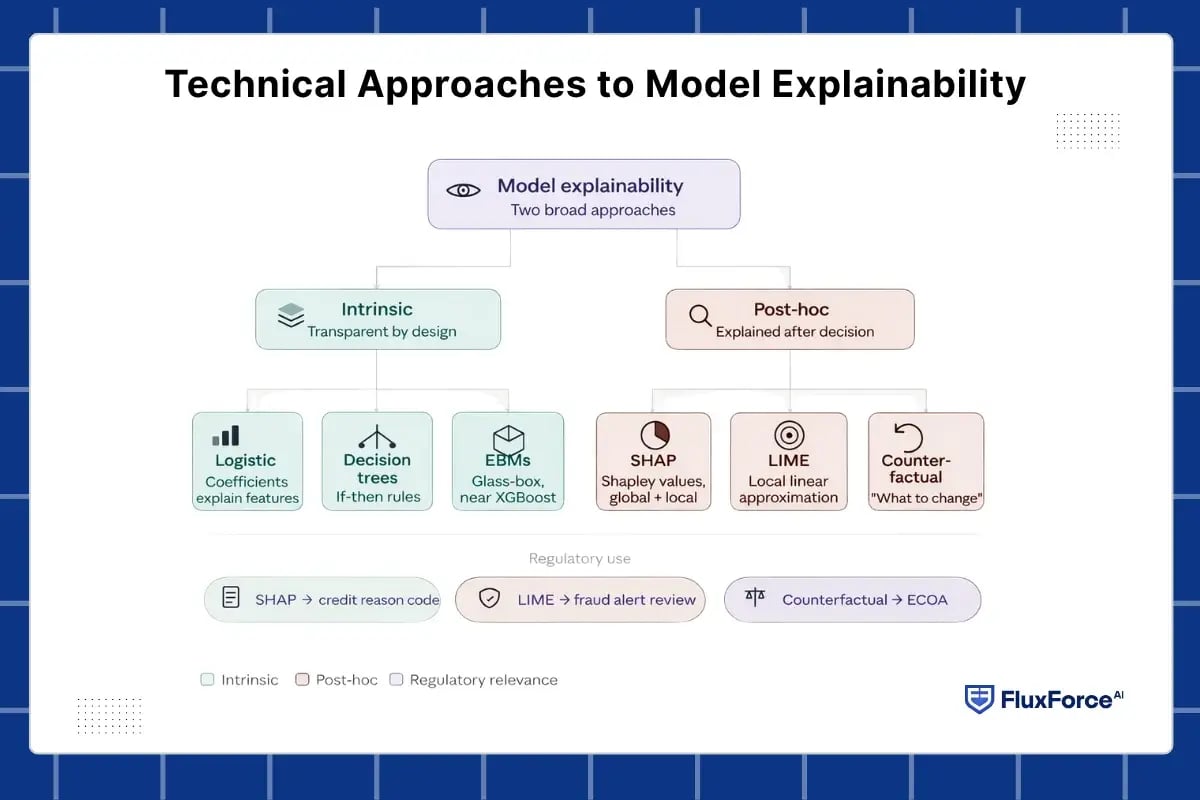
Intrinsic Explainability — Transparent Models
The simplest path to explainability is to use models that are inherently interpretable.
Logistic Regression: Coefficients directly indicate the direction and magnitude of each feature's influence. If the coefficient for "transaction amount" is 0.45, the model increases the risk score as transaction amount increases. This is perfectly transparent.
Decision Trees: The decision path can be visualized as a series of if-then rules. "If transaction amount > $10,000 AND sender country is high-risk AND no prior transaction history → flag as suspicious."
Explainable Boosting Machines (EBMs): Developed by Microsoft Research, EBMs are glass-box models that achieve accuracy competitive with gradient boosted trees while maintaining full interpretability. According to benchmark studies published at NeurIPS 2025, EBMs achieved within 1-3% accuracy of XGBoost on financial fraud detection datasets while providing complete feature-level explanations.
Post-Hoc Explainability — Explaining Complex Models
When business requirements demand more complex models (e.g., for detecting novel fraud patterns), post-hoc explainability methods become essential.
SHAP (SHapley Additive exPlanations)
SHAP is based on Shapley values from cooperative game theory. It calculates the contribution of each feature to a specific prediction by measuring how much the prediction changes when each feature is included versus excluded.
- Strengths: Theoretically grounded, provides both global (model-level) and local (prediction-level) explanations, model-agnostic.
- Limitations: Computationally expensive for large datasets, assumes feature independence (which can be problematic for correlated features).
- Regulatory relevance: SHAP values can directly generate "reason codes" for adverse action notices, making it particularly valuable for credit decisioning.
LIME (Local Interpretable Model-agnostic Explanations)
LIME creates a simple interpretable model (typically linear) that approximates the complex model's behavior in the local neighborhood of a specific prediction.
- Strengths: Fast to compute, intuitive outputs, works with any model type.
- Limitations: Explanations can be unstable (small input changes can produce different explanations), local approximation may not capture global model behavior.
- Regulatory relevance: Useful for transaction monitoring alert explanations where analysts need to quickly understand why a specific transaction was flagged.
Counterfactual Explanations
Counterfactual explanations answer the question: "What would need to change for the model to produce a different outcome?" For example: "This loan application was denied. If the applicant's debt-to-income ratio were 35% instead of 48%, the application would have been approved."
- Strengths: Highly intuitive for end users, directly actionable, naturally addresses "what would I need to change" questions.
- Limitations: Multiple valid counterfactuals may exist, can reveal model vulnerabilities if shared externally.
- Regulatory relevance: Directly aligned with ECOA adverse action notice requirements — they tell applicants exactly what to change.
SHAP vs. LIME for Financial Model Explainability: When to Use Which
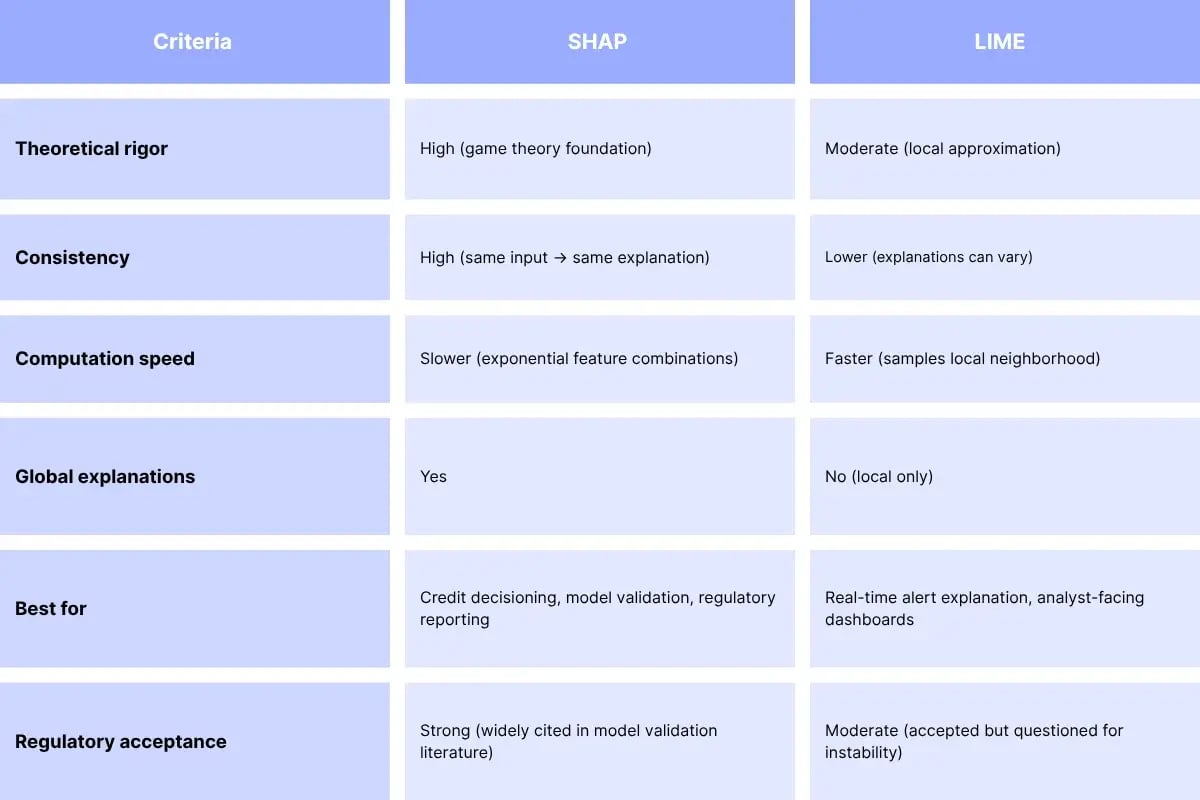
Key Insight: For regulated financial applications, SHAP is generally the safer choice for formal model validation and regulatory submissions. LIME works well for operational explainability where speed matters and formal rigor is less critical.
If you are building a new fraud detection or credit decisioning pipeline today, the actionable step is to integrate SHAP into your model validation workflow from day one rather than retrofitting it later. For existing production models, start by generating SHAP explanations for a sample of recent decisions and reviewing them with your model risk team to identify gaps before examiners do.
How Black-Box Models Increase Investigation Time and Analyst Costs
When a transaction monitoring model flags an alert without explaining why, the analyst must manually investigate the reasoning. According to a 2025 study by Accenture, analysts spend an average of 22 minutes per alert when the model provides no explanation, compared to 8 minutes when clear feature attributions are provided. For a mid-market bank processing 500 alerts per day, that difference translates to 116 additional analyst hours per day — roughly 7 additional full-time employees. 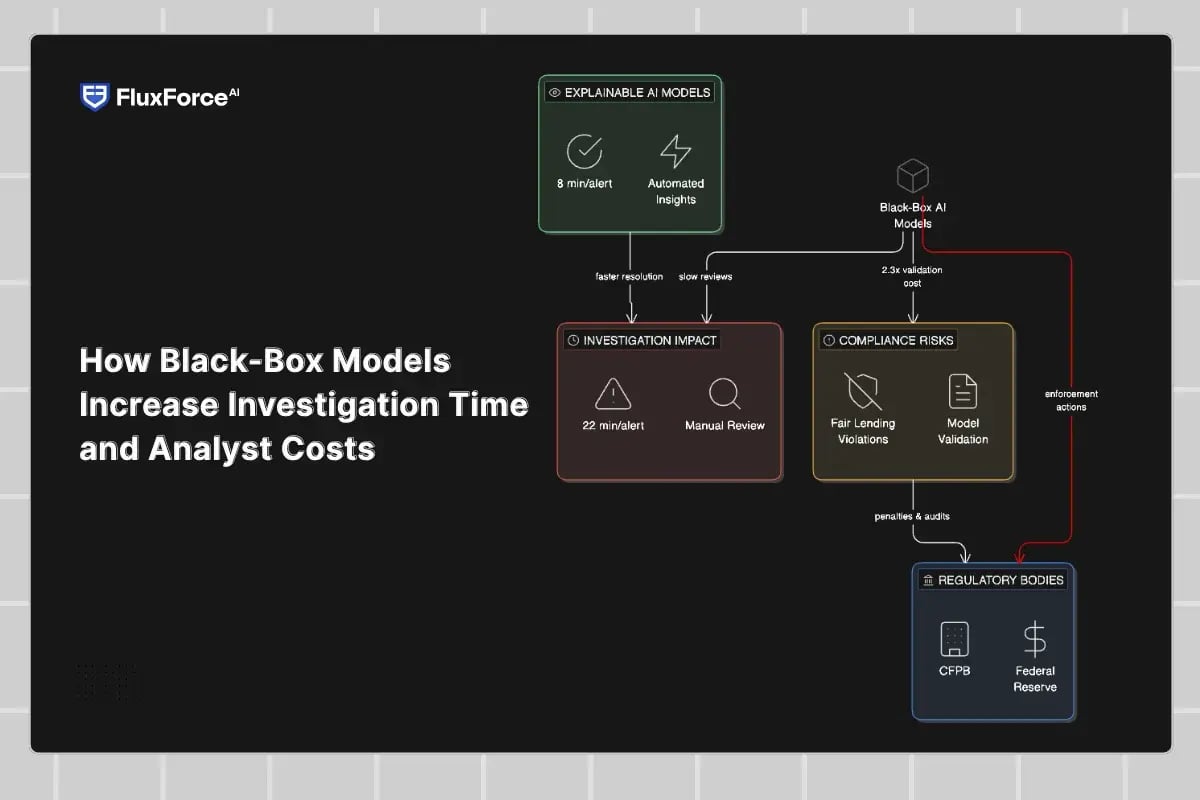
Model Validation Failures
According to a 2025 report by the Federal Reserve Bank of Richmond, model validation costs for black-box AI models average 2.3x higher than for interpretable models. The additional cost comes from the need for more extensive testing, independent replication, and additional documentation to satisfy SR 11-7 requirements.
Fair Lending Violations from Unexplainable AI Credit Models
In 2024, the CFPB issued a consent order against a mid-size lender whose AI-based credit scoring model was found to produce disparate impact against protected classes. The lender could not demonstrate that the model's decisions were based on legitimate credit factors because the model was insufficiently interpretable. The penalty: $3.6 million plus mandatory model replacement.
According to the National Fair Housing Alliance's 2025 report, fair lending complaints involving AI/ML models increased 47% from 2023 to 2025. The trend is accelerating.
Financial Impact
The total cost of alert fatigue encompasses direct fraud losses, analyst salaries spent on false positives, turnover costs, and regulatory penalties. According to Aite-Novarica's 2025 analysis, the average mid-market bank spends $3.2M annually on alert investigation, of which approximately $2.2M is spent investigating transactions that are ultimately determined to be legitimate.
Building an Explainability Framework for Your Institution

Step 1 — Classify Models by Risk Tier
Not all models need the same level of explainability. Create a risk tiering framework:
- Tier 1 (Highest risk): Models that directly impact consumers (credit decisions, pricing) or trigger regulatory filings (SAR decisions). Require full SHAP-level explainability with counterfactual analysis. Institutions should reference best practices for explainable AI model governance in banks when building their Tier 1 frameworks.
- Tier 2 (Moderate risk): Models used for internal risk management (fraud detection alerts, customer risk scoring). Require feature attribution explanations (SHAP or LIME).
- Tier 3 (Lower risk): Models used for operational purposes (workload routing, capacity planning). Standard documentation and periodic review sufficient.
Step 2 — Establish Explanation Standards
Define what a "sufficient explanation" looks like for each tier:
- Tier 1: Top 5 contributing features with Shapley values, counterfactual analysis, demographic parity metrics, and individual prediction-level documentation.
- Tier 2: Top 3-5 contributing features with importance scores, alert-level explanation narratives, and model-level feature importance dashboards.
- Tier 3: Model-level feature importance documentation, periodic output analysis.
Step 3 — Embed Explainability in the Model Development Lifecycle
Explainability is not an afterthought. It must be a gate in your model development process:
- Design phase: Select model architectures that support required explainability levels. If Tier 1 explainability is needed, consider whether a glass-box model (EBM) can achieve acceptable performance before reaching for deep learning.
- Validation phase: Include explainability testing in model validation — do explanations make domain sense? Are they stable across similar inputs?
- Deployment phase: Ensure explanation generation is part of the production inference pipeline, not a separate offline process.
- Monitoring phase: Track explanation quality over time. If SHAP values for a key feature shift dramatically, it may indicate concept drift. Maintaining thorough AI model documentation for regulators throughout this lifecycle is critical for examination readiness.
How FluxForce.ai Approaches Explainability
FluxForce.ai was built on the principle that evidence and auditability are the product, not an add-on feature.
Every decision includes a full reasoning chain. When FluxForce flags a transaction, the alert includes: which rules fired, which behavioral anomalies were detected, which ML features contributed (with SHAP values), and what historical precedents informed the risk assessment. This is not a summary — it is a complete, auditable decision record.
Explainability is architecture, not a layer. In FluxForce's 12-layer pipeline, explainability is not a post-processing step. The Decision Engine (Layer 7) generates explanations as a core output alongside risk scores. The Evidence & Auditability layer (Layer 10) preserves the full reasoning chain for regulatory review.
Multi-agent validation for high-impact decisions. Powered by FluxForce's AI-based fraud detection platform, multiple AI agents independently assess high-risk cases and must reach consensus. Each agent provides its own reasoning chain, creating a multi-perspective explanation that is inherently more reliable than a single model's output.
XAI boosts ROI for AI investments in banking
by enhancing transparency, trust, and decision-making.
Key Takeaways
- 38% of financial institutions using ML models reported examination findings related to explainability in the past two years (Bank Policy Institute 2025). Black-box models are an active regulatory liability.
- SR 11-7, FFIEC examination standards, ECOA/Regulation B, and the EU AI Act all require or strongly expect that financial AI models can explain their decisions.
- SHAP provides the most theoretically rigorous explanations and is preferred for model validation and regulatory submissions. LIME is faster and suitable for operational alert explanations.
- Glass-box models (EBMs) achieve within 1-3% accuracy of black-box models on financial fraud datasets while providing complete transparency — often the best starting point.
- The cost of not explaining is quantifiable: 22 minutes per unexplained alert vs. 8 minutes with explanations (Accenture 2025), 2.3x higher model validation costs (Fed Richmond), and $3.6M+ penalties for fair lending violations.
- Explainability must be embedded in the model lifecycle from design through monitoring, not added as a post-hoc layer.


Share this article