















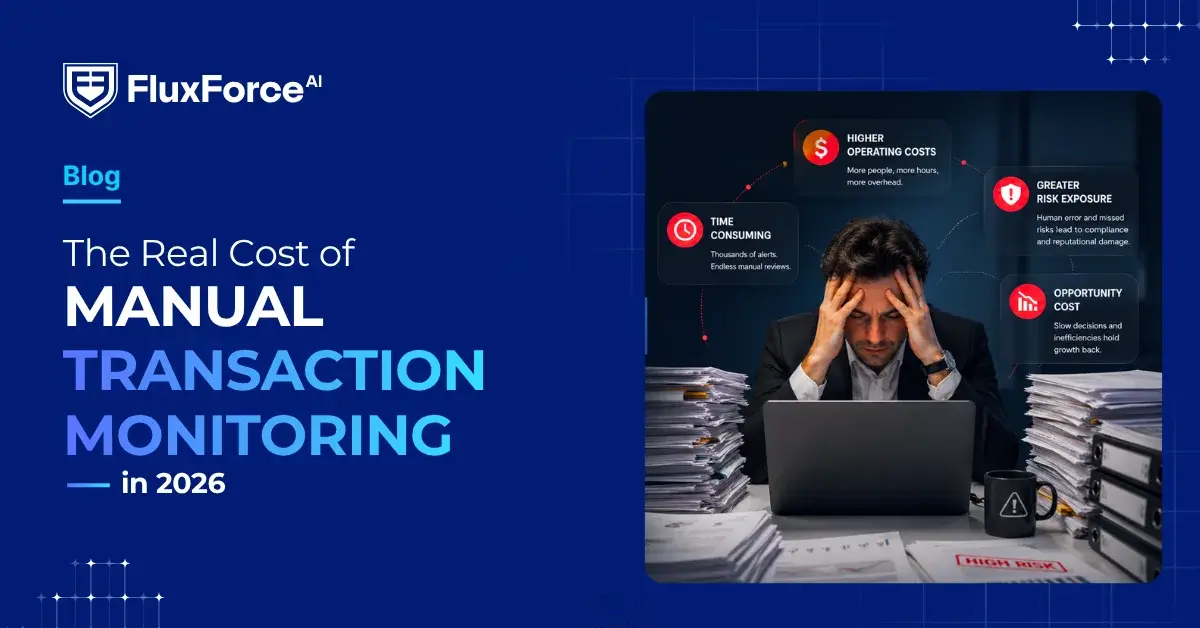



The transaction monitoring cost at most financial institutions runs far higher than the compliance budget line suggests. A 2024 LexisNexis Risk Solutions study found that total financial crime compliance costs for U.S. businesses reached $61.3 billion, with manual review labor accounting for roughly 40% of that figure. Add in the downstream costs of missed fraud, regulatory fines, and analyst burnout, and the real number climbs considerably. This post is a hard look at where that money goes, which costs are avoidable, and why institutions that have moved to automated transaction monitoring are seeing materially different numbers in 2026.
What Manual Transaction Monitoring Actually Costs in 2026
The visible cost of a manual monitoring program is staffing. In our client engagements, a mid-tier bank running a 20-person AML/fraud operations team typically pays $95,000 to $130,000 per analyst per year in the U.S. when you include benefits, training, and turnover. A team of 20 puts that direct labor cost at roughly $1.9 million to $2.6 million annually, before accounting for supervisors, compliance managers, and the QA layer that every regulated institution needs.
But direct labor isn't the worst part of the transaction monitoring cost picture.
The more damaging number is throughput. A trained analyst can realistically review 30 to 50 alerts per eight-hour shift, depending on complexity. At a mid-market institution generating 4,000 alerts per day, clearing the queue requires 80 to 130 full-time analysts, with no buffer for volume spikes. Most institutions don't have that. They set thresholds higher to reduce alert volume, which lets more fraud slip through. Or they set thresholds lower to catch more fraud, which pushes false positive rates so high that analysts stop looking carefully at individual alerts.
In our client engagements, compliance officers at institutions under $50 billion in assets consistently cite alert backlogs as their single biggest operational challenge. Backlogs don't just create compliance risk. They create liability. When a suspicious transaction sits in a queue for 72 hours unreviewed and funds move, the institution owns that outcome.
The False Positive Problem: Where Transaction Monitoring Cost Accumulates
False positives are the silent budget killer in any transaction monitoring cost calculation. Industry benchmarks consistently show that between 85% and 95% of all transaction monitoring alerts in rule-based systems are false positives. Each one still requires a human to open it, review it, document their reasoning, and close it.
At a 90% false positive rate on 4,000 daily alerts, analysts spend their day reviewing 3,600 legitimate transactions that triggered a rule. That's not compliance work. That's expensive data entry.
In our client engagements, the cost per false positive investigation typically runs between $12 and $35 in direct analyst time, depending on alert complexity and documentation requirements. At scale, false positive costs can represent 60% or more of a compliance department's total operational spend, a pattern we see consistently across financial institutions.
There's also the second-order cost: alert fatigue. When analysts review hundreds of false positives per shift, they develop a pattern of quickly dismissing alerts. Real fraud starts to look the same as noise. The analysis of rule-based vs. AI systems for false positive reduction quantifies exactly how this heuristic degradation compounds over time and what it costs in missed detections.
Rule-based monitoring systems were designed for a different transaction volume era. They weren't built to handle the signal density of 2026 payment rails.
How AI Fraud Detection Reduces Operational Transaction Monitoring Cost
AI fraud detection is the use of machine learning models to analyze transaction patterns, entity relationships, and behavioral data in real time, scoring each transaction for fraud probability rather than applying static rule thresholds. The model learns what normal looks like for each customer, each account type, and each payment corridor, then flags transactions that deviate meaningfully from that baseline.
The practical impact on transaction monitoring cost is direct:
- Institutions deploying AI fraud detection consistently report false positive rates dropping from 85-95% down to 20-40%, based on published case studies from major vendors.
- Analyst alert volume decreases by 60-80%, allowing the same team to cover a far higher proportion of genuine risk.
- Actual fraud catch rates increase because models detect behavioral anomalies that rule sets miss entirely, such as gradual velocity increases or coordinated account activity that stays under per-transaction thresholds.
The caveat worth acknowledging: AI fraud detection software requires clean training data and ongoing model governance. A model trained on biased historical data reproduces those biases. That governance cost is real, and institutions should budget for it honestly.
The comparison of AI vs. traditional fraud detection approaches covers the data requirements and model drift issues in detail, which is worth reviewing before selecting any vendor platform.
Onboard Customers in Seconds

Real-Time Fraud Detection and Why Latency Has a Direct Dollar Value
Batch processing was the operational norm for transaction monitoring through the early 2020s. Run the rules overnight, review alerts in the morning. That model is now an active liability.
Real-time fraud detection processes each transaction at the moment it's initiated, scoring it and either clearing it, flagging it, or blocking it before funds move. The financial value of this isn't abstract. In wire fraud, ACH fraud, and account takeover scenarios, the window between initiation and irreversibility is often under 90 seconds. Batch monitoring doesn't operate in that window.
Real-time fraud detection in banking has become a regulatory expectation in many jurisdictions. The EBA's guidelines on fraud reporting under PSD2 reference transaction-level monitoring requirements that batch systems cannot reliably meet.
Real-time automated transaction monitoring also changes the fraud cost equation directly. When a fraudulent transaction is blocked before settlement, the institution avoids the loss entirely. When it's reviewed after settlement, recovery rates average only 30-40% on domestic transfers and far less on cross-border transactions.
The math is clear. If your institution processes 100,000 transactions per day with a 0.05% fraud rate, that's 50 fraud events daily. Catching them in real time prevents losses on all 50. Catching them in batch review, with a 35% recovery rate, means absorbing losses on 32 or 33 of those events each day. At an average fraud loss of $3,200 per event, the daily cost of detection latency alone exceeds $100,000.
Synthetic Identity Fraud: Why Manual Transaction Monitoring Keeps Failing
Synthetic identity fraud is the fastest-growing fraud category in 2026, and it's specifically the kind of fraud that manual monitoring handles worst.
A synthetic identity is built by combining real and fabricated information to create a persona that passes standard identity checks. The fraud pattern typically involves months of legitimate, low-activity behavior to build a credit or account history, followed by a "bust-out" where maximum credit or account access is exhausted quickly. The slow-build phase produces no alerts. The bust-out phase may produce alerts, but by then the fraud is complete and funds are gone.
Detecting synthetic identity fraud in real time requires analyzing behavioral signals across the full account lifetime, not just at individual transaction thresholds. Manual analysts reviewing individual alerts in a queue have no practical way to see this pattern.
The Federal Reserve's research on synthetic identity fraud estimates these schemes cost U.S. lenders approximately $20 billion annually. Mid-market institutions absorb these losses disproportionately because they typically have less sophisticated detection than the largest banks but serve comparable transaction volumes.
AI fraud detection in banking addresses this through graph-based entity models that track relationships between accounts, devices, IP addresses, and behavioral sequences. A pattern that looks innocuous in any single transaction becomes statistically significant when the full behavioral graph is visible.
Transaction Monitoring Software: Evaluating Your Options
The transaction monitoring software market organizes around three categories: legacy compliance platforms, point solutions from fraud-specific vendors, and AI-native platforms.
Legacy platforms such as FIS, Temenos, and Oracle FCCM were built for regulatory reporting workflows. They handle audit trails and SAR filing well, but their underlying detection logic is largely rule-based, and their false positive rates reflect that. Implementation timelines run 12 to 18 months, and customization requires vendor professional services.
Point solution vendors like Sardine and Unit21 have built AI-native platforms targeting fintechs and mid-market banks. Unit21 focuses on no-code rule management and case management with machine learning layered on top. Sardine positions on device intelligence and behavioral biometrics, making it particularly effective for mobile-first institutions.
When evaluating sardine vs unit21, the key distinction is detection surface: Sardine covers pre-transaction signals such as device fingerprint, session behavior, and typing cadence, while Unit21 covers transaction-level and entity-level signals post-initiation. The right choice depends on where your fraud is entering. If account takeover via mobile is your primary attack vector, device intelligence matters more. If synthetic identity and bust-out fraud are the priority, entity-level graph modeling is the higher-value capability.
For institutions focused on AML compliance alongside fraud prevention, the agentic AI approach to false positive reduction shows how purpose-built AI agents handle alert triage in ways that general-purpose ML models don't address.
Building the Business Case for Automated Transaction Monitoring
Getting compliance automation approved at the executive level requires framing transaction monitoring cost in terms that finance teams understand.
Start with a current-state cost model built around five components:
- Direct labor cost: headcount multiplied by fully-loaded cost per analyst
- False positive cost: (daily alerts × false positive rate × cost per investigation × 365)
- Missed fraud cost: estimated annual fraud loss attributable to detection gaps
- Regulatory penalty exposure: apply recent industry fine data to your alert backlog and coverage gaps
- Analyst turnover cost: in our experience, compliance analyst turnover often runs 20-35% annually, with replacement cost averaging roughly 1.5x annual salary
A realistic model at a mid-tier institution with 20 analysts typically shows that automated transaction monitoring pays back within 12 to 18 months, primarily through false positive reduction and analyst capacity reallocation to higher-value investigative work.
The harder argument to make is on missed fraud, because it requires estimating losses you haven't directly measured. The most credible approach: run a retroactive analysis on 90 days of closed alerts. Have an AI model score them and compare what the model would have flagged against what analysts dismissed. The gap is your missed fraud estimate. Most institutions are surprised by the size of it.
For teams building the regulatory case alongside the financial one, the 90-day framework for deploying regulatory compliance agents covers a deployment approach that applies directly to both AML and fraud monitoring use cases.
The main risk to acknowledge honestly in any business case: model migration. Moving from rule-based to AI-based transaction monitoring means accepting a calibration period where coverage may briefly dip before it improves. Budget for a 60 to 90-day parallel operation phase where both systems run simultaneously and outputs are compared before fully switching over.
Onboard Customers in Seconds
Conclusion
The transaction monitoring cost problem in 2026 isn't primarily a technology problem. It's a math problem. Manual review workflows were built for transaction volumes and fraud patterns that no longer exist. The result is compliance teams spending the majority of their time on false positives, real fraud slipping through detection gaps, and per-SAR costs that, in our experience, often run between $1,200 and $4,500 depending on institution size.
Automated transaction monitoring, built on AI fraud detection and real-time decisioning, consistently cuts false positive rates by 60% or more and reduces per-investigation cost by a comparable margin. The institutions getting the best results aren't just replacing their rules with models. They're restructuring analyst workflows so that human judgment is reserved for the cases that genuinely need it.
If your current transaction monitoring cost model still relies primarily on rule-based alert generation and batch review cycles, the gap between your operation and a modernized one is already significant, and it grows with every year of deferred automation. The question in 2026 is no longer whether to automate. It's whether your institution can afford to wait any longer.

Share this article