.webp)







Introduction
Cybersecurity failures in global supply chains now represent one of the most significant risk management challenges procurement heads face. Third-party suppliers introduce vulnerabilities at every connection point from vendor portals and shared logistics platforms to financial data exchanges and regulatory reporting systems. Under frameworks including GDPR, DORA, and PCI DSS, organizations bear direct accountability for third-party cybersecurity failures that affect their supply chain operations.
Traditional procurement risk management relies on periodic manual assessments that miss the continuous threat detection and supplier monitoring that modern supply chain security requires. Deloitte reported that 68% of global organizations experienced supply chain disruptions tied to third-party cybersecurity weaknesses in 2024.
AI-powered solutions address this gap by monitoring suppliers in real time, detecting potential disruptions before they escalate, and maintaining automated compliance checks across global vendor networks.
This post covers the cybersecurity gaps in current procurement risk management, the AI risk assessment capabilities that address them, the implementation challenges procurement heads face, and the specific strategies that produce measurable supplier risk reduction across global supply networks.
Current Cybersecurity Gaps in Procurement Risk Management
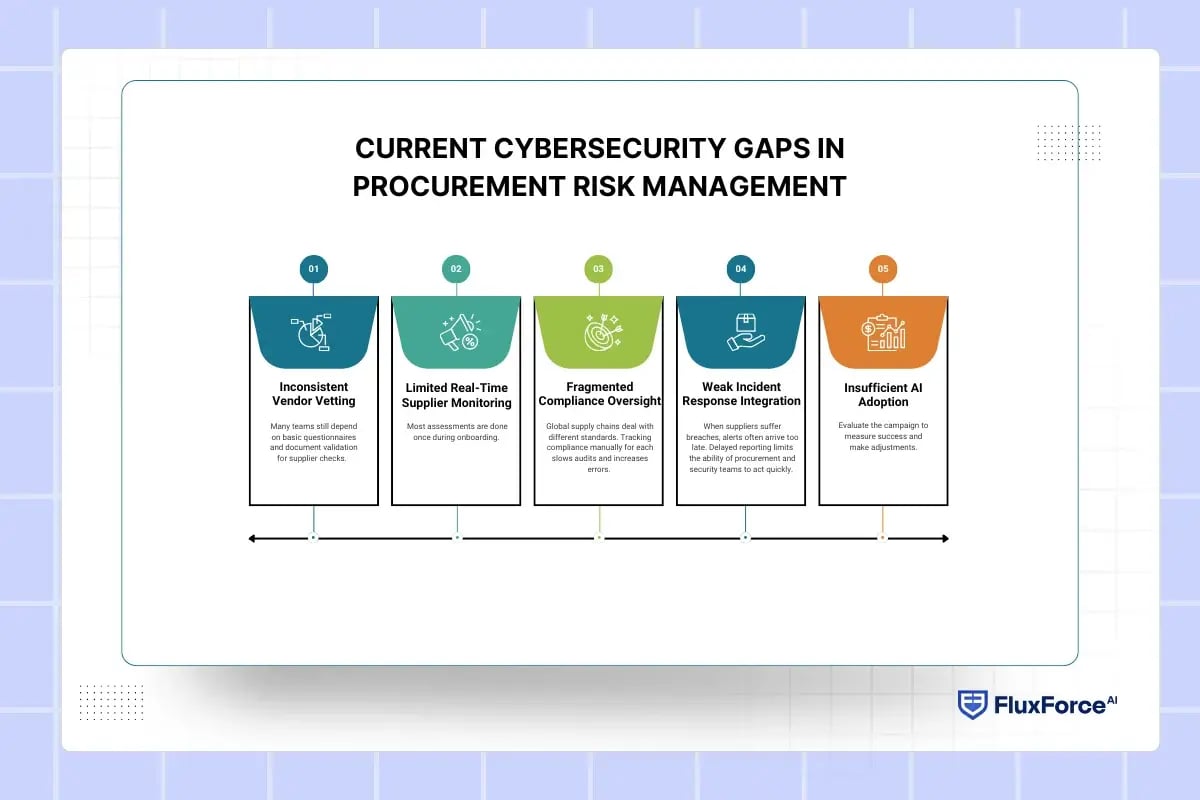
- Inconsistent Vendor Vetting: Many teams still depend on basic questionnaires and document validation for supplier checks.
- Limited Real-Time Supplier Monitoring: Most assessments are done once during onboarding. Without continuous monitoring, risks build quietly until they trigger a costly incident.
- Fragmented Compliance Oversight: Global supply chains deal with different standards. Tracking compliance manually for each slows audits and increases errors. For procurement teams mapping DORA, GDPR, and PCI DSS compliance obligations across global vendor networks, our post on DORA compliance for banks: 7 ICT risk requirements covers where third-party risk management and regulatory compliance obligations intersect under supervisory examination.
- Weak Incident Response Integration: When suppliers suffer breaches, alerts often arrive too late. Delayed reporting limits the ability of procurement and security teams to act quickly.
- Insufficient AI Adoption: AI can detect patterns that humans miss, yet many procurement teams have not integrated these tools.
According to a report by Deloitte, 68% of global organizations experienced supply chain disruptions tied to third-party cybersecurity weaknesses in 2024. The need for modern risk management tools became essential to ensure supply chain security.

The Power of Integrating AI-Driven Risk Assessment for Supply Chains
AI risk assessment in supply chains processes data volumes, detects patterns, and makes risk scoring decisions at a scale and speed that manual procurement programs cannot match. McKinsey reported that two out of three organizations adopted AI-driven supply chain tools following COVID-19 disruptions to strengthen operational resilience. The comparison below shows the specific performance gaps across real-time monitoring, predictive alerts, compliance management, and incident response that drive AI adoption decisions in procurement.
|
Aspect |
With AI |
Without AI |
|
Real-Time Supplier Health Monitoring |
Discover continuous tracking of supplier financial, cyber, and operational signals. |
Monitoring happens infrequently, missing early signs of supplier distress. |
|
Predictive Risk Alerts |
Continuous monitoring enables early alerts, flagging risks before they disrupt operations. |
Risks are monitored periodically, usually after visible damage. |
|
Compliance Management |
Automated checks against GDPR, DORA, PCI DSS, ISO standards. |
Manual reviews slow down reporting and increase audit gaps. |
|
Supply Chain Visibility |
Unified dashboards give transparency across global vendors. |
Fragmented data sources limit visibility to a few suppliers at a time. |
|
Incident Response Speed |
Automated signals connect procurement and security teams in real time. |
Response relies on delayed vendor notifications, slowing recovery |
From continuously monitoring suppliers to providing data-backed insights, AI helps procurement teams with correct vendor selection and frame risk mitigation strategies.
Challenges in AI-Based Supplier Risk Management in Procurement
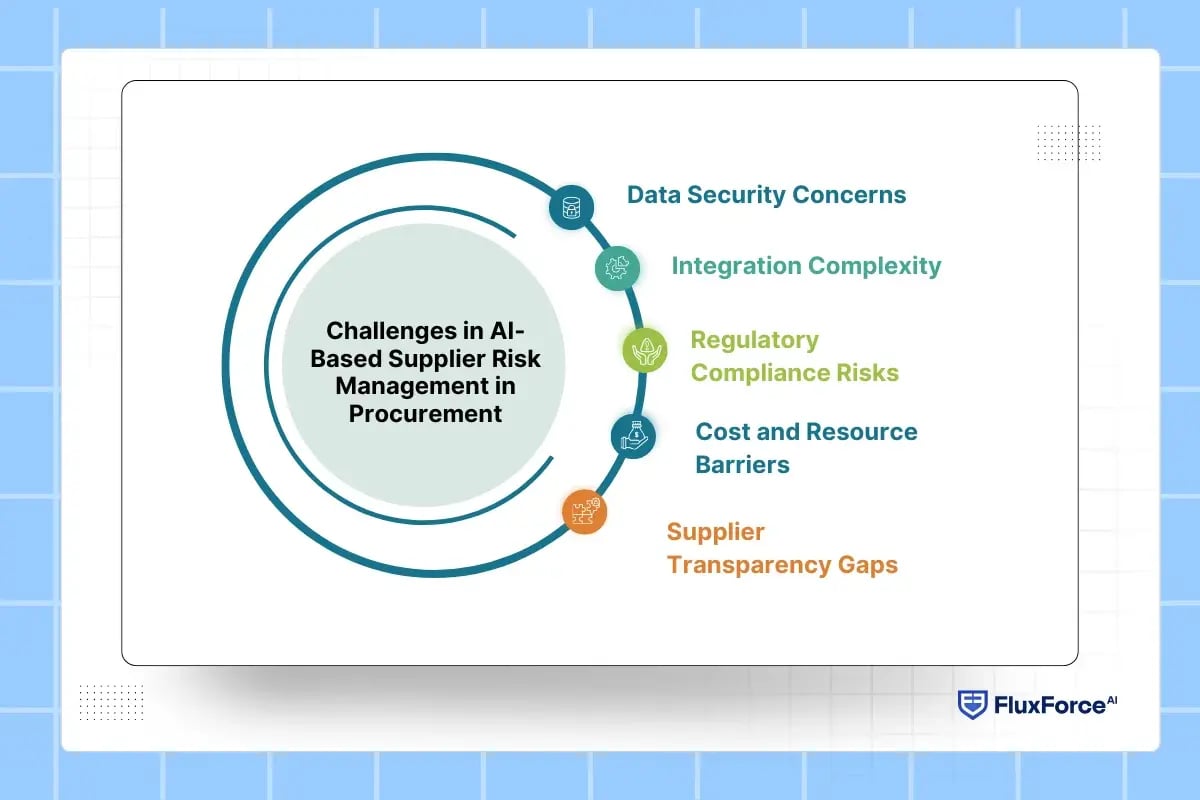
For organizations, AI-powered supply chain security is highly effective. However, for procurement professionals, it presents a complex set of cost and data security complications that can slow adoption and limit visibility. These include:
1. Data Security Concerns: Integrated AI systems handle sensitive supplier data, both business and sensitive personal information. Without robust cloud infrastructure, procurement heads may face security breaches.
2. Integration Complexity: Linking AI tools with legacy-operated ERP platforms is often slow. Many organizations struggle to merge old systems with AI-driven dashboards, delaying efficiency gains and accurate risk reporting.
3. Regulatory Compliance Risks: AI processes must be regularly trained to align with GDPR, DORA, PCI DSS, and other standards. Misalignment or reliance on automation can result in audit issues and financial penalties.
4. Cost and Resource Barriers: AI adoption demands significant cloud investment and skilled staff. Budget limits and resource constraints often slow implementation across global supplier networks.
5. Supplier Transparency Gaps: AI tools rely on supplier cooperation for data sharing. When suppliers withhold information, visibility decreases, reducing accuracy of risk assessments.
AI-Driven Global Supplier Risk Management Strategies for Procurement Heads
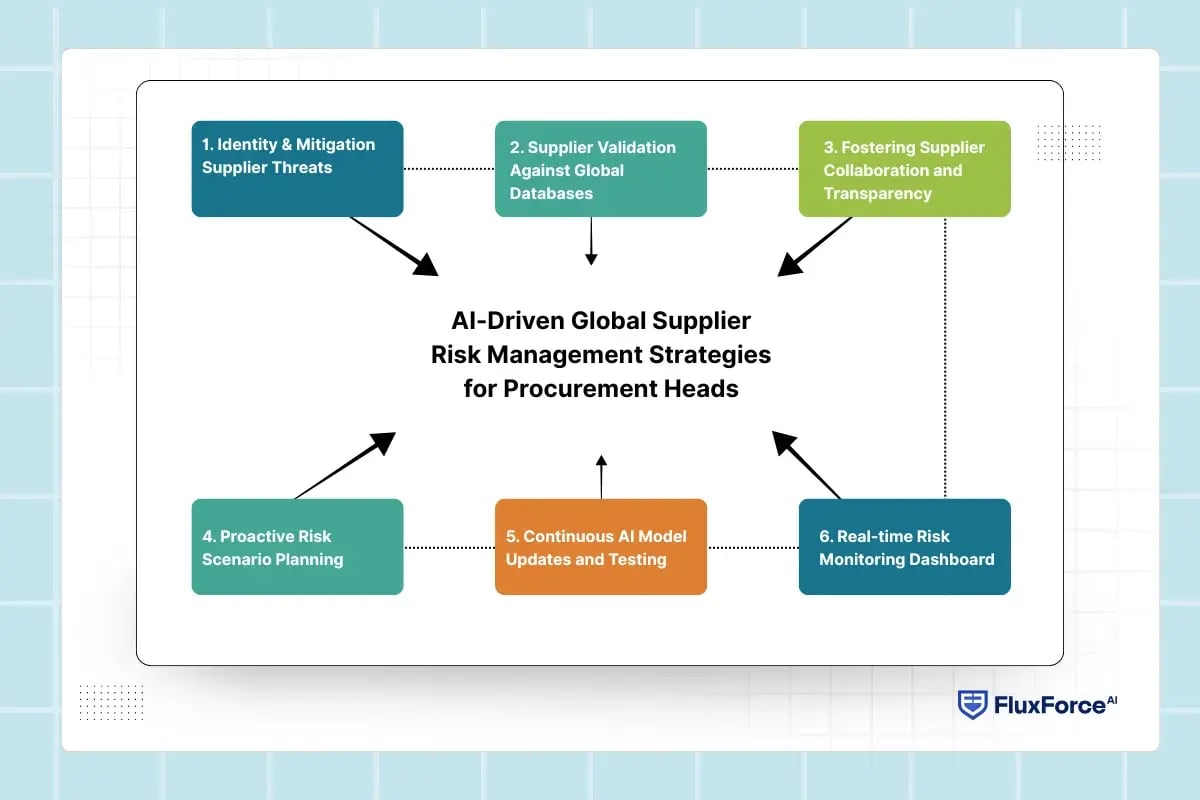
Under high-risk global supply chains, integrating AI solutions is more of a strategic implementation rather than a one-size-fits-all approach. Below are proven strategies for procurement officers to prevent supplier fraud and supply chain disruptions using AI:
1. Identifying and Mitigating Supplier Threats with AI
Modern AI tools, powered with machine learning and predictive analytics, provide an all-in-one solution. Procurement teams can identify potential threats early, validate suppliers against global databases, and continuously monitor operations through automated alerts.
2. Supplier Validation Against Global Databases
For organizations, ensuring vendor compliance in global supply networks is essential under major regulatory standards. Through automated tools, procurement heads can validate suppliers with KYC checks, monitor certifications, and notify third-party vendors of any system vulnerabilities promptly.
3. Fostering Supplier Collaboration and Transparency
For AI-driven insights to be accurate, procurement teams must maintain clear communication and data transparency with suppliers. Accurate shared information and regular updates ensure AI models reflect real operational conditions across the supply chain.
4. Proactive Risk Scenario Planning
Procurement teams should use AI to simulate potential supply chain disruptions, such as delivery delays, financial stress, or regulatory changes. This enables proactive planning and faster decision-making before risks materialize.
5. Continuous AI Model Updates and Testing
AI models require regular updates and testing to adapt to changing supplier behaviour, market conditions, and regulatory requirements. Continuous evaluation ensures predictions remain reliable and risk mitigation strategies stay effective.
Onboard Customers in Seconds

Key AI-Powered Supply Chain Security Solutions for Global Enterprises
Integrating AI solutions into procurement and supply chain operations is essential for ensuring robust cybersecurity and accurate supplier risk assessment. Below are some key AI-powered solutions for high-risk supply chain enterprises:
1. Advanced AI-Powered Analysis
Generative AI and NLP tools help procurement teams analyse vast unstructured supplier data, such as contracts, communications, and regulatory filings. These insights uncover hidden risks, flag unusual patterns, and support proactive decisions across complex global sourcing networks.
2. Adaptive AI Models for Risk Forecasting
Predictive AI and machine learning models continuously learn from supplier performance, delivery data, and market indicators. Procurement teams can anticipate disruptions, rank vendors by risk, and take early corrective action to prevent operational or financial losses.
3. Pre-Built Agentic AI Models
For compliance teams building continuous monitoring programs across procurement and financial crime risk simultaneously, our post on agentic AI for continuous compliance monitoring covers how autonomous agents maintain oversight across multiple regulatory frameworks without proportional staffing increases.
Conclusion
Supplier-related risks affected 42% of global procurement operations in 2024. Traditional, fragmented risk management programs cannot monitor supplier cybersecurity, validate compliance, and detect emerging threats simultaneously across global vendor networks at the volume and speed that modern supply chain security requires. AI-powered procurement risk management addresses this through real-time supplier health monitoring, predictive threat detection, automated compliance verification against GDPR, DORA, and PCI DSS, and structured risk documentation that satisfies regulatory examination requirements.
Procurement organizations of all sizes now implement AI risk assessment programs — the operational benefit and cost-effectiveness of AI monitoring have extended well beyond organizations with large IT departments and dedicated cybersecurity teams.
For procurement organizations evaluating AI-driven supply chain security and compliance infrastructure, the FluxForce regulatory compliance automation solution provides a starting point.
Share this article