


















Listen To Our Podcast🎧
How do graph neural networks help detect fraud rings?
Graph neural networks, or GNNs, help fraud teams examine relationships that a row-by-row model may not capture. Instead of looking only at one payment or one account, a graph can connect accounts, people, devices, phone numbers, addresses, merchants, beneficiaries, sessions, and transactions. A GNN can then learn from an entity's own attributes and selected information from nearby entities.
That makes graph methods relevant to coordinated behavior such as fraud rings and mule networks. It does not make a suspicious connection proof of fraud. Shared infrastructure can be innocent, entity matching can be wrong, labels can be incomplete, and a network pattern can change when the graph definition changes.
A useful program therefore treats a GNN as one part of an investigation system. The model can rank or describe signals, but an authorized analyst reviews the source evidence, considers legitimate explanations, and records the disposition.
- How records become a fraud graph
- How fraud rings and mule networks appear as relationship problems
- Where GraphSAGE and CARE-GNN evidence applies
- How to test graph quality, camouflage, imbalance, and labels
- How human controls and FluxForce Fraud Prevention fit
Request a fraud investigation demo
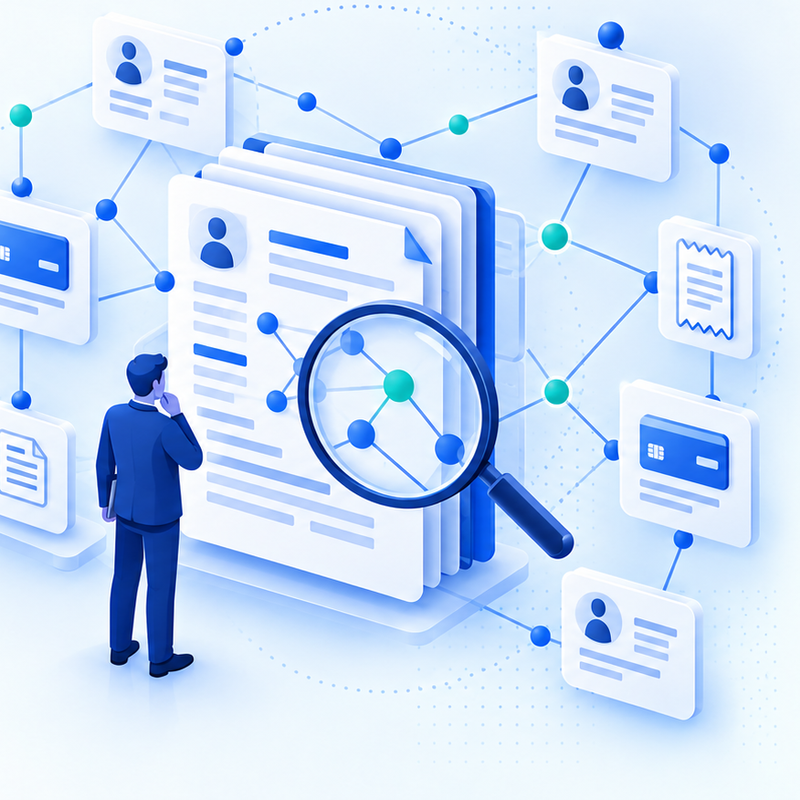
Graph neural networks can organize evidence across connected accounts, payments, devices, beneficiaries, and identities. They can support fraud-ring and mule-network review, but graph quality, labels, validation, and analyst judgment determine whether the signal is useful.
What is a graph in fraud detection?
A graph has nodes and edges. A node represents an entity or event, such as an account, payment, device, beneficiary, or identity record. An edge represents a defined relationship, such as sent payment, used device, or paid beneficiary. Both can carry attributes.
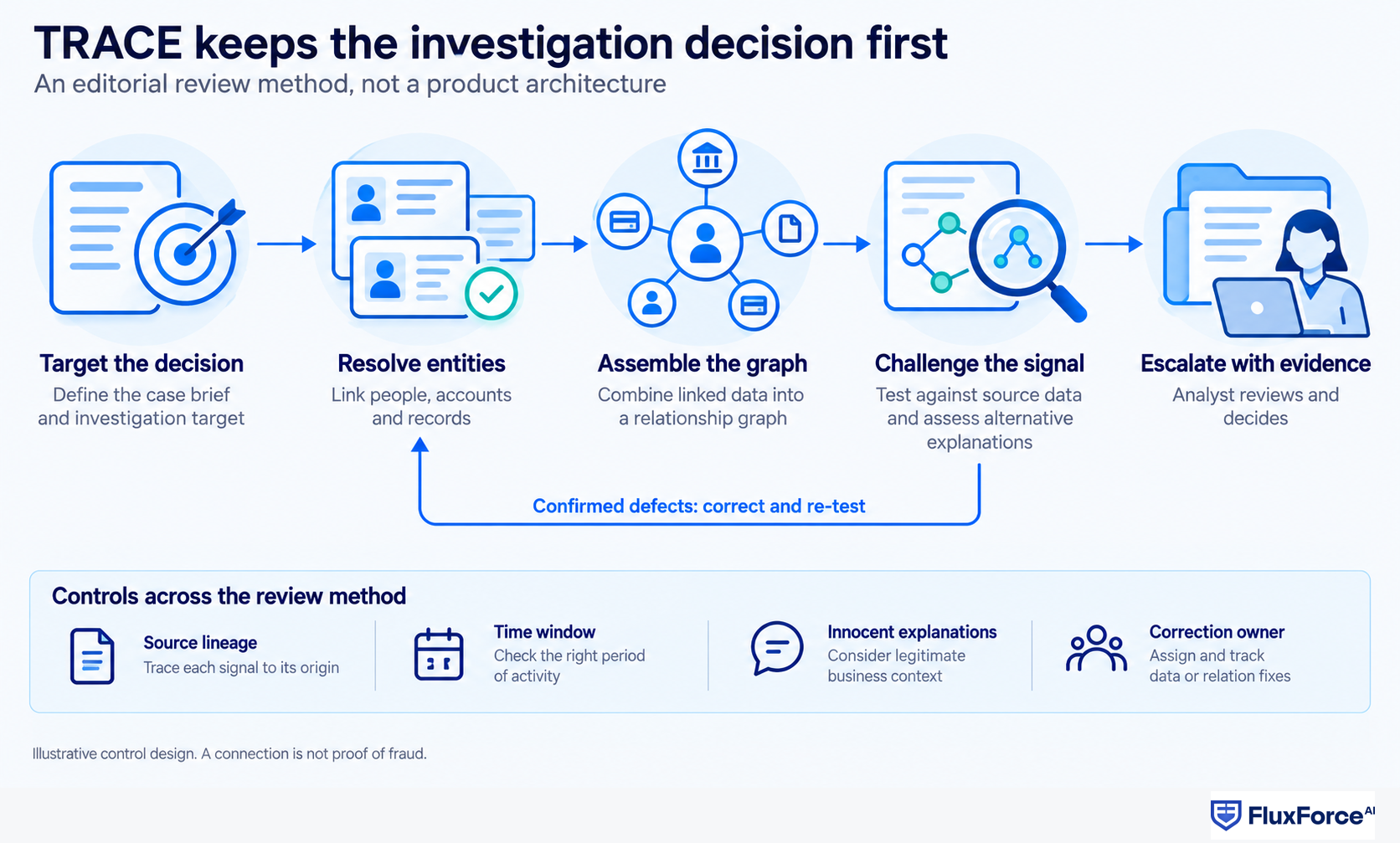
- TRACE moves from the investigation target to entity resolution, graph assembly, challenge testing, and analyst escalation. Confirmed data or relation defects return to the responsible owner for correction and re-test.
Source context: https://www.fluxforce.ai/blog/graph-neural-networks-for-fraud-detection
Each relation needs a precise meaning, direction where relevant, time period, source, and confidence rule. More relations are not automatically better. Weak links can spread noise, and a shared address or network can connect legitimate parties. Time-aware snapshots also matter because later information must not enter an earlier test period.
TRACE moves from the investigation target to entity resolution, graph assembly, challenge testing, and analyst escalation. Confirmed data or relation defects return to the responsible owner for correction and re-test.
How does a GNN learn from relationships?
Many GNNs use a process often called neighborhood aggregation or message passing. A node starts with its own features. The model gathers selected information from neighboring nodes, combines it, and updates the node representation. Repeating the process can include information from nodes farther away.
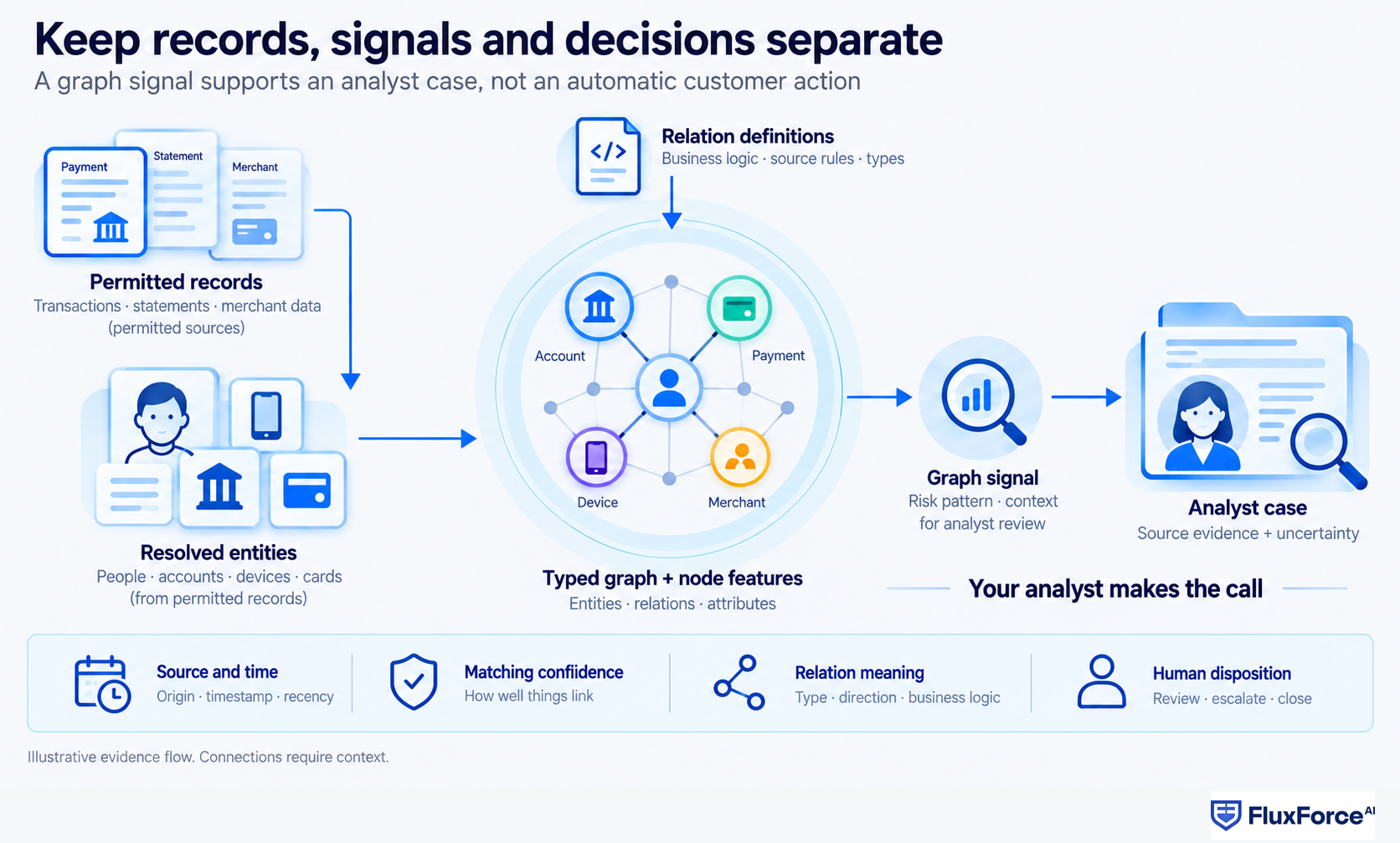
- Permitted source records support resolved entities. Resolved entities and documented relation definitions form typed relationships and node features. Graph analysis produces a signal for an analyst case, not a direct customer action.
Source context: https://www.fluxforce.ai/blog/graph-neural-networks-for-fraud-detection
In plain terms, an account can be evaluated with its own behavior plus defined context from linked transactions, devices, counterparties, or other entities. The meaning depends on the relation design and the aggregation rule. A large neighborhood is not always useful. It may contain service providers, public infrastructure, stale links, or connections introduced by matching errors.
The output can support classification, ranking, or embedding generation. It still needs a case standard and a human workflow.
Permitted source records support resolved entities. Resolved entities and documented relation definitions form typed relationships and node features. Graph analysis produces a signal for an analyst case, not a direct customer action.
Why are fraud rings and mule networks graph problems?
A fraud ring coordinates multiple entities or accounts toward a shared objective. A mule network can receive, move, split, or forward funds through accounts that may look ordinary when reviewed separately. The useful evidence can sit in the pattern: repeated counterparties, shared infrastructure, common control attributes, short transfer paths, synchronized events, or money moving through several accounts.
The mule-network typology gives supporting context. A shared attribute is not enough. Investigators need the source, time, confidence, possible innocent explanation, and related evidence. Graphs can organize those facts, but a bad identity match or narrow label source can create a false cluster.
What makes graph construction reliable?
Graph construction is a data and control discipline. Teams should document each node, relation, attribute, timestamp, source, matching rule, retention period, and owner.
| Approach | Useful question | Main limit |
|---|---|---|
| Transaction rules | Does an event meet a defined condition? | Conditions need maintenance and may miss distributed behavior. |
| Graph queries | Which records share a documented relation or transfer path? | A connection needs context; it is not proof of fraud. |
| GNN representation | Can attributes and selected neighborhood information support ranking? | Results depend on labels, relation quality, evaluation and intended use. |
| Analyst review | What does source evidence support under institution policy? | Capacity and consistency need controls; a model cannot supply missing evidence. |
Key Insight: The model sees the graph the institution built. Graph construction choices are control choices.
Entity resolution
Entity resolution decides whether records refer to the same entity. Exact matches can miss formatting changes, while loose matches can merge different people. Teams should retain the source and reason for each link, then measure confirmed merges, splits, unresolved cases, and correction time.
Relation design
A relation should represent one clear fact or controlled inference. Direction matters for payments and ownership. Time matters for device use and address history. Different meanings should remain separate.
Features and labels
Features can describe amounts, timing, channel, geography, account age, verification state, or other permitted facts. Labels may come from confirmed cases, disputes, analyst outcomes, or another approved source. Each source has delay, coverage, and error limits. An analyst disposition is not always a final truth label, so label provenance and uncertainty should remain visible.
Class imbalance
Confirmed fraud is usually a small share of the population. A model can appear accurate by predicting the majority class. Evaluation should examine precision and recall at relevant review volumes, false positives, false negatives, subgroup behavior, and investigator capacity.
GraphSAGE: what it does and what its evidence supports
The GraphSAGE paper describes an inductive method that learns a function for generating node embeddings. It samples and aggregates features from a node's local neighborhood rather than learning a separate fixed embedding for every training node.
The inductive idea is relevant when a graph changes and new nodes appear. A fraud team could study whether that design is suitable for accounts, devices, merchants, or beneficiaries that were absent during training. Sampling can also limit how much neighborhood information is processed at once.
The evidence boundary is firm. The paper reports three inductive node-classification benchmarks using citation data, Reddit post data, and protein-protein interaction graphs. It does not report banking fraud, fraud-ring, mule-account, false-positive, latency, or deployment results. A financial institution would need its own graph design, labels, evaluation, governance, and workflow tests.
GraphSAGE is therefore an educational architecture example, not proof that a particular fraud program will improve. This article does not claim that FluxForce uses GraphSAGE.
CARE-GNN: camouflage resistance and its dataset boundary
The CARE-GNN paper focuses on fraudsters who try to resemble benign entities or connect to benign neighbors. It describes feature camouflage and relation camouflage. Its proposed approach uses a label-aware similarity measure, reinforcement learning to select how many neighbors to retain, and aggregation across different relations.
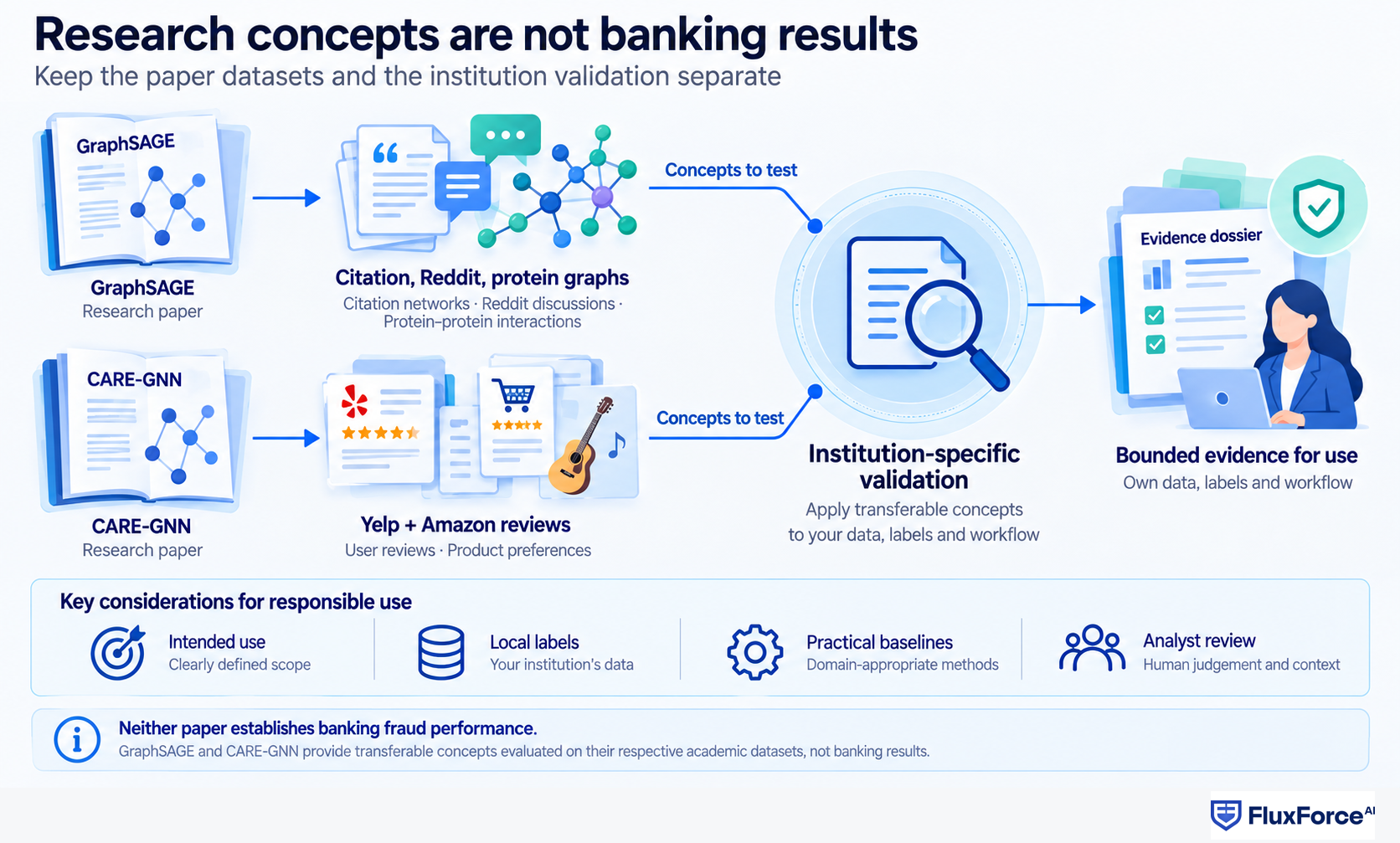
- GraphSAGE research leads to evidence from citation, Reddit, and protein-interaction benchmarks. CARE-GNN research leads to evidence from Yelp and Amazon review datasets. Transferable concepts inform institution-specific validation; neither research route establishes banking performance.
Source context: https://www.fluxforce.ai/blog/graph-neural-networks-for-fraud-detection
The paper is useful because it makes a practical risk visible: neighborhood aggregation can dilute a suspicious signal when many weak or benign-looking neighbors are included. Relation design and neighbor selection are therefore part of the model-risk discussion.
The dataset boundary is also firm. The experiments use Yelp hotel and restaurant review data and Amazon Musical Instruments review data. The tasks are spam-review detection and fraudulent-user detection. The graph relations are designed from review users, products, ratings, time, and text similarity. Those are not bank transaction graphs or payment-system mule networks.
CARE-GNN results should not be restated as bank detection rates, false-positive reductions, or operational outcomes. Its concepts can inform testing for camouflage and relation quality, but a bank or payment firm needs evidence from its own data, use case, and investigation process. This article does not claim that FluxForce uses CARE-GNN.
GraphSAGE research leads to evidence from citation, Reddit, and protein-interaction benchmarks. CARE-GNN research leads to evidence from Yelp and Amazon review datasets. Transferable concepts inform institution-specific validation; neither research route establishes banking performance.
How camouflage, noisy links, and imbalance affect a GNN
Fraud behavior can adapt to controls by spreading activity, resembling ordinary behavior, or connecting to benign entities. Institution data can add its own noise through false matches, delayed feeds, changed identifiers, and high-degree hubs such as common merchants or networks.
Class imbalance, late labels, and limited investigation capacity can distort evaluation. Tests should cover removed or false edges, benign-looking neighbors, stale identities, merged or split entities, missing relations, changed time windows, and shifts in customer or channel mix.
How should a graph-based fraud model be validated?
Validation starts with intended use: population, output, user, decision, customer impact, fallback, and prohibited uses. Test the full chain from source record to final case.
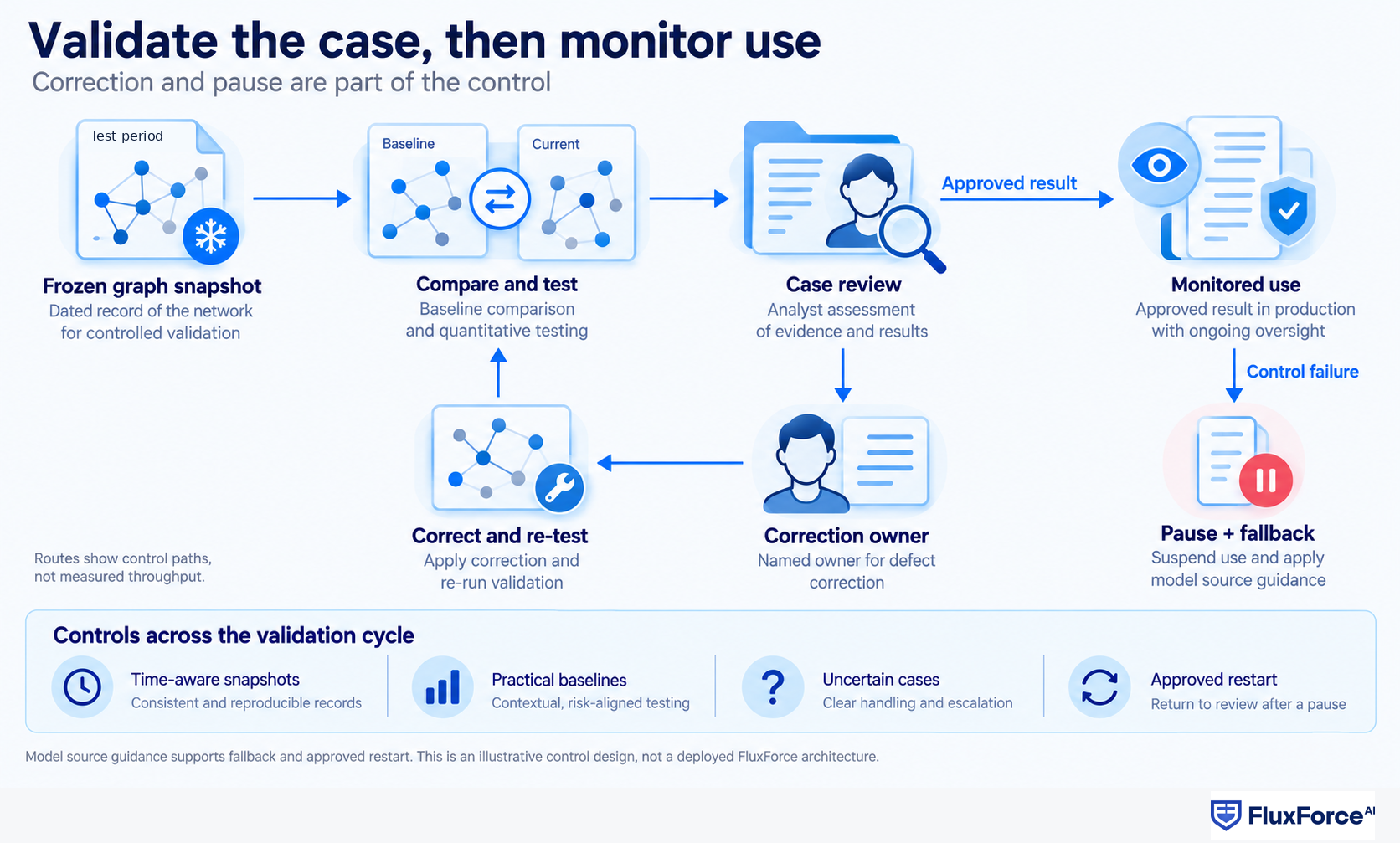
- A frozen graph snapshot enters baseline comparison, quantitative testing, and case review. Confirmed defects go to a named owner for correction and re-test. Only an approved result proceeds to monitored use; failed controls require a pause.
Source context: https://www.fluxforce.ai/blog/graph-neural-networks-for-fraud-detection
- Freeze a time-aware graph snapshot and record the intended decision.
- Compare the candidate with current rules and simpler methods using the same bounded test population.
- Review uncertain and high-impact cases against source records, including innocent explanations.
- Assign defects to an owner, correct and re-test, then obtain approval before monitored use.
Use time-based separation, keep graph snapshots consistent with the test date, and compare against practical baselines. Measure precision and recall at defined queue sizes, data and identity defects, subgroup behavior, overrides, evidence completeness, and case-preparation time.
Case review should sample positive, negative, uncertain, and high-impact outcomes. Confirm that each graph path is supported, current, and reviewed for innocent explanations. Monitor node and edge counts, relation mix, unmatched records, label delay, review outcomes, and correction rates.
A frozen graph snapshot enters baseline comparison, quantitative testing, and case review. Confirmed defects go to a named owner for correction and re-test. Only an approved result proceeds to monitored use; failed controls require a pause.
What does Federal Reserve SR 26-2 mean here?
SR 26-2 is dated April 17, 2026. The Federal Reserve letter says the revised interagency guidance supersedes and replaces SR 11-7 and SR 21-8. It emphasizes a risk-based approach tailored to a banking organization's model-risk profile and the size and complexity of its operations.
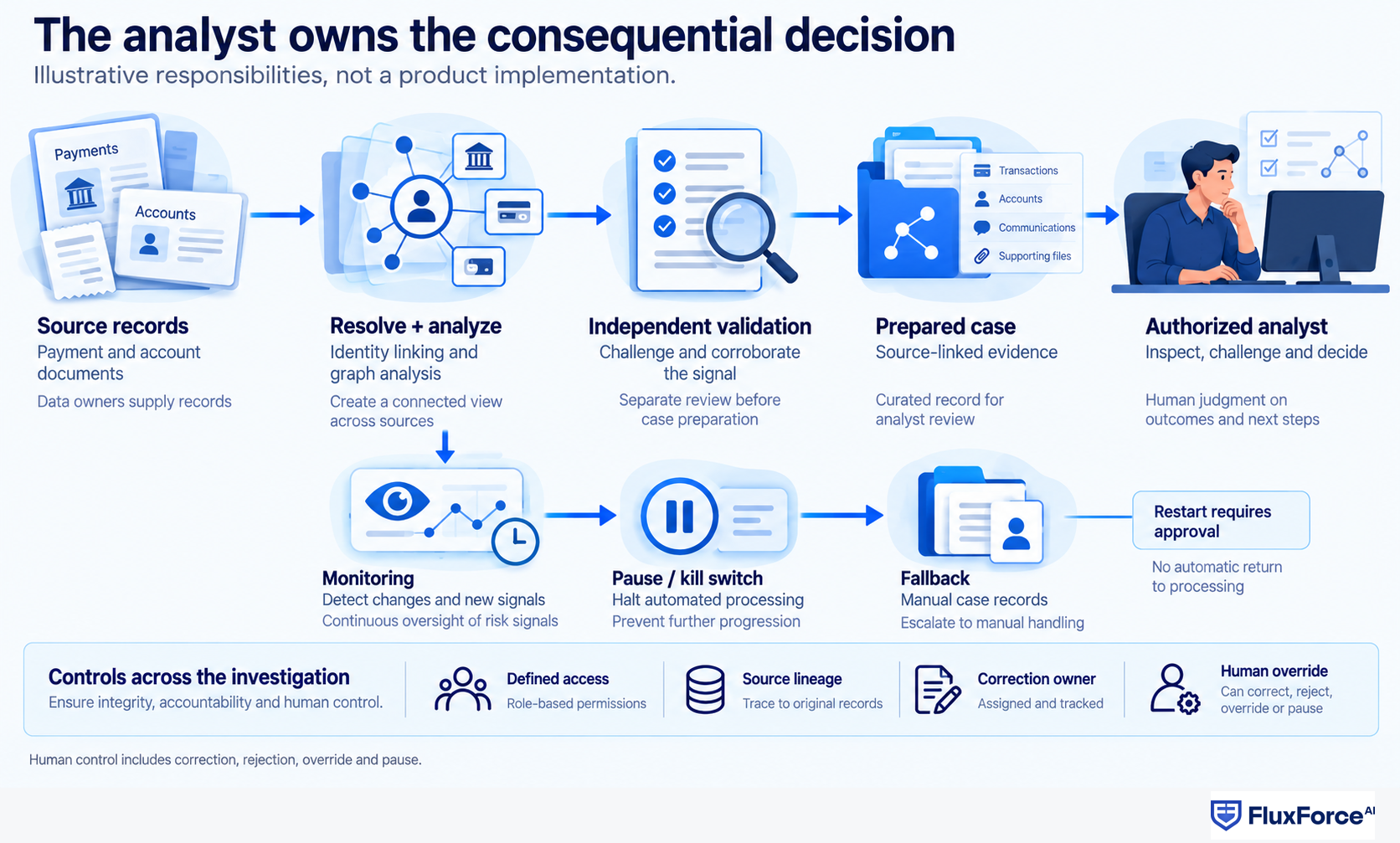
- In the illustrative control design, data owners supply records to entity resolution and graph analytics. Independent validation challenges the signal before case preparation. The prepared case goes to an authorized analyst. Monitoring can trigger correction or a pause; a kill switch leads to fallback, and restarting requires approval.
Source context: https://www.fluxforce.ai/blog/graph-neural-networks-for-fraud-detection
The letter states that it is expected to be most relevant to banking organizations with more than $30 billion in total assets that are regulated by the Federal Reserve. That is an applicability boundary, not a global rule for every financial institution or every graph technique.
For a relevant banking organization, the institution should assess purpose, data, validation, monitoring, change control, documentation, dependencies, and human oversight under its applicable framework. This article does not give legal advice or claim that SR 26-2 approves a model, vendor, or architecture.
In the illustrative control design, data owners supply records to entity resolution and graph analytics. Independent validation challenges the signal before case preparation. The prepared case goes to an authorized analyst. Monitoring can trigger correction or a pause; a kill switch leads to fallback, and restarting requires approval.
- GNNs learn from defined relationships as well as entity attributes.
- Graph construction and entity resolution are control decisions.
- GraphSAGE and CARE-GNN have distinct research dataset boundaries.
- Validation must cover data, relations, labels, cases, correction, monitoring, and human control.
- SR 26-2 has a stated Federal Reserve applicability boundary.
- FluxForce Fraud Prevention prepares evidence for review while the analyst decides.
Conclusion
Graph neural networks can help fraud teams examine relationships that transaction-only views may miss. Their usefulness depends less on the label GNN than on the quality of the graph, the validity of the evaluation, and the design of the investigation workflow.
Start with one bounded queue. Use TRACE to define the target, resolve entities, assemble the graph, challenge the signal, and escalate with evidence. Keep research results within their dataset boundaries, measure the whole control, and give analysts real authority to correct, override, pause, or stop the process.
Request a fraud investigation demo
Frequently Asked Questions
About the author

Sahil Kataria
Founder and CEO of FluxForce
Share this article