



















Listen To Our Podcast🎧
Introduction
Fraud alert fatigue at financial institutions is not a minor operational inconvenience—it is a systemic crisis that simultaneously wastes resources, burns out analysts, and paradoxically increases the likelihood that real fraud is missed. When 95 out of every 100 alerts are false positives, the system designed to catch fraud becomes the very thing preventing your team from catching it.
According to Gartner's 2025 Financial Crime Operations Survey, the average financial institution's fraud team spends 70% of its working hours investigating alerts that turn out to be legitimate transactions. That means for every 10 analysts on your fraud team, 7 of them are functionally doing nothing productive at any given moment. The remaining 3 are expected to catch actual fraud while managing the psychological weight of an endless, mostly meaningless alert queue.
This is not sustainable. And it is not necessary.
In this article, you'll learn:
- The 5 root causes of fraud alert fatigue (it is not just "too many rules")
- Quantified impact on analyst productivity, turnover, and missed fraud
- The alert-to-investigation funnel and where the breakdown occurs
- 5 proven solutions that reduce false positives by 40–60%
- How leading institutions are redesigning their alert management architecture

Fraud Alert Fatigue at Financial Institutions: The Crisis in Numbers
The scale of alert fatigue in financial institutions is staggering when examined through data.
According to Aite-Novarica's 2025 Global Fraud Operations Benchmark, the average mid-market bank (assets $1B–$10B) generates between 500 and 2,000 fraud alerts daily across all channels—card transactions, wire transfers, ACH, P2P, and account-level activity. Of these:
- 85–95% are false positives (legitimate transactions incorrectly flagged)
- 3–8% are true positives (actual fraud or suspicious activity)
- 2–7% are inconclusive (insufficient data to determine)
Key insight: The false positive rate in financial institution fraud detection has remained essentially unchanged for a decade. According to the ACFE's 2024 Global Fraud Study, the industry-wide false positive rate for transaction monitoring was 97% in 2015 and 93% in 2025—a marginal improvement despite billions invested in detection technology. 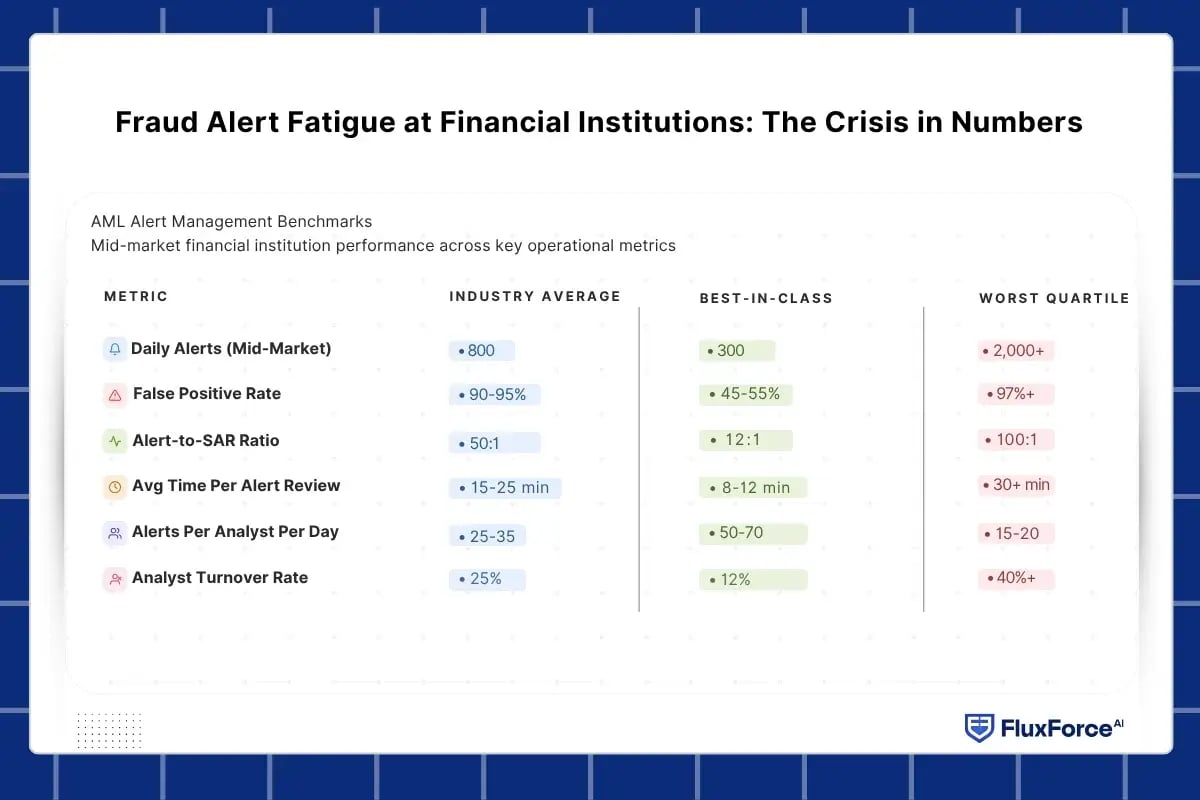
The disparity between best-in-class and worst quartile is striking. Best-in-class institutions process more alerts per analyst while generating fewer total alerts—the result of smarter detection, not harder-working analysts.
The Alert-to-Investigation Funnel: Where Breakdown Occurs
To understand alert fatigue, you must understand where alerts originate, where they are filtered, and where the process breaks down. The typical alert lifecycle follows a funnel:
Stage 1: Alert Generation
Transaction monitoring systems evaluate transactions against rules and/or models. Any transaction that triggers a threshold, matches a pattern, or exceeds a risk score generates an alert. This is where most institutions fail—they generate too many alerts because their detection logic is too broad.
Stage 2: Initial Triage
An L1 analyst reviews the alert, verifies basic facts, and decides whether to escalate or close. According to Gartner, 60% of analyst time is consumed at this stage, much of it on alerts that should never have been generated.
Stage 3: Investigation
Escalated alerts receive deeper investigation—transaction history review, customer context analysis, counterparty research. This stage should receive the majority of analyst attention but is chronically under-resourced because triage consumes all available bandwidth.
Stage 4: Decision and Filing
Investigated cases result in a SAR filing, case closure, or operational action (account restriction, enhanced monitoring). According to FinCEN data, the average mid-market institution files 1 SAR for every 50 alerts generated—an alert-to-SAR ratio of 50:1.
Key insight: The alert-to-investigation funnel is inverted at most institutions. The stage that requires the least analytical skill (initial triage of obvious false positives) consumes the most analyst time, while the stage that requires the most skill (deep investigation of complex cases) is starved of resources. Fraud alert fatigue at financial institutions is fundamentally a resource allocation problem.
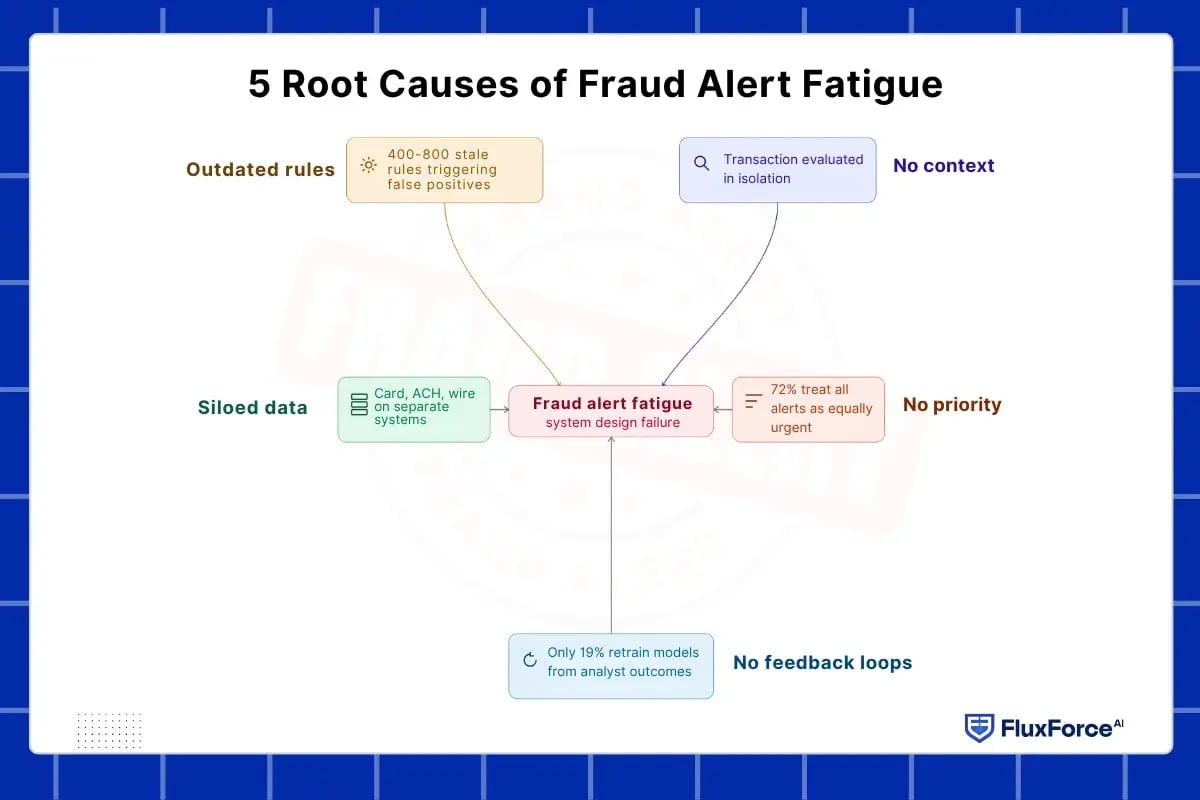
5 Root Causes of Fraud Alert Fatigue
Alert fatigue is not caused by "too many alerts." It is caused by systemic detection architecture failures that produce low-quality alerts. Here are the five primary root causes.
Root Cause 1: Why Outdated Fraud Rules Generate So Many False Positives
Most financial institutions accumulate rules over years without systematic review. Understanding the rule-based systems vs AI for false positives tradeoff is essential to diagnosing this problem. According to Aite-Novarica's 2025 survey, the average mid-market bank has 400–800 active fraud detection rules, many of which were authored for fraud patterns that no longer exist. Rules are added reactively (after a fraud event) but rarely retired or tuned.
The result: overlapping rules trigger multiple alerts for the same transaction, outdated rules flag behaviors that are now normal (e.g., international P2P transfers), and threshold-based rules that were set conservatively at inception have never been recalibrated.
Example: A rule created in 2019 flags any international wire transfer over $3,000. In 2026, with the growth of cross-border digital payments, this rule generates 200+ daily alerts at a mid-market institution—of which fewer than 2% are actually suspicious.
Root Cause 2: Lack of Contextual Enrichment
Most alert systems evaluate transactions in isolation. They see a $5,000 wire transfer to a new payee and flag it. What they do not see: the customer has made similar transfers monthly for 3 years, the payee is a well-known vendor, and the customer just changed banks, so the "new payee" designation is a data artifact.
According to McKinsey's 2025 Financial Crime Report, institutions that enrich alerts with contextual data (customer history, entity intelligence, behavioral baselines) before they reach analysts reduce false positives by 35–45%.
Root Cause 3: Siloed Data Across Systems
Fraud detection systems at most institutions operate on incomplete data. Card fraud, wire fraud, ACH monitoring, and account-level monitoring typically run on separate systems with separate databases. A customer's full behavioral profile is fragmented.
According to the FFIEC IT Examination Handbook, examiners consistently find that siloed monitoring systems are a top-5 root cause of both false positives and missed fraud. When each system sees only its own channel, it cannot distinguish between normal cross-channel behavior and genuinely suspicious activity.
Root Cause 4: No Risk-Based Alert Prioritization
When every alert has equal priority, nothing is actually prioritized. Most alert queues are sorted by time (newest first) or by rule trigger (alphabetical). This means a $50 card decline alert sits in the same queue as a $500,000 wire transfer to a sanctioned jurisdiction.
According to Gartner's 2025 Financial Crime Operations Survey, only 28% of mid-market institutions use risk-based alert scoring—meaning 72% treat every alert as equally important. The result is that analysts spend as much time on trivial alerts as on genuinely high-risk activity.
Root Cause 5: Absence of Feedback Loops
Most detection systems do not learn from analyst decisions. When an analyst closes 100 alerts as false positives, that information does not flow back to the detection engine to improve future alert quality. According to the Federal Reserve's 2025 Payments Fraud Study, only 19% of mid-market institutions have automated feedback loops from investigation outcomes to detection model retraining.
Without feedback, the same bad alerts are generated indefinitely. The system never improves.
Key insight: Alert fatigue is a system design failure, not an analyst performance problem. Asking analysts to "work harder" or "process faster" without fixing the upstream causes is like asking someone to bail water faster while ignoring the hole in the boat.
The Hidden Costs: Burnout, Turnover, and Missed Fraud
The consequences of fraud alert fatigue extend far beyond operational inefficiency.
How Alert Fatigue Drives Fraud Analyst Burnout and Turnover
According to a 2025 survey by the Association of Certified Anti-Money Laundering Specialists (ACAMS), 67% of fraud and AML analysts report moderate to severe burnout, with alert volume cited as the #1 contributing factor. The same survey found that the average fraud analyst tenure is 2.1 years, compared to 3.8 years for other financial institution risk roles.
The cost of turnover is substantial. According to the Society for Human Resource Management (SHRM), replacing a specialized fraud analyst costs $45,000–$75,000 when accounting for recruitment, training, and productivity loss during ramp-up. For a mid-market institution with a 25% annual turnover rate on a 10-person fraud team, that translates to $112,000–$187,000 in annual turnover costs.
Why More Fraud Alerts Actually Lead to More Missed Fraud ?
The most dangerous consequence of alert fatigue is the one that is hardest to measure: missed fraud. When analysts are overwhelmed by false positives, they develop "alert blindness"—a documented psychological phenomenon where repeated false alarms reduce response quality.
According to research published in the Journal of Financial Crime (2025), analysts reviewing more than 30 alerts per day showed a 22% decline in detection accuracy compared to those reviewing 15 or fewer. The more alerts an analyst reviews, the more likely they are to dismiss a true positive as another false alarm.
FinCEN enforcement data from 2024–2025 supports this finding: 4 of the top 10 BSA/AML enforcement actions cited "failure to adequately investigate suspicious activity"—cases where the underlying alerts existed but were closed without sufficient review because analysts were overwhelmed.
Financial Impact
The total cost of alert fatigue encompasses direct fraud losses, analyst salaries spent on false positives, turnover costs, and regulatory penalties. According to Aite-Novarica's 2025 analysis, the average mid-market bank spends $3.2M annually on alert investigation, of which approximately $2.2M is spent investigating transactions that are ultimately determined to be legitimate.
5 Solutions for Fraud Alert Fatigue at Financial Institutions
The following solutions are drawn from documented deployments at financial institutions, with measurable outcomes. 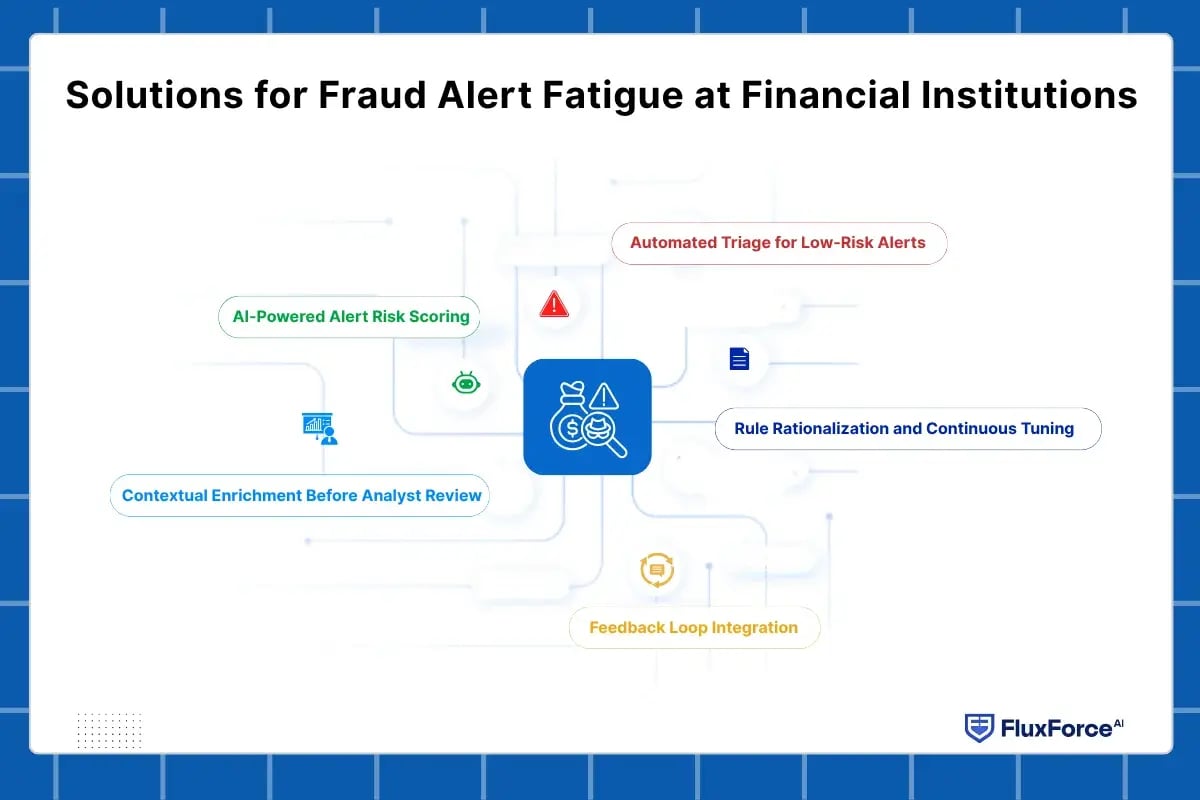
Solution 1: AI-Powered Alert Risk Scoring
Instead of treating every alert equally, assign a machine learning-generated risk score to each alert based on the probability of true fraud. Institutions exploring this approach should review how false positives mitigation by agentic AI accelerates alert quality improvements. High-scoring alerts are prioritized; low-scoring alerts are auto-triaged or deprioritized.
Documented impact: According to a 2025 Celent case study, a $6B regional bank that implemented ML-based alert scoring reduced analyst time spent on false positives by 52% and increased true positive identification by 28% within 8 months.
Solution 2: Contextual Enrichment Before Analyst Review
Automatically enrich every alert with customer behavioral baseline, entity intelligence, transaction history, device intelligence, and counterparty data before it reaches an analyst. This eliminates the manual research that consumes 40–60% of investigation time.
Documented impact: According to McKinsey's 2025 Financial Crime Operations Report, institutions deploying pre-alert contextual enrichment reduced average case handling time from 22 minutes to 9 minutes—a 59% improvement.
Solution 3: Automated Triage for Low-Risk Alerts
Implement automated triage that closes or deprioritizes alerts below a defined risk threshold. This is not "ignoring alerts"—it is applying documented, auditable criteria to route low-risk alerts to a separate review queue with reduced investigation requirements.
Key insight: Regulators support risk-based alert triage when it is properly documented. The FFIEC BSA/AML Examination Manual explicitly acknowledges that "institutions may use risk-based approaches to prioritize alert review, provided the methodology is documented, validated, and subject to periodic assessment."
Solution 4: Rule Rationalization and Continuous Tuning
Conduct a systematic review of every active detection rule. Identify redundant, outdated, and poorly performing rules. Retire rules with consistently high false positive rates and no true positive hits. Implement a formal rule lifecycle that includes periodic performance review.
Documented impact: According to Aite-Novarica, institutions that conducted thorough rule rationalization reduced total alert volume by 30–40% without any decrease in true positive detection.
Solution 5: Feedback Loop Integration
Connect investigation outcomes back to detection systems. As institutions transition from legacy tools to AI-powered fraud mitigation, building these feedback mechanisms becomes significantly easier. When analysts consistently close a certain alert type as false positive, that data should inform rule tuning and model retraining. This creates a feedback-driven system where alert quality increases over time.
Documented impact: According to the Federal Reserve's 2025 Payments Study, institutions with automated feedback loops improved their alert-to-SAR ratio by 35% over 12 months.
Building an Alert Management Architecture That Scales
The most effective institutions treat alert management as an architecture problem, not a staffing problem. The target architecture includes:
- Detection Layer: Rules for hard constraints + ML models for behavioral anomalies
- Scoring Layer: Every alert receives a risk score before entering any queue
- Enrichment Layer: Contextual data is attached automatically, not manually
- Triage Layer: Risk-based routing—high-risk to senior analysts, low-risk to automated or junior review
- Investigation Layer: Analysts receive pre-enriched, prioritized cases with AI-suggested investigation paths
- Feedback Layer: Investigation outcomes feed back to detection and scoring models
This architecture inverts the current funnel: instead of analysts spending 70% of time on false positives, they spend 70% of time on high-probability cases.
XAI boosts ROI for AI investments in banking
by enhancing transparency, trust, and decision-making.
Key Takeaways
- 70% of fraud analyst time is wasted on false positives: According to Gartner (2025), the average fraud team spends the vast majority of working hours investigating legitimate transactions, leaving insufficient time for actual fraud investigation.
- The root cause is architecture, not volume: Alert fatigue stems from five systemic failures—poorly tuned rules, lack of contextual enrichment, siloed data, absent prioritization, and missing feedback loops.
- Analyst burnout drives 25% annual turnover: At an average replacement cost of $45,000–$75,000 per analyst, alert fatigue is a direct financial drain beyond just wasted investigation hours.
- Alert blindness causes missed fraud: Analysts reviewing more than 30 alerts per day show a 22% decline in detection accuracy, meaning alert fatigue actually increases fraud losses.
- AI-powered alert scoring reduces false positives by 40–52%: ML-based risk scoring, combined with contextual enrichment and automated triage, is the most documented path to reducing alert fatigue.
- Regulators support risk-based triage: The FFIEC explicitly allows risk-based alert prioritization when the methodology is documented, validated, and periodically assessed.

Share this article