.webp)







Listen To Our Podcast🎧
Introduction
Session risk scoring is quickly becoming the line between a bank that stops account takeover mid-session and one that hears about it from an angry customer three days later. A password and a one-time code only prove who logged in at the moment of login. They say nothing about the device that gets swapped five minutes later, the new IP address that shows up during a wire transfer, or the typing pattern that suddenly looks nothing like the real account holder.
We have watched banks add more one-time passcodes and call it security, then watch fraud losses climb anyway, because the attack happened after login, not at the front door. That gap is exactly what session risk scoring closes.
In this guide we cover what session risk scoring actually is, how it pairs with continuous authentication, where agentic AI in banking is genuinely ready for production, and where it is still marketing. We also walk through the real fraud prevention ROI and compliance automation ROI numbers, not the vendor slide-deck version.
- What session risk scoring means and how it differs from a one-time login check
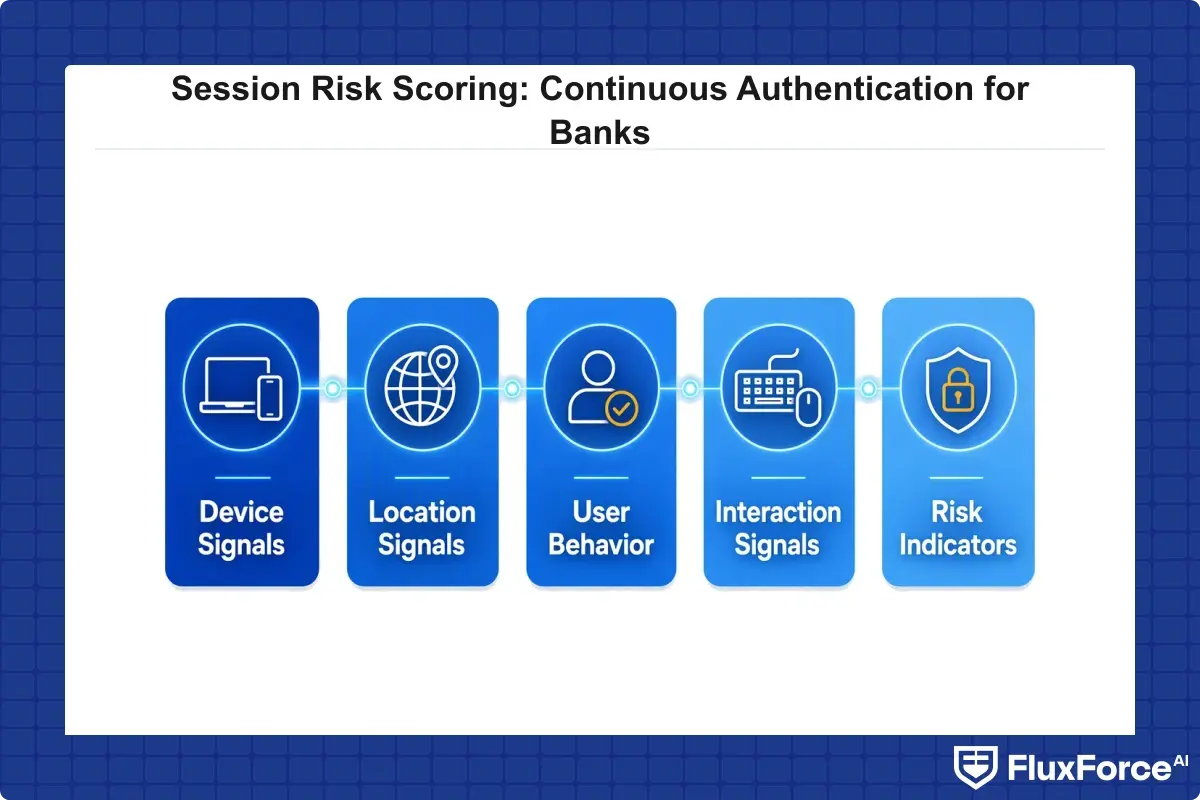
- The 5 signal types that feed an accurate, real-time risk score
- How continuous authentication builds on session risk scoring to stop mid-session fraud
- A direct comparison of session risk scoring against step-up MFA
- How to calculate fraud prevention ROI and compliance automation ROI for your own institution
- Where agentic AI in banking is production-ready today, and where the hype still outruns reality
Onboard Customers in Seconds

What Is Session Risk Scoring in Banking?
Session risk scoring is a continuous process that assigns a dynamic risk value to an active banking session, based on device, behavioral, and transaction signals, rather than checking identity once at login and trusting it for the next 20 minutes. Every action inside the session, a balance check, a payee change, a large transfer, gets re-scored against the current risk picture.
That continuous re-scoring is what separates it from traditional authentication, and it is also why it sits naturally inside a zero trust model. We have written before about how zero trust security architecture assumes no session is safe by default, and session risk scoring is the engine that makes that assumption operational instead of theoretical.
The Core Components of a Session Risk Score
A working session risk score typically blends:
- Device trust: fingerprint, jailbreak/root status, browser and OS consistency
- Behavioral pattern: typing cadence, mouse movement, navigation speed
- Transaction context: amount, payee, time of day, channel
- Network signal: IP reputation, VPN or proxy use, ASN changes
- Historical baseline: how this specific customer normally behaves
Each factor gets weighted and combined into a single score, usually 0 to 100, that decides whether the session continues, gets challenged, or gets frozen.
Session Risk Scoring vs One-Time Authentication
One-time authentication answers a single question: is this the right person right now? Session risk scoring keeps asking that question every few seconds for the life of the session. A stolen session cookie or a hijacked device beats the first question easily. It struggles a lot more against the second.
Why Static Authentication Fails Banks in 2026
Static login checks were built for a web that barely exists anymore. Session hijacking, malware-based device takeover, and SIM-swap attacks all happen after a legitimate login, which means password strength and even hardware tokens do nothing once the attacker is inside the session. That is the core reality of ai in banking 2026: the fraud has moved past the login screen, and the defenses mostly have not.
Fraud costs organizations about 5% of annual revenue according to the ACFE's 2024 Report to the Nations, and most of that loss happens in the gap between a verified login and a completed transaction, exactly where static authentication stops watching.
The Cost of Compliance Financial Services Teams Pay for Manual Reviews
The cost of compliance financial services teams absorb is not just the fraud itself, it is the labor behind reviewing every flagged session by hand. Manual compliance cost shows up as analyst hours, backlog, and false positives that send legitimate customers into a review queue for a transaction that was never risky in the first place. In our client engagements, a mid-size bank running manual session reviews typically ties up two to four full-time analysts just triaging alerts that a properly tuned risk engine would auto-clear in under a second.
How Does Continuous Authentication Build on Session Risk Scoring?
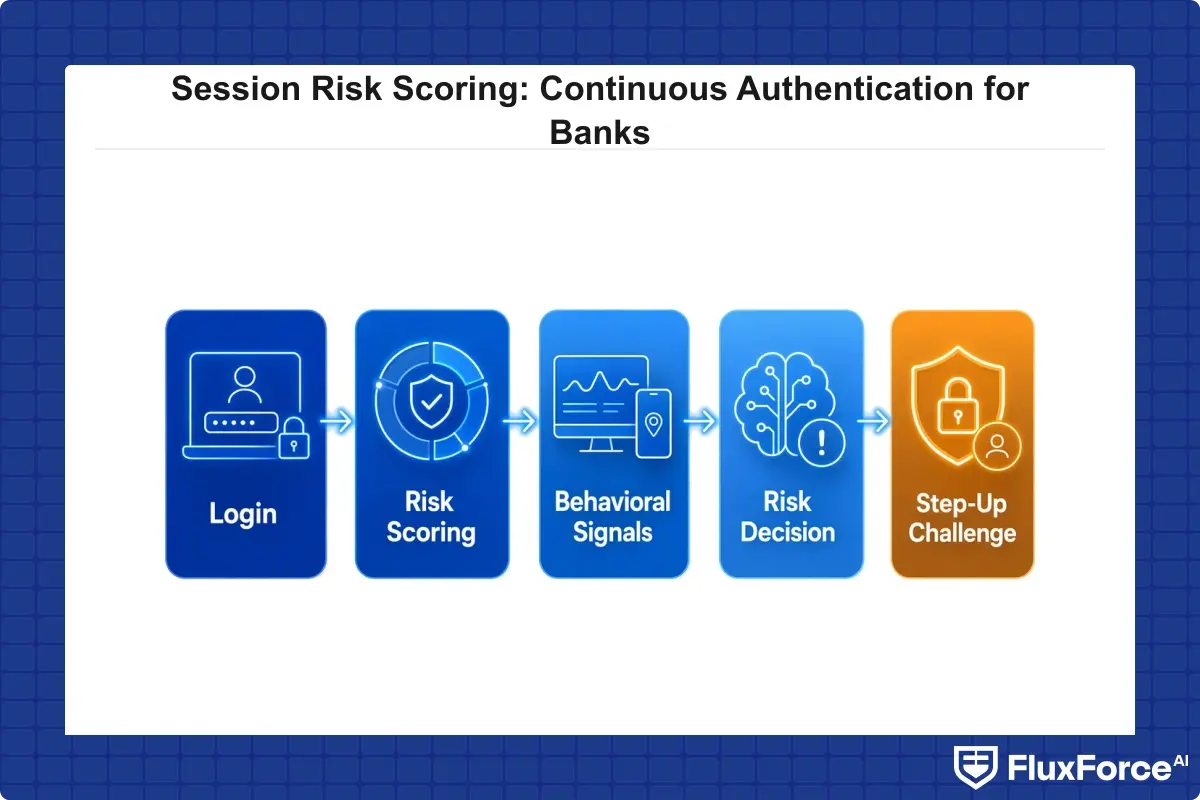
Continuous authentication uses the session risk score as its live input, re-evaluating trust throughout the session instead of granting it once and walking away. Think of session risk scoring as the sensor and continuous authentication as the decision layer that acts on what the sensor reports.
How Continuous Authentication Works Step by Step
- Customer logs in and an initial risk score is set
- The engine ingests device, behavioral, and network signals in real time
- Each new action (transfer, payee add, password change) triggers a re-score
- Low-risk sessions continue uninterrupted
- Medium-risk sessions get a lightweight step-up challenge
- High-risk sessions are frozen and routed to a human reviewer
This is agentic ai banking in practice: an autonomous agent watching the session and making a judgment call, not a human staring at a dashboard waiting for an alert.
Agentic AI Financial Services Use Cases for Session Monitoring
Beyond fraud, agentic ai financial services deployments are showing up in areas like automatically documenting why a session was frozen for an examiner, or triggering a compliance workflow the moment a high-risk session touches a sanctioned payee. That overlaps directly with the work we cover in continuous user verification for banking risk teams, where the verification layer and the compliance layer share the same underlying signal feed.
5 Signals That Feed a Session Risk Scoring Engine
1. Device and Network Fingerprinting
Device ID, browser configuration, OS version, and IP/ASN reputation form the baseline. A returning device on a known network starts every session with a lower risk floor.
2. Behavioral Biometrics
Typing rhythm, swipe pressure on mobile, and mouse trajectory are hard for an attacker to replicate even with valid credentials in hand.
3. Transaction Context and Amount Anomalies
A $50 bill payment and a $50,000 wire to a new payee carry very different baseline risk, even from the same device and the same customer.
4. Geovelocity and Location Checks
If a login happens in Chicago and a transfer is attempted from an IP that geolocates to another continent nine minutes later, that is a physical impossibility worth flagging instantly.
5. Historical Session Baseline
Every customer has a rhythm: login times, typical transaction sizes, usual payees. The score weighs new behavior against that specific customer's history, not a generic population average.
Session Risk Scoring vs Traditional Step-Up MFA
Session Risk Scoring vs Step-Up MFA: Which Wins on Friction?
| Approach | Fraud Coverage | Customer Friction | Ongoing Cost |
|---|---|---|---|
| Password + static OTP | Login-only, blind after auth | Low, but attacker sees it too | Low upfront, high fraud loss |
| Step-up MFA on every high-value action | Better, but reactive | High, customers abandon transfers | Moderate, support tickets rise |
| Session risk scoring alone | Continuous, proactive | Very low for legitimate users | Moderate, tuning required |
| Session risk scoring + continuous auth | Continuous and adaptive | Low, friction only when warranted | Higher upfront, lower total cost |
Step-up MFA is not wrong, it is just blunt. It challenges everyone above a fixed threshold regardless of context. Session risk scoring narrows that challenge down to the sessions that actually earned suspicion, which is the entire point of pairing it with API security controls at the integration layer rather than bolting friction onto every endpoint equally.
Fraud Prevention ROI and Compliance Automation ROI: The Real Numbers
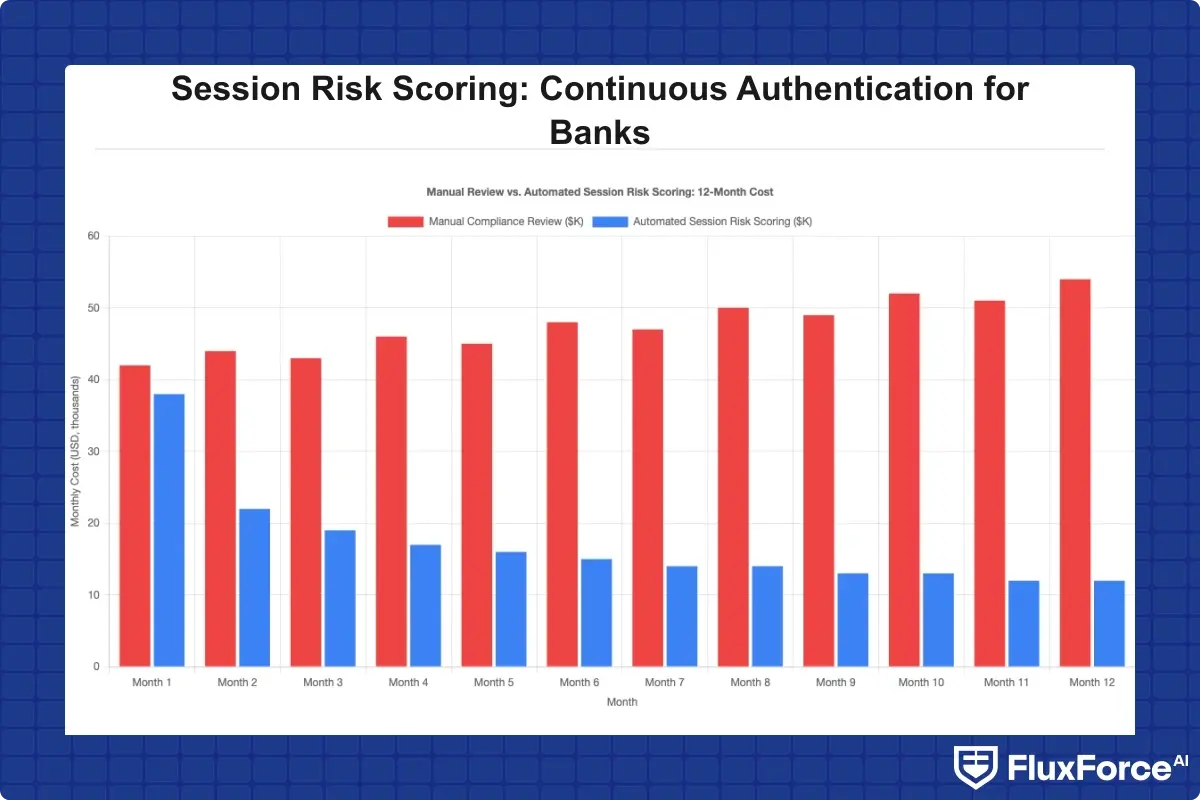
Ai automation banking programs get pitched on fraud prevention ROI alone, and that undersells the case. The stronger number, in our experience, comes from the compliance side, where the labor savings are steadier and easier to forecast than fraud losses ever are.
Calculating Fraud Prevention ROI
Fraud prevention ROI is simplest when you frame it as: (fraud losses prevented plus analyst hours reclaimed) minus (platform cost plus integration cost), divided by total cost. A bank processing 2 million digital sessions a month, at a rough $70 per false-positive review times even a 3% false-positive rate, is looking at $4.2 million a year in review cost alone before a single dollar of actual fraud is counted.
What Compliance Automation ROI Actually Looks Like
Compliance automation ROI shows up as fewer manual escalations, faster examiner response times, and a shrinking backlog rather than a single dramatic number. We have covered the manual-versus-automated tradeoff in depth in our manual compliance vs AI automation comparison, and the pattern holds here too: automation rarely eliminates headcount, it redirects it toward the sessions that actually deserve a human look.
In our engagements, banks that move from manual session review to automated session risk scoring typically cut review volume by more than half within the first two quarters, simply because the engine stops escalating sessions a human would have cleared anyway.
Agentic AI in Banking: Hype vs Reality
Ai in banking hype vs reality is a real gap, and pretending otherwise does not help anyone building a 2026 roadmap. Agentic ai banking tools are genuinely good at narrow, well-defined decisions made thousands of times a day. They are not yet good at judgment calls with ambiguous regulatory consequences.
What Agentic AI in Banking Can Do Today
- Real-time session scoring: production-ready, running at scale today
- Auto-clearing low-risk sessions: mature, low false-positive rates in tuned deployments
- Drafting compliance documentation: solid first drafts, still reviewed by humans
- Flagging pattern shifts across a customer base: strong at surfacing anomalies fast
This overlaps with what we documented in how agentic AI fraud agents cut false positives by 80 percent, where the gains came from narrowing the review queue, not from removing human judgment entirely.
Where the Future of AI in Banking Still Needs Human Oversight
The future of ai in banking is not full autonomy on regulatory decisions. Final sign-off on account freezes tied to sanctions exposure, or any decision with legal liability attached, still belongs with a licensed compliance officer. Treat the agent as the analyst that clears the noise, not the one that signs the report.
How FluxForce Handles Session Risk Scoring for Regulated Banks
FluxForce builds session risk scoring as part of a wider continuous authentication layer rather than a bolt-on fraud rule. That distinction matters because a risk score that lives outside your core banking stack is always a step behind the transaction it is supposed to be protecting. For banks running a fluxforce review of their current fraud and identity stack, the starting question we push clients toward is not "which vendor has the best model," it is "where does the score actually plug in."
FluxForce Review: What Sets the Approach Apart
FluxForce AI scores sessions using the same signal pipeline used for compliance automation, so a session that gets frozen for fraud reasons and a session that gets flagged for AML exposure are evaluated through one consistent engine, not two disconnected systems that disagree with each other.
Core Banking Modernization as the Foundation
Session risk scoring works best when it is not fighting a legacy core system for real-time data access. That is why we tie it to core banking modernization as the underlying foundation, since a modern core exposes the transaction and session data the scoring engine needs on the timeline fraud actually happens on, in milliseconds, not overnight batch files.
- Session risk scoring evaluates trust continuously through a session, not just once at login.
- Five signal types, device, behavior, transaction context, geovelocity, and historical baseline, combine into one live score.
- Session risk scoring plus continuous authentication cuts customer friction compared to blanket step-up MFA.
- Fraud prevention ROI and compliance automation ROI both improve, but the compliance side is the steadier, more forecastable win.
- Agentic AI in banking is production-ready for scoring and triage today, not yet for final regulatory sign-off.
- A modern core banking layer is what lets session risk scoring act in real time instead of after the fact.
Onboard Customers in Seconds
Conclusion
Session risk scoring solves a specific, expensive problem: banks losing money and analyst hours to fraud that happens well after a customer has already logged in successfully. Static passwords and one-time codes were never built to watch a session for its full lifespan, and the $4.2 million-a-year review cost we walked through earlier shows exactly what that blind spot costs at scale.
The fix combines three things: continuous authentication that keeps re-checking trust instead of granting it once, a session risk scoring engine that reads device, behavioral, and transaction signals in real time, and compliance automation that routes only the sessions that genuinely need a human.
Adopting this in practice means auditing your current session data pipeline, tying the score to your core banking system rather than a bolt-on rule engine, and starting with a scoped pilot on your highest-value transaction type. Banks that do this typically see review volume drop by more than half within two quarters, which is the number that actually shows up on next year's budget.
If your current fraud stack still treats login as the only checkpoint, that is the gap to close first. Start by mapping which of your session signals you already collect but never act on in real time.

Share this article