.webp)







Listen To Our Podcast🎧
Introduction
Injection attack liveness detection has moved from a theoretical concern to an active battleground in financial services. As banks and fintechs race to digitize onboarding, fraudsters are exploiting two fundamentally different attack vectors: presentation attacks, where someone holds a photograph or mask to a camera, and injection attacks, where synthetic media is inserted directly into the video stream before the liveness check ever runs. These are not variations of the same problem. They require different defenses, different detection signals, and a different security posture. This post breaks down both attack types, explains why modern deepfake detection banking solutions can only partially close the gap, and outlines what a complete digital identity proofing strategy looks like in 2026.
- Why Injection Attack Liveness Detection Is Now a Frontline Security Priority
- What Is a Presentation Attack?
- How Injection Attacks Bypass Biometric Identity Verification
- The Role of Deepfake Detection in Banking
- How Liveness Detection Fraud Threatens KYC Onboarding Speed
Onboard Customers in Seconds

Why Injection Attack Liveness Detection Is Now a Frontline Security Priority
The Shift From Physical to Digital Fraud Vectors
For most of the last decade, biometric identity verification systems were designed to stop someone sitting in front of a camera with a printed photo of another person. Presentation attacks are visible, detectable by motion analysis, and addressable through active liveness checks. The infrastructure for defending against them is mature and well-understood in most identity verification fintech deployments.
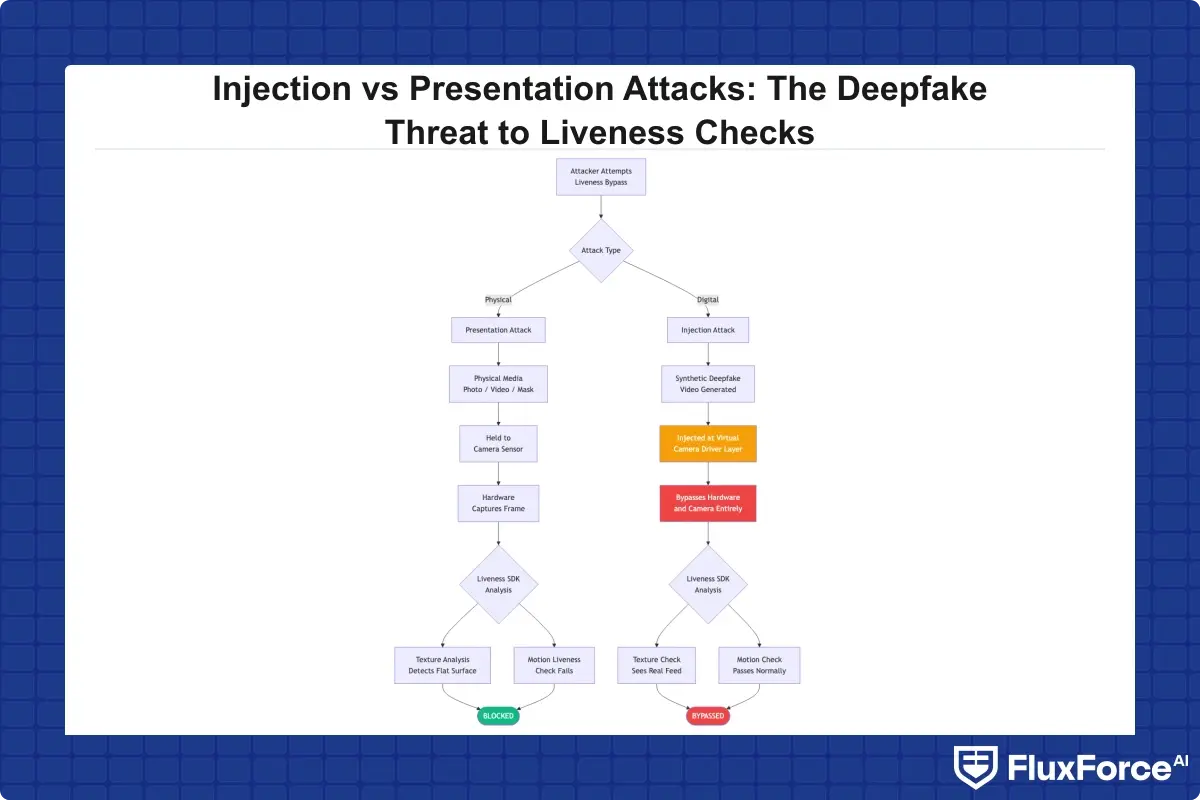
Injection attacks are different. The attacker never touches the camera. Instead, they intercept the software layer between the device camera and the liveness detection API, replacing the real video feed with a synthetic stream. A high-quality deepfake video of the target is inserted, the liveness check receives what looks like compliant sensor data, and the fraudulent onboarding session passes.
The reason this became a priority issue in 2024-2025 is accessible tooling. Generating a photorealistic deepfake from a few dozen public photos now takes under an hour using consumer hardware and open-source models. The barrier to a sophisticated injection attack dropped sharply, and liveness detection fraud incidents are rising as a direct result.
Why KYC Onboarding Speed Creates a Security Trade-Off
Every financial institution faces a trade-off between security depth and kyc onboarding speed. Adding friction to stop injection attacks (hardware attestation requirements, device binding, multi-frame behavioral analysis) can slow onboarding by seconds to minutes. For digital lenders and neobanks where conversion depends on a smooth three-minute sign-up flow, that is a real cost.
The honest answer is that you cannot fully neutralize injection attack risk without accepting some friction. The question is where to place that friction and how to make it invisible to legitimate users while blocking attackers. Identity verification fintech providers that get this right use risk tiering, not blanket friction.
What Is a Presentation Attack?
A presentation attack is any attempt to defeat a biometric system by presenting a physical artifact directly to a sensor. The attacker is physically present in front of the device camera.
ISO/IEC 30107-3, the international standard for Presentation Attack Detection (PAD), defines three primary categories:
- Print attacks: A flat photograph held up to the camera
- Replay attacks: A video playing on a second screen held in front of the camera
- 3D artifact attacks: A sculpted mask or silicone model matching the victim's facial geometry
Modern liveness detection handles print and replay attacks well. Active liveness checks using random micro-movements catch most replay attacks. Passive liveness checks using texture analysis and reflection mapping catch high-quality prints. 3D masks are harder, but hardware-based depth sensors on newer flagship devices make them detectable.
The core weakness of presentation attack detection is that it was designed assuming the camera sees the real world. Injection attacks invalidate that assumption entirely. This is why compliance with PAD standards alone does not protect institutions against the newer threat class.
How Injection Attacks Bypass Biometric Identity Verification
An injection attack inserts a synthetic video signal into the data pipeline at the software layer, using one of three primary methods:
- Replacing the camera driver with a virtual camera that outputs attacker-controlled media
- Hooking into the SDK at the API call level and substituting frame data before it reaches the liveness check
- Running a proxy between the device camera and the liveness SDK to intercept and replace frames in transit
The liveness detection algorithm receives data that appears to originate from a real sensor. Without additional signals such as device integrity checks, frame metadata validation, and certificate pinning on sensor data, the system has no mechanism to detect the synthetic source.
How Deepfakes Make Injection Attacks Viable at Scale
Ten years ago, injection attacks required significant technical expertise. Today, the attack chain looks like this:
- Collect 20-30 public photos of the target from LinkedIn or social media
- Train or fine-tune a face-swap model in under an hour on consumer hardware
- Route the synthetic stream through a virtual camera application such as OBS or a custom driver
- Submit the synthetic stream to the liveness detection check as if it were live camera input
For synthetic identity fraud detection in banking contexts, this is particularly damaging. Attackers often combine a real person's biometrics with fabricated document details, creating composite identities that pass individual checks but fail on cross-referencing. The liveness check passes, the document check passes, and only a correlation layer catches the inconsistency.
What Liveness SDKs Can and Cannot Detect
Most commercial liveness detection SDKs rely on one or more of these signals:
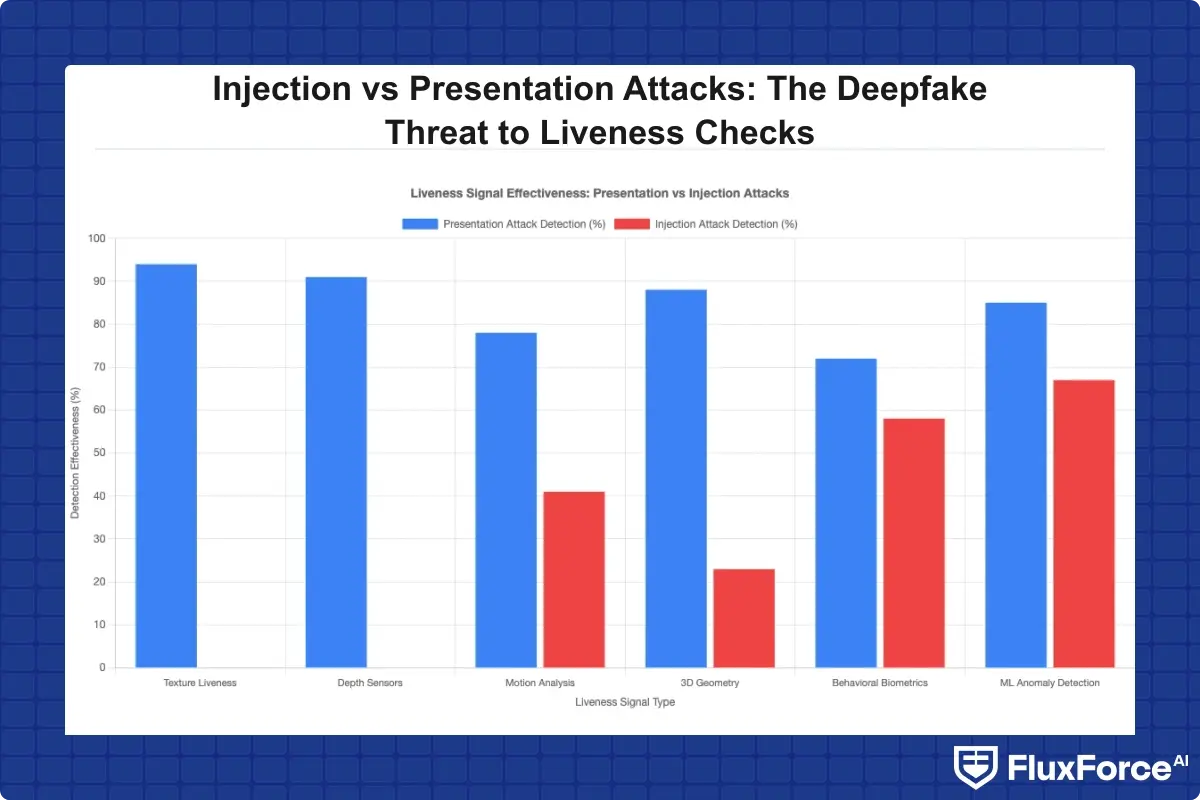
| Signal | Catches Presentation Attacks | Catches Injection Attacks |
|---|---|---|
| Motion analysis (micro-movements) | Yes | Partially |
| Texture liveness (skin vs. paper) | Yes | No |
| Depth sensors (hardware) | Yes | No |
| Frame metadata validation | No | Yes |
| Device attestation (TEE/SE) | No | Yes |
| Behavioral biometrics | No | Partially |
The gap is significant. Signals built for presentation attacks are largely blind to injection attacks. A liveness check that scores 99% on presentation attack detection benchmarks may still pass a high-quality injection attack without additional verification layers in place.
A liveness check that scores 99% on presentation attack detection benchmarks may still pass a high-quality injection attack without additional verification layers in place.
The Role of Deepfake Detection in Banking
Deepfake detection banking solutions have evolved considerably since 2022, but they address a different problem than liveness detection. Deepfake detection analyzes video content for synthetic artifacts: unnatural blinking patterns, inconsistent lighting between face and background, compression artifacts specific to GAN outputs, and frequency-domain anomalies invisible to the naked eye.
This works well for forensic analysis of submitted video. It works poorly as a real-time gate for high-throughput liveness checks, for two practical reasons.
Latency: Deep neural network inference on video frames adds 200-500ms per check in typical cloud deployments. For identity verification API integrations where speed is a selling point, this is a meaningful cost to the user experience.
Adversarial adaptation: Deepfake generators are specifically trained to evade detectors. As detection models improve, generation models adapt. This is an ongoing arms race, not a resolved technical problem. Any static detection model degrades over time without continuous retraining.
The practical approach is to use deepfake detection as a second-pass review signal rather than a primary gate. Flag sessions scoring above a confidence threshold for asynchronous review, while legitimate sessions proceed without delay. For institutions with existing KYC and identity verification processes for insurance claims, layering deepfake scoring on top of document verification and liveness results creates a composite risk signal that meaningfully outperforms any single check.
How Liveness Detection Fraud Threatens KYC Onboarding Speed
The business impact of liveness detection fraud on identity verification fintech platforms extends well beyond individual fraudulent accounts. Consider the downstream effects:
- Chargebacks and direct fraud losses from accounts opened with synthetic or stolen identities
- Regulatory exposure when KYC failures result in AML compliance breaches under FinCEN or FCA rules
- False positive inflation: aggressive defenses flag legitimate users, driving onboarding abandonment rates up
A practical problem many institutions face is that they have no visibility into which sessions experienced injection attempts versus presentation attempts versus clean enrollments. Without that attribution data, tuning defenses correctly is guesswork. You may be applying the wrong mitigations to the wrong attack vector.
Balancing Security and KYC Onboarding Speed
Institutions that manage this balance well share three practices.
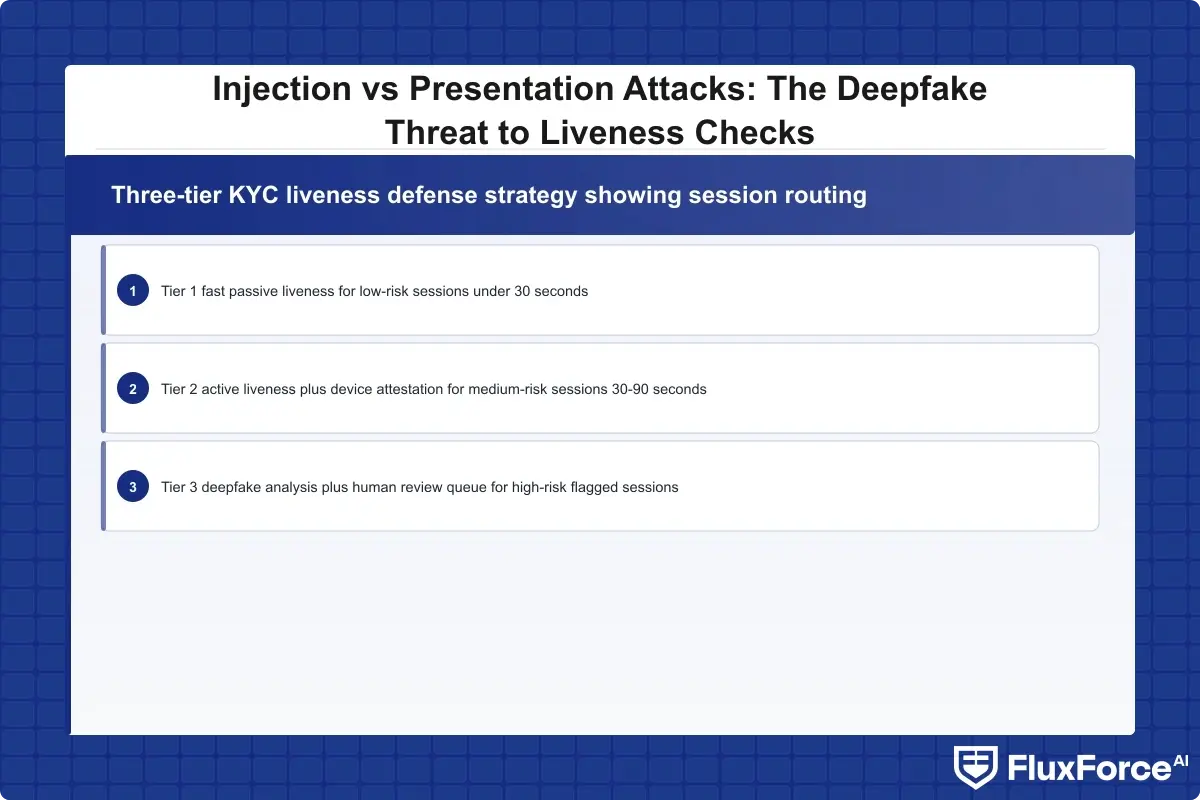
Tiered verification: Apply stronger liveness checks, including device attestation requirements, only to sessions flagged by upstream risk signals such as device reputation scores, behavioral anomalies, or IP risk. Low-risk sessions get a fast, lightweight passive liveness check. This keeps kyc onboarding speed high for the majority of legitimate users.
Asynchronous deepfake review: Run deepfake detection on all enrolled sessions in the background for the first 24 hours after enrollment. Sessions scoring above threshold get escalated for review before funding limits or withdrawal permissions increase.
Continuous re-verification: Liveness checks should not be one-time onboarding events. Applying periodic re-verification for high-value transactions aligns with zero trust security architecture principles for banking operations, where trust is never assumed based on a prior verification event.
Building a Defense: Digital Identity Proofing Under Attack
Effective digital identity proofing against injection attacks requires controls at multiple layers. The camera layer is not trustworthy without additional attestation, and treating it as trustworthy is the root cause of most injection attack vulnerabilities.
Device Integrity Checks
Before the liveness check begins, verify:
- Platform attestation: iOS DeviceCheck and Android Play Integrity API confirm the device is not jailbroken and the app binary is unmodified
- Camera source verification: The SDK validates that video frames arrive from the hardware camera module, not a virtual camera driver
- Certificate pinning: API calls between the client SDK and the liveness backend are certificate-pinned to block man-in-the-middle frame injection
This alone eliminates a substantial share of injection attempts, because most virtual camera tools cannot pass hardware attestation checks without significant additional effort from the attacker.
Behavioral and Environmental Signals
Beyond frame content, behavioral context improves the verification decision considerably:
- How does the user interact with the app before the liveness check? Scripted behavior is detectable from tap timing, scroll velocity, and form fill patterns that diverge from human norms
- Is ambient lighting consistent with a real environment? Uniform flat lighting is associated with studio-shot deepfake source material
- Does the face in the liveness session match the submitted identity document at a feature level, not just a surface similarity score?
Layering these signals is consistent with what NIST's Digital Identity Guidelines (SP 800-63-3) recommend under Identity Assurance Level 2 and 3 proofing: multiple independent evidence sources, not reliance on a single biometric factor.
The Role of KYC/AML Automation in Liveness Defense
Getting the technical defenses right is necessary but not sufficient. The workflow around the liveness check matters as much as the check itself. When identity verification API results feed directly into automated KYC decisioning, the right KYC/AML automation layer can cross-reference liveness results with document verification, watchlist screening, and behavioral risk signals in under two seconds, without adding manual review latency to every clean session.
This is where institutions see measurable improvement: not from a better liveness algorithm in isolation, but from an orchestration layer that combines signals intelligently and routes high-risk sessions appropriately while clearing low-risk sessions fast.
Zero Trust Financial Services and the Identity Verification API
The zero trust security framework has direct implications for how financial institutions should approach identity verification. Traditional security assumes that once a user passes onboarding, they carry some level of inherent trust within the system. Zero trust financial services rejects this entirely: every session, every transaction, and every API call is verified against current risk signals.
Applied to injection attack defenses, this means onboarding liveness checks set a baseline biometric template rather than a permanent trust token. Subsequent high-value actions trigger fresh verification against that template. Device and behavioral signals are evaluated continuously, not only at initial authentication. This is the correct mental model for synthetic identity fraud detection at scale.
How the Identity Verification API Needs to Evolve
Current identity verification API integrations typically return a binary pass/fail liveness result. That is not enough signal for good downstream decisions. A modern API response needs to include:
- A confidence score rather than just pass/fail
- Attack pattern classification indicating whether signals suggest a presentation or injection pattern
- Device attestation status, confirming the source camera is hardware-verified
- A recommended action tier: auto-approve, step-up verification, or queue for manual review
This richer output lets downstream systems make better decisions without adding latency for clean sessions. The FIDO Alliance's authenticator attestation specifications provide a practical model for how device-bound credentials and attestation chains should work in this context. For organizations that have already applied zero trust architecture to supply chain access controls, the same contextual, time-limited trust model translates directly to biometric identity verification programs.
- For most of the last decade, biometric identity verification systems were designed to stop someone sitting in front of a camera with a printed photo of another person.
- A presentation attack is any attempt to defeat a biometric system by presenting a physical artifact directly to a sensor.
- An injection attack inserts a synthetic video signal into the data pipeline at the software layer, using one of three primary methods:
- Deepfake detection banking solutions have evolved considerably since 2022, but they address a different problem than liveness detection.
- The business impact of liveness detection fraud on identity verification fintech platforms extends well beyond individual fraudulent accounts.
Onboard Customers in Seconds
Conclusion
Injection attack liveness detection is the harder problem in biometric identity verification, and most financial institutions are still underinvested in it. Presentation attacks are largely solved by mature, well-tested controls. Injection attacks, accelerated by accessible deepfake tools and virtual camera software, are not.
The path forward for banks, fintechs, and insurers involves layering defenses across device attestation, behavioral signals, and asynchronous deepfake scoring rather than treating liveness as a single-gate check. Liveness detection fraud continues to grow as deepfake tooling improves, which means digital identity proofing stacks need to evolve faster than the attack surface. Maintaining kyc onboarding speed while adding these layers requires intelligent risk tiering: heavier checks on flagged sessions, frictionless flow for clean ones.
If your current identity verification fintech stack cannot distinguish a presentation attack from an injection attack at the signal level, that is the right gap to close first. Build the attestation and behavioral signal layer, then optimize the workflow around it.


Share this article