.webp)








Listen To Our Podcast🎧

Introduction
Across banks, AI-enabled RegTech (Regulatory Technology) models are becoming part of everyday compliance work. Many firms have reported higher detection rates and faster regulatory reviews. However, regulators today are shifting the bar from performance to accountability.
Regulators are no longer satisfied with outcomes of Artificial Intelligence alone. They want to know why a decision was made and how it can be justified. Guidance from the Bank for International Settlements and the EU AI Act clearly highlights the need for transparency and auditability in high-risk AI systems.
In regulated environments, every outcome is examined, challenged, and audited. Within this context, explainability becomes essential to justify, defend, and govern AI-driven decisions. This detailed blog discusses the significance of explainability as compared to accuracy for transparent and regulator-aligned decision making.
FluxForceAI prioritizes clarity over mere accuracy
with transparent insights and data-driven decisions

Explainability vs Accuracy: Where Compliance Risk Actually Begins
Accuracy is often used to judge whether a RegTech model is “working.” But recent regulatory reviews show that accuracy alone does not reduce compliance risk. When a model cannot clearly explain why it decided, even correct outcomes can create regulatory exposure.
For example:
A fraud detection model in a bank may flag transactions with 95%+ accuracy yet fail to justify individual account freezes. Under General Data Protection Regulation (GDPR) Article 22 and European Banking Authority (EBA) model governance guidelines, this lack of decision transparency can trigger supervisory findings, customer frustration, and enforcement of penalties ranging from €5–10 million.
In contrast, an AI-driven monitoring system built with human-readable explainability can document decision factors, policy alignment, and case consistency. Under GDPR and financial supervisory audits, this traceability enables audit closure and can help organizations avoid €3–8 million annually.
In RegTech, accuracy delivers outcomes. Explainability determines whether those outcomes survive regulatory scrutiny.
Why Explainability is Crucial in Regulatory Technology
Lack of explainability in RegTech AI caused millions of wasted audit hours worldwide in 2024. Compliance leaders now treat explainability as a core control, not a technical enhancement. Several factors make explainability unavoidable in modern RegTech deployments:
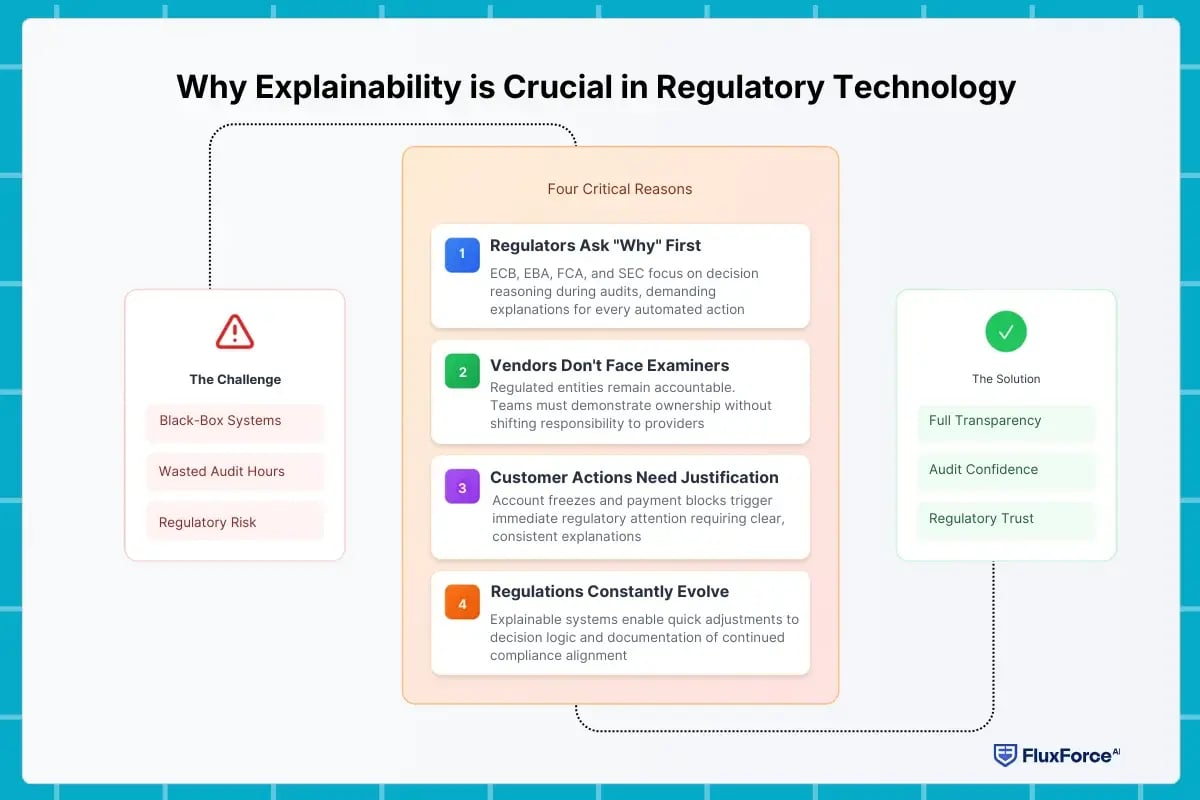
Reason #1: Regulators Ask “Why” Before Accepting Any Automated Decision
Regulators such as the European Central Bank, European Banking Authority, FCA, and SEC focus on decision reasoning during audits. Supervisors ask compliance teams to explain why systems flagged transactions, approved cases, or restricted accounts, regardless of model accuracy or detection performance.
Reason #2: Vendors Do Not Sit in Regulatory Examination Rooms
Supervisory bodies hold regulated entities accountable for every automated decision. During examinations, regulators question internal logic, approval criteria, and escalation rules. Explainable RegTech systems help compliance teams demonstrate ownership instead of shifting responsibility to technology providers.
Reason #3: Customer Actions Trigger Immediate Regulatory Attention
Account freezes, payment blocks, and fraud interventions affect customer rights directly. Regulators expect clear justification for such actions. Explainability enables teams to respond consistently to complaints, ombudsman cases, and supervisory follow-ups without operational confusion.
Reason #4: Changing Regulations Expose Black-Box Systems Quickly
Regulatory expectations evolve through enforcement actions and supervisory guidance. Explainable RegTech systems allow compliance teams to adjust decision logic, document updates, and show continued alignment during regulatory reviews.
How explainable AI improves regulatory decisions
An AI model, with interpretable machine learning power in banking, builds strong confidence in regulatory decision-making. With clear reasoning, teams can demonstrate how outcomes were reached and align decisions with policies. Below are some of the benefits of transparent AI models in RegTech decisioning:
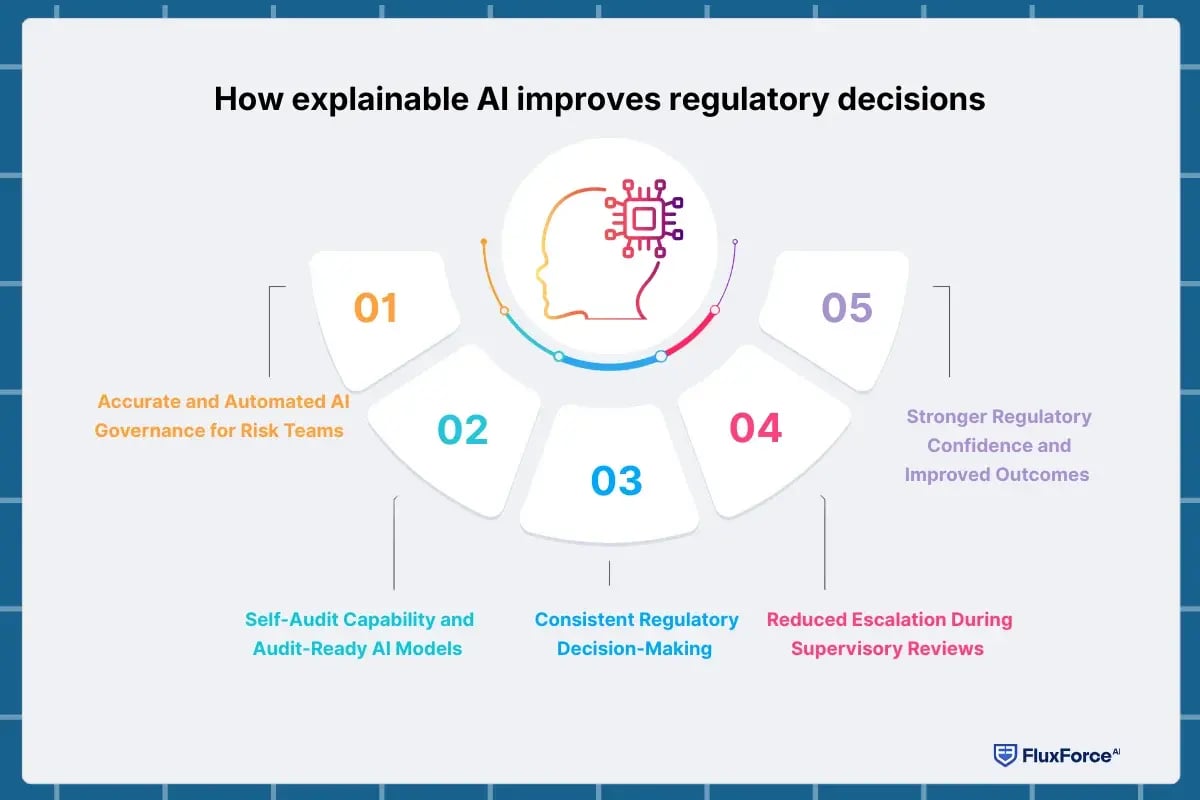
1. Accurate and Automated AI Governance for Risk Teams
Explainable AI enables risk teams to govern models proactively rather than reactively. Decision logic can be reviewed before deployment, monitored during operation, and reassessed when regulations change. Compliance officers understand not only what the model decided, but why it decided that way. Governance becomes continuous, not episodic.
2. Self-Audit Capability and Audit-Ready AI Models
Explainability transforms internal reviews into ongoing self-audits. When models produce transparent reasoning trails, organizations can test decisions against policies before regulators do. This capability enables model auditability in RegTech systems, reducing dependence on manual reconstruction during regulatory examinations.
3. Consistent Regulatory Decision-Making
Transparent AI models improve consistency across similar cases. When decision logic is visible, compliance teams ensure comparable scenarios receive comparable treatment. This consistency strengthens regulatory trust and reduces the risk of perceived bias or arbitrary enforcement.
4. Reduced Escalation During Supervisory Reviews
Explainable decisions shorten regulatory conversations. Teams can present clear rationale, supporting data points, and documented logic instead of relying on accuracy alone. This approach reduces follow-up questions, remediation demands, and supervisory friction.
5. Stronger Regulatory Confidence and Improved Outcomes
Case studies on explainability-enhanced AML tools report material reductions in false positives, ranging from 30% to 80%. Research in 2024 shows that adding structured explanations directly improved regulator confidence and defensibility of suspicious-activity reporting. Teams can demonstrate oversight, compliance alignment, and evidence-based decision-making.
What Defines Explainability in AI-driven compliance tools ?
Audit reports become more reliable and actionable when AI decisions are explainable. Clear reasoning behind alerts, exceptions, and approvals improves verification and helps auditors prepare defensible reports efficiently. The table below highlights the quality differences: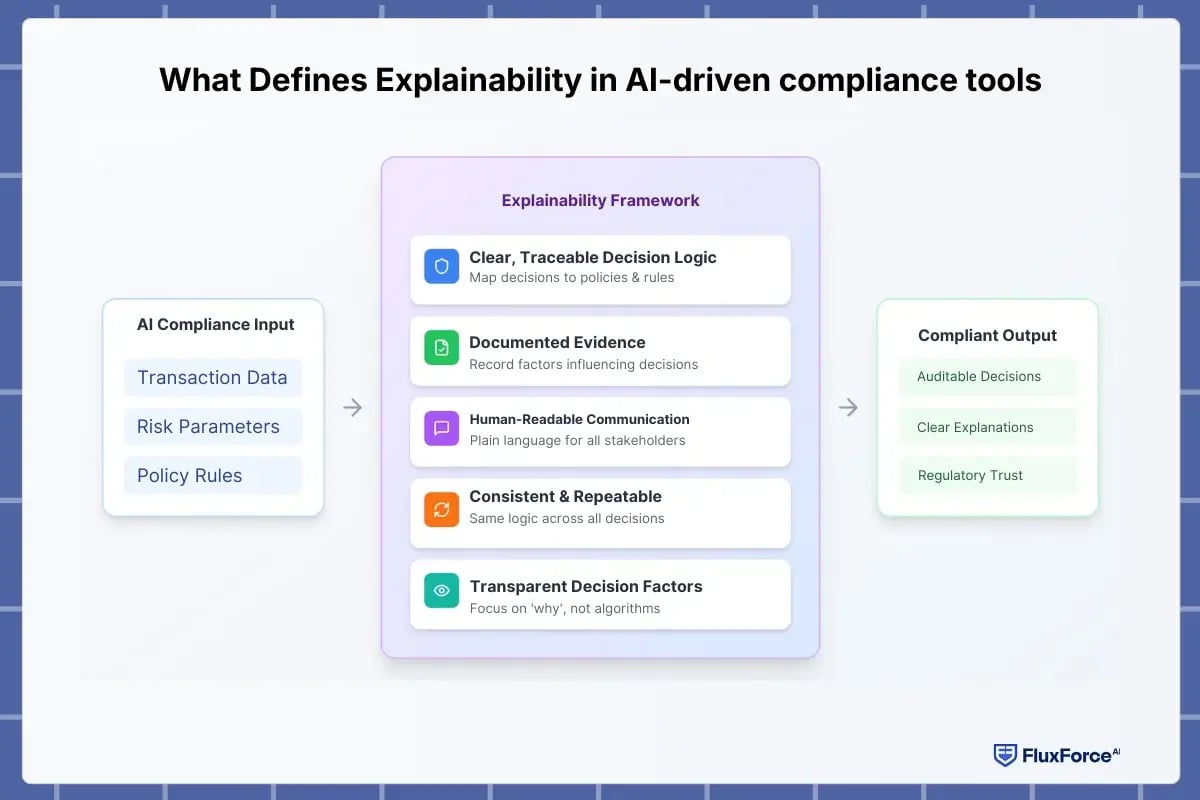
Model transparency in RegTech is often determined by whether outputs can be understood in human-readable, practical terms. Several elements define explainability in compliance tools:
- Clear, Traceable Decision Logic- AI Decisions must map directly to policies, risk thresholds, or regulatory rules. Compliance teams should clearly demonstrate why a transaction was flagged, approved, or blocked, ensuring every action is reviewable and auditable.
- Documented Evidence for Every Outcome- Compliance tools with integrated machine learning AI must provide records of the factors influencing each decision. Regulators expect consistent documentation that links alerts or approvals to policy requirements, supporting audit closure and supervisory confidence.
- Human-Readable Communication- Outputs should describe model reasoning in plain language. Compliance officers, auditors, and risk managers must understand and communicate the logic behind automated decisions without needing technical expertise.
- Consistent and Repeatable Explanations- Each automated decision should follow the same logic and documentation standards. Consistency ensures regulators can verify patterns over time, detect anomalies, and confirm policy alignment across the system.
- Transparent Decision Factors, Not Algorithms- Explainability focuses on why decisions are made, not the internal code or mathematical formulas. Supervisors only want clear, interpretable reasoning to validate outcomes and enforce accountability.
Across major financial institutions, RegTech models powered with deep learning techniques often generate accurate outcomes without revealing the reasoning behind decisions. Techniques such as Shapley Additive Explanations (SHAP) or Local Interpretable Model-Agnostic Explanations (LIME) help identify the factors that influenced each decision.
Boost trust in your audits today with FluxForceAI.
with transparent insights and data-driven decisions
Conclusion
Blackbox systems pose one of the biggest explainability challenges in financial compliance tools. In RegTech, automated decisions affect people, money, and organizational reputation.
While accuracy can show the metric that a system produces correct outcomes, it does not prove responsible operation. For regulators, customers, and leadership teams, transparency: understanding “why” a decision was made matters far more than how advanced the system is. Explainability, for compliance officers, is essential to defend actions, reduce regulatory risk, and maintain stakeholder trust.
In an environment where audits, investigations, and enforcement actions carry serious consequences, prioritizing explainability ensures that compliance tools not only produce results but operate with accountability, clarity, and confidence.


Share this article