


















Listen To Our Podcast 🎧

Introduction
Can insurance companies gain speed with AI without compromising security? That’s the question keeping CIOs and risk managers awake at night. Agentic AI in insurance promises a new era of autonomous decision-making—claims can be processed in minutes, fraud detected in real-time, and customer queries answered instantly. But does moving at this pace introduce unseen vulnerabilities?
The benefits are well-documented. Across a growing range of insurance use cases, AI applications now span automated underwriting, dynamic risk scoring, and AI-driven customer communication. Insurers are finding that AI for the insurance industry can meaningfully reduce operational costs while improving underwriting and claims accuracy.
Industry case studies and analyst research—including findings cited by Capgemini—show that insurers piloting autonomous AI in claims operations are beginning to achieve measurable reductions in processing time, particularly in low‑complexity claims.
But speed comes with a warning. The tension between insurance AI velocity and security is real: moving too fast with agentic AI in insurance can create gaps in data protection, regulatory compliance, or risk validation. The central question for insurers is: how can they adopt agentic AI at scale without exposing themselves to security or compliance risk?
Before exploring solutions, consider this: does your organization have the AI governance frameworks, continuous monitoring, and risk controls in place to deploy agentic AI responsibly?
How Insurance Companies Can Use Agentic AI to Balance Speed and Security ?
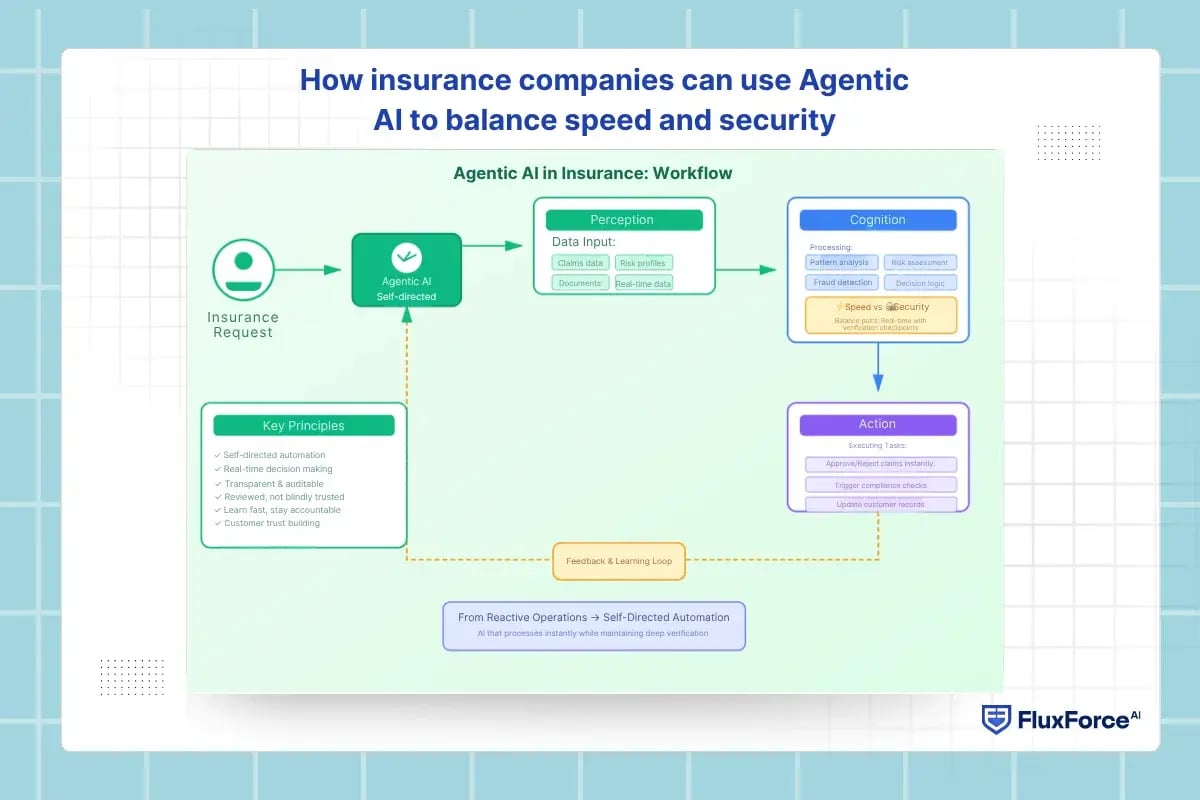
Speed has long been a competitive differentiator in insurance. Whether it's claim approvals or risk assessments, faster response times directly strengthen customer trust and retention. Whether it’s claim approvals or risk assessments, the faster you respond, the stronger your customer trust. Agentic AI in insurance is pushing this boundary further by enabling systems to make independent, real-time decisions. This marks a fundamental shift from reactive operations to self-directed automation.
But here's the real challenge: across many AI use cases in insurance, speed can conflict with data control and oversight. When AI applications in insurance process information instantly, they sometimes skip deeper verification layers that humans naturally perform. A small data mismatch or an unseen pattern can trigger an incorrect payout or miss a compliance trigger. Developers who build AI solutions for insurance know this that’s why smart insurers design feedback loops where AI decisions are reviewed, not blindly trusted.
This balance is what defines the future of AI insurance software. The benefits of AI in insurance are undeniable. Yet, insurance AI velocity vs security is no longer a trade-off but more like a discipline. It’s about building systems that learn fast but remain auditable, transparent, and accountable.

The Hidden Risks and Security Challenges of Agentic AI in Insurance
Agentic AI in insurance is helping insurers accelerate claims processing, strengthen fraud detection, and manage risks more efficiently. But as automation speeds up, a critical concern emerges: maintaining control and ensuring security at every decision point.
When Speed Creates Blind Spots
In many AI adoption in insurance deployments, data flows rapidly across multiple interconnected systems. If a single API endpoint or integration layer is left unprotected, sensitive policyholder data can be exposed before security teams are even alerted. This often happens when AI insurance software is integrated with older systems that were not designed for such high-speed data exchange.
Another major challenge is bias. When AI use cases in insurance rely on outdated or limited data, the models can repeat flawed decisions, such as approving risky claims or rejecting genuine ones. To address this, developers building AI applications in insurance increasingly deploy model monitoring tools that track decision logic, flag anomalies, and generate explainability reports. This helps insurers maintain fairness, transparency, and regulatory compliance.
Strong AI security in insurance extends well beyond data encryption. It requires full visibility into AI decision-making, continuous behavioral monitoring, and clear accountability when systems deviate from expected outputs. Without continuous monitoring and model validation, the push for speed in agentic AI deployments can rapidly translate into regulatory exposure, financial liability, or reputational damage.
Ultimately, agentic AI in insurance can only deliver sustainable value when insurers maintain full governance over what it learns, how it decides, and where it acts autonomously.
Building trustworthy and compliant Agentic AI systems in insurance
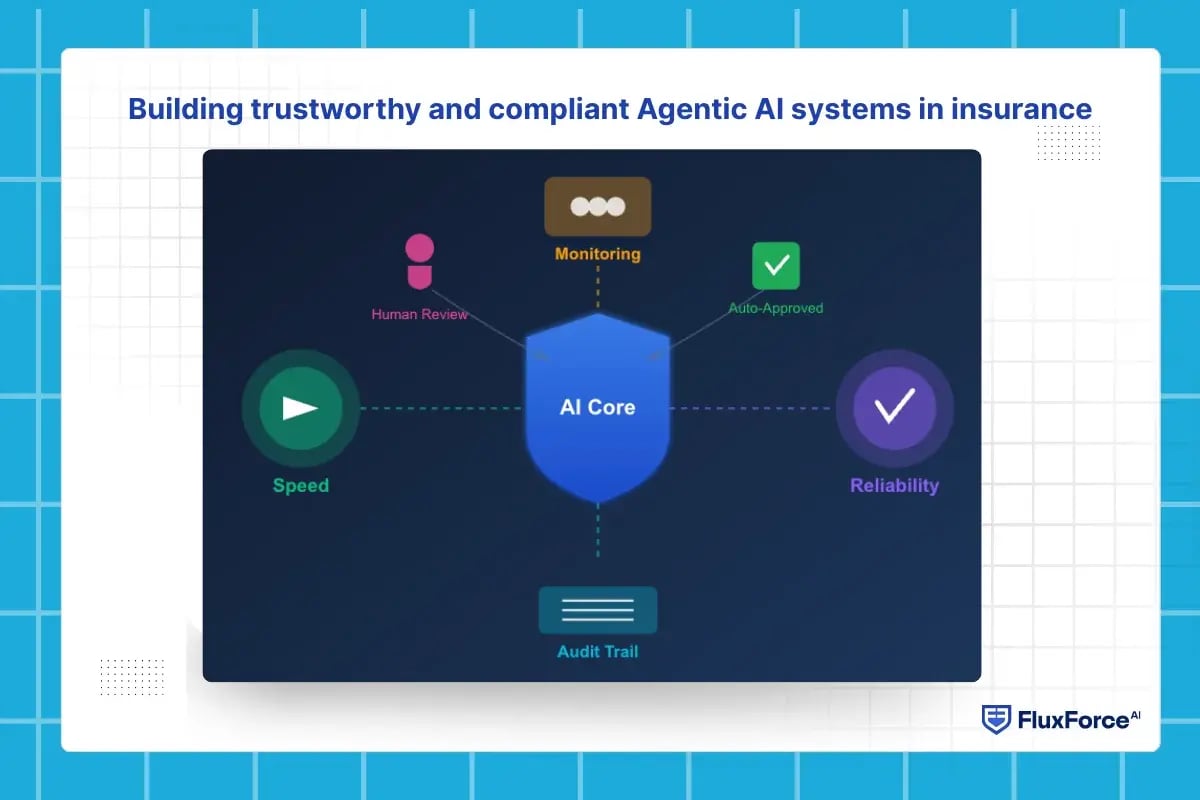
Insurers increasingly demand agentic AI systems that operate at speed without generating compliance risk. The key lies in designing AI architectures that are both high-performing and inherently secure.
How to make AI both fast and reliable
It starts with architecture design. AI solutions for insurance must be built on transparent, auditable frameworks where every automated decision is fully trackable and explainable. For example, while AI can autonomously approve low-risk claims, high-risk or anomalous claims can be automatically escalated for human review. This tiered, human-in-the-loop approach maintains processing speed without compromising security controls.
Continuous monitoring is essential. Using insurance analytics and AI tools, insurers can log every action the AI takes, creating a real-time record of all automated decisions and system behaviors. AI insurance software can generate real-time audit trails, giving compliance teams full visibility into what decisions were made, when, and why. This capability significantly reduces the effort required to meet regulatory requirements without disrupting operational workflows.
Compliance does not have to be a bottleneck. With AI applications in insurance, regulatory rules — including data privacy requirements and fraud detection protocols — can be embedded directly into automated workflows from the ground up.
The core takeaway is this: speed matters, but governance matters equally. When insurers design agentic AI in insurance with built-in visibility, automated checks, and compliance controls, they no longer face a forced compromise. The result is AI that is fast, accurate, and secure by design.
The future of Agentic AI in insurance
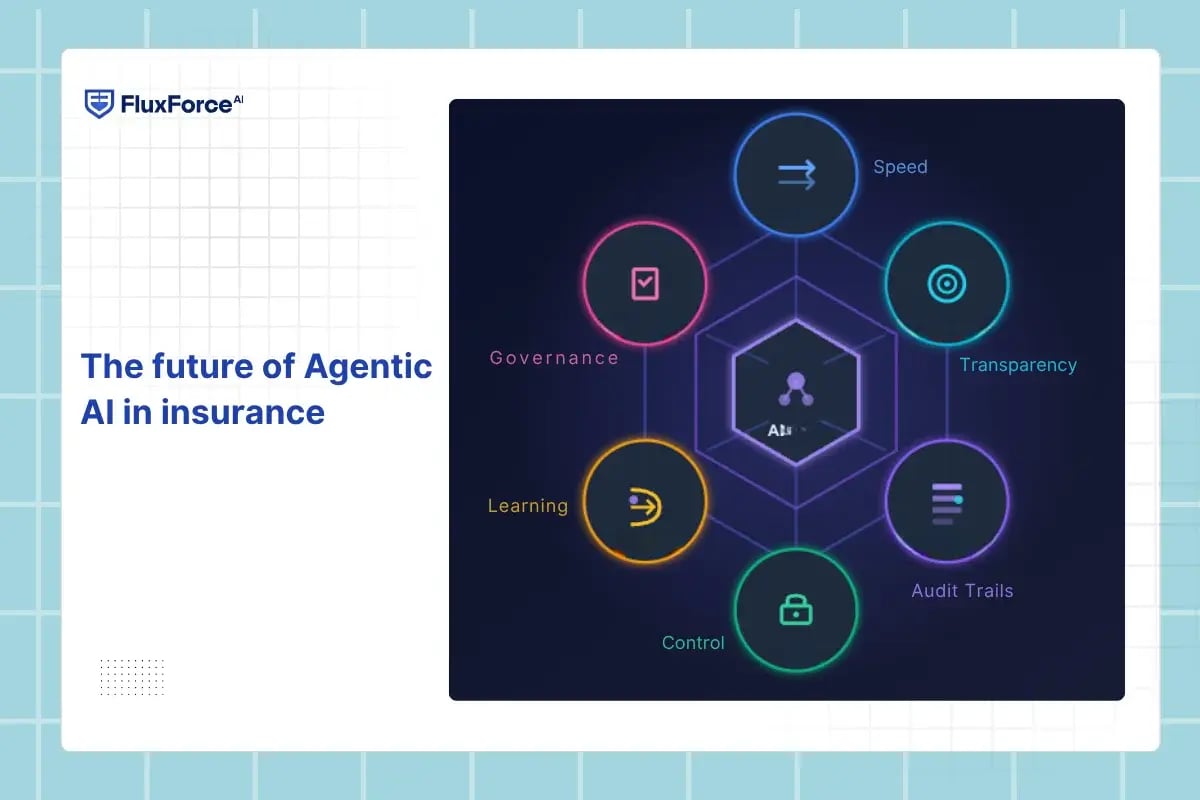
Agentic AI in insurance is moving from experimental to operational. Companies are realizing that speed alone doesn’t win; the real advantage comes from AI that can act independently while staying accountable.
Moving forward without losing control
The key is practical implementation. Insurers need AI insurance software that logs every decision and flags unusual patterns for human review. Models must be retrained continuously with clean, updated data to prevent bias or errors. Using AI applications in insurance for underwriting, claims triage, and fraud detection can cut processing times dramatically, but only if governance is built into the workflow.
Transparency matters. Teams should be able to explain why a claim was approved or rejected. Combining insurance analytics and AI with clear audit trails ensures both speed and regulatory compliance. This approach turns AI adoption in insurance into a competitive advantage rather than a risk exposure.
The companies that lead will be those who treat speed and security as complementary, not opposing goals. The benefits of AI in insurance is a better customer experience, and that come only when AI is carefully monitored, tested, and integrated into daily operations. Balancing insurance AI velocity vs security is now become the standard for insurers who want to stay ahead.
Turn Your Data into Real-Time Decisions
Transform your third-party risk management with Agentic AI Agents.
Conclusion
Insurers today face a choice: let AI dictate the pace or take control of how it transforms operations. Agentic AI in insurance offers speed, smarter claims handling, and improved risk evaluation, but its power comes with responsibility. The difference between leaders and followers will be how they balance innovation with oversight.
The companies that win will do more than implement AI solutions for insurance. They will integrate AI insurance software and AI applications in insurance with clear monitoring, audit trails, and decision transparency. They will use insurance analytics and AI not just to process data faster, but to make every action accountable and explainable.
The real value comes when AI moves confidently and safely. Insurers who manage AI adoption in insurance with practical controls can harness speed without exposing themselves to errors, compliance risks, or customer distrust. Insurance AI velocity vs security is not a trade-off; it is a strategy that separates operational efficiency from reckless automation.
For decision-makers, the takeaway is clear. Focus on speed, but design every AI decision with accountability. Invest in systems that allow AI to act independently but remain fully auditable. When executed thoughtfully, Agentic AI in insurance will do more than transform workflows and redefine insurance services.
Share this article