PHASE 4/5 — IN DEVELOPMENT

AI Core Banking Modernization That Launches Products 40% Faster

Cory Bankson — Director AI Core Banking Modernization

Your core banking monolith takes 6-12 months to launch a new product. Fintechs do it in weeks. Cory Bankson modernizes your core with 40% faster product launches, 100% data consistency during migration, and API-first architecture — without the $100M+ multi-year rip-and-replace. Incremental. Measurable. Safe.


20 Cory Bankson_Hero section_superhuman image (1)
profile

Cory Bankson

Director AI Core Banking Modernization

coming soon

40%

Faster Product Launches

100%

Data Consistency During Migration

API-First

Architecture Coverage

Measured

Cost Savings Legacy→Cloud

Incremental

Migration No Big Bang

Target metrics from design specifications. Validation pending Phase 4/5 deployment.
Trusted by Teams across Banking, Fintech, Insurance, and Global Trade
Logo 1 Logo 2 Logo 3 Logo 4 Logo 5 Logo 6 Logo 7 Logo 1 Logo 2 Logo 3 Logo 4 Logo 5 Logo 6 Logo 7
THE PROBLEM

The Problem Your Core Banking Platform Creates Every Day

Your core banking system was built for a different era. It runs on a monolithic architecture that makes every change — a new product, a regulatory update, a partner integration — a 6-12 month project. Meanwhile, fintechs and neobanks launch products in weeks.

According to Accenture's Banking Technology Vision 2025, 70% of bank CIOs report that their core banking platform is the single biggest barrier to digital transformation.


Slow product launches

New products take 6-12 months to ship because every change touches the monolith. Business teams wait in a queue while competitors launch first. According to McKinsey, banks with modern core platforms launch products 5x faster than those running legacy systems.


No cloud-native architecture

Legacy core systems cannot leverage cloud scalability, container orchestration, or microservice decomposition. Infrastructure costs grow linearly with volume. According to Celent, banks spend 65-75% of their IT budget on maintaining legacy systems — leaving only 25-35% for innovation.


Data consistency risk

Every core banking migration project carries the risk of data inconsistency — balances that do not match, transactions that get lost, and audit trails that break. This risk is why many banks have delayed modernization for years, choosing expensive maintenance over risky transformation.

JOB DESCRIPTION 

What Cory Bankson Does — Job Description

Cory Bankson is a Director AI Core Banking Modernization that operates inside your technology organization as a dedicated modernization architect and migration specialist.

CORY BANKSON   

Director AI Core Banking Modernization | FF-CBM 

 Not Built — In Development 

Reports To

 Your CIO / Head of Core Banking 

Works With

Existing core banking systems, data
platforms, and integration layers

Deployed In

 Phase 4/5 (assessment mode first)

KEY RESPONSIBILITIES

01

Map every dependency, data flow, and business rule in your legacy core banking monolith 

02

Generate optimal migration sequences — incremental, risk-prioritized 


03

Maintain 100% data consistency during every migration step with continuous reconciliation

04

Enable API-first architecture by decomposing monolithic functions into API-accessible services

05

Measure and track legacy-to-cloud cost savings at every migration milestone 

AUTONOMY MODEL

Low risk —  Acts autonomously (mapping, docs, test generation) 

Medium risk — HITL by default (configurable) 

High risk —  ALWAYS human review (non-negotiable)

  You configure the threshold per incident severity

Kill switch : Disable instantly

PERFORMANCE METRICS

Measured Performance — Not Promises

These metrics are from Cory Bankson's design specifications, pending validation in Phase 4/5 deployment.

40%
Product Launch Speed
faster new products to market
Tracked
Microservices Migration Rate
per service with completion rate
100%
Data Consistency
maintained throughout
Full
API-First Coverage
all banking capabilities
Measured
Legacy-To-Cloud Cost Savings
per milestone vs legacy costs
Scored
Migration Risk Score
per service before migration
100%
Dependency Mapping Coverage
all dependencies mapped
100%
Audit Trail Coverage
every migration step logged

Inputs: Core APIs, legacy interfaces, migration configs, microservice schemas, data consistency rules | Primary Layer: Ingestion + Platform Services | Last updated: March 2026

HOW IT WORKS

How AI Core Banking Modernization Works with Cory Bankson

Cory Bankson connects to your existing core banking systems and integration layers — no rip-and-replace. Here is how your monolith becomes a modern, API-first platform:

01

Map

Cory Bankson connects to your core banking APIs, legacy interfaces, and data stores. Every dependency, data flow, business rule, and integration point is mapped automatically. You get a complete  picture of your monolithic architecture — including undocumented dependencies that manual analysis would miss.

02

Monitor

AI generates the optimal migration sequence. High-value, low-risk services are prioritized for early migration. Dependencies are resolved in the correct order. Data transformation rules are generated. The plan includes risk scores per service and rollback procedures for every step.


03

Migrate

Services are migrated incrementally — one at a time. During each
  migration:
  • Legacy and modern systems run in parallel
  • Data consistency is validated continuously
  • Automated reconciliation catches discrepancies
  • Rollback triggers automatically if any issue is detected

04

Validate

Every migrated service is validated for:
  • 100% data consistency with the legacy source
  • API compliance and performance benchmarks
  • Regulatory mapping (DORA, PSD2, ISO 20022)
  • Cost comparison vs legacy infrastructure

The bank sees value from early migrations. The full program continues incrementally until the monolith is fully decomposed.


Want to See Your Core Banking Dependency Map?

Request early access to Cory Bankson. Run a dependency analysis on your core banking system — see every integration, every data flow, every risk before committing to migration.

COMPLIANCE & REGULATORY MAPPING

Regulatory Frameworks Supported

AI core banking modernization in regulated financial services requires compliance at every migration step. Every service Cory Bankson migrates is validated against the regulatory framework that applies.

PSD2

PSD2

Open banking API access and strong customer authentication

DORA

DORA

Operational resilience during and after technology transitions

ISO 20022

ISO 20022

Payment messaging standard compatibility during migration

Basel III/IV

Basel III/IV

Capital and liquidity reporting integrity during transition

PCI DSS

PCI DSS

Payment card data security through the migration lifecycle

SOC 2

SOC 2

System availability and data integrity controls

YOUR ANALYST'S VIEW

What Your Core Banking Team Sees

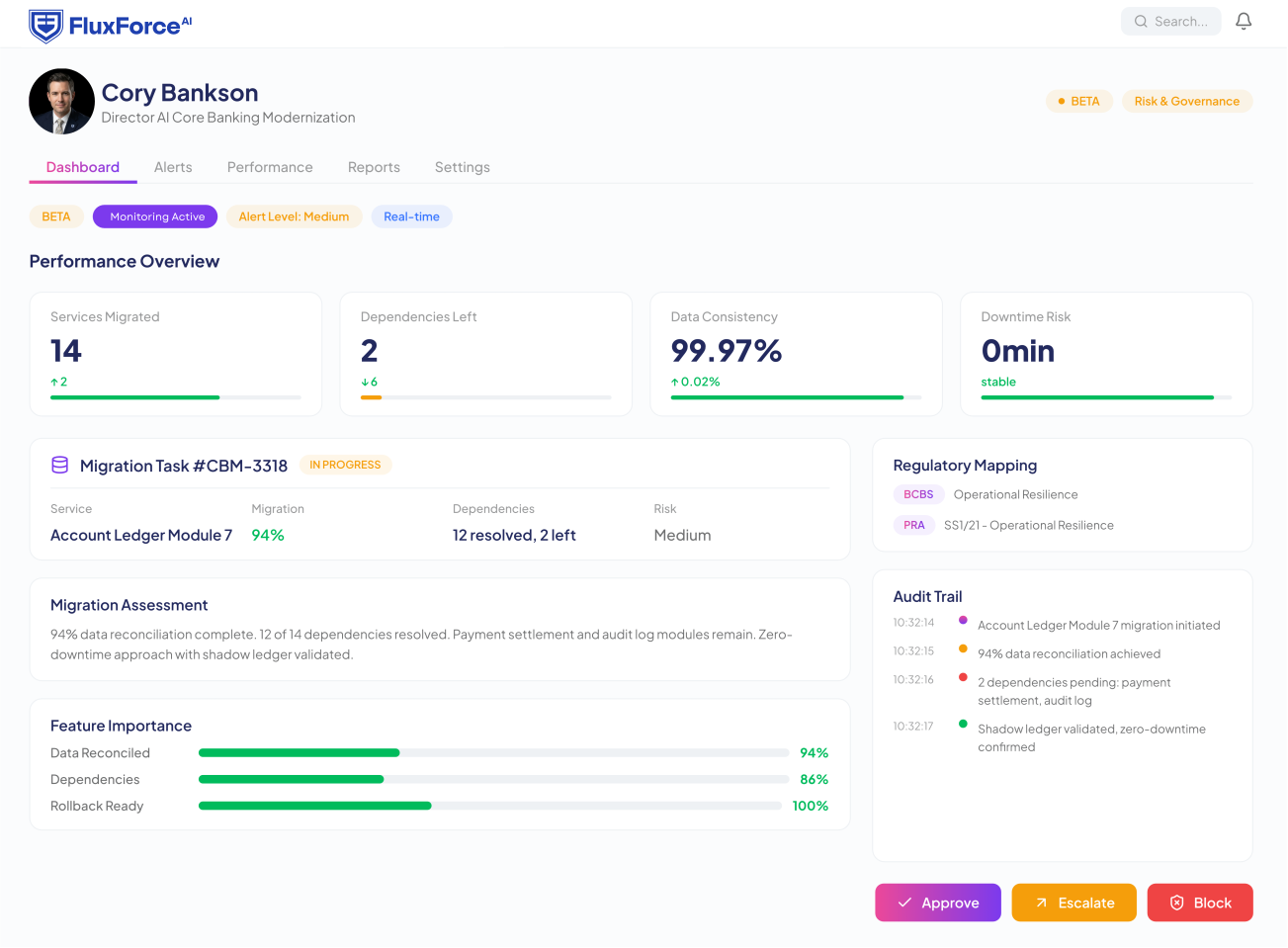
dash board1.19

See every dependency. Migrate with confidence. Zero data loss.

BEFORE vs AFTER  

BEFORE CORY BANKSON 

  • 6-12 month launches
  • Monolithic architecture
  • 75% budget on legacy 
  • Manual dependency docs 
  • Big-bang migration risk

AFTER CORY BANKSON        

  • 40% faster product launch
  • API-first microservices 
  • Measured cost savings 
  • Automated full mapping 
  •  Incremental, validated 

ROI — AI CORE BANKING MODERNIZATION vs TRADITIONAL vs NO ACTION

AI Core Banking Modernization Cost Comparison — 2026

How does Cory Bankson compare to traditional system integrator-led modernization or maintaining the status quo?

Criteria  Traditional SI-Led Modernization Maintain Legacy (Status Quo) Cory Bankson
    Total cost $50M-$500M (3-7 year program)  $10M-$50M/year (maintenance) Not yet priced (Phase 4/5)
Timeline  3-7 years Indefinite  Incremental — value in months 
Data consistency risk High (big-bang cutover) None (no change) 100% continuous validation 
Product launch speed Improves after 3-7 years 6-12 months per product 40% faster after first migrations
Budget overrun risk  70% exceed budget by 50%+ Predictable (but growing) Measured per milestone
API-first coverage    After full program completion  None  Incremental with each migration 
  Regulatory compliance during transition   Risk of gaps   Maintained (no change)    Validated per migration step
  Cloud cost savings    None    None   Measured per migrated service
  Rollback capability     Limited      N/A    Automated per service


Key insight: According to McKinsey, 70% of large-scale banking transformation projects exceed their budget by 50% or more, and 17% fail to deliver any value. Celent estimates banks spend 65-75% of their IT budget maintaining legacy systems. Cory Bankson enables incremental modernization with measurable value at every milestone — not a multi-year /bet on a big-bang migration.

WORKS BEST WITH

Agents That Work Best with AI Core Banking Modernization

Cory Bankson delivers maximum impact when paired with these FluxForce SuperHumans:

Percy Planner

Senior AI Capacity Planning Strategist

Plans the infrastructure capacity for the modernized cloud-native platform 

Learn now

Devon Pulse

Lead AI DevSecOps Pipeline Architect

Secures the CI/CD pipeline that deploys the modernized microservices  Cory builds

Learn now

Aria Linkwell

Senior AI API Security Specialist

Secures every API endpoint that the modernized platform exposes to partners and customers

Learn now
TRUST BUILDERS

Built for CIOs and Core Banking Teams

Configurable Autonomy

Low risk: Cory acts autonomously for dependency mapping, documentation
generation, and test creation.
Medium risk: HITL by default (configurable). High risk: Always human review for production data migrations, service cutover, and core system changes. You set the threshold per migration phase.

Kill Switch

 Disable Cory Bankson instantly. No system impact. No downtime. One click. Migration pauses cleanly — legacy systems continue operating without interruption.

Shadow Mode

Run Cory Bankson in assessment mode. Dependency mapping and migration planning only — no changes, no migrations. Validate the plan before committing to any production changes.

Explainability

Every migration recommendation includes clear reasoning — why this service first, what dependencies exist, what risks are mitigated, and what cost savings are projected. Your CIO and board can read the migration rationale directly.

Audit Trail

Every mapping, planning, migration, and validation step is logged with immutable, tamper-evident records. Service → dependency → migration plan → execution → data validation → outcome.

No Migration

Ironic but true: Cory Bankson itself requires no migration. Sidecar integration to your existing core banking APIs and interfaces. Your legacy system stays untouched until you choose to migrate.

Insights on AI Security,Compliance
& Financial Automation

Keep up with the latest AI trends, insights, and conversations.

Read Insights star
AI Insights star

Zero Trust banking: how CISOs secure core systems in 2026

AI Insights star

AML transaction monitoring: how AI cuts false positives by 60%

AI Insights star

Deepfake identity fraud: 5 detection gaps banks overlook

Questions? We Have Answers star

Frequently Asked
Questions

AI core banking modernization works by mapping every dependency in your legacy monolith, generating optimal migration sequences, and orchestrating incremental service decomposition with 100% data consistency. Systems like Cory Bankson by FluxForce connect to core APIs and legacy interfaces to automate the transition from monolith to cloud-native microservices — without the risk and cost of a big-bang rip-and-replace.
Banks need to modernize because legacy monolithic systems create a competitive disadvantage. New product launches take 6-12 months instead of weeks. Infrastructure costs grow linearly. Open banking and PSD2 require API access that monoliths cannot provide. According to Accenture, 70% of bank CIOs report that their core platform is the single biggest barrier to digital transformation.
Traditional core banking modernization takes 3-7 years with system integrators. AI-assisted modernization by Cory Bankson enables incremental migration — moving one service at a time — so the bank sees value within months. According to McKinsey, 70% of large-scale transformation projects exceed budget by 50% or more. Incremental AI-driven approaches reduce this risk significantly.
Yes. Data consistency is the most critical requirement. A single inconsistency can cause financial discrepancies and regulatory violations. Cory Bankson maintains 100% data consistency by running legacy and modern systems in parallel, validating every data transformation continuously, and triggering automated rollback if any discrepancy is detected.
AI core banking modernization uses configurable autonomy. Low-risk tasks (dependency mapping, documentation, test generation) are handled autonomously. Medium-risk tasks (migration sequencing, configuration changes) default to human review but can be configured. High-risk tasks — production data migrations, service cutover, core changes — always require CIO or core banking head sign-off. You control the threshold.
API-first banking means every banking capability is exposed as an API. It matters because PSD2 and Open Finance regulations require API access, fintech partnerships depend on API integration, and product launches are dramatically faster on composable services. According to Celent, banks with API-first platforms launch products 5x faster than those on legacy monoliths. Cory Bankson enables API-first architecture through incremental microservice decomposition.
FluxForce pricing is customized based on transaction volume, regulatory requirements, and deployment model. Contact our team for a tailored quote.
AI Core Banking Modernization — 40% Faster. 100% Data Consistency.