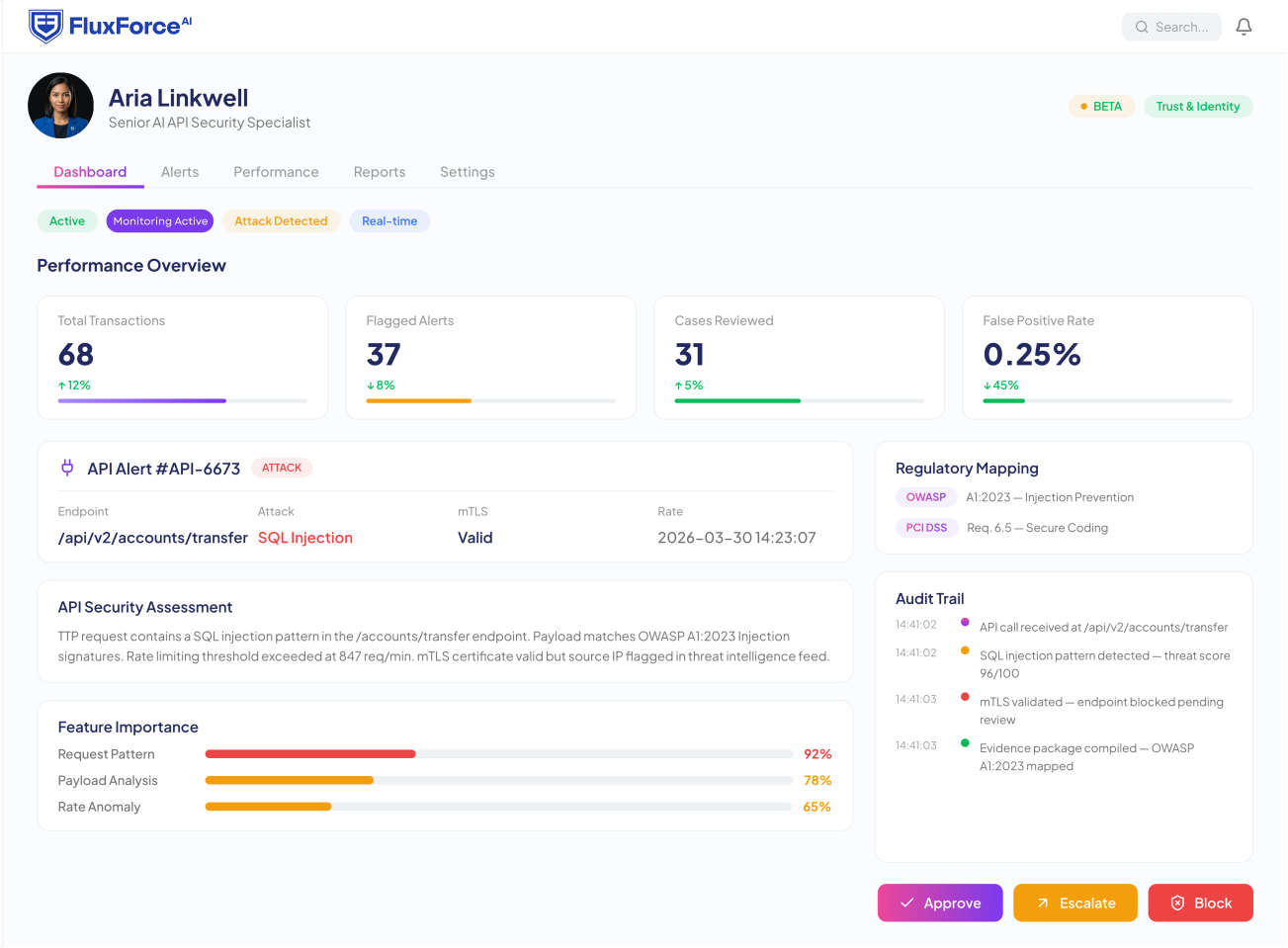
Your APIs are your attack surface. Every endpoint, every third-party integration, every call is a potential vector. Aria Linkwell provides continuous API monitoring with 100% mTLS validation per call, credential stuffing detection in <500ms, and per-API compliance audit scoring. No gaps. No blind spots.
.png?width=2000&height=2000&name=18%20Aria%20Linkwell_Hero%20section_superhuman%20image%20(1).png)
Senior AI API Security Specialist

mTLS Validation Per Call
Credential Stuffing Detection
Rate Limit Enforcement Accuracy
Compliance Audit Score
Attack Blocking
Your organization exposes hundreds of API endpoints — to mobile apps, partner integrations, open banking connections, and internal services. Each endpoint is an attack vector. And most organizations. lack continuous monitoring across their full API estate.
According to Salt Security's State of API Security Report 2025, API attacks grew by 681% over two years, with 94% of organizations experiencing an API security incident in the past 12 months.
Most API security is periodic — penetration tests once a quarter, WAF rules updated manually. Between tests, APIs are unmonitored. According to Gartner, by 2026, 50% of data theft will be traced to unsecured APIs — making API security the number one web application attack vector.
Many API-to-API communications still run without mutual TLS validation. Without mTLS, man-in-the-middle attacks, service impersonation, and data interception are possible. Open banking regulations under PSD2 mandate strong authentication for all API communications.
Every third-party API integration introduces risk — data exposure, credential leakage, and unmonitored traffic. According to OWASP, "Unsafe Consumption of APIs" is now a Top 10 API security risk, yet most organizations do not continuously monitor third-party API behavior.
JOB DESCRIPTION
Aria Linkwell is a Senior AI API Security Specialist that operates across your API layer as a dedicated endpoint security monitor.

Senior AI API Security Specialist | FF-API

Reports To
Your CTO / Head of AppSec
Works With
Existing API gateways, WAFs, and identity providers
Deployed In
Phase 4/5 (shadow mode first)
KEY RESPONSIBILITIES
Continuously monitor every API endpoint — internal, external, and third-party
Validate mTLS on 100% of API calls with certificate chain verification
Detect and block credential stuffing attacks in under 500 milliseconds
Enforce rate limits per endpoint with adaptive thresholds based on traffic patterns
Score every API for compliance against OWASP API Top 10, PCI DSS, and DORA requirements
AUTONOMY MODEL
Low risk — Acts autonomously (rate limiting,known-attack blocking)
Medium risk — HITL by default (configurable)
High risk — ALWAYS human review (non-negotiable)
You configure the threshold per incident severity
Kill switch : Disable instantly
These metrics are from Aria Linkwell's design specifications,pending validation in Phase 4/5 deployment.
Inputs: API logs, endpoint configs, rate limits, mTLS certs, OAuth/API key registries | Primary Layer: Ingestion + Deployment & Reliability |Last updated: March 2026
HOW IT WORKS
Aria Linkwell connects to your existing API gateways, WAFs, and identity providers — no infrastructure migration. Here is how every API call is secured:
Aria Linkwell discovers every API endpoint in your environment —
internal services, external-facing APIs, third-party integrations, and shadow APIs that may not be in your current inventory. Endpoint configurations, authentication methods, and traffic baselines are mapped automatically.
Every API call is validated in real time. mTLS certificates are verified on 100% of calls. OAuth tokens are checked for expiry, scope, and revocation status. API keys are validated against the registry. Any call that fails validation is flagged immediately.
AI analyzes traffic patterns across all endpoints. Credential stuffing attempts are detected in under 500ms. Injection attacks, broken authorization, excessive data exposure, and other OWASP API Top 10 threats are identified and classified by severity.
Based on threat severity and your autonomy settings:
• Low risk → Blocked autonomously (known attacks, rate limits)
• Medium risk → Flagged for AppSec review (configurable)
• High risk → Escalated to security team (always)
Every action is logged with an immutable audit trail and per-API compliance score. Your AppSec team gets actionable intelligence, not noise.
Request early access to Aria Linkwell. Run a discovery scan across your API estate — see every endpoint, every gap, every risk.
AI API security in regulated industries requires more than threat detection — it requires provable compliance at the endpoint level. Every API call Aria Linkwell validates is scored against the regulatory framework that applies.
Full coverage of all ten API security risk categories
API-level transaction security and authentication requirements
Strong customer authentication for banking APIs
ICT risk management for third-party API dependencies
Security strategies for microservices and API architectures
PI access controls, logging, and monitoring requirements
YOUR ANALYST'S VIEW
Every endpoint. Every call. Every threat scored.
BEFORE vs AFTER
BEFORE ARIA LINKWELL
AFTER ARIA LINKWELL

ROI — AI API SECURITY vs HIRING vs LEGACY TOOLS
How does Aria Linkwell compare to hiring AppSec engineers or using legacy WAF/API gateway tools?
| Criteria | Hire 3 AppSec Engineers | Legacy WAF + API Gateway | Aria Linkwell |
|---|---|---|---|
| Annual cost | $540K-$1.05M (salary + benefits) | $100K-$350K (license + ops) | Not yet priced (Phase 4/5) |
| Monitoring coverage | Manual, sample-based | Perimeter-only | Continuous, all endpoints |
| mTLS validation | Manual configuration | Policy-based (gaps common) | 100% per call, automated |
| Credential stuffing detection | Hours (forensic analysis) | Minutes (signature-based) | Minutes (signature-based) | <500ms (AI behavioral) |
| Third-party API monitoring | Manual audits (quarterly) | Limited or none | Continuous, scored |
| Scales with API volume | Hire more ($$) | License more ($$) | Auto-scales |
| Available 24/7 | No (shifts needed) | Yes (alerting only) | Yes (detection + enforcement) |
| OWASP API Top 10 coverage | Varies by engineer | Partial | Full, per endpoint |
| Audit trail | Manual, inconsistent | Partial logging | 100% immutable, per call |
Key insight: According to IBM's Cost of a Data Breach Report 2025, the average cost of a data breach involving API vulnerabilities is $4.45 million. AppSec engineer salaries average $120,000-$180,000 per year (Glassdoor). Aria Linkwell provides continuous, per-endpoint security that scales with your API estate — at a fraction of the cost of a breach.
Aria Linkwell delivers maximum impact when paired with these FluxForce SuperHumans:
Enforces zero trust identity verification for every API caller before Aria validates the call

Ensures tenant isolation at the API layer that Aria monitors and protects

Secures open banking API connections that Aria validates and monitors
Low risk: Aria acts autonomously for known attacks, rate limiting,and standard mTLS validation.
Medium risk: HITL by default (configurable).
High risk: Always human review for production API blocking, credential revocation, and authentication changes. You set the threshold per endpoint.
Disable Aria Linkwell instantly. No system impact. No downtime. One click. API traffic continues through existing gateways and WAFs.
Run Aria Linkwell on your live API traffic. Observation only — no blocking, no enforcement. Validate detection accuracy and discover your full API inventory before going active.
Every detection, validation, and enforcement action includes a clear explanation — which OWASP category applies, why the call was flagged, and what evidence supports the decision. Your AppSec team and auditors can trace every action back to its source.
Every API call validation, threat detection, and enforcement action is logged with immutable, tamper-evident records. Endpoint → call → validation → threat → action → compliance score.
WAFs, and identity providers. Your infrastructure stays untouched.
Keep up with the latest AI trends, insights, and conversations.
Read Insights