Your cloud bill grows every month, but 40% of what you pay for sits
idle. Outages still happen because scaling is reactive. Percy Planner reduces cloud overprovisioning by 40%, predicts peak loads hours in advance, and delivers measurable monthly infra cost savings. Predictive. Not reactive.
.png?width=2000&height=2000&name=21%20Percy%20Planner_Hero%20section_superhuman%20image%20(1).png)
Senior AI Capacity Planning Strategist

Cloud Overprov. Reduction
Peak-Load Prediction Lead Time
Forecast Accuracy (% Variance)
Right-Sizing Acceptance Rate
Infra Cost Savings ($)
Your cloud bill arrives and it is higher than last month. Again. Your team overprovisions to avoid outages during peak periods, but most of that capacity sits idle 80% of the time. When peak load hits unexpectedly, reactive auto-scaling is too slow — and outages still happen.
According to Flexera's 2025 State of the Cloud Report, organizations waste an average of 32% of their cloud spend on overprovisioned or idle resources. For mid-market financial institutions, that translates to $500K-$2M in annual waste.
Teams overprovision by 40%+ to create safety margins. This waste compounds monthly. According to Gartner, through 2027, 60% of infrastructure and operations leaders will encounter public cloud cost overruns that negatively impact their budgets.
Without predictive models, scaling is reactive. Reactive auto-scaling takes minutes to respond — but peak load spikes can cause degradation or outages in seconds. According to the Uptime Institute, 60% of outages cost more than $100,000, with 15% costing over $1 million.
Infrastructure teams know they should right-size,but manual analysis is time-consuming and risky. Without AI-driven confidence in the recommendations, teams default to overprovisioning. The result: growing cloud bills and no clear path to optimization.
JOB DESCRIPTION
Percy Planner is a Senior AI Capacity Planning Strategist that operates across your infrastructure as a dedicated capacity optimization and forecasting specialist.

Senior AI Capacity Planning Strategist | FF-CAP

Reports To
Your CIO / Head of Infrastructure
Works With
Existing cloud platforms, monitoring tools, and billing systems
Deployed In
Phase 4/5 (observation mode first)
KEY RESPONSIBILITIES
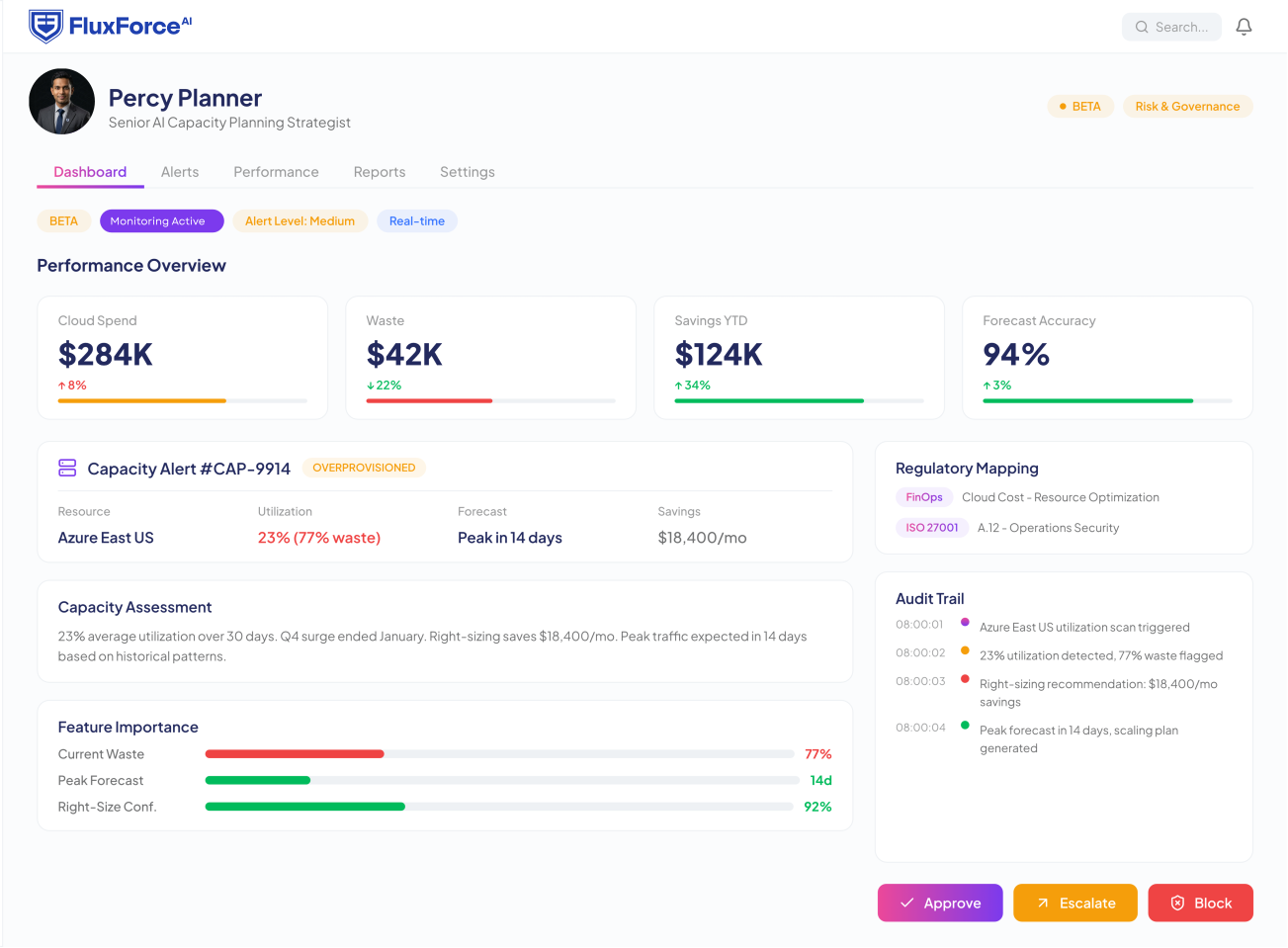
Analyze compute/storage usage across all cloud providers and on-premise infrastructure
Forecast capacity needs using historical data,growth projections, and seasonal patterns
Predict peak loads hours in advance to enable proactive scaling
Generate right-sizing recommendations with projected cost savings per resource
Track and report monthly infrastructure cost savings from optimization actions
AUTONOMY MODEL
Low risk — Acts autonomously (monitoring, non-prod right-sizing)
Medium risk — HITL by default (configurable)
High risk — ALWAYS human review (non-negotiable)
You configure the threshold per environment
Kill switch : Disable instantly
These metrics are from Percy Planner's design specifications,
pending validation in Phase 4/5 deployment.
Inputs: Compute/storage usage, txn load history, growth projections, cost data, cloud billing | Primary Layer: Learning Layer + Platform Services | Last updated: March 2026
HOW IT WORKS
Percy Planner connects to your existing cloud platforms and monitoring tools — no infrastructure changes. Here is how capacity is optimized:
Percy Planner ingests data from your cloud providers (AWS, Azure, GCP),on-premise infrastructure, monitoring systems (CloudWatch, Prometheus),and cloud billing platforms. Compute usage, storage utilization,transaction load history, and cost data are analyzed continuously.
AI models predict future capacity needs using historical patterns, seasonal trends, business event calendars, and growth trajectories. Peak loads are predicted hours in advance. Forecast accuracy is measured and reported as percentage variance against actual usage.
Services are migrated Right-sizing recommendations are generated for every resource:
• Overprovisioned compute instances → optimal instance type and size
• Idle storage volumes → archive or delete recommendations
• Under-provisioned resources → scale-up recommendations
• Each recommendation includes projected $ savings and risk score
Based on your autonomy settings:
• Low risk → Implemented automatically (non-prod, idle resources)
• Medium risk → Queued for infrastructure review (configurable)
• High risk → Escalated to infrastructure lead (always)
Monthly cost savings are tracked and reported. Your FinOps team gets measurable results, not dashboards.
Request early access to Percy Planner. Run an infrastructure assessment across your cloud estate — see exactly where you are overprovisioning and how much you can save.
AI capacity planning for regulated financial institutions requires more than cost optimization — it requires operational resilience. Every capacity recommendation Percy Planner generates is validated against the operational requirements that apply.
Operational resilience capacity requirements for ICT systems
Infrastructure capacity for payment processing systems
System availability and capacity management controls
Infrastructure for capital and liquidity reporting systems
Availability and capacity management for information security
Operational resilience capacity requirements for UK firms
YOUR ANALYST'S VIEW
See the waste. Predict the peaks. Save every month.
BEFORE vs AFTER
BEFORE PERCY PLANNER
AFTER PERCY PLANNER

ROI — AI CAPACITY PLANNING vs HIRING vs LEGACY TOOLS
How does Percy Planner compare to hiring infrastructure engineers or using legacy monitoring tools?
| Criteria | Hire 3 Infrastructure Engineers | Legacy Monitoring + Manual Planning | Percy Planner |
|---|---|---|---|
| Annual cost | $480K-$900K (salary + benefits) | $100K-$300K (tooling + ops) | Not yet priced (Phase 4/5) |
| Timeline | 10-20% (manual analysis) | 5-15% (alert-based) | 40% (AI-driven) |
| Peak-load prediction | None (reactive) | Basic (threshold alerts) | Hours in advance |
| Right-sizing accuracy | Manual, inconsistent | Rule-based, partial | AI-optimized, per resource |
| Multi-cloud visibility | Per engineer per platform | Tool-dependent | Unified across all providers |
| Scales with infrastructure | Hire more ($$) | License more ($$) | Auto-scales |
| Available 24/7 | No (shifts needed) | Yes (alerting only) | Yes (prediction + optimization) |
| Cost savings tracking | Manual, quarterly | Limited | Automated, monthly |
| Audit trail | Manual documentation | Partial logging | 100% immutable |
Key insight: According to Flexera, organizations waste an average of 32% of their cloud spend. For a financial institution spending $2M per year on cloud infrastructure, that is $640,000 in waste. Infrastructure engineers average $120,000-$160,000 per year (Glassdoor). Percy Planner reduces overprovisioning by 40% with measurable monthly savings — typically paying for itself within the first quarter.
Percy Planner delivers maximum impact when paired with these FluxForce SuperHumans:
Modernizes the core banking platform that Percy plans capacity for

Manages real-time transaction scaling that Percy forecasts and optimizes

Governs the AI models that Percy uses for capacity forecasting and optimization
Low risk: Percy acts autonomously for monitoring, forecasting, and non-production right-sizing.
Medium risk: HITL by default (configurable).
High risk: Always human review for production infrastructure changes and capacity reductions during peak periods. You set the threshold per environment.
Disable Percy Planner instantly. No system impact. No downtime. One click. Infrastructure continues operating with existing configurations.
Run Percy Planner in observation mode. Forecasting and recommendation only — no changes to infrastructure. Validate forecast accuracy and right-sizing quality before enabling active optimization.
Every forecast, recommendation, and optimization action includes clear reasoning — what data supports the prediction, what savings are projected, and what risk exists. Your CIO and FinOps team can evaluate every recommendation before action.
Every analysis, forecast, recommendation, and optimization action is logged with immutable, tamper-evident records. Resource → usage pattern → forecast → recommendation → action → cost savings.
Sidecar integration. Percy connects to your existing cloud platforms, monitoring tools, and billing systems. Your infrastructure stays untouched until you approve optimizations.
Keep up with the latest AI trends, insights, and conversations.
Read Insights