Black Friday. Salary runs. Market volatility. Your payment infrastructure fails when you need it most — and fraudsters know it. Theo Surge detects surges seconds before they peak, auto-scales with integrated risk checks, and reduces failed transactions by 85% while maintaining 100% fraud coverage during peaks. Join the early access waitlist.

.png?width=2000&height=2000&name=12%20Theo%20Surge_Hero%20section_superhuman%20image%20(1).png)
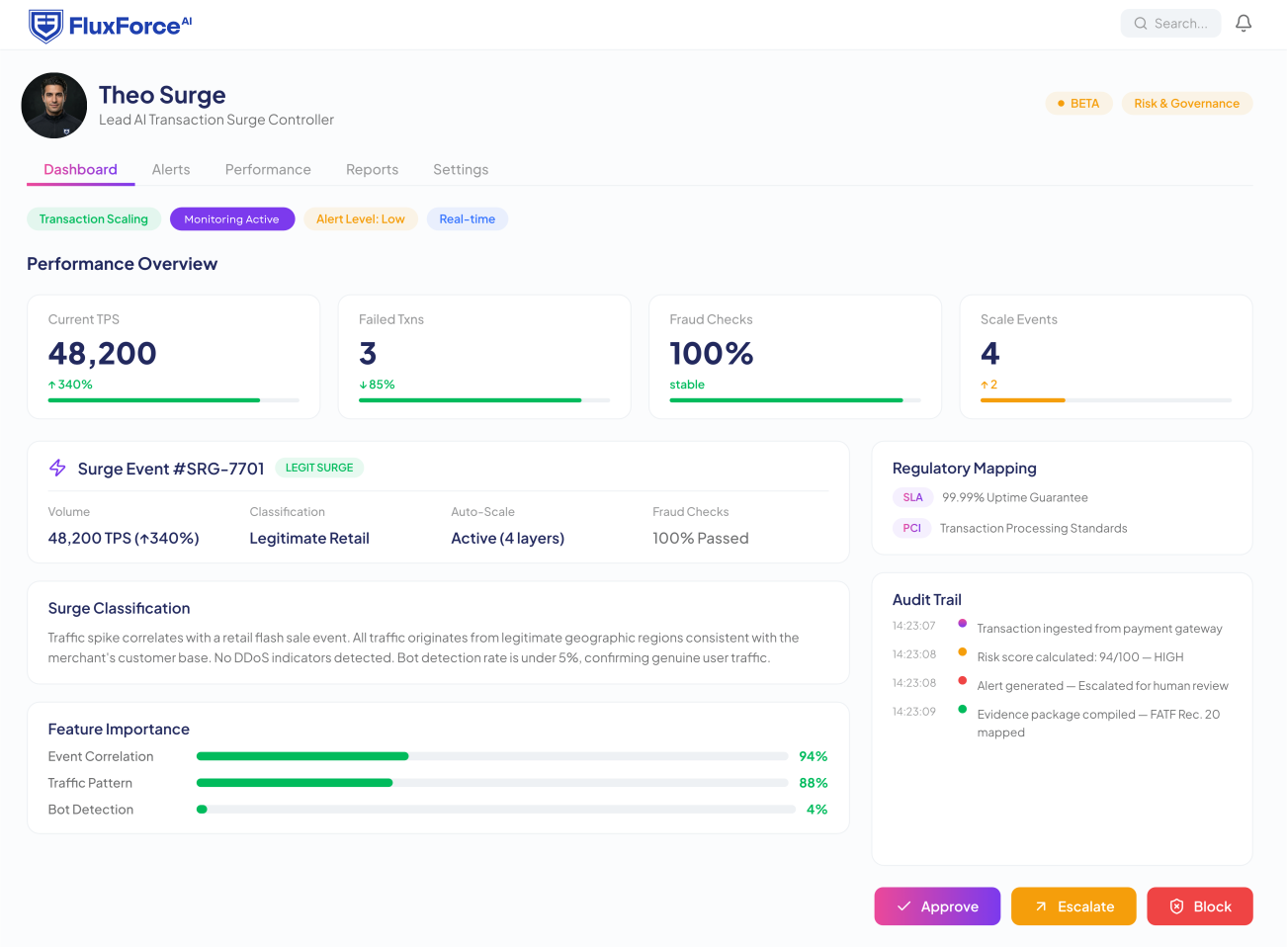
Lead AI Transaction Surge Controller
Fewer Failed Transactions
Fraud Check Coverage During Peaks
Surge Detection Lead Time
Scale Response Across Infra
Legitimate vs Attack Accuracy
Your payment infrastructure handles normal volumes just fine. But when Black Friday hits, salary runs peak, or market volatility drives a surge — transactions fail. According to Akamai, financial services experience 3-5x normal traffic during peak events.
Meanwhile, fraudsters deliberately time their attacks during surges when defenses are weakened.
When volume exceeds capacity, queues overflow, timeouts spike, and transactions are dropped. According to Akamai, financial services sites experience 3-5x normal traffic during peak events. Each failed legitimate transaction is lost revenue and damaged customer trust.
According to the FBI's Internet Crime Complaint Center (IC3), cybercriminals deliberately coordinate fraud attacks during high-volume periods when security teams are overwhelmed and fraud checks may be degraded to maintain throughput. Your fraud coverage should never drop below 100%.
Traditional auto-scaling adds compute capacity but does not scale the risk pipeline. According to Gartner, payment processors that scale compute without scaling compliance and fraud detection create windows of vulnerability that sophisticated attackers exploit.
JOB DESCRIPTION
Theo Surge is a Lead AI Transaction Surge Controller that operates inside your payment infrastructure as a dedicated surge management specialist.
Lead AI Transaction Surge Controller | FF-TXS
Reports To
Your Head of Payments / CTO
Works With
Existing payment processing, infrastructure, and fraud systems
Deployed In
Phase 4 (development target Q2 2027)
KEY RESPONSIBILITIES
Detect transaction surges seconds before peak using predictive analytics and pattern matching
Classify surge type — legitimate spike vs coordinated attack — in real time
Auto-scale transaction processing AND risk pipeline in parallel (fraud, compliance, audit)
Maintain 100% fraud check coverage during every surge — no bypasses, no degradation
Produce post-surge analysis reports with volume metrics, classification accuracy, and outcomes
AUTONOMY MODEL
Low risk — Acts autonomously (scale up/down)
Medium risk — HITL by default (configurable)
High risk — ALWAYS human review (non-negotiable)
You configure scaling thresholds per channel
Kill switch : Disable instantly
These metrics represent the production targets for Theo Surge.
Development begins Q2 2027.
Primary Layer: Capacity management layer + Surge response layer | Architecture : Designed and documented | Development : Planned Q2 2027
HOW IT WORKS
Theo Surge connects to your existing payment infrastructure and monitoring systems — no data migration, no core system changes. Here is how every surge is handled:
Theo Surge monitors volume metrics, system load data, queue depths, and request rate velocity in real time. Historical surge patterns and calendar events (Black Friday, salary runs, market opens) inform predictive detection - identifying surges seconds before they peak.
Each surge is classified in real time:
• Legitimate spike — seasonal, event-driven, organic growth
• Coordinated attack — DDoS, fraud surge, bot traffic
• Anomalous pattern — requires investigation
Classification determines the scaling and security response strategy.
Based on classification and projected peak, Theo Surge triggers
auto-scaling across the entire processing stack:
• Transaction processing capacity
• Fraud detection capacity
• Compliance monitoring capacity
• Audit logging capacity
Legitimate surges get more capacity. Attack surges get more security.
Throughout the surge, Theo Surge continuously verifies:
• Fraud checks maintain 100% coverage
• No transactions are dropped
• All compliance controls remain active
• SLA thresholds are maintained
Post-surge, a detailed report is generated with volume analysis, classification accuracy, and scaling effectiveness metrics.
Theo Surge is in architecture design. Join the waitlist to receive documentation, influence feature priorities, and be first to deploy when shadow mode testing begins.
AI transaction scaling in regulated industries requires that compliance and risk controls scale with capacity — not degrade during surges. Every scaling decision Theo Surge makes maintains regulatory compliance.
Transaction-level security maintained at all volumes
Anti-money laundering checks not bypassed during peaks
Operational resilience and incident reporting during surges
Strong customer authentication enforced during instant payment peaks
Security controls maintained for wire transfer surges
Messaging compliance during cross-border volume spikes
YOUR ANALYST'S VIEW
Every surge detected. Every transaction protected. Every decision explained.
BEFORE vs AFTER
BEFORE THEO SURGE
AFTER THEO SURGE

ROI — AI TRANSACTION SCALING vs OVER-PROVISIONING vs MANUALS
How does Theo Surge compare to over-provisioning infrastructure or manual surge management?
| Criteria | Over-Provision 3x | Manual Surge Team | Theo Surge |
|---|---|---|---|
| Annual cost | $500K-$2M (3x infrastructure) | $400K-$800K (salary + on-call) | TBD (Phase 4) |
| Response time | Instant (always provisioned) | Minutes to hours | Seconds (predictive) |
| Failed transaction rate | Low (expensive headroom) | High during response gap | 85% reduction target |
| Fraud check coverage | Full (if scaled) | Often degraded during surge | 100% always |
| Cost efficiency | Low (paying for idle 90%+ of time) | Medium | High (scale on demand) |
| Attack distinction | None | Human judgment (slow) | Real-time classification |
| Explainability | Infrastructure logs | Verbal, inconsistent | Plain-English + audit trail |
| Post-surge analysis | Manual | Manual, days later | Automated, immediate |
| Scales across layers | Compute only | Depends on team |
Full stack + risk pipeline |
| Available 24/7 | Yes (infrastructure) | No (on-call) | Yes |
Key insight: According to Akamai, financial services experience 3-5x normal traffic during peak events. Over-provisioning to handle 3x peaks means paying for 3x infrastructure 365 days a year when you only need it for a few days. Theo Surge provides elastic scaling that costs only what you use, with integrated risk checks that manual and over-provisioned approaches cannot match.
Theo Surge delivers maximum impact when paired with these FluxForce SuperHumans:
Secures every payment channel while Theo Surge handles volume management

Ensures infrastructure changes during auto-scaling are compliant and tested

Monitors that ML fraud models maintain accuracy during surge conditions when Theo scales them
Low risk: Theo acts autonomously (scale up for predictable events).
Medium risk: HITL by default (configurable). High risk: Always human review (unusual surge patterns, potential attacks). You set the threshold per event type, per scaling tier, per infrastructure layer.
Disable Theo Surge instantly. No system impact. No downtime. One click. Infrastructure reverts to manual scaling controls.
Run Theo Surge alongside your current surge management for 30 days. Observation only — recommendations without action. Validate detection accuracy before enabling auto-scaling.
Every scaling decision includes plain-English reasoning: why the surge was detected, how it was classified, what was scaled, and what the outcome was. Your operations team and auditors can read it directly.
Every decision logged with immutable, tamper-evident evidence chain. Surge detected → classified → scaling action → compliance verified → outcome.
Sidecar integration. Theo Surge monitors your existing infrastructure metrics and payment feeds. Your core systems stay untouched.
Keep up with the latest AI trends, insights, and conversations.
Read Insights