.webp)







Listen To Our Podcast🎧

How should a UAE bank evaluate transaction monitoring software?
Evaluate transaction monitoring software against a written acceptance record built from your bank's risks, representative data and investigation workflow. Ask the vendor to demonstrate each requirement, preserve the test evidence and let your designated bank reviewers decide whether the result is acceptable. A polished demonstration cannot show whether your own transaction records arrive intact or whether your analysts can explain an alert.
This guide is for an MLRO or Head of Compliance at a bank supervised by the Central Bank of the UAE (CBUAE). It focuses on pre-implementation acceptance, rather than vendor rankings or a catalogue of features. The checklist is an editorial framework for evaluating a purchase. It is not a regulator-issued form, a legal opinion or evidence that a particular product satisfies your obligations.
The CBUAE's transaction monitoring and sanctions screening guidance, published in September 2021, describes pre-implementation testing of automated transaction monitoring. Section 2.4 covers historical data where appropriate, system integration, user acceptance and remediation with retesting. Use that operational starting point alongside your institution's current applicable requirements. A DIFC or ADGM firm needs its own supervisory mapping; the UAE is not one interchangeable rulebook.
 Sahil Kataria | Founder and CEO of FluxForce | 2026-10-02
- Define testable acceptance evidence.
- Check source-data completeness.
- Review investigator handoffs and exceptions.
- Record bank decisions and retest conditions.
Request a product-fit review
Evaluate the proposed system against bank-defined risks, representative data and investigation work. Preserve the test evidence and let the designated bank reviewers decide whether the scope is acceptable.
Use an evidence-to-acceptance record
Start with the decision you need to make. Your record should connect an identified risk to a testable requirement, then connect the observed result to a named human decision. That connection is more useful than a feature marked "available" in a sales spreadsheet.
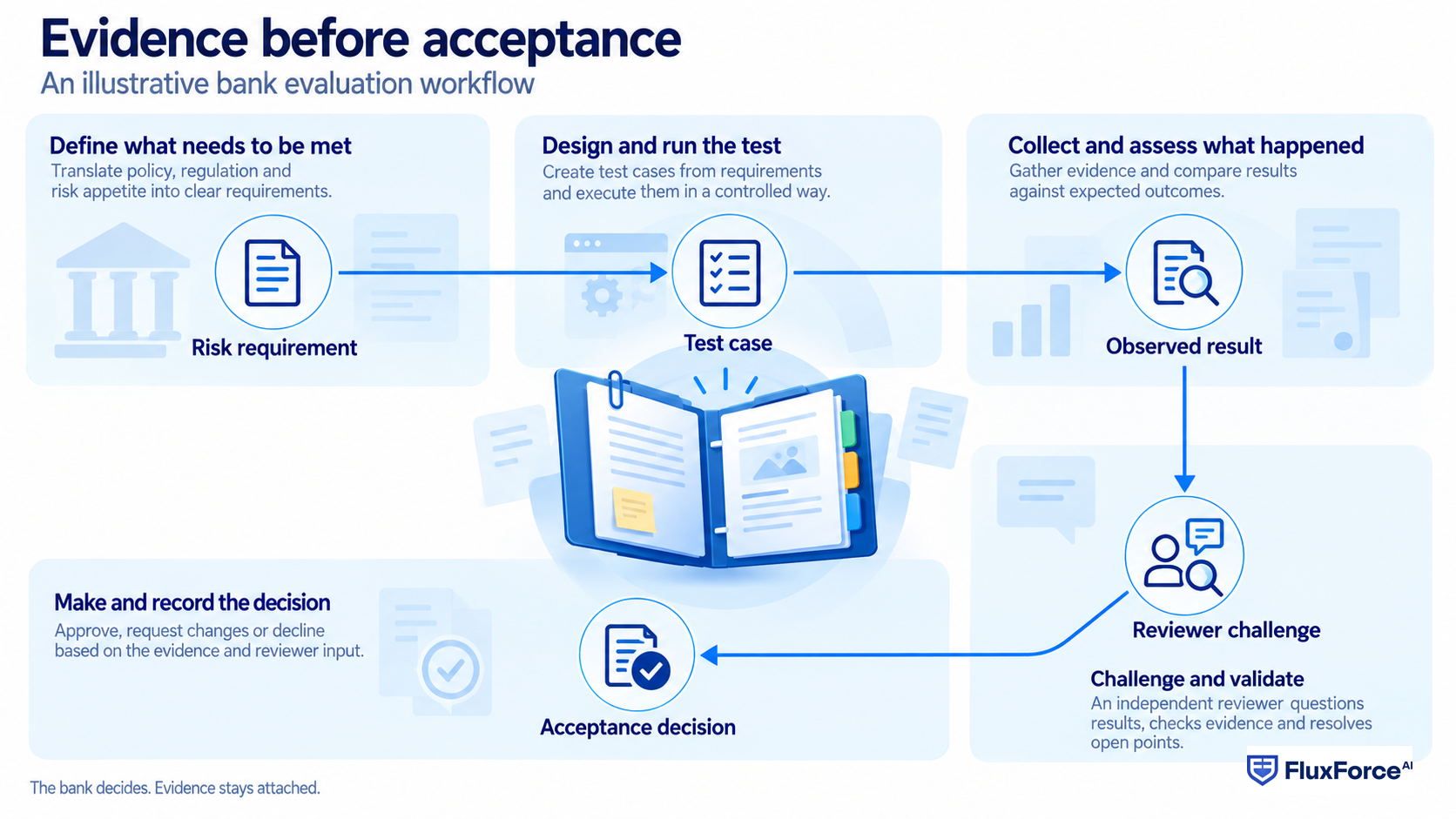
- A risk requirement informs a test case.
- A test case produces an observed result.
- An observed result goes to reviewer challenge.
- Reviewer challenge informs the bank's acceptance decision.
We call this the evidence-to-acceptance record. It has four stages: define the requirement, demonstrate the behavior, challenge the result and record the acceptance decision. These are proposed evaluation steps, not FluxForce product components. They do not describe an autonomous approval process.
A risk requirement informs a test case. A test case produces an observed result. An observed result goes to reviewer challenge. Reviewer challenge informs the bank's acceptance decision. Keep the evidence attached at each handoff so that a later reviewer can reconstruct what the team actually tested.
Give every test a stable identifier. Record the data period, included customer segment, relevant configuration and the person who ran it. Agree the expected behavior before opening the results. If a test cannot establish the answer, mark it inconclusive and explain what additional evidence is needed. Do not turn missing evidence into a pass simply because a contract deadline is approaching.
For a broader account of monitoring operations, use the AML transaction monitoring guide. Keep this acceptance record narrower: it should help the bank decide whether the proposed system is fit for its agreed scope before deployment.
Select scenarios from your risk assessment
Build the test population around the activity your bank needs to understand, including ordinary activity that resembles a suspicious pattern. A successful test should expose both missed patterns and unnecessary investigation work. Testing only known suspicious cases gives a distorted view of the queue your team will inherit.
The CBUAE guidance describes scenarios and thresholds that reflect the institution's risk assessment and customer or product context. It also calls for documentation of detection scenarios and their assumptions. In a vendor evaluation, ask for the link between each chosen scenario and your own documented risk. A vendor's default scenario library can start the discussion; it cannot settle your coverage decision.
UAE-specific evidence can help you choose relevant questions. According to the UAE Financial Intelligence Unit's Organized Financial Fraud report, fraud-related STRs and SARs received during July 2023 to June 2024 numbered 9,403. The report describes a 57% increase over the preceding period. These are suspicious reports, not confirmed crimes, a bank-level detection rate or a market-size estimate.
The same report's analysis of 879 suspicious reports found possible mule accounts connected with 33% of the examined reports. That supports asking how a candidate system helps investigators examine movements of suspected fraud proceeds. It does not justify treating an account as criminal because it shares one characteristic with a reported case.
In that analysis, outward mobile or internet banking transfers accounted for 42% of the reported transaction modes. Use the finding to question whether your evaluation data properly represents the channels relevant to your bank. Do not transplant that percentage into your bank's expected transaction mix. The report's sample and observation period are specific, and reporting behavior can affect what appears in the data.
Include a scenario with several incoming payments followed by outward transfers, alongside a legitimate business with superficially similar activity. Give the reviewer access to the customer context needed to explain the difference. Avoid universal "correct" thresholds: the appropriate settings depend on the approved risk and operating context.
Prove that transaction data reaches the test intact
Reconcile the source population with the records available to the monitoring system before interpreting detection results. A missed alert can originate in a missing transaction or an incorrect customer identifier rather than in the detection logic. The test record should make that distinction visible.
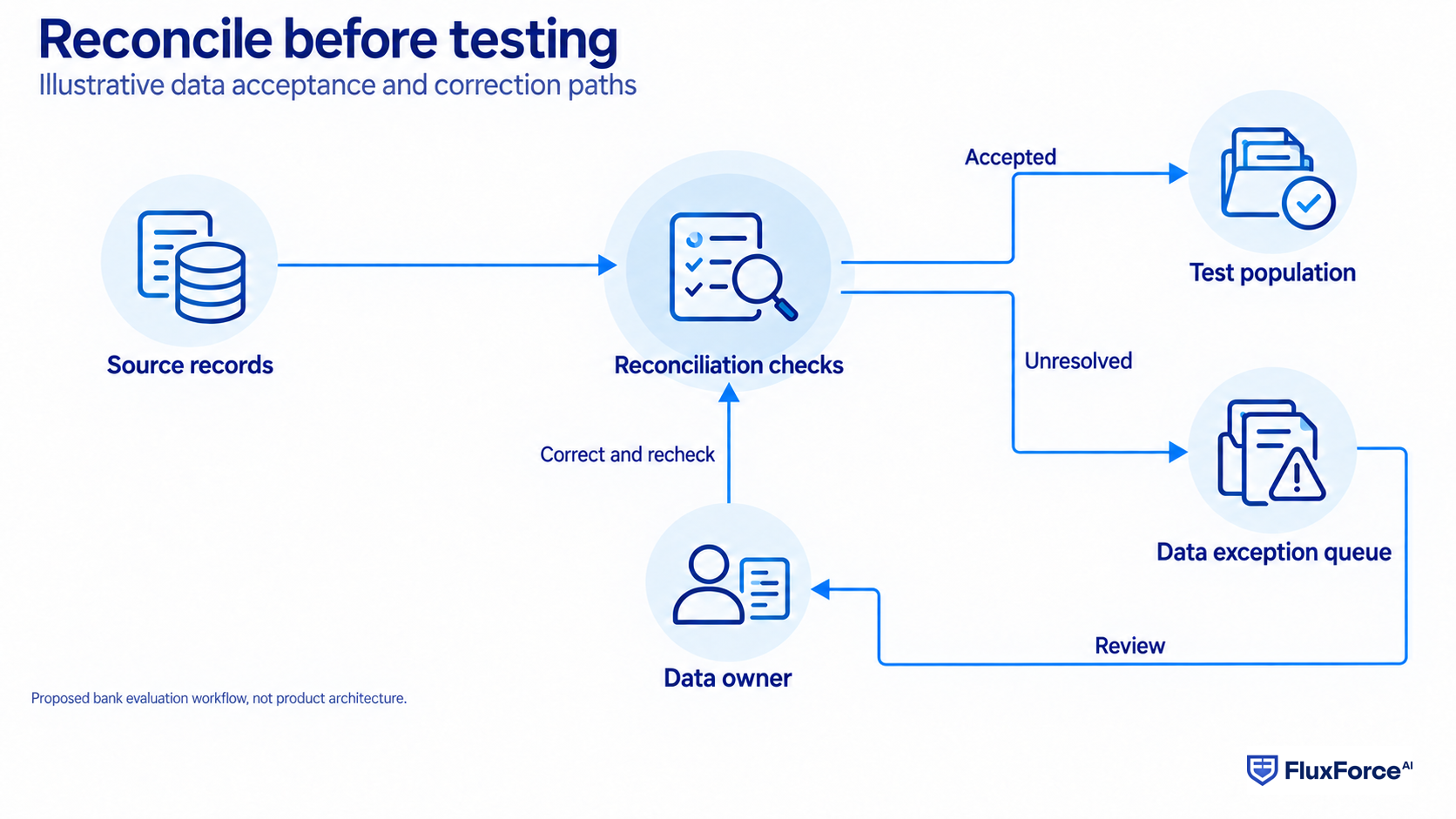
- Source transaction records feed reconciliation checks.
- Reconciliation checks send accepted records to the test population and unresolved records to a data exception queue.
- A data owner reviews the data exception queue before corrected records return to reconciliation checks.
Section 2.3 of the CBUAE guidance addresses identified data sources, accountable owners and complete, accurate, traceable data transfer. Translate those subjects into evidence requests. Ask the vendor and your integration team to demonstrate how a source record reaches the monitoring view and how they detect missing or rejected records.
Source transaction records feed reconciliation checks. Reconciliation checks send accepted records to the test population and unresolved records to a data exception queue. A data owner reviews the data exception queue before corrected records return to reconciliation checks. This is a proposed evaluation workflow; it is not a diagram of FluxForce's internal architecture.
Check practical details that often disappear in presentations. Can a late-arriving transaction be identified? Does a currency conversion preserve the original amount and currency? Are reversals distinguishable from new activity? Can the team link a customer across the agreed accounts without silently combining different people?
Use deliberately incomplete test records where lawful and appropriate. Omit a required identifier or supply an unsupported transaction code, then watch the failure behavior. Your acceptance condition should describe the expected rejection, escalation or explicit limitation. A blank field quietly accepted by a pipeline is not proof that the downstream analysis remains valid.
Test the investigator's work, not just the alert
Ask an analyst to work a case without a vendor presenter narrating every screen. The analyst should be able to identify the relevant transactions, understand why the scenario triggered and record a reasoned disposition. A queue that produces an impressive score but hides the underlying activity leaves the bank with more investigation work.
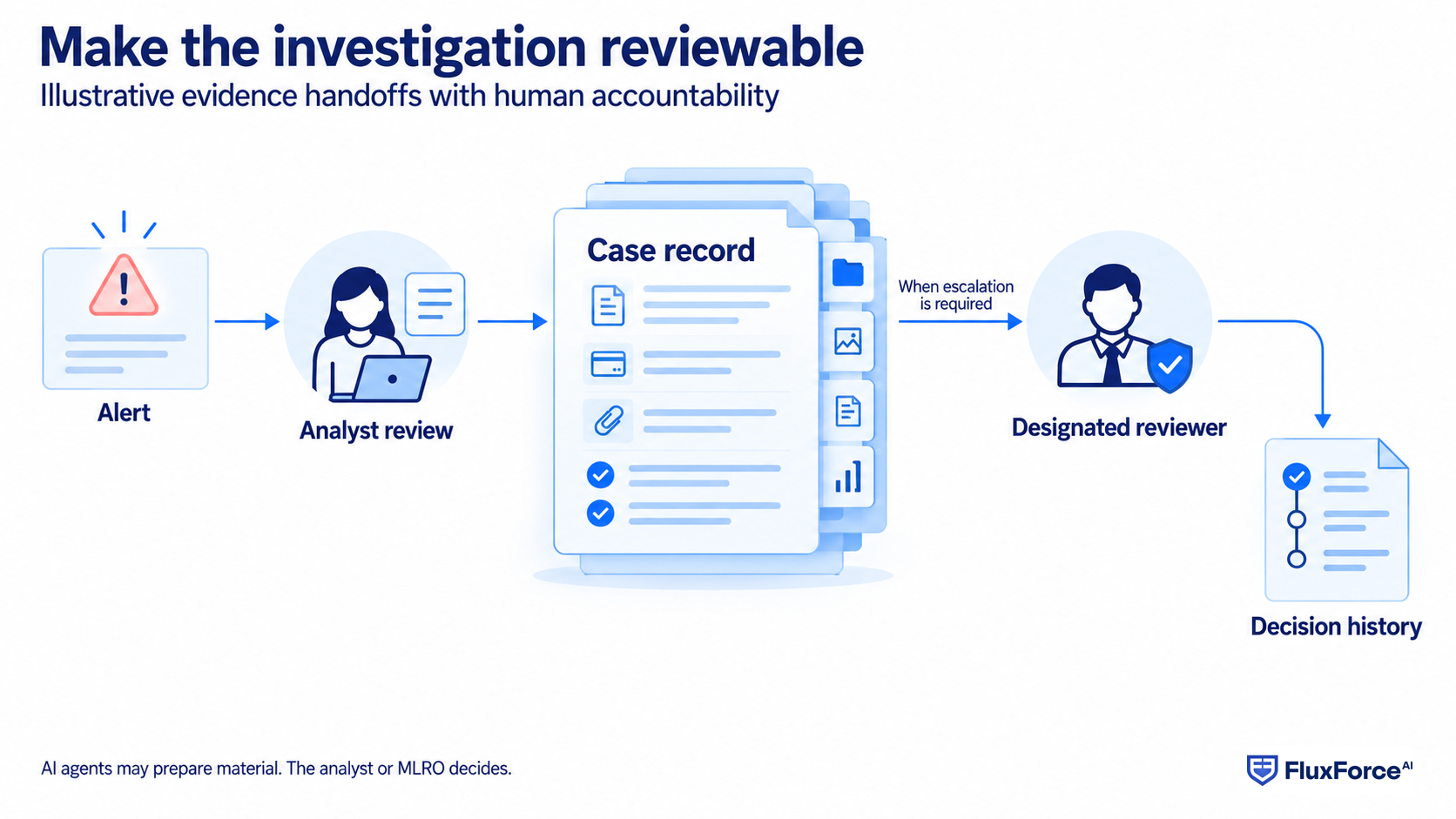
- An alert provides transaction context to analyst review.
- Analyst review adds rationale to the case record.
- The case record goes to the designated reviewer when bank policy requires escalation.
- The designated reviewer records a disposition in the decision history.
An alert provides transaction context to analyst review. Analyst review adds rationale to the case record. The case record goes to the designated reviewer when bank policy requires escalation. The designated reviewer records a disposition in the decision history. AI agents may prepare and organize material where you allow it; the analyst or MLRO remains accountable for the decision.
Test access restrictions using the actual roles proposed for the deployment. An operator who can change a scenario may need different rights from an investigator or an approver. Ask who can alter a disposition, whether the earlier record remains visible and how someone reviewing the case later distinguishes original evidence from a subsequent correction.
A useful demonstration includes an inconvenient result. Ask the analyst to disagree with a system suggestion and explain the reason. Observe whether the workflow records that disagreement without erasing the original suggestion. Then test an escalation that remains unresolved. The system should represent unfinished work honestly rather than force a completed status to tidy the dashboard.
Separate transaction monitoring from sanctions screening in the acceptance plan. They share data and operational dependencies, but their purposes and intervention points are not identical. Do not infer that a transaction monitoring evaluation has validated every payment-screening obligation or filing workflow.
Compare results with a decision table
Score evidence quality and fitness for your agreed scope, rather than adding every feature into one total. A high overall score should not hide a material data failure or an unresolved control responsibility. Keep mandatory acceptance conditions separate from optional preferences.
| Evaluation area | Evidence to request | Decision to record |
|---|---|---|
| Data completeness | Source totals, accepted records and explained exceptions | Whether the test population is usable |
| Scenario coverage | Risk mapping, configuration and representative cases | Whether the agreed risk is meaningfully tested |
| Investigator workflow | Case walkthrough, rationale and escalation history | Whether reviewers can explain and challenge the result |
| Integration behavior | Failure handling, reconciliation and recovery evidence | Whether dependencies operate within the agreed scope |
| Evidence retrieval | Exported case material with versions and timestamps | Whether another reviewer can reconstruct the test |
| Unresolved defects | Owner, impact, correction and retest record | Whether to accept, defer or reject the proposed scope |
Keep quantitative results attached to their denominators. "False positive rate" can refer to different measures across presentations. Ask whether the denominator is all legitimate transactions, all alerts or a reviewed sample. If the labels are incomplete, explain that limitation rather than reporting a precise-looking performance number.
Measure review effort separately from detection quality. An analyst can work an alert faster because the evidence is easier to retrieve, even if the detection logic is unchanged. Conversely, fewer alerts can indicate missing data rather than better monitoring. Neither observation should become an unsupported promise about future savings.
Use the transaction monitoring cost discussion as a prompt for cost categories, not as proof of a vendor's return on investment. Ask for institution-specific estimates of integration work, investigation effort, training and ongoing validation. Keep pricing and commercial terms in your private procurement record.
Work through an illustrative failed test
Consider a fictional UAE bank evaluating a new monitoring workflow. Its compliance lead selects a scenario involving incoming payments from unrelated parties followed by outward transfers. The test initially generates fewer alerts than the bank expected. That is an observation requiring explanation, not a successful result.
During reconciliation, the integration team finds that a transaction code was mapped to the wrong activity group. The analyst can see some incoming records but not the complete sequence used in the expected case. The team records a data defect and marks the scenario result inconclusive.
The data owner corrects the mapping. The tester repeats the reconciliation and then reruns the same documented scenario. The reviewer compares the corrected result with the original expectation, checks ordinary activity in the test population and records whether further work is required. The vendor does not approve its own unresolved defect on the bank's behalf.
This example has no measured performance outcome and does not describe a customer deployment. Its purpose is to show why a lower alert count is insufficient evidence for procurement approval. The CBUAE guidance's discussion of material data issues, remediation and retesting is the relevant operational reference, not a guarantee that this fictional test covers every legal requirement.
Keep acceptance and production release separate
Record who can accept the test evidence and who can authorize production use. A vendor-selection decision is not automatically a deployment approval. There may still be security, outsourcing, data protection or operational conditions for the bank to resolve through its own governance.
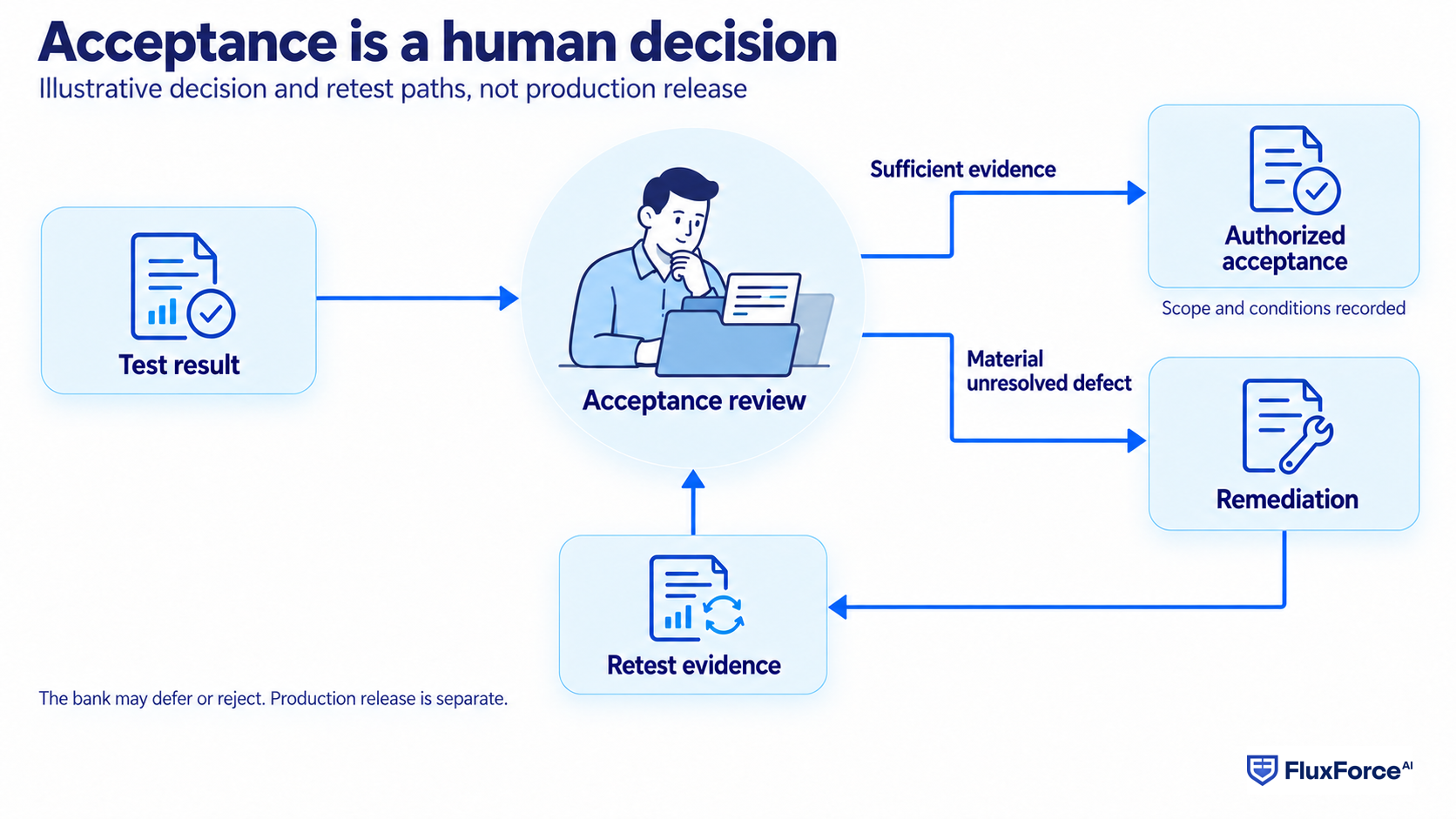
- A test result enters acceptance review.
- Acceptance review sends a material unresolved defect to remediation or sends sufficient evidence to an authorized acceptance decision.
- Remediation produces retest evidence, which returns to acceptance review.
A test result enters acceptance review. Acceptance review sends a material unresolved defect to remediation or sends sufficient evidence to an authorized acceptance decision. Remediation produces retest evidence, which returns to acceptance review. The authorized acceptance decision records scope and conditions; it does not itself move a system into production.
This proposed responsibility model keeps the bank's control visible. The compliance owner defines the monitoring question. The data owner explains source quality. Technology staff establish what was integrated and tested. Reviewers challenge whether the evidence supports the proposed use. The designated bank authority decides whether the defined scope is acceptable.
Do not accept "the vendor manages it" as a complete answer to an ownership question. Ask what the bank can inspect, what the vendor can change and how a change becomes visible to bank reviewers. Document any dependency that the evaluation did not test, including an interface represented only by sample output.
A phased deployment can limit exposure, but it creates its own conditions. Agree what remains outside scope, how exceptions reach a human reviewer and what would cause the bank to suspend the new workflow. Do not describe a restricted pilot as full operational coverage.
Prepare the handover before the final demonstration
Assemble a review pack that someone outside the evaluation team can read without reconstructing weeks of meetings. Include the agreed scope, data provenance, test definitions, observed results, unresolved limitations and decision owners. Link the underlying evidence rather than pasting screenshots without context.
Before acceptance, check that every material defect has a recorded disposition. "Fixed" should point to a retest result rather than rely on a developer's statement. "Accepted limitation" should name the accountable authority, the affected scope and any conditions attached to the decision. A feature planned for later remains unavailable evidence for today's acceptance.
Useful operating measures include the proportion of test records reconciled, unresolved data exceptions, cases requiring additional evidence and time spent assembling a reviewable case record. Define the population and observation window for each. These are suggested evaluation measures, not product benchmarks or regulatory thresholds.
Give the acceptance pack a version and preserve the configuration used for the test. If a vendor changes the system after the demonstration, ask which results remain applicable and which require retesting. That question protects the meaning of your evidence without turning every minor correction into a full restart.
- Freeze the requirement and the population being tested.
- Attach the observed result and any limitation.
- Obtain the designated reviewer's challenge and disposition.
- Record the bank's acceptance scope separately from production authorization.
Key Insight: A missing transaction and a missed detection require different corrections. Establish which problem occurred before interpreting an alert count.
Where FluxForce fits in the evaluation
FluxForce is an Agentic OS for Regulated Industries. Its positioning is that AI agents do the legwork, the analyst decides and every decision has evidence an examiner can replay. For a product-fit discussion, focus on Transaction Monitoring and Case Management and Investigations, using the acceptance questions above to examine the proposed scope.
Ask for a demonstration of the relevant workflow and evidence rather than assuming that a named solution satisfies each test. This guide does not establish particular integrations, certifications, performance results, deployment timelines or regulatory approval. It does not promise that an agent clears an alert or submits a report independently.
The UAE compliance context page is a starting point for market navigation. Confirm current obligations directly with the appropriate authority and your advisers. Your bank's acceptance decision remains separate from a sales demonstration and from any later production authorization.
Key takeaways
- Write the acceptance conditions before reviewing vendor results.
- Reconcile source records before interpreting detection behavior.
- Test an analyst's ability to explain, challenge and escalate a case.
- Distinguish a failed test from an inconclusive one and preserve the reason.
- Keep the bank's acceptance decision separate from production release.
- Write acceptance conditions before reviewing results.
- Reconcile source data before interpreting alerts.
- Test human review and escalation.
- Preserve failed and inconclusive results.
- Separate acceptance from production release.
Conclusion
Bring one documented monitoring scenario and a representative test population to your next vendor discussion. Ask the team to trace the data, explain the case and preserve the evidence needed for an independent review. Use the resulting acceptance record to decide what you can responsibly approve, what needs retesting and what remains outside the proposed scope.
Request a product-fit review
Frequently Asked Questions
About the author

Sahil Kataria
Founder and CEO of FluxForce


Share this article