.webp)





Listen to our podcast 🎧

Introduction
Modern AI models frequently produce outputs that look accurate on the surface but provide no clarity on how they arrived there. Consider a credit risk model flagging an applicant as “high risk” even though their financial record appears stable. The output may be correct, but without visibility into the model’s internal reasoning, the decision becomes difficult to justify and creates operational blind spots especially in highly regulated sectors. This is where decision paths become essential.
Leaders are moving toward models that reveal their reasoning in a simple, reviewable way. This shift pushes the need for practical AI model explainability and more transparent AI systems that help teams trace the core steps behind a prediction.
Industries with higher risk, especially finance, now treat visibility as essential. They are turning to interpretable machine learning and XAI for banking to support responsible decision-making and to meet expectations for regulatory-driven AI transparency.

Why Decision Paths Matter for AI Interpretability ?
AI decisions can be accurate but meaningless if you cannot explain how they were made. AI decision paths provide the transparency teams need to trust, validate, and act on AI outputs.
Decision paths improve clarity
Decision paths reveal the actual steps an AI model takes to reach an outcome. When these steps become visible, teams gain stronger AI interpretability and a clearer view of how data shapes predictions. This is the foundation of solid AI model explainability, because it moves the conversation from “What did the model predict?” to “Why did it predict that?”
Decision paths help detect issues early
Seeing the model’s reasoning makes it easier to catch weak patterns, faulty assumptions, or bias signals before they escalate. This practical view supports real AI reasoning traceability, helping risk, audit, and data teams understand how a model behaves in different scenarios.
Decision paths support transparent operations
When decision steps are easy to track, organizations reduce their dependence on black-box logic. It becomes simpler to validate decisions, justify outcomes, and respond to reviews. This leads to more dependable transparent AI systems that teams can manage, explain, and continuously improve.
How Decision Paths Drive Operational Confidence in AI Model Explainability ?
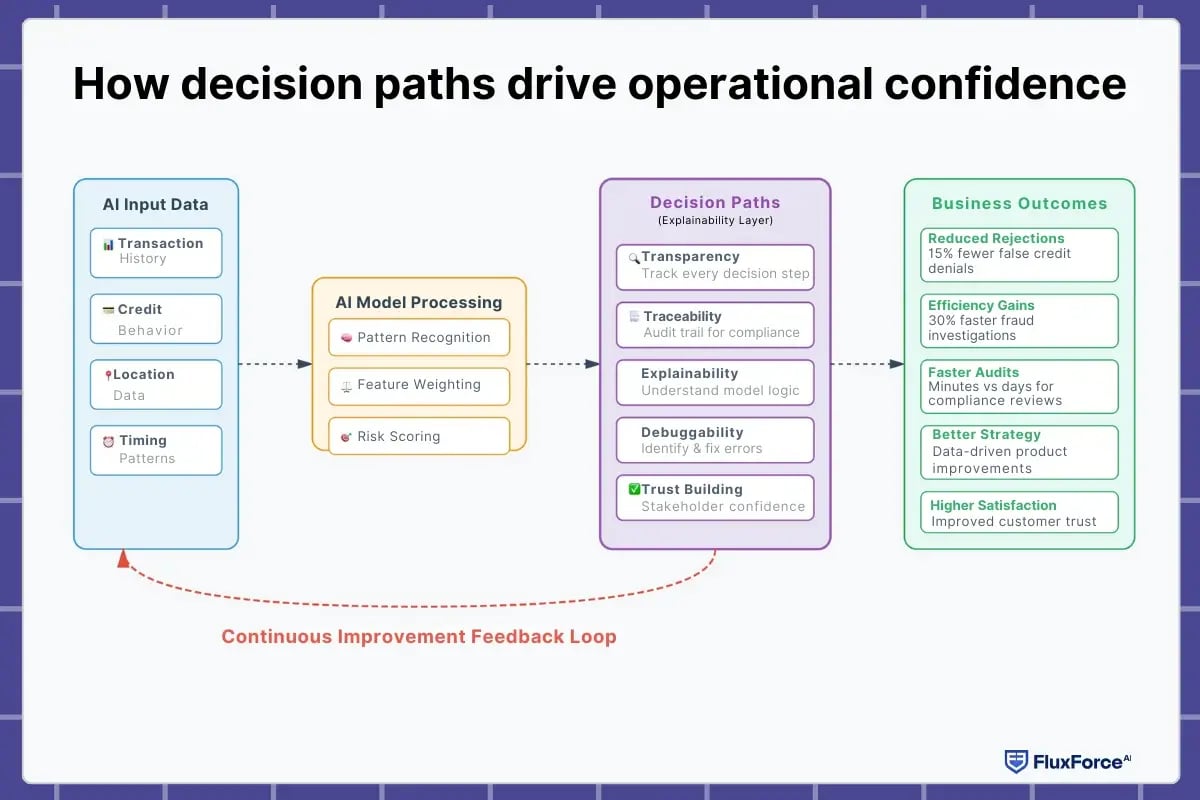
AI models are only useful if teams can trust and act on their decisions. Decision paths provide that trust by turning opaque outputs into actionable insights across industries.
Reducing false credit rejections
A retail bank noticed a spike in rejected loans despite applicants having strong records. By tracing AI decision paths, the team discovered the model overweighted certain short-term credit behaviors. Adjusting the weights using Explainable AI (XAI) reduced wrongful rejections by 15%, improving customer satisfaction and saving operational costs.
Improving fraud detection efficiency
A payments company faced hundreds of false fraud alerts daily. Using AI decision paths, analysts could pinpoint which features—like unusual location or transaction timing—were producing false positives. Implementing these insights cut investigation time by 30% while maintaining accuracy, showing that transparent AI systems directly improve operational efficiency.
Accelerating audit and regulatory approvals
A global bank struggled with compliance queries for its AI credit scoring model. With AI reasoning traceability from decision paths, auditors could review every step of the model’s logic in minutes instead of days. This practical transparency supports regulatory-driven AI transparency and reduces time-to-approval for new AI systems.
Enabling better business decisions
Beyond compliance, decision paths inform product strategy. Insurance teams analyzing claims patterns used AI model explainability to redesign risk thresholds. The result: fewer denied claims and more targeted policies, proving that decision paths can create measurable business value.
How to implement decision paths effectively for Explainable AI ?
Capture every step in the model workflow
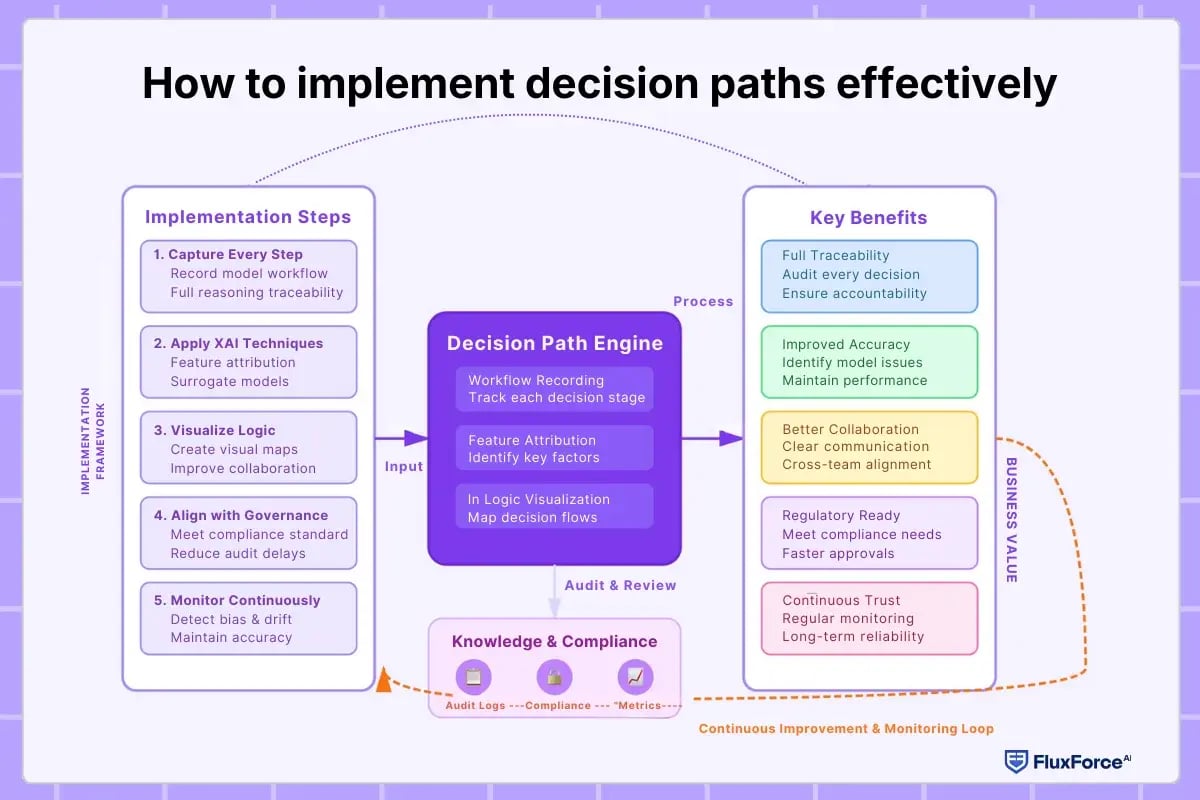
Teams should record each stage of the machine learning decision process, creating full AI reasoning traceability. This ensures that decisions can be audited, verified, and explained, supporting decision transparency for enterprise AI.
Apply explainable AI techniques strategically
Applying explainable AI techniques — such as SHAP (Shapley Additive Explanations) and LIME (Local Interpretable Model-Agnostic Explanations) — breaks down complex predictions. Decision path modeling in ML allows stakeholders to interpret outcomes clearly, improving AI interpretability without reducing model performance.
Visualize decision logic for clarity
Creating visual maps of AI decision paths or visualizing AI decision logic translates abstract calculations into understandable flows. This improves collaboration between data teams, business units, and compliance officers, forming transparent AI systems that are easier to review.
Align with governance and compliance
Integrating decision paths into governance practices ensures outputs meet both internal standards and regulatory expectations. It supports regulatory-driven AI transparency and enables explainable AI for risk and compliance, reducing audit delays and operational risk.
Monitor, update, and maintain continuously
Decision paths should be reviewed regularly to detect bias, model drift, or inconsistencies. Maintaining up-to-date AI decision paths ensures AI model explainability stays accurate over time and preserves trust across the enterprise.
How to unlock the full potential of decision paths in Explainable AI ?
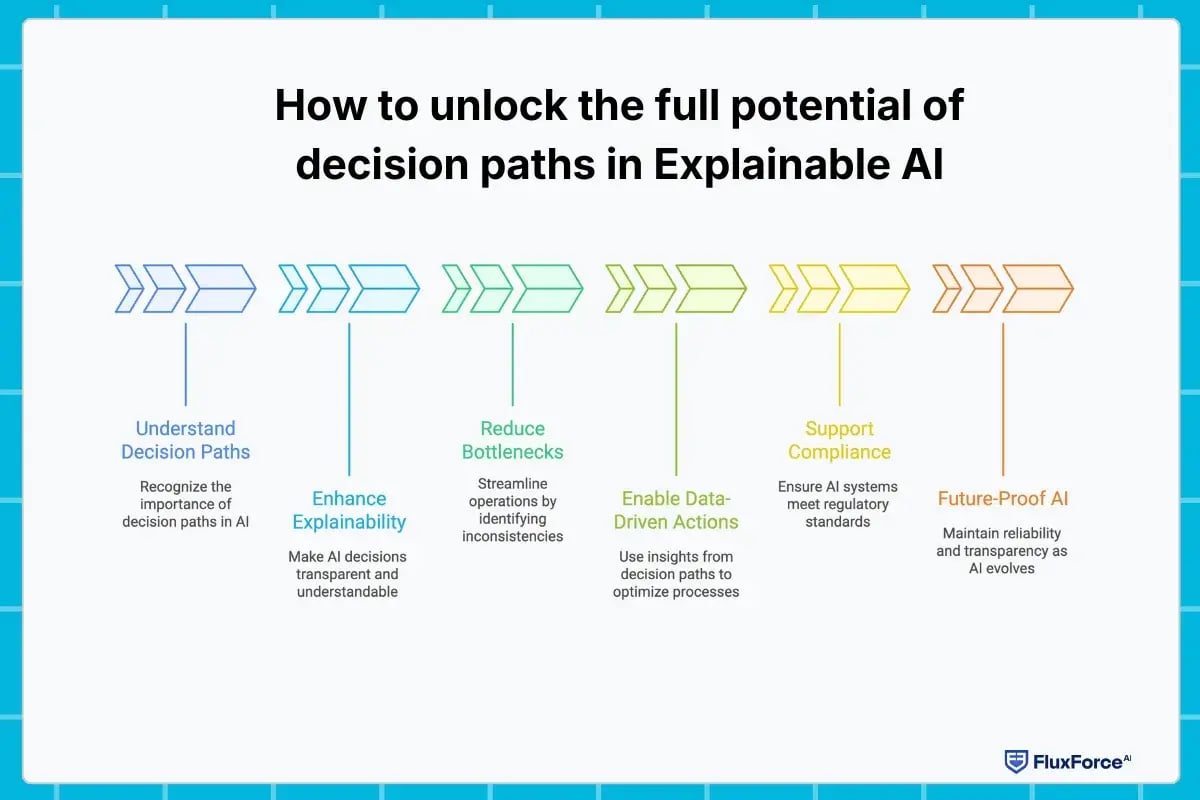
Understanding decision paths directly impacts how organizations use AI responsibly. By making the reasoning behind every output visible, teams can transform black-box predictions into actionable insights, enhancing trust and operational confidence.
Make AI decisions fully explainable
Clear AI decision paths allow teams to see which inputs and feature interactions influenced an outcome. This strengthens AI model explainability and ensures transparent AI systems that are practical for day-to-day operations.
Reduce operational bottlenecks
With traceable decision paths, analysts, risk managers, and compliance teams can quickly spot inconsistencies or potential bias. Decision path modeling in ML allows for faster validation and consistent performance without hours of manual review.
Enable confident, data-driven actions
By visualizing AI decision logic, teams can understand patterns and dependencies that affect decisions. This enables smarter adjustments, process optimizations, and prioritization of interventions while maintaining AI reasoning traceability.
Support compliance and audit readiness
Decision paths make AI outputs defensible for regulators and internal governance. Explainable AI for risk and compliance and regulatory-driven AI transparency become operational practices rather than checkboxes, reducing audit delays and exposure to risk.
Future-proof enterprise AI
Structured decision paths help maintain reliable interpretable machine learning as models evolve. Organizations achieve decision transparency for enterprise AI, scale AI responsibly, and preserve trust across stakeholders.
Conclusion
Decision paths are the backbone of explainable AI. They show how models make decisions, helping teams spot risks, improve processes, and stay accountable. With audit-ready XAI and clear reasoning, organizations gain transparency across operations. From reducing false alerts to speeding up regulatory approvals, decision paths deliver practical, measurable improvements. Teams that focus on them can use AI responsibly while keeping trust intact.
Read more: Explainable AI in finance — a comprehensive blog.


Share this article