.webp)







Listen To Our Podcast🎧
Introduction
SAR filing efficiency is the compliance metric nobody talks about at board meetings, yet it is the single largest time sink consuming your compliance team's capacity. While leadership focuses on alert volumes, detection rates, and examination results, the teams actually doing the work are drowning in the labor-intensive process of researching, writing, reviewing, and filing Suspicious Activity Reports.
According to ACAMS' 2025 SAR Filing Benchmark Study, SAR-related activities consume 30-40% of total compliance team working hours at mid-market financial institutions. The average time to complete a single SAR — from investigation to filing — ranges from 4 to 8 hours per report. For an institution filing 50-100 SARs per month, that represents 200-800 analyst hours monthly dedicated to a single output.
The problem is not that SARs are unimportant. They are a regulatory obligation and a critical tool in the fight against financial crime — and SAR accuracy in risk operations directly impacts examination outcomes. The problem is that the SAR filing process is overwhelmingly manual, repetitive, and ripe for automation — yet most institutions have invested far more in upstream detection technology than in the downstream reporting workflow that determines whether detection actually translates into actionable intelligence.
Explainable AI in finance enhances transparency, trust, and decision-making
with FluxForce AI’s explainability tools.

In This Article, You'll Learn
In this article, you'll learn:
- Why SAR filing consumes such a disproportionate share of compliance resources
- Time-per-SAR benchmarks and where the hours actually go
- FinCEN's quality expectations and why they matter more than speed
- Specific automation opportunities across the SAR filing workflow
- How to measure and improve SAR filing efficiency
SAR Filing Efficiency: The Problem by the Numbers
The scale of the SAR filing burden is staggering and growing every year. According to FinCEN's 2025 Annual Statistics, financial institutions filed 4.6 million SARs in 2025 — a 12% increase over 2024 and a 58% increase over 2020. SAR filing volumes have grown every year for over a decade, with no signs of slowing.
For mid-market institutions specifically, the numbers look like this:
|
Metric |
Mid-Market Benchmark (2025) |
|
Average monthly SAR filings |
50-120 |
|
Average time per SAR (investigation to filing) |
4-8 hours |
|
Monthly analyst hours on SAR activities |
200-960 hours |
|
SAR-related activities as % of compliance team time |
30-40% |
|
Average SAR narrative word count |
800-1,500 words |
|
SAR rejection/amendment rate |
8-15% |
|
Cost per SAR filed |
$350-$700 |
Key insight: According to Deloitte's 2025 Compliance Efficiency Report, the cost per SAR at mid-market institutions is $350-$700, factoring in analyst time, supervisory review, technology costs, and amendment rework. At 100 SARs per month, that is $420,000-$840,000 annually on SAR filing alone.
Where the Hours Go: Anatomy of SAR Filing Time
Understanding where the hours are spent is essential for identifying automation opportunities. Based on ACAMS' 2025 SAR Process Benchmark and Deloitte's workflow analysis, here is the breakdown of time allocation per SAR.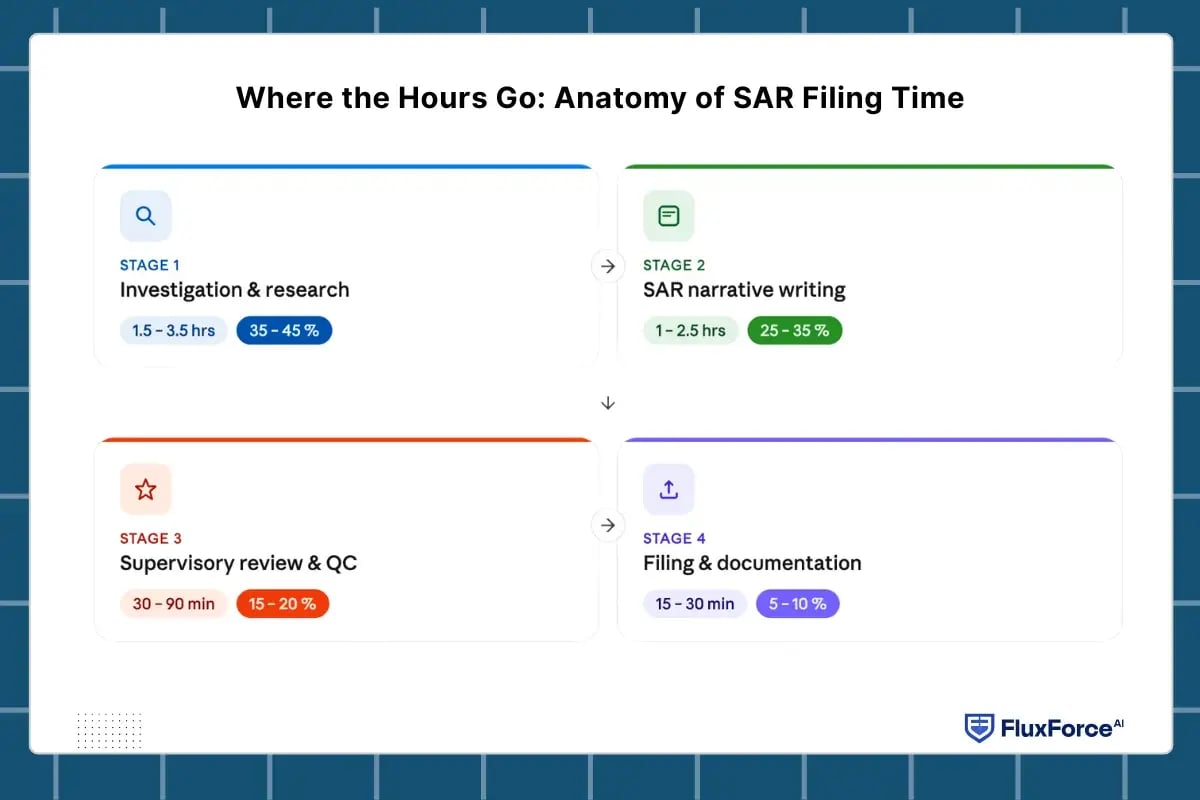
Stage 1: Case Investigation and Research (35–45% of time)
Before a SAR can be written, the analyst must conduct a thorough investigation of the suspicious activity. This involves:
- Reviewing the original alert and supporting documentation
- Pulling transaction history across relevant accounts and time periods
- Checking customer due diligence files (KYC records, risk ratings, prior SARs)
- Conducting OSINT research (adverse media, public records, social media)
- Reviewing related cases and prior investigation findings
- Documenting the investigation trail
Average time: 1.5–3.5 hours per SAR
The investigation stage is the most variable. Simple structuring cases with clear transaction patterns might take 90 minutes. Complex money laundering schemes involving multiple entities, layered transactions, and cross-border flows can take 6–8 hours to investigate fully.
Stage 2: SAR Narrative Writing (25–35% of time)
The SAR narrative is the free-text portion of the filing that describes the suspicious activity in detail. This is the most intellectually demanding and time-consuming writing task in compliance.
Average time: 1–2.5 hours per SAR
The narrative must include:
- Who is involved (subjects, associated parties, account details)
- What happened (specific transactions, amounts, dates, patterns)
- When the activity occurred (timeframe, sequence of events)
- Where transactions originated and terminated (geographic details)
- Why the activity is suspicious (the analyst's professional judgment)
- How the suspicious activity was conducted (methodology, typology)
Stage 3: Supervisory Review and Quality Control (15–20% of time)
Every SAR must be reviewed by a supervisor or quality assurance analyst before filing. This review checks for:
- Factual accuracy (do the numbers match the underlying transactions?)
- Narrative completeness (are all five W's adequately addressed?)
- Regulatory compliance (are all required fields populated correctly?)
- Consistency with prior filings for the same subjects
- Appropriate typology classification
Average time: 30–90 minutes per SAR
According to ACAMS, first-pass approval rates average only 65–75% at mid-market institutions, meaning 25–35% of SARs require revision before filing. Each revision cycle adds an additional 30–60 minutes.
Stage 4: Filing and Documentation (5–10% of time)
The actual electronic filing through FinCEN's BSA E-Filing System, plus internal documentation and case closure.
Average time: 15–30 minutes per SAR
The SAR Narrative: The Hardest Part Nobody Prepares You For
The SAR narrative deserves special attention because it is the component that most directly impacts both compliance quality and filing efficiency. 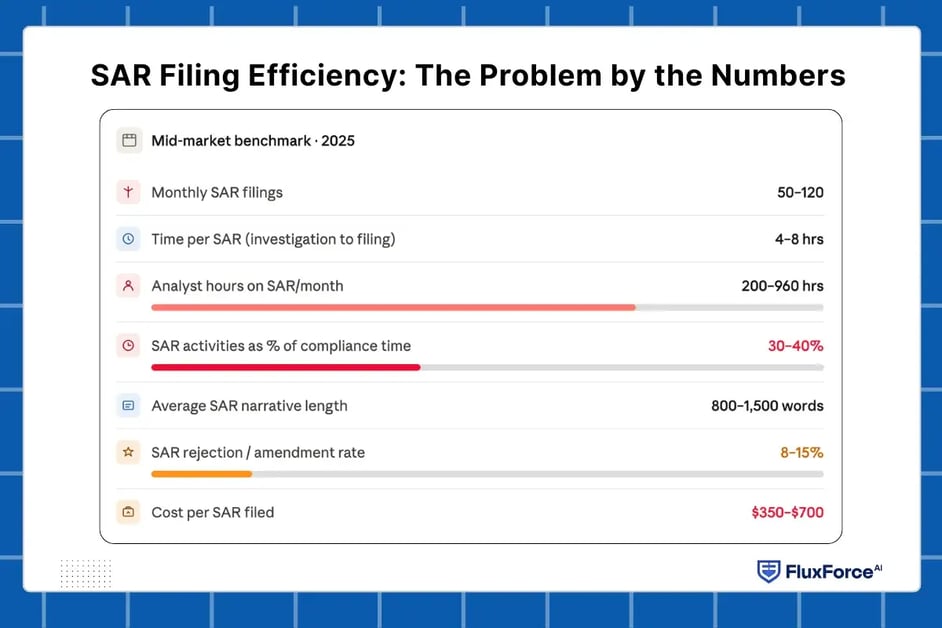
Why Is SAR Narrative Writing So Difficult for Compliance Teams?
SAR narrative writing is a unique skill that combines legal precision, investigative analysis, and clear prose. According to a 2025 ACAMS survey of SAR analysts:
- 67% of analysts cite narrative writing as the most time-consuming part of SAR filing
- 43% report receiving no formal training in SAR narrative writing before being assigned filing responsibilities
- 72% say they reference prior SARs as templates, creating consistency risks when those prior SARs had quality issues
The challenge is not just time — it is quality. A well-written SAR narrative enables law enforcement to understand and act on the information. A poorly written narrative — even if factually accurate — can render the filing effectively useless.
What Are the Most Common SAR Narrative Quality Issues?
FinCEN has publicly identified recurring narrative quality problems across the industry:
- Vague suspicion statements: "Activity appeared unusual" without specifying what made it unusual relative to expected behavior
- Missing transaction details: Narrative describes a pattern but omits specific transaction amounts, dates, or counterparties
- No "why" explanation: Report describes what happened but fails to articulate why it is suspicious
- Boilerplate language: Copy-paste narratives that do not reflect the specific facts of the case
- Inconsistent subject information: Subject details in the narrative conflict with structured data fields
Key insight: According to FinCEN's 2025 SAR Quality Review, approximately 22% of SARs filed by mid-market institutions have significant narrative quality deficiencies that reduce their utility for law enforcement analysis.
FinCEN Quality Expectations: Speed vs. Substance
Improving SAR filing efficiency cannot come at the expense of quality. FinCEN has been increasingly explicit about its quality expectations, and regulators evaluate both timeliness and substance.
Timeliness Requirements
- 30 calendar days from the date of initial detection of suspicious activity to file a SAR (extendable to 60 days if the subject is not identified)
- Continuing SARs are required every 90 days for ongoing suspicious activity
- Late filings are tracked and may trigger regulatory findings
According to FinCEN's 2025 statistics, 14% of SARs from mid-market institutions are filed within the final 5 days of the 30-day window, indicating that a significant percentage of institutions are running up against the deadline.
Quality Expectations
FinCEN's 2025 guidance emphasizes that SAR quality matters as much as timeliness:
"A timely SAR that lacks sufficient detail to enable law enforcement to understand and act on the reported activity does not fulfill the filing institution's obligation." — FinCEN Advisory, November 2025
The OCC's examination procedures now explicitly assess SAR narrative quality as part of BSA/AML examinations, including:
- Completeness of the five W's in every narrative
- Specificity of transaction details cited
- Clarity of the analyst's basis for suspicion
- Consistency across related filings
- Appropriate use of FinCEN's suspicious activity typology categories
Key insight: According to FFIEC examination statistics, SAR quality deficiencies were cited in 28% of BSA/AML examinations of mid-market institutions in 2025 — making it the second most common finding after transaction monitoring effectiveness.
Improving SAR Filing Efficiency Through Automation
SAR filing automation is not about removing human judgment from the process. It is about removing the manual, repetitive tasks that consume 50–70% of SAR filing time, so analysts can focus their expertise on the investigation and judgment components that require human intelligence. 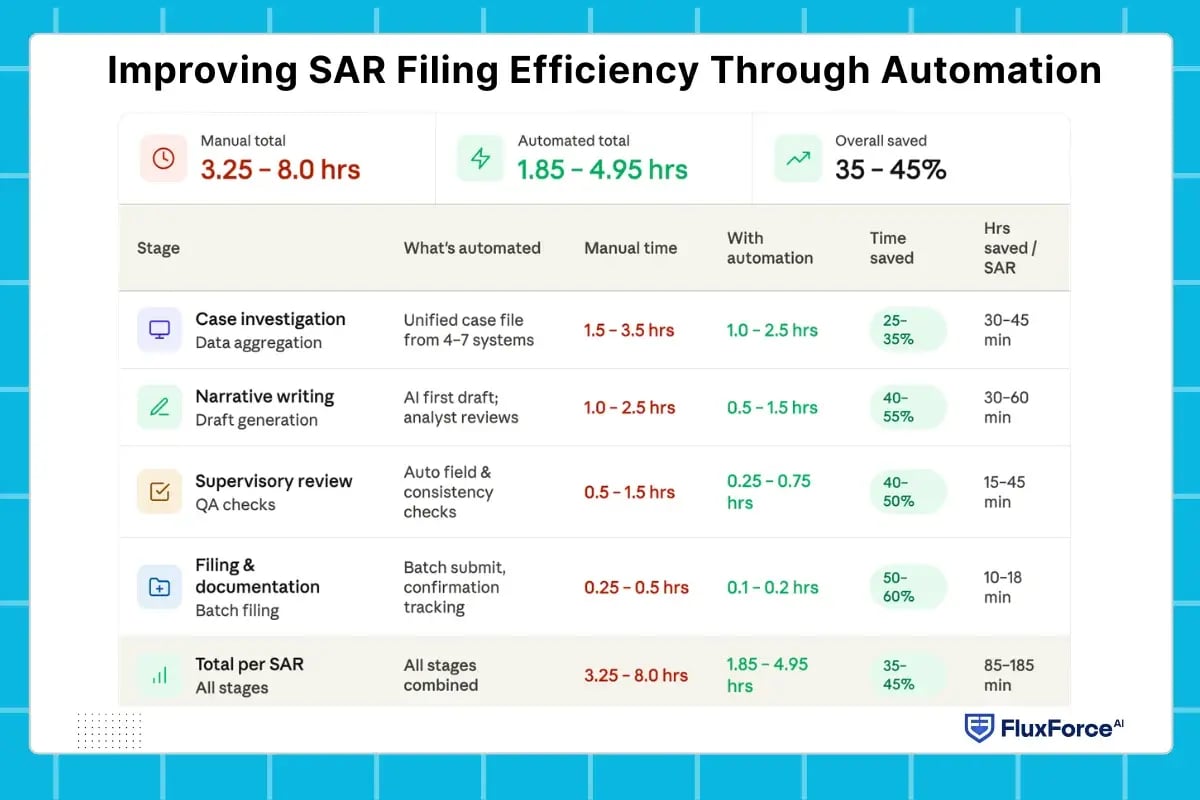
What Can Be Automated Today
1. Case Data Aggregation (saves 30–45 minutes per SAR)
Automatically compile all relevant data for the investigation: transaction history, customer profile, prior SARs, KYC records, alert history, and case notes. Instead of analysts navigating 4–7 different systems to manually gather information, automated data aggregation presents a unified case file.
According to Deloitte's 2025 analysis, this single automation reduces Stage 1 investigation time by 25–35%.
2. Structured Field Population (saves 15–20 minutes per SAR)
Automatically populate SAR structured fields (subject information, account numbers, institution details, filing type) from case management data. This eliminates manual data entry and reduces transcription errors.
3. SAR Narrative Draft Generation (saves 30–60 minutes per SAR)
AI-powered narrative generation tools can produce a first draft of the SAR narrative based on case data, transaction patterns, and typology classification. The analyst reviews, edits, and approves the narrative rather than writing from scratch.
According to a 2025 ACAMS technology survey, institutions using AI-assisted narrative drafting report 40–55% reduction in narrative writing time while maintaining or improving narrative quality scores on supervisory review.
4. Quality Assurance Checks (saves 15–25 minutes per SAR)
Automated QA tools check for common deficiencies: missing required fields, narrative-to-data inconsistencies, typology misclassification, and format compliance. This reduces the supervisory review burden and improves first-pass approval rates.
5. Filing and Documentation (saves 10–15 minutes per SAR)
Automated batch filing, filing confirmation tracking, and case documentation closure streamline the administrative tail of the process.
What Cannot (and Should Not) Be Automated
- Investigative judgment: The determination of whether activity is genuinely suspicious requires human expertise, contextual understanding, and professional judgment
- Final narrative approval: A human analyst must review and certify every SAR narrative before filing
- Escalation decisions: Whether to file a SAR, refer to law enforcement, or take other action requires human decision-making
- Complex entity analysis: Untangling beneficial ownership structures, shell company networks, and multi-jurisdictional schemes requires investigative skill
The Efficiency Impact
|
SAR Stage |
Manual Time |
With Automation |
Time Saved |
|
Case investigation |
1.5–3.5 hrs |
1.0–2.5 hrs |
25–35% |
|
Narrative writing |
1.0–2.5 hrs |
0.5–1.5 hrs |
40–55% |
|
Supervisory review |
0.5–1.5 hrs |
0.25–0.75 hrs |
40–50% |
|
Filing & documentation |
0.25–0.5 hrs |
0.1–0.2 hrs |
50–60% |
|
Total per SAR |
3.25–8.0 hrs |
1.85–4.95 hrs |
35–45% |
Key insight: At 100 SARs per month, a 35–45% time reduction translates to 115–355 analyst hours saved monthly — equivalent to 0.7–2.2 full-time analysts redeployed from filing to investigation and risk analysis.
Measuring and Improving SAR Filing Efficiency
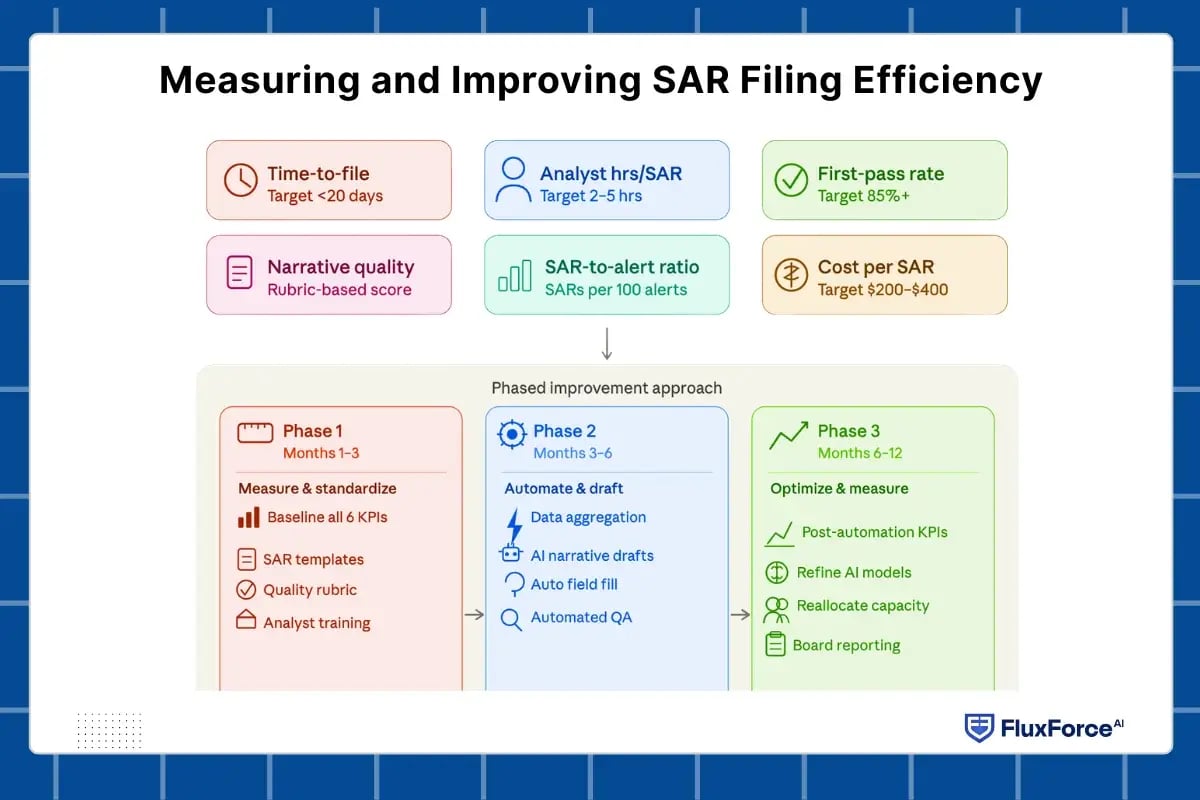
What Metrics Should Banks Track for SAR Filing Efficiency?
Most institutions track SAR filing volume and timeliness. To genuinely improve SAR filing efficiency, track these additional metrics:
- Time-to-file: Average calendar days from alert disposition to SAR filing (target: <20 days of the 30-day window)
- Analyst hours per SAR: Total analyst time from case assignment to filing (benchmark: 4–8 hours; target with automation: 2–5 hours)
- First-pass approval rate: Percentage of SARs approved by QA without revision (benchmark: 65–75%; target: 85%+)
- Narrative quality score: Internal scoring rubric based on FinCEN's quality criteria (completeness, specificity, clarity)
- SAR-to-alert ratio: Number of SARs filed per 100 investigated alerts (indicates investigation efficiency)
- Cost per SAR: Fully loaded cost, including analyst time, review time, and technology (benchmark: $350–$700; target with automation: $200–$400)
A Phased Improvement Approach
Phase 1 (Months 1–3): Measure and Standardize
- Establish baseline metrics for all six KPIs above
- Standardize SAR narrative templates by typology (structuring, money laundering, fraud, etc.)
- Create a narrative quality rubric aligned with FinCEN expectations
- Train analysts on narrative writing best practices
Phase 2 (Months 3–6): Automate Data and Drafting
- Deploy automated case data aggregation
- Implement AI-assisted narrative draft generation
- Automate structured field population from case management
- Deploy automated QA checks
Phase 3 (Months 6–12): Optimize and Measure
- Measure post-automation KPIs against baselines
- Refine narrative templates and AI models based on QA feedback
- Reallocate recovered analyst capacity to complex investigations
- Report efficiency gains to the board with cost-per-SAR metrics
According to ACAMS' 2025 benchmarks, institutions completing all three phases achieve 35–50% reduction in analyst hours per SAR and 15–25% improvement in first-pass approval rates, while maintaining full regulatory compliance. Organizations pursuing broader automated regulatory reporting for modern enterprises can extend these efficiency gains across their entire compliance function.
Key Takeaways
- SAR filing consumes 30–40% of compliance team time at mid-market institutions, at a cost of $350–$700 per report. At 100 SARs monthly, that is $420K–$840K annually on filing alone.
- Narrative writing is the biggest bottleneck, consuming 25–35% of total SAR time. 43% of analysts receive no formal narrative training, and 22% of SARs have significant quality deficiencies per FinCEN's review.
- SAR filing efficiency automation can reduce total time by 35–45% per SAR through data aggregation, AI-assisted narrative drafting, automated QA, and streamlined filing — while maintaining human judgment for investigation and final approval.
- FinCEN and OCC now evaluate SAR quality, not just timeliness. Quality deficiencies were cited in 28% of BSA/AML examinations of mid-market institutions in 2025.
- First-pass approval rates of 65–75% mean 25–35% of SARs require rework, adding 30–60 minutes per revision. Automated QA checks can push first-pass rates above 85%.
- The recovered analyst time is the real ROI. At 100 SARs monthly, automation saves 115–355 analyst hours — equivalent to 0.7–2.2 FTEs that can be redeployed to complex investigations and risk analysis.
Explainable AI is revolutionizing finance. Dive into key benefits, real-world applications
with FluxForce AI’s explainability tools.
Conclusion
SAR filing is no longer just a compliance requirement. It has become a growing operational burden. With rising volumes, limited headcount, and increasing regulatory scrutiny, relying on manual processes is not sustainable.
The real opportunity lies in streamlining repetitive tasks through automation while preserving human judgment where it matters most. Institutions that adopt this approach can reduce time, improve quality, and allow analysts to focus on higher-risk investigations.
In simple terms, SAR filing efficiency is not only about speed. It is about achieving more with the same resources without compromising compliance.



Share this article