.webp)




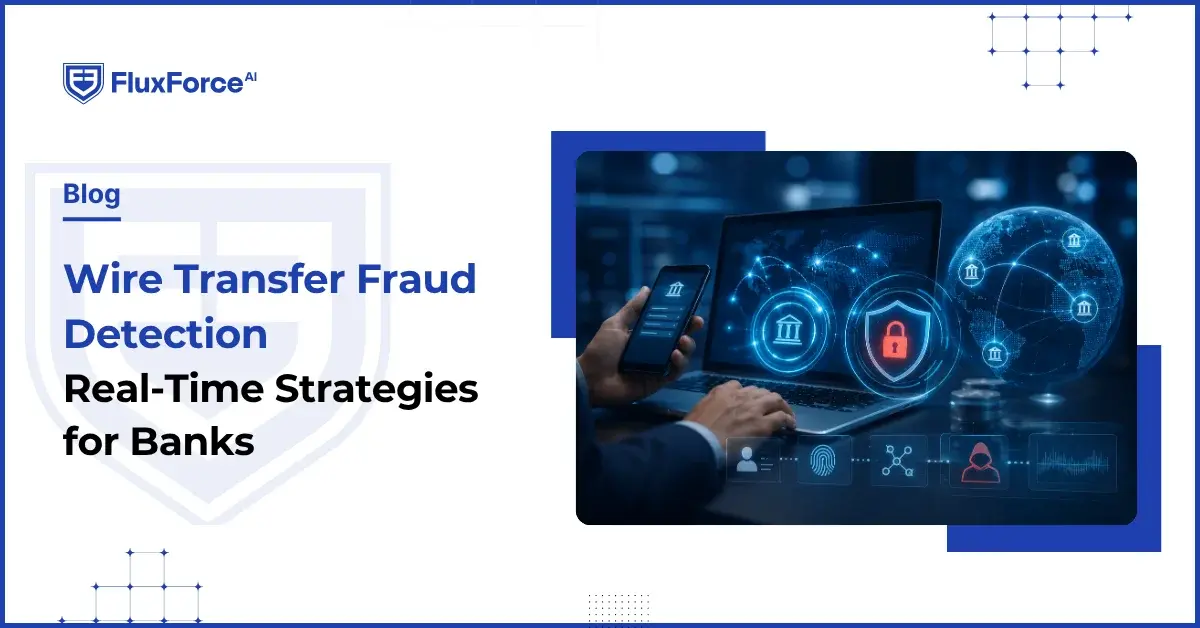



Wire transfer fraud detection in banks has moved from a compliance checkbox to a frontline business problem. According to the FBI's Internet Crime Complaint Center, business email compromise and wire fraud schemes cost U.S. organizations over $2.9 billion in 2023 alone, with banks bearing both the direct losses and the reputational fallout. The fraud itself is fast. The wire clears in seconds. The recovery, when it happens at all, takes weeks.
The challenge for compliance officers and risk heads is no longer whether to invest in better fraud controls. It's how to build detection that keeps pace with modern transaction velocity without drowning analysts in false alerts or creating friction that pushes customers to competitors. This post covers what real-time wire transfer fraud detection looks like in 2026, why rule-based systems are a structural disadvantage, and what leading AI approaches are doing differently.
Why Wire Transfer Fraud Is Outpacing Traditional Bank Controls
Wire fraud is not new, but its speed and sophistication have outrun most banks' detection infrastructure. The core mismatch: banks built fraud controls for batch processing environments, and those same controls now operate on real-time payment rails where a suspicious transaction needs a decision in under 300 milliseconds.
The Rising Cost of Wire Fraud in Banking
Business Email Compromise (BEC) attacks that redirect wire payments remain the dominant attack vector. Fraudsters compromise email accounts, monitor payment workflows, then intercept and redirect transactions at the worst possible moment. A bank's fraud team often doesn't know a wire was fraudulent until the receiving institution flags it, days after the funds moved.
The losses compound quickly. Beyond the direct fraud loss, banks absorb investigation costs, regulatory scrutiny, and customer churn. A single high-value wire fraud incident at a mid-size bank can cost seven figures once you account for staff time, legal exposure, and remediation.
Why Legacy Rule Engines Fail
Rule-based transaction monitoring systems work by checking transactions against static thresholds: flag anything over $10,000, flag anything to a new payee, flag anything from an unusual geography. These rules produce both too many alerts and too few catches.
They generate too many alerts because they can't distinguish a legitimate large payment from a fraudulent one using static thresholds alone. They miss fraud because sophisticated actors know the rules, structure transactions to stay under limits, and build relationship histories before executing a large fraudulent transfer. Rule engines are, by definition, reactive to known patterns.
How Does AI Detect Fraud in Real-Time Wire Transfers?
AI fraud detection in the context of wire transfers means using machine learning models to evaluate hundreds of signals simultaneously, in real time, and produce a risk score that determines whether to approve, flag, or block a transaction.
Behavioral Baselines and Anomaly Scoring
The foundational capability in modern ai fraud detection in banking is behavioral profiling. Instead of checking a transaction against a fixed threshold, the system builds a dynamic baseline for each account: what does this entity's normal payment behavior look like? Typical payees, typical amounts, typical timing, typical geographies.
When a wire deviates from that baseline, the system scores the anomaly. A $50,000 wire to a new payee in a new country might score a 0.94 risk probability for an account that typically sends payroll domestically, but only 0.12 for a treasury desk that routinely executes international transfers. Context is everything, and rules can't capture context at that granularity.
AI Fraud Detection Explained: The Core Decision Logic
How does AI detect fraud at the transaction level? It combines several model types working in parallel:
- Supervised classification models trained on labeled fraud and non-fraud transactions to identify patterns that predict fraud
- Unsupervised anomaly detection to catch novel fraud patterns that don't match historical fraud signatures
- Network and graph models that map relationships between accounts, payees, and devices to surface mule networks
- Natural language processing on transaction memos and payment descriptions
The output is a composite risk score, often with an explainability layer that tells the analyst exactly which signals drove the score. That explainability is required under model risk management guidance from FinCEN and OCC for regulated institutions.
Real-Time Fraud Detection: What Sub-Second Response Actually Requires
Real time fraud detection isn't just about model inference speed. The infrastructure around it matters as much as the model itself. Real time fraud detection in banks requires event streaming (typically Apache Kafka or a proprietary equivalent), low-latency feature computation, and a serving layer that can evaluate a model in under 100ms without a round trip to a data warehouse.
Most banks discover the hard way that their existing wire transfer fraud detection stack can't meet this bar. Their models run in batch, their features are computed overnight, and their alerts arrive after the wire has already settled. Retrofitting a real-time layer onto a batch system is expensive and rarely clean.
Machine Learning Fraud Detection: What Banks Are Deploying
Machine learning fraud detection has matured significantly in the past three years. Banks that moved early now have multiple model generations in production. Those that delayed are facing a harder catch-up problem, particularly as fraud patterns continue shifting.
Supervised vs. Unsupervised Models in Banking
For wire transfer fraud specifically, supervised models trained on historical confirmed fraud cases perform best when the fraud type is well-understood. BEC fraud, payee substitution, and first-party fraud all have recognizable patterns that gradient boosting or neural network models can learn effectively.
Unsupervised models (autoencoders, isolation forests, clustering algorithms) are more valuable for detecting novel attack patterns where labeled training examples don't exist. They're also critical for catching synthetic identity fraud, where the fraudster has built a legitimate-looking transaction history before executing the attack. For a deeper look at how AI compares to traditional approaches, AI vs. Traditional Fraud Detection: Key Differences Every Risk Officer Should Know covers the practical trade-offs in detail.
Graph Analytics for Mule Network Detection
One area where machine learning fraud detection consistently outperforms rules is in identifying money mule networks. A mule account looks perfectly normal in isolation: small, regular deposits, periodic withdrawals. The fraud signal lives in the network topology, not the individual account.
Graph analytics models map relationships between accounts based on shared attributes: same device, same IP, same beneficiary, same phone number. When these relationships cluster in ways that resemble known mule network patterns, the model can surface the entire ring rather than individual suspicious transactions. This is a qualitatively different capability from anything a rule engine can provide.
Onboard Customers in Seconds

The False Positive Problem in Wire Transfer Fraud Detection
Here's the honest answer: AI doesn't eliminate false positives. It reduces them significantly in most deployments, but false positives fraud detection remains a real operational challenge that most vendors understate and most compliance teams underestimate in their business cases.
False Positive Rate Fraud Detection: The Real Numbers
Industry data suggests that rule-based AML systems generate false positive rates of 95% or higher, meaning 95 out of every 100 flagged transactions are legitimate. Some high-volume institutions report analysts investigating thousands of alerts per month where fewer than 1% result in a confirmed Suspicious Activity Report filing.
AI-powered systems typically reduce this to somewhere in the 40-70% false positive range depending on model quality, training data, and threshold configuration. That's a real improvement, but a 50% false positive rate still means half your analyst time is spent on legitimate transactions. The false positive rate fraud detection problem is partly a model quality issue and partly an operations design issue.
False Positive Cost Fraud: What You're Actually Losing
The false positive cost fraud teams absorb is rarely calculated explicitly, but it adds up fast. An experienced BSA analyst reviewing a flagged wire transaction takes roughly 20-40 minutes per case including documentation. At 500 false alerts per week, that's 200 or more analyst hours spent on transactions that weren't fraud.
That's not just a cost problem. It's a fraud alert fatigue problem. Analysts who clear hundreds of false alerts per week start developing confirmation bias toward approving alerts quickly. The one alert that actually matters gets the same cursory review as the 499 that didn't. The post How Agentic AI Fraud Agents Cut False Positives by 80% examines how agentic workflows are changing this dynamic in real deployments.
How to Reduce False Positives in Transaction Monitoring
Reducing false positives requires working on three things simultaneously: model quality, threshold calibration, and workflow design. You can't fix one without considering the other two.
How to Reduce False Positives in AML Programs
The most effective technique to reduce false positives transaction monitoring teams face is contextual enrichment. Before a transaction is scored, append every available signal: customer relationship history, prior SARs, device fingerprint, IP reputation, account age, and product type. A model with 50 features will almost always outperform one with 10, and contextual enrichment is the fastest path to adding meaningful signal without collecting new data.
Second, stop using a single global threshold. A threshold calibrated for retail wire transfers will generate unacceptable false positives for corporate treasury operations. Segment your customer base and calibrate thresholds separately by customer type. As a practical reference, Reducing False Positives: Rule-Based Systems vs. AI-Driven Solutions outlines how segmented thresholds reduce alert volume by 30-40% without meaningfully increasing missed fraud rates.
Tiered Alert Scoring and Fraud Alert Fatigue
A tiered alert model changes the analyst workflow from reviewing everything flagged to prioritizing by risk band. Transactions scoring above 0.9 get immediate hold and human review. Transactions scoring 0.6-0.9 go to a secondary review queue. Transactions below 0.6 clear automatically but are logged for model feedback.
This approach combats fraud alert fatigue directly. Analysts working the high-priority queue are reviewing genuinely suspicious activity most of the time, which improves both accuracy and morale. According to NIST's AI Risk Management Framework, maintaining clear human-in-the-loop escalation paths for high-risk decisions is both an operational best practice and an emerging regulatory expectation.
Automated Transaction Monitoring: Beyond the Rule Engine
Automated transaction monitoring is the operational layer where detection strategy meets execution. The model is only as useful as the system that operationalizes it.
Transaction Monitoring Software: What Separates Leaders from Laggards
The best transaction monitoring software platforms in 2026 share characteristics that legacy vendors consistently lack:
- Streaming data pipelines that process transactions as events rather than in overnight batches
- Feature stores that pre-compute behavioral features for instant lookup at scoring time
- Model management that allows retraining and A/B testing without a full deployment cycle
- Explainability interfaces that show analysts why a transaction was flagged, not just that it was
The transaction monitoring cost of a best-in-class platform is real. In our client engagements, mid-size banks typically see costs in the low millions annually. But that number needs to be measured against the alternative: a custom-built stack that typically costs more, lags in model quality, and requires specialized ML talent to maintain year over year.
Transaction Monitoring Cost: Build vs. Buy
The build vs. buy question for automated transaction monitoring usually resolves to: buy the platform, customize the models. Pure build approaches routinely underestimate data engineering complexity and overestimate internal ML talent availability. Pure buy approaches underestimate the configuration work required to fit a vendor model to a specific customer population.
The hybrid approach, where a bank licenses a core platform like AI-powered fraud detection software and then trains models on its own transaction history, typically delivers the best combination of deployment speed and detection accuracy.
Synthetic Identity Fraud and Wire Transfer Risk
Synthetic identity fraud is the fastest-growing category of financial fraud in the U.S. by most estimates, and it creates a specific problem for wire transfer fraud detection in banks: the fraud account looks legitimate because the fraudster built it to look that way over months.
How Synthetic Identity Fraud Enters the Wire Transfer Chain
A synthetic identity is constructed from a real Social Security number (often belonging to a child or deceased person) combined with fabricated personal details. The fraudster spends months building credit history, passing KYC checks, and establishing normal small-dollar transaction patterns. When the account is ready, they execute a large wire transfer and disappear.
By the time a bank's fraud team identifies the account as synthetic, the funds are long gone. This is why synthetic identity fraud requires detection at the identity layer, not just the transaction layer. For an in-depth look at how banks are detecting this at onboarding, Detecting Synthetic Identity Fraud in Real-Time covers both the technical and operational approaches in detail.
Payment Fraud Prevention at the Identity Layer
Payment fraud prevention for synthetic identities means integrating identity signals into the transaction scoring model. When a wire request is scored, the model should incorporate:
- Age of the identity relationship at the credit bureau
- Device and behavioral biometrics captured at login
- Velocity of recent account changes (address, phone, email)
- KYC verification quality scores from original onboarding
No single signal is definitive, but the combined pattern can surface synthetic accounts before losses occur. Banks that connect identity risk at account opening to transaction risk at payment initiation consistently detect this fraud type earlier than those that treat each layer separately.
What to Look for in AI Fraud Detection Software: Beyond Sardine vs Unit21
The sardine vs unit21 comparison comes up frequently in banking fraud discussions, and for good reason: both are purpose-built for financial services and have meaningful market traction. But for enterprise banks, choosing ai fraud detection software involves considerations that vendor comparison posts rarely address.
Sardine vs Unit21: A Direct Comparison
Sardine focuses heavily on device and behavioral intelligence at the session level, making it particularly strong for digital-first banks and fintechs where the web and mobile session is the primary attack surface. Its real-time scoring at login and transaction initiation is technically strong.
Unit21 takes a more investigation-workflow-centric approach: its core strength is case management, SAR filing automation, and analyst tooling. Banks with large compliance teams often find Unit21's workflow features more operationally useful than Sardine's detection depth alone.
Neither platform dominates across all use cases. Enterprise banks with complex wire transfer operations often layer a best-of-breed detection engine with a separate case management platform rather than relying on a single vendor for both functions.
What AI Fraud Detection in Banking Actually Requires at Scale
At enterprise scale, ai fraud detection in banking needs to handle millions of transactions per day with sub-second latency. That means platform architecture matters as much as model quality. Key requirements include:
- Horizontal scalability for transaction volume peaks at month-end and quarter-end
- On-premises or private cloud deployment options for data sovereignty requirements
- Native integration with SWIFT, FedWire, and internal core banking systems
- Continuous model retraining pipelines fed by confirmed fraud cases
The most important step compliance officers can take before selecting a platform is defining their false positive budget rather than their fraud detection target. Working backwards from the number of analyst hours available per week leads to more honest vendor conversations than starting with a catch-rate percentage.
Onboard Customers in Seconds
Conclusion
Wire transfer fraud detection in banks is no longer a problem that compliance teams can solve with more analysts or more rules. Transaction volumes are too high, fraud moves too fast, and the false positive cost is too significant to maintain the status quo.
Real-time fraud detection powered by machine learning fraud detection models, contextual enrichment, and tiered alert workflows is the current operational standard for institutions staying ahead of losses. The banks getting this right have defined their false positive tolerance, chosen their platform architecture deliberately, and invested in continuous model improvement rather than treating deployment as a one-time event.
Payment fraud prevention is ultimately a data quality problem as much as a technology problem. Banks that build clean, labeled training datasets and maintain feedback loops from confirmed fraud cases will see model performance improve steadily. Banks that treat the model as a static deployment will find it degrading within months as fraud patterns shift.
For compliance officers and risk heads looking to upgrade wire transfer fraud detection capabilities, start with an honest audit of your current false positive rate and the analyst hours it consumes. That number, more than any vendor demo, will tell you how urgent the upgrade is and what success actually needs to look like.

Share this article