.webp)








Listen To Our Podcast🎧
Introduction
Operating within regulatory frameworks is no longer just a compliance obligation—it defines operational integrity for enterprises.
Regulatory bodies such as the SEC, expanding reporting requirements for foreign private issuers from March 2026, and the Basel Committee, implementing Basel III Endgame reforms through 2028, have intensified expectations for timely, accurate, and auditable submissions.
Financial institutions, insurance carriers, and publicly traded companies now face growing scrutiny over fragmented reporting, delayed submissions, and inconsistent data handling. Manual compliance processes cannot keep pace with this regulatory intensity.
Automated regulatory reporting transforms these challenges into operational advantage. For compliance leaders, risk managers, and reporting officers, the shift is from report assembly toward building traceable, defensible, and regulator-ready processes that align with evolving standards.

Overview of Automated Regulatory Reporting
Automated Regulatory Reporting (ARR) refers to the use of several interconnected software systems to manage end-to-end compliance workflows, from data collection and validation to report submission and audit trail management.
Several recognized regulated enterprises have implemented ARR to streamline operations and reduce compliance risk:
Banks: JPMorgan Chase, Goldman Sachs, Bank of America leverage automation for Basel III, Dodd-Frank, and liquidity reporting.
Insurance: Allianz, AXA, Prudential Financial deploy ARR for Solvency II, statutory filings, and risk-based capital calculations.
How Automated Regulatory Compliance Management Transforms Traditional Processes ?
At its core, regulatory compliance software works as an intelligent orchestration layer that eliminates the overwhelming workload for compliance teams. From fixing delayed report submissions to ensuring data integrity across systems, automation delivers measurable improvements by:
1. Accelerating Processing Speed– Automated systems reduce report generation time from weeks to hours. Organizations using AI-driven compliance automation report 25% faster processing times and can reduce audit preparation times by up to 80%. This acceleration prevents last-minute submissions and regulatory penalties.
2. Ensuring Data Accuracy and Consistency– Manual data entry introduces errors that create compliance risk. Automated validation rules, cross-system reconciliation, and standardized data formats reduce reporting errors by identifying discrepancies before submission. Systems flag anomalies in real-time, allowing teams to address issues proactively.
3. Maintaining Continuous Audit Trails– Every data transformation, calculation, and approval is automatically logged with timestamps and user attribution. This creates defensible documentation that satisfies regulatory scrutiny and simplifies internal audits. Compliance officers can trace any reported figure back to its source within minutes.
4. Reducing Operational Costs– Financial institutions collectively spend an estimated $61 billion annually on compliance operations, with AI-enabled automation cutting these costs by up to 40%. Resources previously dedicated to manual report assembly can shift to strategic risk analysis and regulatory intelligence.
Role of AI in Automating Core Regulatory Reporting Functions
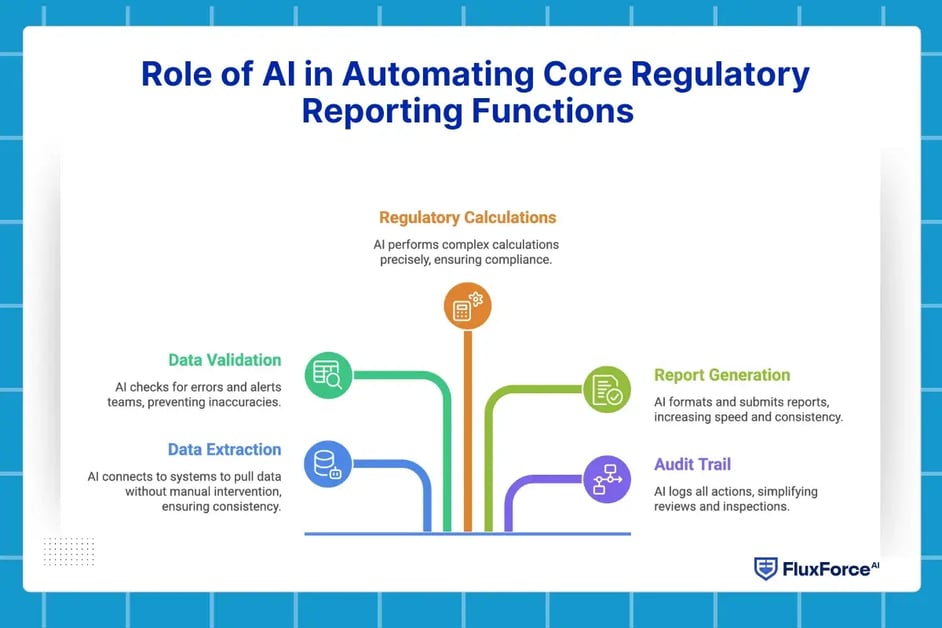
AI transforms regulatory reporting by actively handling every step that once relied on manual effort. Here’s a breakdown of steps:
1. Data Extraction and Integration
AI connects directly to ERPs, trading platforms, and risk management systems, pulling complete and standardized data without manual intervention. It ensures consistency across multiple sources and jurisdictions.
2. Data Validation and Quality Checks
AI continuously checks for inconsistencies, missing data, and threshold breaches. It alerts teams immediately, preventing errors from reaching regulators and ensuring reports remain accurate.
3. Regulatory Calculations
AI performs complex calculations such as risk-weighted assets, liquidity ratios, and solvency metrics. It applies regulatory rules precisely, reducing miscalculations and ensuring compliance with Basel III, SEC, or Solvency II requirements.
4. Report Generation and Submission
AI formats reports according to regulatory standards (XBRL, XML, CSV) and can submit directly to regulatory portals. Teams gain speed, consistency, and reduced manual errors.
5. Audit Trail and Documentation:
AI logs every data point, calculation, and approval with timestamps and user details. Teams can trace any figure quickly, simplifying internal reviews and regulator inspections.
Business Outcomes Enterprises Achieve with Regulatory Reporting Automation
Automated regulatory reporting delivers major improvements in efficiency, compliance, and strategic decision-making.
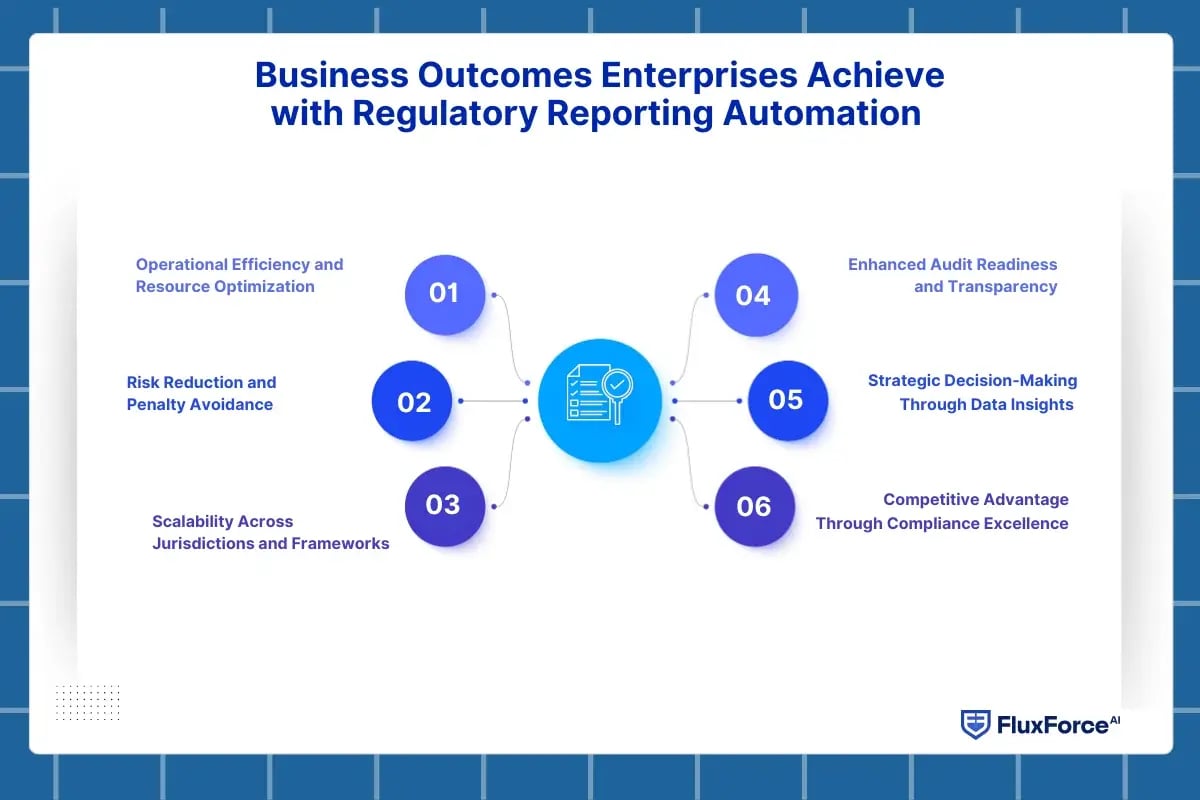
Here are some of the tangible benefits enterprises realize when they implement automated regulatory reporting software:\
1. Operational Efficiency and Resource Optimization
Compliance teams redirect effort from manual reporting to value-added activities. Enterprises report up to 50% improvement in efficiency and 30% lower compliance costs, freeing analysts to interpret regulations and advise business units strategically.
2. Risk Reduction and Penalty Avoidance
Manual reporting processes lead to 3.2 times more violations than automated systems. Real-time validation prevents errors, missed deadlines, and incomplete disclosures, reducing regulatory penalties and exposure to enforcement actions.
3. Scalability Across Jurisdictions and Frameworks
Automated platforms scale efficiently as organizations expand. A single system can handle Basel III, SEC disclosures, GDPR documentation, and industry-specific requirements simultaneously, ensuring consistent, accurate reporting across all regions.
4. Enhanced Audit Readiness and Transparency
Automation generates complete audit trails, version-controlled documentation, and evidence collection. Enterprises experience 79% shorter audit cycles and 90% fewer evidence requests, enabling independent verification of calculations, data lineage, and control effectiveness.
5. Strategic Decision-Making Through Data Insights
Automated reporting produces analytics that reveal regulatory exposure trends, quantify risk, and highlight emerging compliance issues. Leadership teams use these insights to guide product launches, market entry, and operational resource allocation.
6. Competitive Advantage Through Compliance Excellence
Organizations with mature automation respond to regulatory changes faster than competitors. This agility strengthens regulator relationships, reduces time-to-market, and enhances credibility with investors, customers, and business partners.
Challenges in AI-Enabled Regulatory Reporting
Automated regulatory reporting is drawn to multiple challenges that can affect compliance accuracy and system reliability.
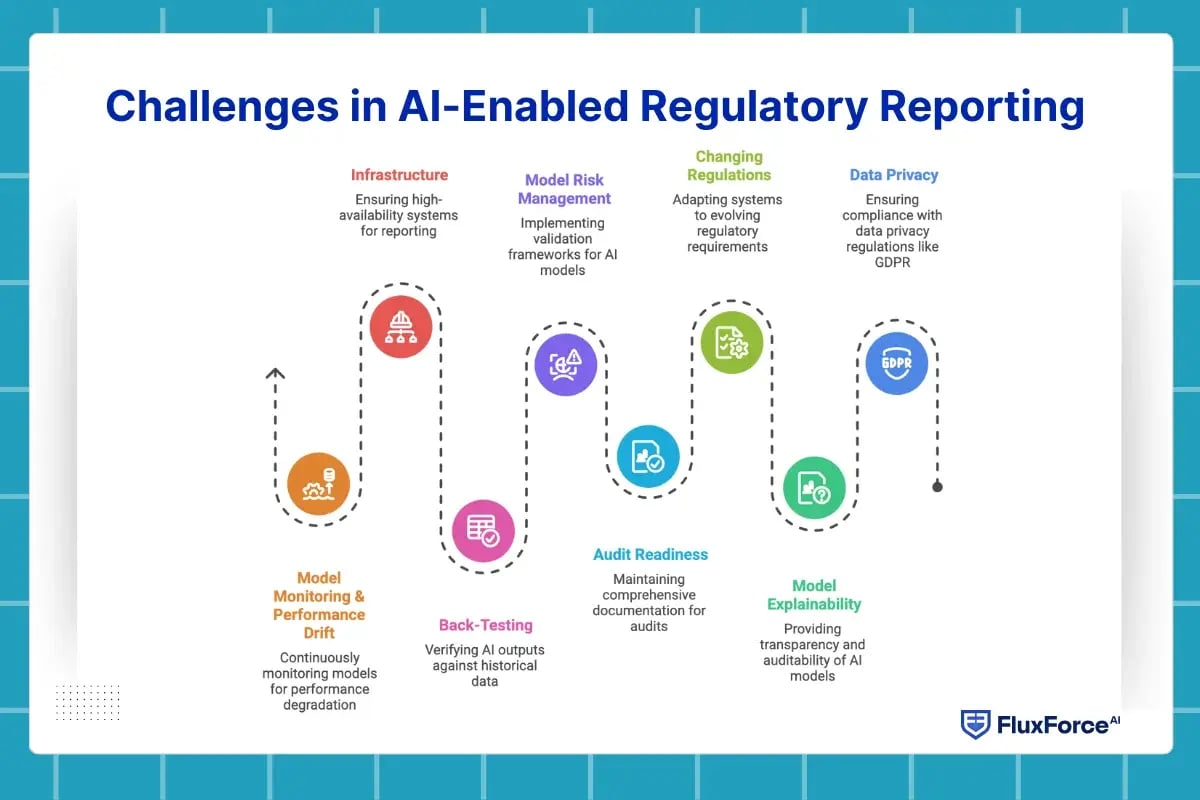
These challenges are broadly distributed into two categories:
1. Enterprise-Level Regulatory Challenges
At an organizational level, AI reporting struggles mainly come from regulatory obligations, internal controls, and enterprise-wide accountability gaps.
- Data Privacy: GDPR requires reporting breaches within 72 hours. Enterprises processing personal data across borders must enforce privacy controls, consent frameworks, and data residency measures for multiple regulatory regimes.
- Model Explainability: Regulators demand transparency. Black-box AI reports pose audit risks. Organizations must document model logic, validate outputs against known scenarios, and maintain human oversight for acceptance.
- Changing Regulations: Regulatory updates now accelerate due to economic shifts and emerging tech. Systems must adapt to new formats, rules, and calculations without compromising stability. Flexibility is essential.
- Audit Readiness: Regulators expect comprehensive documentation. Enterprises must maintain validation evidence, change logs, and exception handling to prove reports are accurate, complete, and timely under all conditions.
2. Model & Technology Challenges
Beyond organizational concerns, technical and model-specific limitations directly influence reporting accuracy, resilience, and regulatory defensibility.
- Model Risk Management: AI models require formal validation frameworks assessing accuracy, reliability, and suitability. Organizations must set governance committees, document methods, and periodically revalidate models for compliance.
- Back-Testing: Automated reports must be checked against historical data and prior submissions. Validation includes comparing AI outputs, verifying calculations, and stress-testing under diverse scenarios.
- Infrastructure: Non-negotiable deadlines demand high-availability systems. Enterprises must deploy redundant infrastructure, backups, failover mechanisms, and disaster recovery to ensure reporting continuity.
- Model Monitoring & Performance Drift: AI models degrade over time. Organizations implement continuous monitoring, thresholds for drift, and dashboards to identify when retraining, recalibration, or replacement is needed.
Prerequisites for Successful Regulatory Reporting Automation
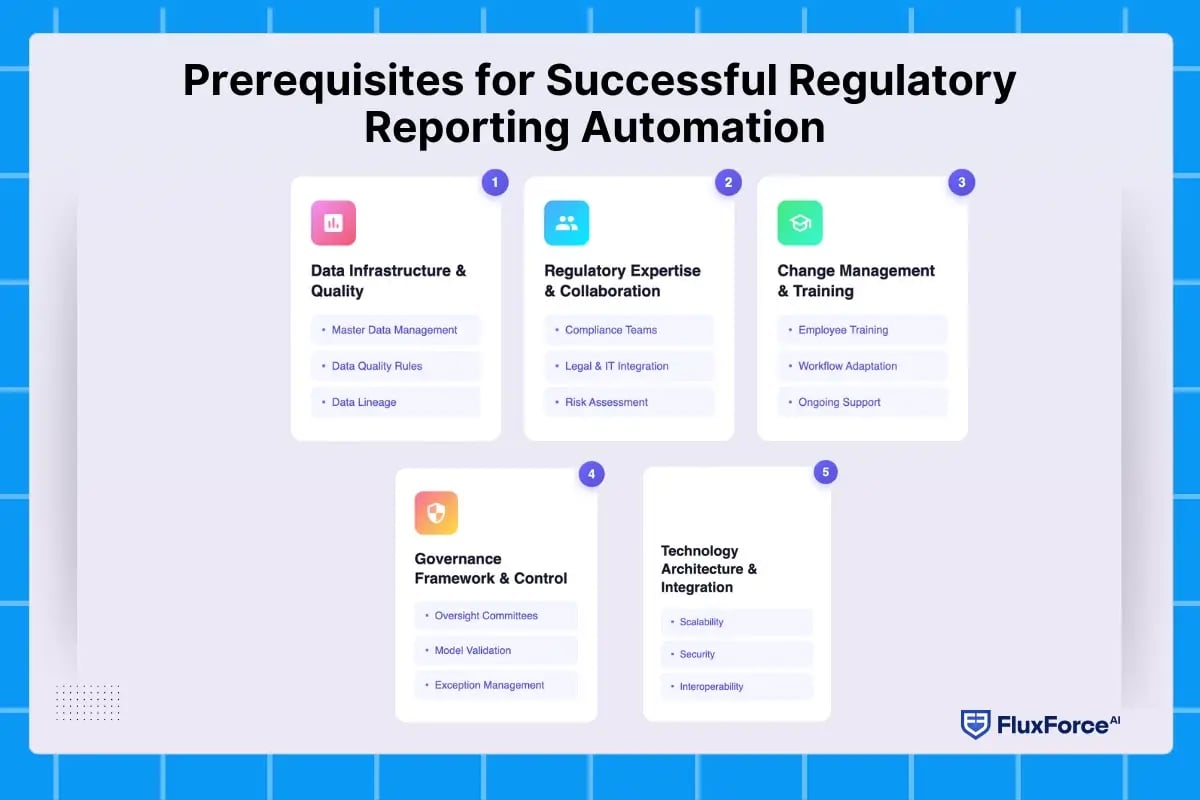
Implementing automated regulatory reporting requires more than deploying technology. Enterprises must ensure:
#1 Data Infrastructure and Quality Management
Automated reporting depends on clean, standardized, and accessible data. Organizations should implement master data management, data quality rules, and business glossaries. Poor input data amplifies errors and undermines automation effectiveness. Governance must define ownership, validation protocols, and data lineage.
#2 Regulatory Expertise and Cross-Functional Collaboration
Successful automation combines technology with regulatory knowledge. Compliance, legal, and IT teams must work together to interpret rules, assess risk, and translate requirements into executable automated logic that aligns with operational realities.
#3 Change Management and Training Programs
Automation changes workflows, requiring employee adoption. Enterprises must provide training on system functionality, interpreting outputs, and recognizing when human intervention is needed. Change management programs address resistance, communicate benefits, and ensure ongoing support.
#4 Governance Framework and Control Environment
Automated reporting demands formal governance defining roles, responsibilities, and approval authorities. Oversight committees should review system changes, validate models, and monitor compliance metrics. Control environments require segregation of duties, approval workflows, and exception management processes.
#5 Technology Architecture and Integration Capabilities
Automation platforms must integrate seamlessly with enterprise systems, avoiding silos. Architecture evaluation should consider scalability, security, interoperability, and deployment options. Integration ensures source data access, reliable reporting, and compliance adherence.
Conclusion
Automated regulatory reporting has evolved from an efficiency experiment into a compliance necessity for enterprises facing growing regulatory complexity. Manual processes increase the risk of errors, missed deadlines, and penalties, creating competitive disadvantages.
The combination of AI, cloud infrastructure, and regulatory pressure presents both urgency and opportunity for transformation. Enterprises implementing automation gain agility to adapt to new rules, reduce operational costs, and redirect compliance resources toward strategic risk management.
Success requires more than technology—it demands data quality, regulatory expertise, cross-functional collaboration, and governance frameworks. Organizations meeting these prerequisites realize faster reporting, fewer errors, lower costs, and enhanced audit readiness, positioning themselves for sustainable compliance excellence.



Share this article