.webp)




.webp)
Listen To Our Podcast🎧
-1.png)
Introduction
Consumer fraud losses reached $12.5 billion in 2024, a 25% increase from the prior year, according to the Federal Trade Commission. Globally, fraud scams and bank fraud contributed an estimated $485.6 billion in losses in 2023, per Nasdaq's 2024 Global Financial Crime Report. Seventy-one percent of financial organizations identified professional crime rings as their primary fraud threat in 2025, with coordinated groups capable of submitting hundreds of fraudulent applications in minutes.
Trade finance is one of the most exposed areas to document fraud detection risk in global banking. Invoices, bills of lading, letters of credit, and shipping documents process across borders, multiple intermediaries, and disconnected systems — creating exactly the complexity that professional fraud rings exploit.
Machine learning fraud detection has transformed how banks approach this problem. AI systems can scan thousands of trade documents simultaneously, detecting inconsistencies that human reviewers miss and patterns that rules-based systems were never designed to catch. The remaining challenge is explainability: when an AI system flags a suspicious invoice or bill of lading, the bank must explain not just what was flagged, but why — to fraud teams, compliance officers, auditors, and regulators.
This is what Explainable AI (XAI) delivers to trade finance: not just smarter detection, but detection that is documented, defensible, and audit-ready. This guide covers how XAI works in trade document fraud detection, why it matters for banking compliance, and how it changes the audit and regulatory review process.
How AI Detects Trade Finance Fraud Through Documents
Document fraud detection in trade finance requires AI systems that analyze multiple document layers simultaneously — not just individual fields in isolation, but the relationships between invoices, shipping documents, letters of credit, counterparty histories, and transaction patterns.
Over 60% of fraud detection systems now incorporate AI and machine learning algorithms, significantly improving the accuracy of real-time fraud prevention, according to 2025 industry data. In trade finance specifically, AI for document fraud detection operates across four analytical dimensions that manual review cannot cover at scale.
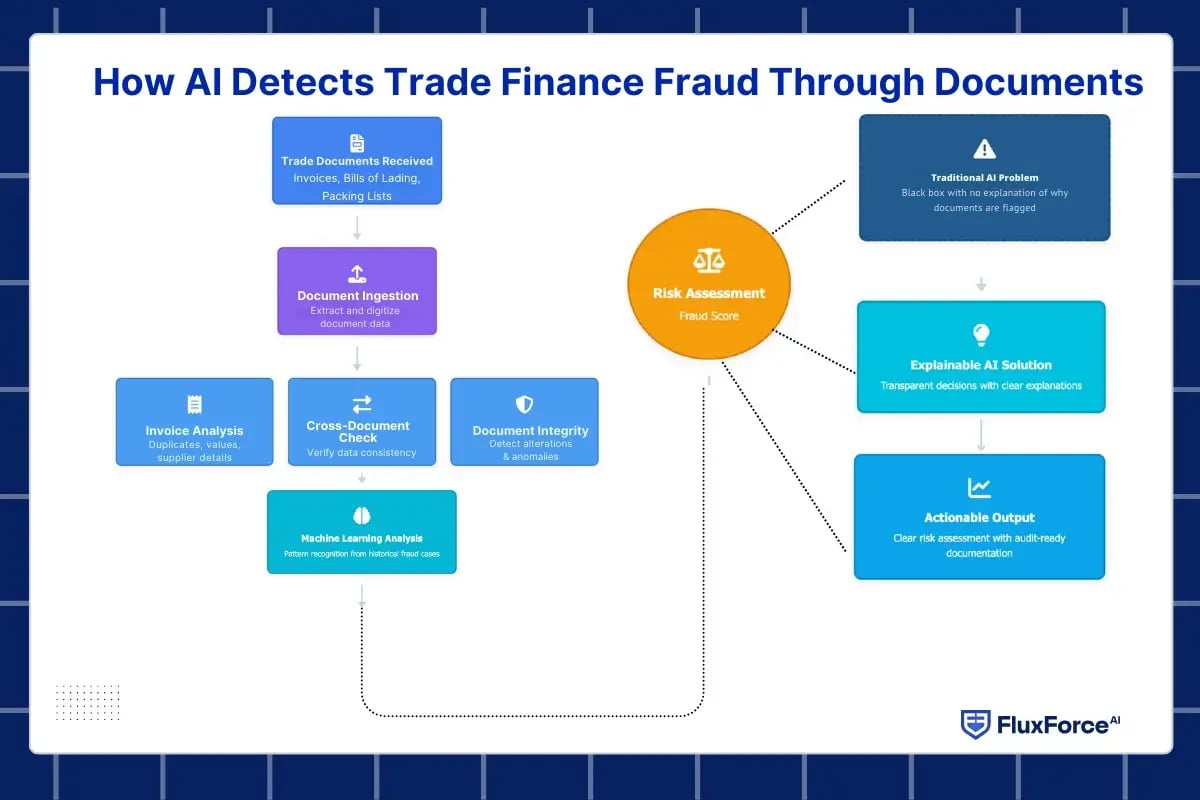
Where AI focuses in trade document fraud detection
AI models examine multiple document and transaction layers at once:
- Invoice fraud detection by identifying duplicate invoices, inflated values, or mismatched supplier details
- Cross-checking trade documents such as invoices, bills of lading, and packing lists for data inconsistencies
- Detecting altered metadata, reused templates, or unusual formatting patterns
- Linking documents to account behavior for stronger risk management in trade finance
- Which field triggered the alert?
- Was it the invoice value, vendor mismatch, or document alteration?
- Can this decision be justified during an audit?
This approach strengthens automated fraud detection systems by combining document intelligence with transaction context. It is especially effective in fraud detection in banking, where speed and accuracy directly impact compliance and customer trust.
Why traditional AI alone is not enough
While machine learning fraud detection models are powerful, they often operate as black boxes. A document may be flagged, but analysts are left asking:
This lack of clarity limits the adoption of AI in high-risk areas like AI in trade finance and AML fraud detection AI workflows.
That is where Explainable AI (XAI) becomes critical. It adds transparency to financial fraud detection using AI, ensuring that every flagged trade document comes with a clear and defensible explanation.

Explainable AI (XAI) for Financial Crime Detection in Trade Finance
Explainable AI for fraud detection addresses the operational gap that machine learning alone creates: the system flags a suspicious trade document, but the fraud team cannot see why, the compliance officer cannot defend the decision, and the auditor cannot trace the logic.
93% of fraud professionals believe AI will revolutionize fraud detection, according to Alloy's 2025 State of Fraud Benchmark Report. The adoption barrier is not technical performance. It is explainability. When a bank's compliance team cannot justify an AI-generated alert to a regulator or auditor, the alert loses operational value regardless of the model's accuracy.
How explainable AI works in trade document fraud detection
Explainable AI in banking compliance focuses on showing how and why a model reaches a conclusion. In AI-based trade document verification, XAI typically provides:
- Field-level explanations showing which invoice or shipping data triggered the alert.
- Clear feature importance, such as value mismatches, supplier risk history, or document reuse patterns.
- Human-readable reasoning that supports trade document verification and investigator review.
- Consistent explanations that can be stored as part of an audit trail.
- Why a document was flagged as suspicious
- How the model aligns with internal risk management in trade finance policies
- Whether controls exist to prevent biased or unexplained decisions
- Reused invoice templates across unrelated counterparties
- Value mismatches between invoices, letters of credit, and shipping documents
- Unusual shipment routes or timing anomalies
- Repeated amendments in trade documents close to settlement
- Which document fields contributed most to the alert
- How those fields deviated from historical or peer behavior
- Whether the risk came from document structure, content, or transaction history
- Why a trade transaction was flagged
- Whether automated decisions were fair and consistent
- How human reviewers validated or overrode AI outputs
This approach improves fraud detection in banking by reducing false positives while strengthening accountability.
Why Regulators and Auditors Require XAI in Trade Finance
Regulatory expectations for AI compliance in banking have shifted from outcome verification to decision traceability. Regulators no longer assess only whether a fraud detection system caught fraud — they assess whether the bank can demonstrate how the system reached each decision, whether that logic was consistent across similar cases, and whether human oversight was applied before final action.
For trade finance specifically, this creates three documentation requirements. Fraud teams must justify why a specific trade document was considered higher risk than comparable documents from the same counterparty. Compliance teams must demonstrate that automated fraud decisions followed documented risk policies. Auditors must be able to trace whether similar transactions across different regions or time periods received equivalent treatment under the same risk logic.
Without XAI, answering these questions requires reconstructing decision logic from archived model outputs — a process that takes days per inquiry and often produces approximations rather than the original reasoning. With XAI, explanation records are captured at the moment of each decision and retrieved directly when auditors request them.
How AI Detects Trade Finance Fraud: From Black-Box Scores to Explainable Decisions
Most AI fraud detection systems in trade finance rely on complex machine learning models to scan documents, transactions, and counterparty behavior. While these systems can flag risk, they often fail at the most important step for banks: explaining the decision.
In trade document fraud detection, a risk score alone is not actionable. Fraud teams need to know what triggered the alert and which document attributes contributed to the risk. This is where Explainable AI (XAI) becomes critical.
.webp?width=1200&height=800&name=explainable%20ai%20(xai).webp)
From Pattern Detection to Decision Rationale
Using machine learning for document fraud detection, AI models analyze patterns such as:
Traditional automated fraud detection systems flag these patterns but provide limited context. Explainable AI for fraud detection adds a transparency layer by attaching a decision rationale to each alert.
Instead of saying “high risk”, the system explains:
This approach enables fraud detection in banking teams to act faster and with confidence.
In fraud detection in banking, explainability is not optional. Regulators expect banks to demonstrate:
Explainable AI in banking compliance ensures every alert is supported by traceable evidence. Decision explanations can be stored alongside the case record, supporting audits, internal reviews, and regulatory examinations.
If a fraud analyst cannot explain the alert, the bank cannot defend it.
This is especially relevant for AI in trade finance, where cross-border transactions increase scrutiny and regulatory exposure.
Explainable AI for Trade Finance Audits and Regulatory Reviews
Trade finance fraud decisions that reach the audit stage face a specific evidentiary standard: regulators and auditors want to know not just what the AI system decided, but how it reached that decision, whether that reasoning was consistent across comparable transactions, and whether the bank had adequate human oversight before final action.
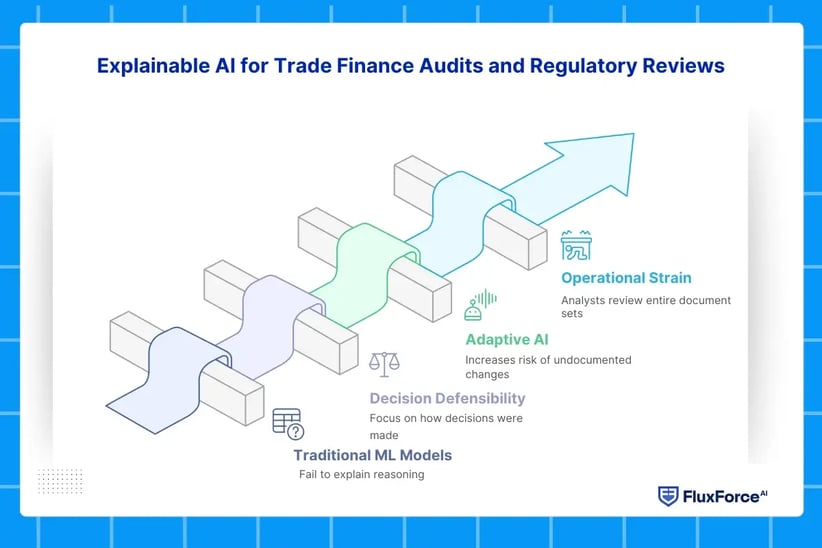
The Post-Decision Problem Banks Actually Face
Trade finance fraud decisions that reach the audit stage face a specific evidentiary standard: regulators and auditors want to know not just what the AI system decided, but how it reached that decision, whether that reasoning was consistent across comparable transactions, and whether the bank had adequate human oversight before final action.
The Post-Decision Problem Banks Actually Face
Regulatory examination of trade finance fraud controls focuses on three questions that black-box AI systems cannot answer directly.
Which specific document attributes were inconsistent, and how much did each attribute contribute to the risk assessment? How did those inconsistencies deviate from the behavior of similar counterparties in comparable transactions? Was human review applied before final action, and what information did the reviewer have access to?
Without XAI, answering these questions requires reconstructing decision logic from model archives — a process that produces approximations rather than the original reasoning the model applied. With XAI, explanation records are captured contemporaneously and retrieved directly when examiners request them.
As fraudsters use AI to generate synthetic documents and test system boundaries in real time, banks are forced to update detection models more frequently. Each update increases the risk of undocumented logic changes unless explainability is built into the system as a governance control.
Machine learning model validation for trade finance AI systems specifically requires XAI-generated feature attribution records — both for initial validation under SR 11-7's conceptual soundness requirement and for ongoing monitoring that detects when model logic drifts between formal review cycles.
Explainability as an Audit and Governance Control
XAI shifts transparency from a post-hoc documentation exercise to a built-in governance control. Each fraud detection decision generates a structured explanation record at the moment the decision is made — which document features contributed, how they deviated from historical behavior, and what the comparable transaction baseline looked like.
For trade document verification audits, this means compliance teams can reconstruct any fraud decision from the explanation record without contacting the data science team, without accessing model archives, and without reverse-engineering decision logic. The explanation is self-contained evidence.
This approach satisfies model transparency requirements under SR 11-7, EU AI Act Article 12 logging obligations, and the OCC's model risk management guidance for AI systems used in high-impact financial decisions — all from a single explanation record generated at decision time.
Reducing Operational and Regulatory Risk Simultaneously
XAI in trade finance audit preparation reduces operational strain alongside regulatory risk. Fraud analysts receive pre-structured evidence rather than investigating entire document sets blind. Investigation quality improves because analysts focus on the specific attributes the model identified as anomalous. False positive rates decrease because analysts can quickly evaluate whether the flagged attributes represent genuine risk or acceptable variation.
This operational efficiency compounds the regulatory benefit: fewer investigations, faster resolution, better documentation, and lower audit preparation costs — all from the same XAI infrastructure that satisfies regulatory explainability requirements. For organizations with AI risk management framework governance in place, trade finance XAI decisions integrate directly into the institution's model risk documentation structure.
Explainability as an Audit and Governance Control
Explainable AI for fraud detection shifts transparency from an afterthought to a built-in control. Instead of producing a single risk score, the system provides context around the decision. It clarifies how different document features, transactional behavior, and historical comparisons contributed to the outcome.
For trade document verification, this allows banks to reconstruct decisions during audits. Compliance teams can trace why an invoice was considered higher risk, how the model interpreted structural or behavioral anomalies, and whether the same logic would apply to similar transactions across regions or counterparties.
This level of model transparency supports AI compliance in banking by ensuring decisions are explainable, reviewable, and defensible over time. It also aligns with model risk management expectations, where consistency and traceability matter as much as detection capability.
Reducing Operational and Regulatory Risk at the Same Time
Explainability does more than satisfy regulators. It reduces operational strain. Fraud analysts no longer need to review entire document sets blindly. Instead, they can focus on the specific areas that influenced the model’s assessment, improving investigation quality and reducing false positives.
This directly reflects the shift highlighted in the references: from static rules to real-time behavioral understanding, without sacrificing governance. AI-powered fraud detection only scales safely when banks can see, monitor, and defend how decisions are made.
In trade finance, where document fraud, cross-border complexity, and regulatory scrutiny intersect, Explainable AI in banking compliance is no longer optional. It is the foundation that allows financial fraud detection using AI to operate at scale without creating new regulatory exposure.
Stop Fraud Before It Strikes
Detect and block suspicious activity in real time to prevent financial losses before they impact your business.
Conclusion
71% of financial organizations now identify professional crime rings as their primary fraud threat — and those crime rings specifically target the document complexity of trade finance because it creates the largest number of review gaps in traditional banking fraud prevention programs.
Explainable AI (XAI) brings accountability to fraud detection in banking by making decisions transparent, auditable, and defensible. It allows machine learning fraud detection systems to support investigators and compliance teams rather than replace their judgment.
For AI in trade finance, explainability is what turns automation into a controlled, regulator-ready capability. It reduces friction, improves confidence in alerts, and aligns financial fraud detection using AI with governance and compliance expectations.
As fraud evolves, explainable AI is no longer optional. It is becoming the minimum standard for trade document fraud detection in regulated banking environments.
Request a Demo to see how FluxForce.ai delivers explainable, enterprise-safe AI for trade finance fraud detection.
Share this article