.webp)







Listen to our podcast 🎧
Introduction
Payment failures have frustrated customers and businesses for years. Even with payment orchestration platforms in place, many global organisations still face disruptions due to different rules, security standards, and gateway behaviours.
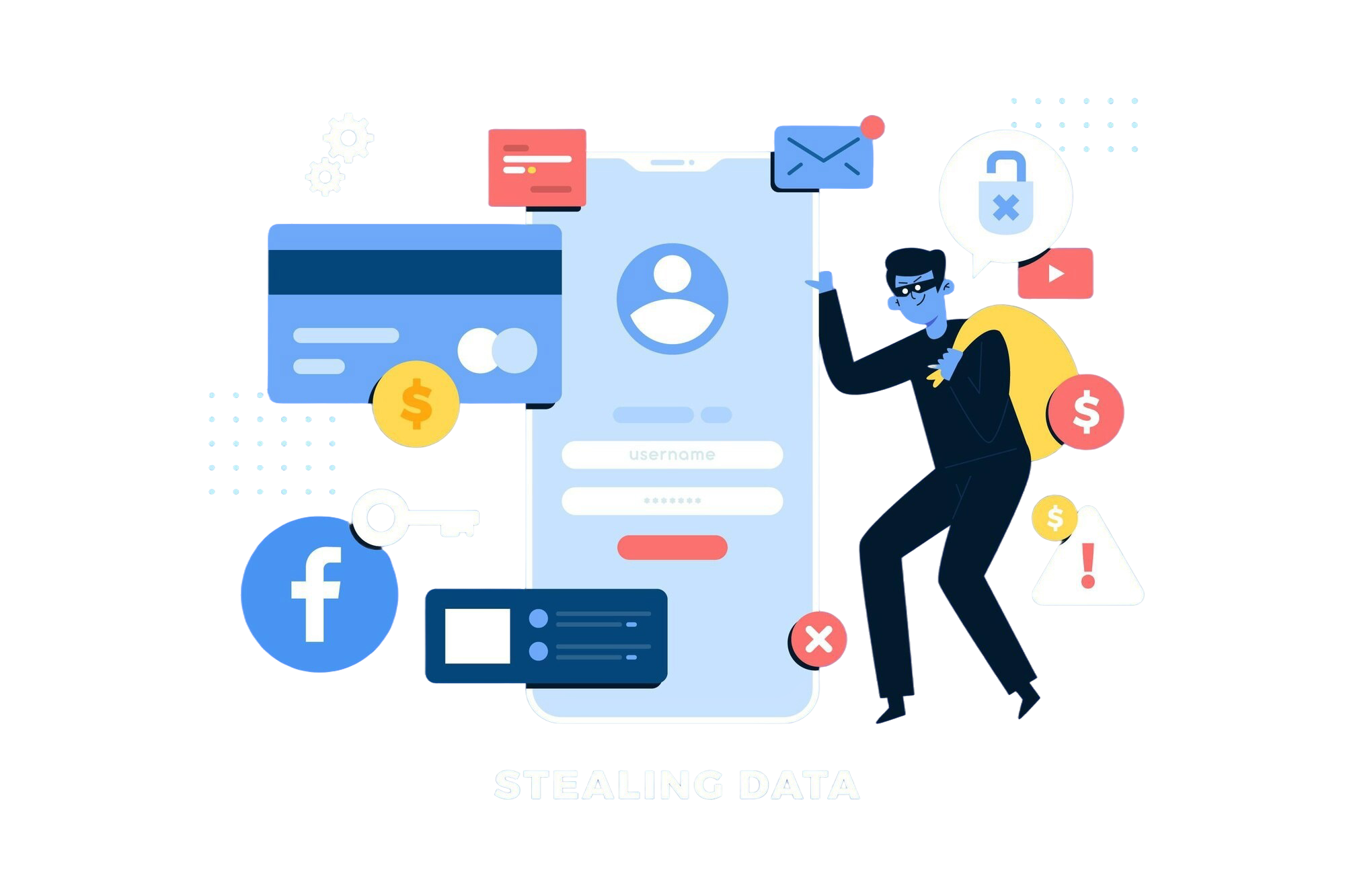
In 2024, multi-gateway environments reported a 32% rise in security risks, mostly driven by inconsistent authentication checks and weak routing controls. As transaction volumes grow and new gateways enter the payment stack, operations teams face more pressure to maintain stability while countering fraud.
This article offers clear steps for payments operations leaders to strengthen security across orchestrated payment workflows. It also explains how leaders can apply consistent controls, minimise failure points, and support seamless transactions across every market they serve.
Establishing Enterprise Payment Infrastructure as a Core Security Defence
Upgrading from outdated systems to cloud-based setup becomes the first line of defence for ensuring safe and seamless transactions. Organisations must invest in enterprise-grade infrastructure that:
- Scales Automatically– Auto-scaling cloud capacity helps teams handle higher transaction volumes without delays or failed requests.
- Supports Secure API Payment Integrations– Secure API gateways ensure proper authentication and encrypted data exchange for every payment request.
- Maintains Global Compliance– Compliance-ready controls help businesses meet PCI DSS, PSD2, and other regional security requirements with less effort.
- Strengthens Routing Reliability– Stable routing engines reduce payment errors and prevent disruptions caused by inconsistent gateway behaviour.
- Offers Unified Security Monitoring– Central dashboards give teams a clear view of unusual activity, fraud signals, and gateway-level issues in real time.
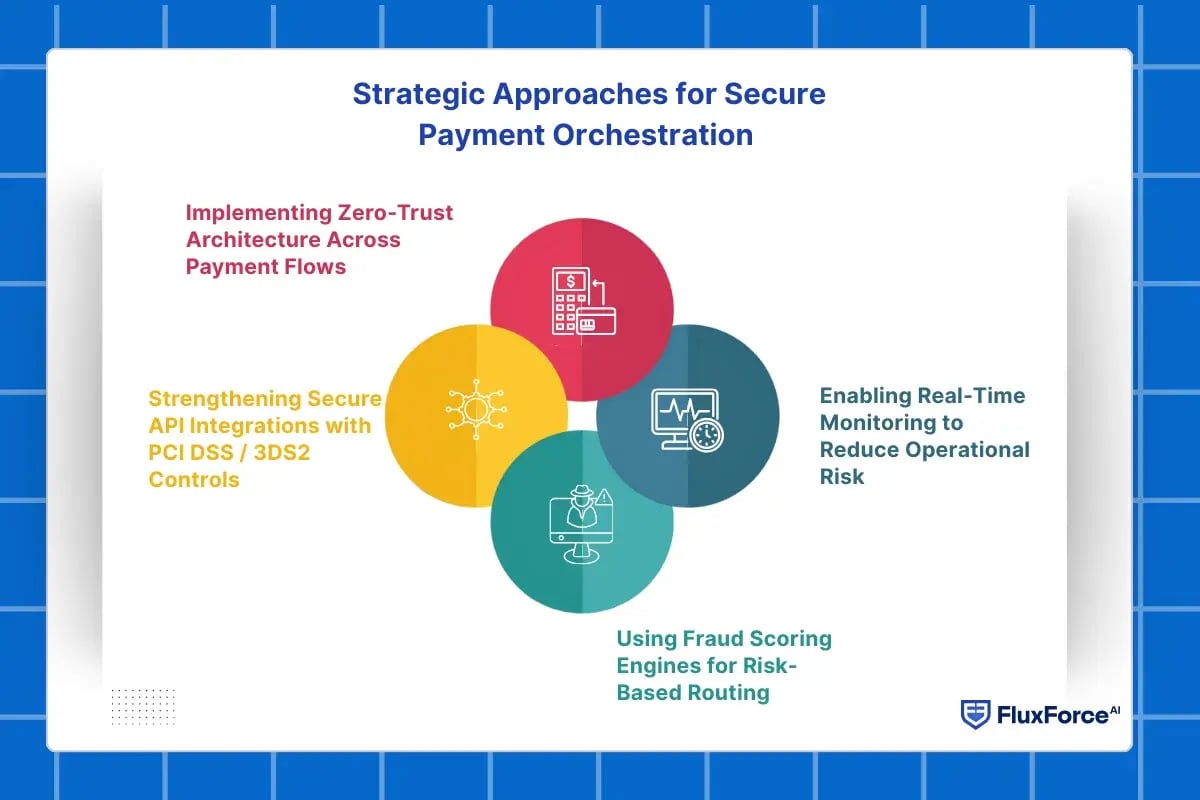
Strategic Approaches for Secure Payment Orchestration
A recent 2025 study found that 18.4% of fintech companies publicly reported breaches linked to digital payment workflows. Securing payment orchestration in a multi-gateway environment is now essential. The following approaches help global enterprises stay future-ready against evolving risks.
1. Implementing Zero-Trust Architecture Across Payment Flows
Zero-trust controls help ensure every gateway interaction is verified—either through multi-factor authentication, step-up verification, or strict policy checks. Strong verification reduces weak entry points across the payment stack and prevents unauthorised movement between interconnected payment services.
2. Strengthening Secure API Integrations with PCI DSS / 3DS2 Controls
Secure API structures help enforce consistent authentication, encrypted handshakes, and gateway-level verification. PCI DSS and 3DS2 controls support safer processing by reducing cardholder exposure, preventing data interception, and maintaining strong authentication across geographically distributed payment gateways.
3. Using Fraud Scoring Engines for Risk-Based Routing
Fraud scoring engines help classify each transaction using device signals, behavioural patterns, and velocity rules. Risk-based routing directs high-risk attempts through stronger verification paths and keeps low-risk transactions flowing efficiently, improving revenue protection and approval quality.
4. Enabling Real-Time Monitoring to Reduce Operational Risk
Real-time monitoring helps detect early shifts in routing patterns, authentication failures, unusual gateway responses, or sudden fraud spikes. Faster detection supports quick intervention, stabilises payment performance, and limits disruptions across multi-gateway orchestration environments.
Strengthening Multi-Gateway Security Through AI and Adaptive Threat Prevention
For operational leaders, the challenge of ensuring security across multiple payment gateways and Payment Service Providers (PSPs) continually increases. In this context, AI supports unified protection by applying the same security logic, controls, and responses even when individual gateways behave differently.
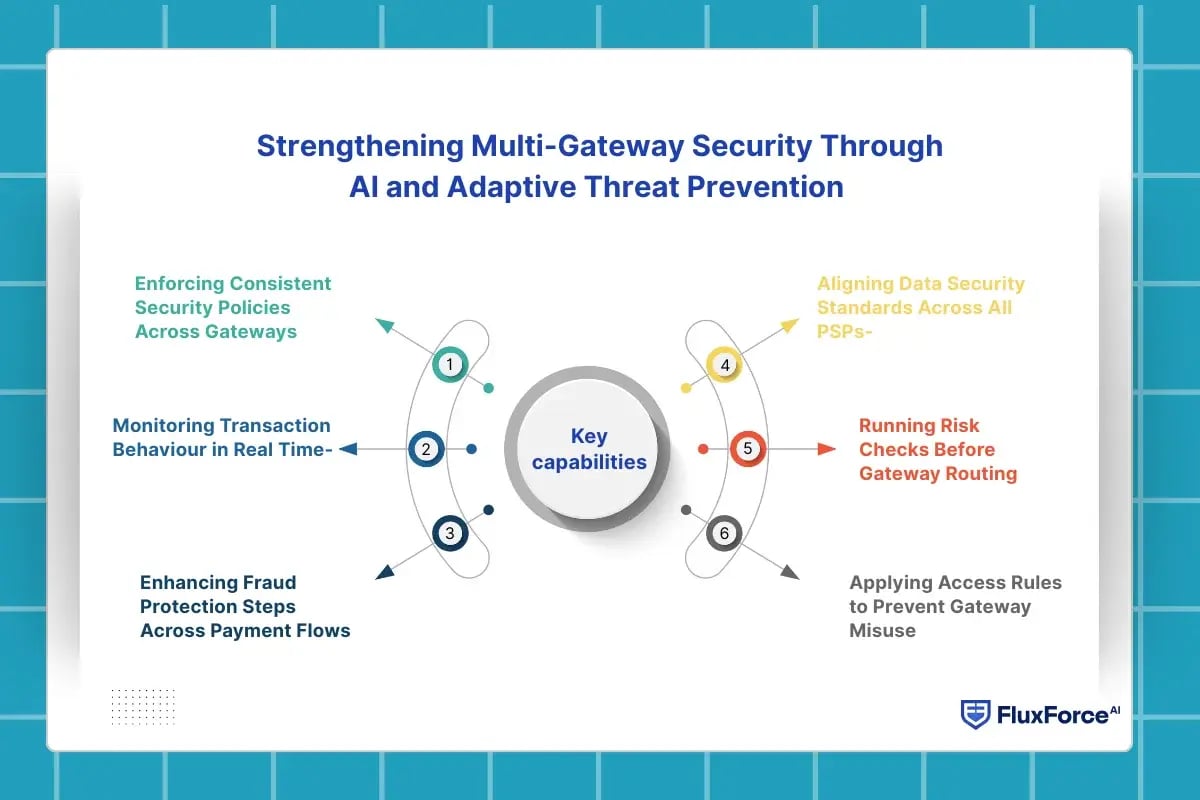
Key capabilities include:
1. Enforcing Consistent Security Policies Across Gateways- AI enforces stable security policies across Razorpay, PayPal, Stripe, and other PSPs by understanding each gateway’s authentication flow. Uniform enforcement closes policy gaps, prevents uneven protection levels, and helps teams maintain a reliable security posture across all payment routes.
2. Monitoring Transaction Behaviour in Real Time- AI monitors transaction behaviour across Stripe, Adyen, and Razorpay through continuous pattern analysis. Early detection of unusual routing, inconsistent response codes, or unexpected spikes provides faster intervention opportunities and greater operational control across every connected PSP.
3. Enhancing Fraud Protection Steps Across Payment Flows- AI evaluates velocity patterns, device activity, and behavioural signals before directing transactions to the gateway. Stronger fraud protection steps support safer routing decisions and create a balanced approach that controls risk without disrupting approval performance.
4. Aligning Data Security Standards Across All PSPs- AI reviews data protection methods across gateways and identifies outdated or weaker encryption practices. Automated alignment of standards across providers supports stronger compliance and reduces exposure within distributed payment environments.
5. Running Risk Checks Before Gateway Routing- AI performs risk checks using transaction history, spending behaviour, IP consistency, and value thresholds. Higher-risk payment attempts move through more secure routing paths, reducing unnecessary exposure across multi-gateway structures and strengthening enterprise control.
6. Applying Access Rules to Prevent Gateway Misuse- AI tracks access patterns across API keys, user actions, and internal service calls. Irregular activity across gateways triggers stricter access rules, preventing misuse and maintaining a controlled and secure operational environment across every payment integration.
How Payment Orchestration Platforms Ensure Operational Resilience ?
A secure payment orchestration platform can deliver many benefits for enterprise payment teams, these include:
- Minimising Single Points of Failure: AI-assisted orchestration reroutes transactions across Razorpay, PayPal, or Stripe during outages, keeping payments flowing without interruption.
- Improving Routing Efficiency Across Markets: Integrated monitoring evaluates gateway performance and routes transactions through the most reliable providers, optimising approvals and reducing failures.
- Supporting Quick Failover During Gateway Disruptions: Automatic failover detects errors or delays and redirects traffic to alternative gateways, maintaining uninterrupted transaction processing.
- Maintaining Consistent Security Controls Across PSPs: Centralised orchestration applies uniform authentication and encryption across all gateways, ensuring compliance and reducing security gaps.
- Providing Unified Visibility for Operations Teams: Dashboards consolidate multi-gateway data and highlight anomalies, enabling teams to act quickly and maintain smooth operations.
- Scaling Payment Operations Without Resource Stress: Cloud-based orchestration automatically adjusts capacity as volumes rise, ensuring stable processing during peak traffic or seasonal spikes.
Proactive Leadership Practices for Payment Operations Leaders

Ensuring Continuous Monitoring
Leaders must implement 24/7 monitoring across gateways such as Razorpay, PayPal, Stripe, and Adyen. Continuous oversight detects anomalies early, prevents high-value transaction failures, and reduces operational downtime—proving that proactive vigilance directly improves reliability.
Promoting Cross-Team Coordination
Strong coordination between payment, security, and compliance teams ensures rapid response to emerging threats. Companies with integrated teams report faster resolution times and fewer payment disruptions, demonstrating that collaboration is a measurable driver of operational resilience.
Building Scalable Processes
Establishing workflows that adapt to increasing transaction volumes and new PSPs prevents bottlenecks. Scalable routing, onboarding, and compliance processes reduce errors, proving that forward-thinking structures maintain efficiency as operations grow.
Establishing Clear Risk Management Protocols
Defining and enforcing risk protocols allows teams to assess fraud, gateway errors, and compliance gaps systematically. Organisations with documented risk frameworks experience fewer breaches and faster recovery, showing the value of structured risk oversight.
Reviewing and Improving Processes Regularly
Regular reviews, feedback loops, and AI-driven insights help refine workflows and strengthen security measures. Leaders who prioritise ongoing improvement see measurable reductions in failures and fraud, proving that iteration is critical for payment operations excellence.
Introducing FluxForce AI Modules as a Security Framework
FluxForce provides pre-built, enterprise-ready AI modules that enable robust security payment orchestration. With seamless integration across payment operations, the modules deliver immediate results, reducing fraud and maintaining stable multi-gateway workflows without complex configuration or setup.

Key Features of FluxForce AI Modules
- Enforcing Zero-Trust Security: Validates every transaction and access point across all gateways.
- Fraud Risk Scoring Engines: Detects suspicious activity with 99.2% accuracy in real time.
- Real-Time Monitoring: Tracks transactions, routing, and anomalies across varied payment gateways, such as: Razorpay, PayPal, Stripe.
- Adaptive Threat Prevention: Adjusts security rules automatically to evolving fraud patterns.
- Policy Compliance Checks: Ensures PCI DSS, 3DS2, and regional standards are always applied.
Conclusion
Nearly 63% of customers worry about cyber fraud when shopping online, and 44% of e-commerce shoppers have experienced payment fraud. This makes payment orchestration security critical for safe and seamless transactions. Operations leaders must adopt strategies to reduce fraud risk, simplify payment gateway management, and ensure compliance.
Implementing a centralized payment orchestration layer with secure protocols and real-time monitoring allows teams to protect customer data effectively while maintaining operational efficiency.
By prioritizing these measures, businesses can build customer trust, minimize financial risk, and deliver a reliable, secure online payment experience that supports long-term growth.

Share this article