.webp)








Listen to our podcast 🎧
.jpeg)
Introduction
AI screens customers, flags unusual activity, and influences credit decisions across financial systems. It is basically making most of the financial decisions. The speed is quite impressive, yet something important is slipping out of sight. As AI in finance and AI/ML models grow more complex, their decision logic becomes harder to interpret. A system may decline a loan or clear a risky transaction, but the logic sits inside a black box AI in finance that teams cannot interpret.
In regulated industries, lack of clarity becomes a significant concern. It weakens trust, complicates audits. It even puts compliance teams in difficult situations.
That is why explainability in financial AI is no longer optional. Regulators expect institutions to show how their financial AI models think and why they act the way they do. This rise in AI governance in finance is shaping new expectations around fairness, oversight and accountability. This is the real risk behind non explainable AI. Institutions gain speed and scale, yet hidden weaknesses stay buried until something breaks. The danger affects operations, regulatory alignment, and reputation at the same time. This is why the industry is now rethinking how explainable AI in finance should be designed and governed.
Discover the hidden risks of non-explainable AI in finance
Improves trust and compliance with FluxForce AI’s insights.

Where Non-Explainable AI Quietly Creates Risk ?
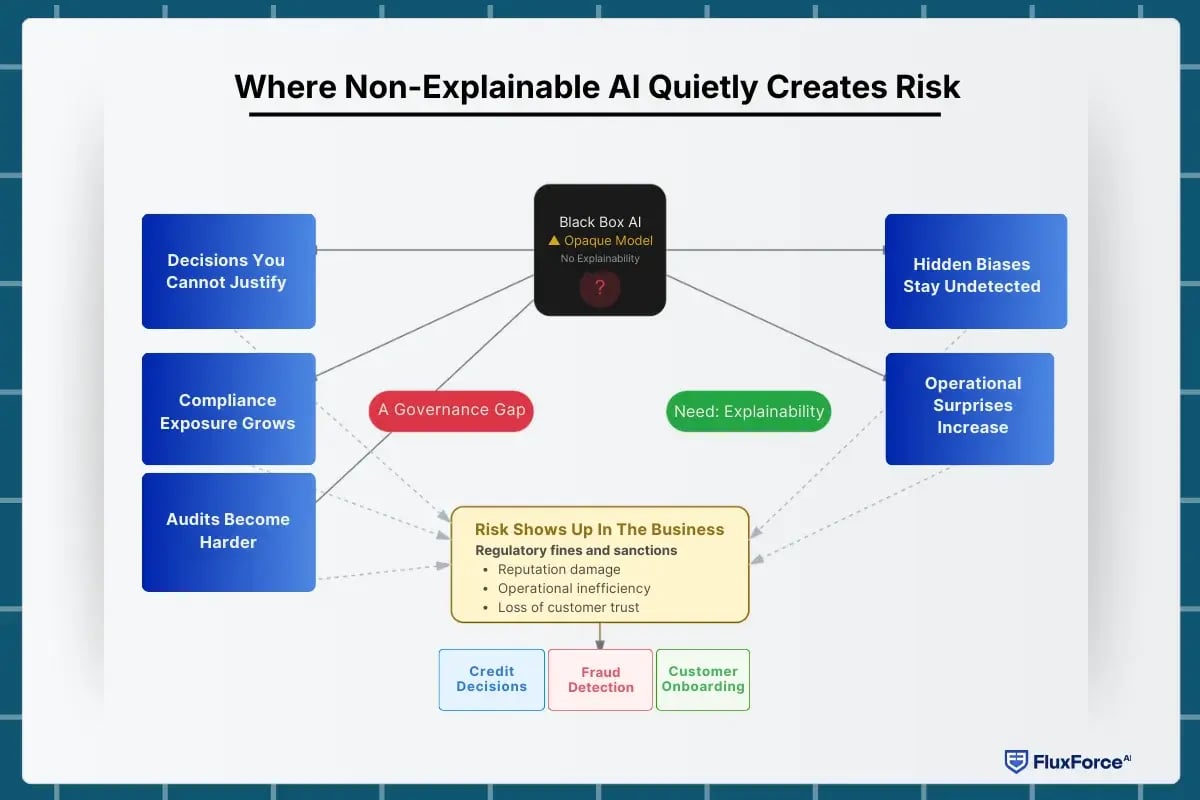
Financial institutions use AI and ML to make decisions at scale. The challenge is that when these systems work as black boxes, risk does not show up in the model. It shows up in the business.
1. Decisions You Cannot Justify
A loan rejection or a flagged transaction is only part of the story. Regulators expect institutions to explain why. Without explainability in financial AI, teams cannot prove fairness or accuracy. The risk is not just the decision itself. It is the inability to defend it.
2. Compliance Exposure Grows Fast
Opaque AI models increase regulatory pressure. Supervisors now demand clear AI governance in finance that shows why a model acted as it did. If an institution cannot explain a financial AI model, it is treated as a compliance gap.
3. Audits Become Harder
Internal audit teams need evidence: timestamps, risk scores, matched attributes, and decision paths. Financial AI model risks multiply when systems cannot provide this. A model may detect the issue correctly, but without proof of its reasoning, audits slow down and questions rise.
4. Hidden Biases Stay Undetected
When a system’s logic is invisible, biases go unnoticed. Hidden biases in AI models can affect decisions in credit, fraud, or onboarding. Performance may look strong, but fairness and accountability are at stake until explainable AI mechanisms reveal them.
5. Operational Surprises Increase
Opaque AI can work today and fail tomorrow. Without AI transparency in banking, teams cannot trace errors. This puts pressure on underwriting, fraud, and compliance units that rely on consistent, verifiable logic.
Compliance and the Rising Demand for Explainable AI
Consider a regulator asking why a bank approved a high-risk loan. The model gave a green signal, but the decision path is hidden. If your team cannot explain it, the answer “That’s what the AI predicted” is not enough.
This is where explainable AI in finance becomes critical. Regulators expect institutions to demonstrate AI transparency in banking. They want to see the logic, the rules applied, and the data that drove each decision. Without this, a bank faces fines, audits, or reputational damage. Global frameworks are tightening. The EU AI Act sets clear standards for high-risk AI systems in financial services, where every financial AI model must be traceable, auditable, and defensible.
Lack of explainability also affects daily operations. Teams need to know why fraud alerts were triggered, why credit scoring flagged a client, or why onboarding was denied. Without visibility, auditors see gaps, and compliance teams struggle to respond. In short, regulators are signaling that non explainable AI risks are not theoretical. They are measurable, enforceable, and expensive. Banks and fintechs cannot rely on model output alone. They need audit-ready AI, where every decision is backed by model interpretability and data lineage.
Explainable AI is a compliance requirement, a risk management tool, and a foundation for trust in the financial system.
The Business and Financial Risks of Black-Box AI
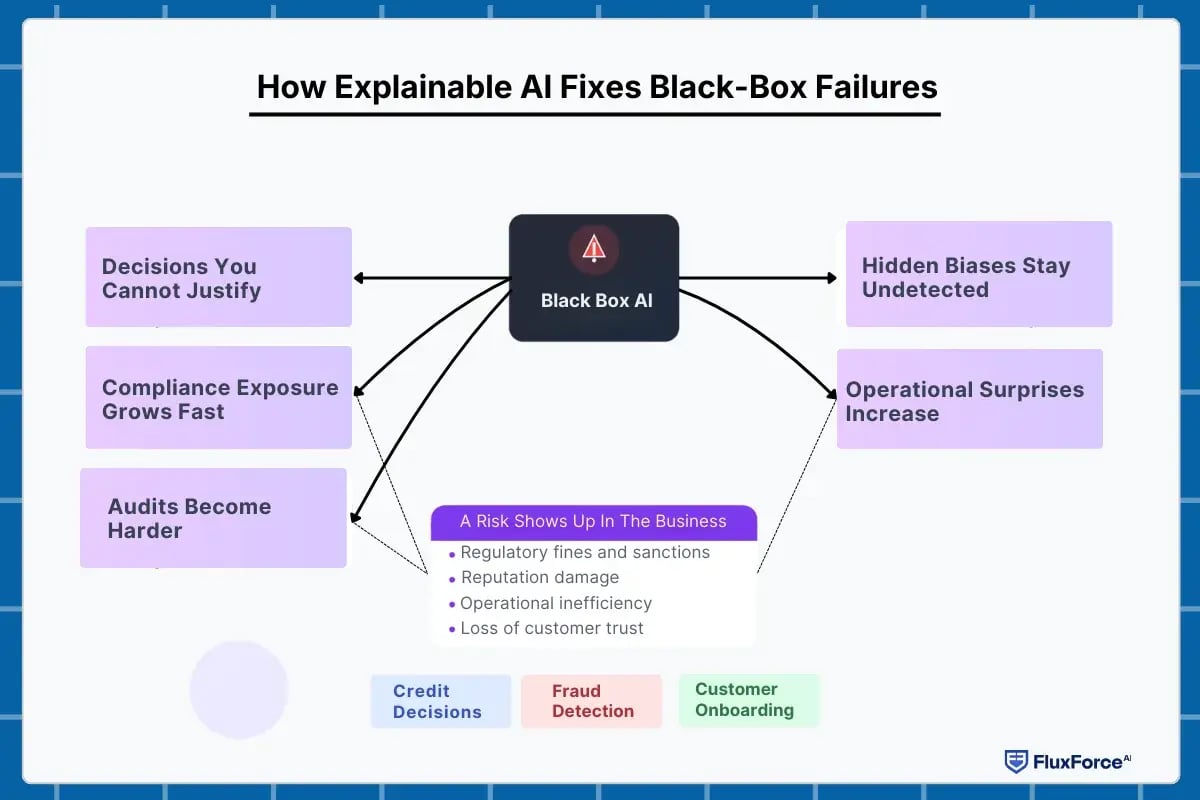
Financial institutions adopt AI and ML to make faster decisions and scale operations. But when models operate as black boxes, hidden risks quietly accumulate—affecting profits, strategy, and reputation.
1. Financial Exposure You Cannot See
Small misclassifications in credit approval, fraud detection, or onboarding may seem minor individually. Over time, these errors can accumulate into significant losses. Without explainable AI in finance, institutions cannot trace the causes, leaving financial exposure invisible until it becomes critical.
2. Strategic Blind Spots
AI models often inform portfolio management, pricing, or investment strategies. If executives cannot explain why a system makes certain recommendations, decisions may lack justification. Hidden model biases or misclassifications can misguide strategic planning, creating long-term business risk.
3. Regulatory Penalties and Compliance Costs
Opaque models increase the likelihood of regulatory fines. Supervisors now expect AI transparency in banking, and non explainable AI risks can result in penalties, compliance investigations, or restrictions before organizations even recognize the problem.
4. Reputation and Trust Erosion
Customers, partners, and stakeholders expect fairness and accountability. Every unexplained AI decision chips away at confidence. Trust, once broken, is slow and expensive to rebuild, impacting customer retention, partnerships, and market perception.
5. Hidden Biases with Business Impact
Biases in AI models do not just affect operations—they can skew customer outcomes, product pricing, or lending strategies. Undetected, these biases create financial and reputational risks that silently accumulate over time.
What Financial Leaders Should Watch for in Hidden AI Risks ?
If you are a bank executive, compliance officer, or fintech leader, understanding hidden risks in non-explainable AI is crucial. These risks often remain invisible until they create financial, operational, or reputational damage.
1. Daily Decisions with Hidden Consequences
AI may approve loans, flag fraud, or prioritize alerts without clear reasoning. Without explainable AI in finance, you cannot trace why certain decisions were made. This can quietly expose your institution to misclassifications, missed fraud, or financial losses.
2. Regulatory Blind Spots
Regulators expect AI transparency in banking. Non explainable AI risks can trigger fines, audits, or compliance interventions before your team even realizes there’s an issue. Institutions need audit-ready AI models with traceable decision paths to avoid costly regulatory gaps.
3. Operational Stress You Cannot See
Teams may face alert overload, misprioritized tasks, or inefficiencies without knowing which signals are real risks. Hidden operational stress slows response times and increases the chance of errors, affecting both compliance and business performance.
4. Hidden Biases and Inequities
Your AI may unintentionally treat some customer segments differently. Without model interpretability, these biases stay invisible, potentially leading to compliance violations, unfair lending decisions, or customer dissatisfaction.
5. Financial Exposure that Builds Silently
Even small errors in credit, fraud, or onboarding can accumulate. Non explainable AI risks quietly grow into significant financial exposure, affecting profitability, strategic planning, and risk management.
Actionable Takeaways for Leaders
To protect your institution:
- Implement explainable AI in finance for all high-risk models.
- Ensure AI models are audit-ready with clear decision paths and data lineage.
- Regularly monitor for hidden biases in AI models.
- Train teams to understand AI outputs and intervene when necessary.
How to Tackle Hidden AI Risks in Finance ?
If you work in banking, fintech, or insurance, you may ask yourself: how can I prevent hidden risks while still getting the benefits of AI? Non-explainable AI can quietly create financial, operational, and regulatory problems, but there are clear ways to reduce them. 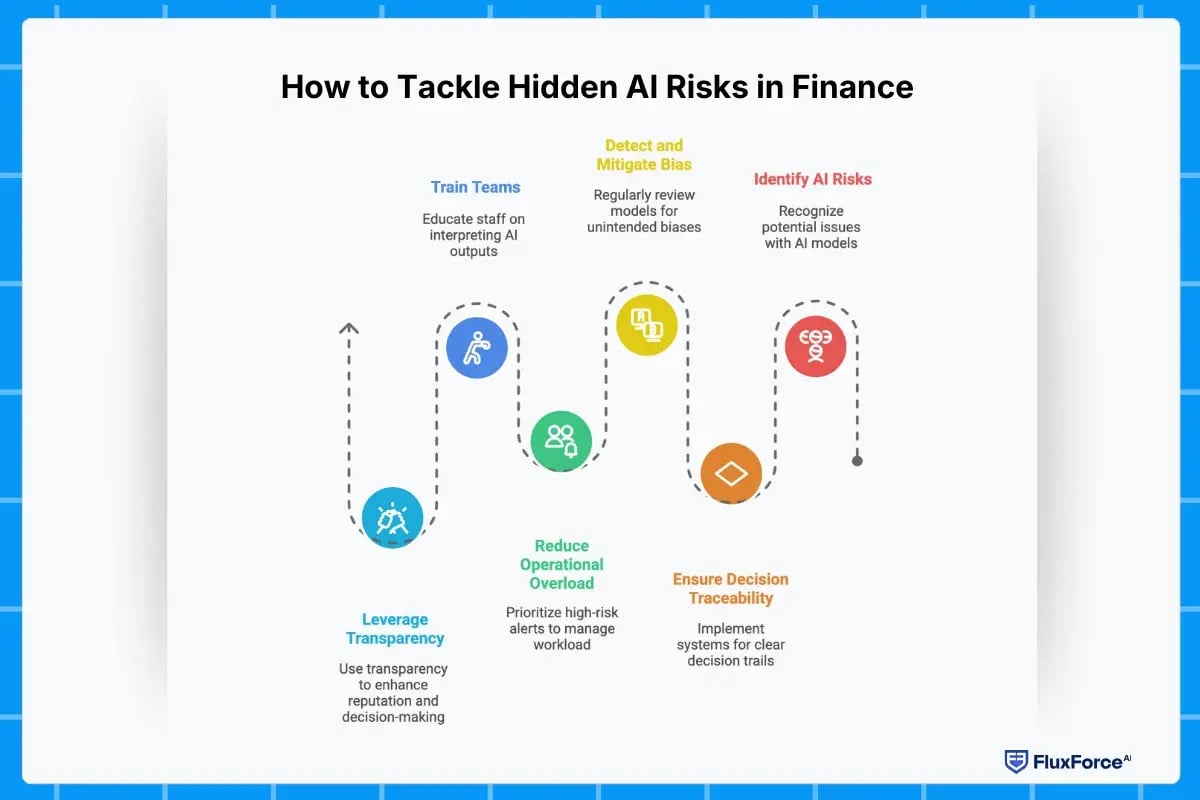
1. Make Every Decision Traceable
The biggest problem arises when a model gives a yes or no answer but no one knows why. High-risk decisions, like loan approvals or fraud alerts, must be fully traceable. Using explainable AI in finance ensures every output is backed by clear reasoning, data sources, and decision steps. This keeps your institution audit-ready and compliant.
2. Spot Bias Before It Hits
Hidden biases can silently affect outcomes. AI models may unintentionally favor certain customers or regions. Regular review of financial AI models can reveal these biases before they create complaints, regulatory penalties, or financial losses. Explainable AI is the most effective way to uncover them.
3. Reduce Operational Overload
AI can produce thousands of alerts, which can overwhelm teams. The key is to provide AI transparency in banking and prioritize high-risk alerts. This allows analysts to focus on the most important cases, reduces operational stress, and prevents critical risks from being missed.
4. Train Teams to Read AI Outputs
Even the most explainable AI needs human oversight. Teams must learn to interpret model outputs, verify reasoning, and escalate issues when necessary. Proper training ensures that hidden risks do not translate into real business losses.
5. Turn Transparency into a Business Advantage
Institutions that embrace explainability gain more than compliance. Customers and regulators see that decisions are fair, auditable, and backed by evidence. Transparency strengthens reputation and enables better internal decision-making.
Discover the hidden risks of non-explainable AI in finance
Improves trust and compliance with FluxForce AI’s insights.
Conclusion
AI in finance can silently create hidden biases, misclassifications, and compliance gaps. Non-explainable AI may speed up decisions, but without traceable reasoning, it exposes institutions to regulatory scrutiny and operational failures. Explainable AI and model transparency make every credit, fraud, or onboarding decision auditable and risk controlled.
FluxForce’s “The Future of Financial AI: Transparent, Auditable, Explainable” shows why transparency and governance are becoming essential in financial AI.

Share this article