.webp)








Listen To Our Podcast🎧
.png)
Introduction
Just 12.2% of financial institutions describe their AI or machine learning strategy as well-defined and resourced, according to Wolters Kluwer's Q1 2026 Banking Compliance AI Trend Report. Explainability and transparency ranked as the most acute regulatory concern among surveyed banks, cited by 28.4% of respondents. The gap between rapid AI adoption and the governance infrastructure needed to support it is now the central challenge for banks and fintechs operating under regulatory scrutiny.
AI governance in financial services has moved from advisory principle to enforcement expectation. The OCC, Federal Reserve, and CFPB have consistently emphasized that explainability and transparency are not merely architectural preferences. They are compliance requirements, particularly when AI systems influence credit decisions or customer outcomes subject to fair lending laws, according to Wolters Kluwer's 2026 analysis of the US regulatory landscape.
Banks now use AI in financial services for credit approvals, fraud monitoring, and compliance screening. These systems process decisions at a pace and volume no human team could match. The accountability question that follows is just as large: who can explain why a specific model produced a specific outcome for a specific customer, and can that explanation survive a regulatory review months later?
This blog examines how AI governance, explainable AI in finance, and a reliable AI audit trail combine to make financial AI systems defensible, not just capable.
The conversation has moved from innovation to accountability. Leaders want explainable AI in finance that supports human judgment rather than replacing it. A 2025 KPMG survey of over 90 US board members found that 70% have developed responsible AI use policies for employees, with implementing a recognized AI risk and governance framework among the most popular oversight initiatives.
This blog covers how institutions can build AI governance frameworks, maintain an AI audit trail, and deploy trustworthy AI in banking that regulators can examine without needing a data science degree to do it.
AI Governance and Explainable AI in Finance: Why Transparency Now Defines Regulatory Acceptance
The shift toward AI in financial services has improved speed and efficiency, yet it has also created a new challenge. Many AI systems provide results without clear reasons. 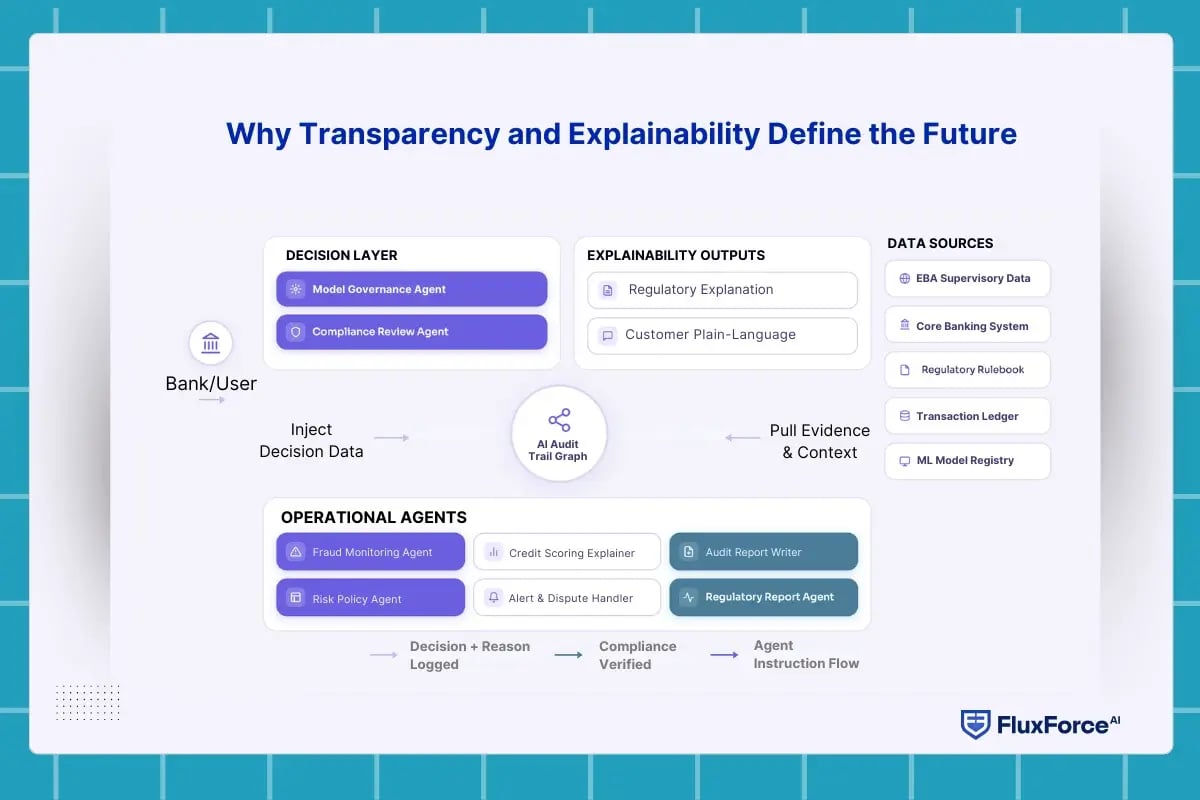 This gap between decision and explanation creates risk for banks that must justify every action to regulators and customers.
Explainability as a regulatory need
Regulators now expect institutions to demonstrate how a model reached a conclusion, especially in credit scoring and fraud monitoring. A deeper breakdown of how this works in practice is explained in explainable AI in finance, especially in credit scoring and fraud monitoring. The pace of AI innovation is increasingly outstripping regulatory capacity, with regulators adopting a sliding-scale approach where the level of oversight correlates directly with the risk and sensitivity of each AI use case, according to RGP's 2025 AI in Financial Services analysis. For credit approvals, fraud detection, and compliance screening, that oversight level is at its highest.
Banks need systems that support AI for regulatory compliance and provide a reliable AI audit trail. When a decision can be traced step by step, compliance teams can respond to investigations with confidence. Accurate models that can't be explained still fail internal reviews, because regulators don't evaluate performance in isolation. They evaluate control.
Business value of clear AI
Transparency also improves daily operations. AI transparency helps risk teams connect automated outputs with business policies. It supports AI governance by turning model behaviour into visible evidence. This approach strengthens AI model governance and reduces uncertainty between technical and non technical teams.
The benefits of transparent AI in banking include faster approvals, fewer disputes, and better collaboration. Institutions that adopt trustworthy AI find it easier to align innovation with control. A practical question remains for many leaders. Can our current systems explain a decision in language that a customer and a regulator both understand?
Choosing the right approach
Banks now face a choice between speed and clarity. Black box tools may appear attractive, but they often conflict with AI governance best practices in financestrong>. Controlled systems that support AI compliance solutions and AI model monitoring offer a safer path. The direction taken today will shape the future of AI in finance for years.
AI Risk Management and Governance Frameworks: Implementing Explainable AI in Banking Operations
Banks now see that explainability must connect with daily discipline. The future of AI in finance will not be decided by clever models alone, but by how safely those models operate inside real institutions. When AI decisions affect customers, banks need clear control rather than technical promises.
Ensuring Decision Accountability for Risk Teams
Explainable systems must work within an AI governance framework. Governance defines who approves a model, how changes are reviewed, and how outcomes are checked. Without this structure, AI in financial services becomes difficult to defend during audits and investigations.
Clear reasoning supports AI accountability. Risk officers need to see why a fraud alert appeared. Compliance teams must understand how a risk score was created. This connection between logic and action makes explainable AI in finance useful for everyday banking instead of only for data teams.
Continuous Monitoring to Prevent Operational Risk
Markets and customer behaviour change quickly. For this reason, AI risk management cannot be a one-time exercise. Regular AI model monitoring keeps systems aligned with policy and prevents outdated logic from guiding new decisions. Controlled reviews ensure that AI remains reliable.
A detailed AI audit trail is the backbone of this process. It records data sources, rule updates, and human approvals so any decision can be traced when questions arise. More than 50% of fraud now involves artificial intelligence, including deepfakes and synthetic identities, according to Wolters Kluwer's 2026 banking analysis, reinforcing why continuous model monitoring and a defensible audit trail have become operational necessities rather than governance aspirations. Institutions increasingly treat AI auditability in financial institutions with the same seriousness as financial records.
Collaboration Across Teams for Compliance Confidence
The success of AI in banking depends on cooperation between departments. Data specialists, compliance officers, and operations teams must read the same explanations. Transparent processes reduce confusion and support practical AI compliance solutions. When everyone understands how a model works, trust in AI grows.
Strong governance turns innovation into a stable operating model and prepares banks for AI for regulatory compliance. This link between explainability and control will define the future of AI in finance.
AI for Regulatory Compliance: What Banks Must Demonstrate to Regulators Today
Banks face increasing scrutiny from regulators when deploying AI in core processes.
The future of AI in finance depends not only on model performance but also on how well institutions demonstrate compliance and traceability.
Aligning AI with Regulatory Expectations
Financial regulators expect banks to show exactly how AI decisions are made. SR 11-7 set the standard: explainability, model governance, and validation. The EU AI Act and regulators worldwide are now building on the same foundation.
Explainable AI is what makes those requirements satisfiable in practice. When a credit approval, fraud alert, or risk score is generated, regulators want reasoning tied to specific inputs and model logic. An unexplained decision isn't just an audit risk. It's evidence of a governance gap that regulators treat as a structural control failure.
Building Practical Compliance Measures
AI compliance solutions now focus on embedding transparency into workflows. For example, AI audit trails capture inputs, outputs, assumptions, and human approvals, allowing banks to answer questions from auditors and supervisors quickly. This also supports AI risk management, ensuring models remain aligned with regulatory requirements over time.
Integrating compliance into operations requires collaboration. Data teams, risk managers, and compliance officers must work together to maintain clear AI model governance, ensuring that the future of AI in finance is not just innovative but also defensible.
Responsible AI in Finance: Bias Detection, Ethical Practices, and Trustworthy AI Systems
The CFPB released guidance in 2023 specifically describing how lenders using AI for credit decisions must provide specific and accurate reasons when taking adverse actions against consumers, creating a direct legal obligation tied to AI explainability in lending, according to Brookings' September 2025 testimony before the House Financial Services Subcommittee. Banks that can't explain how a model's outputs affect different demographic groups don't just face reputational risk. They face enforcement. 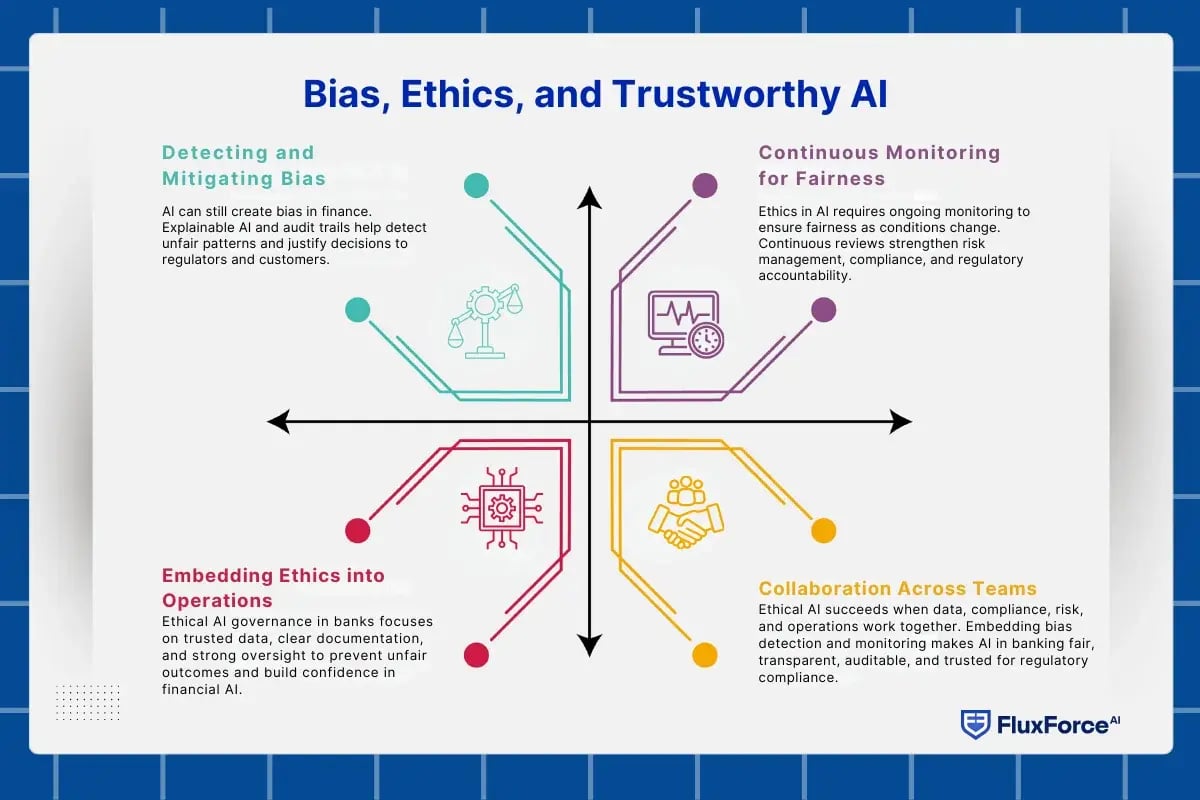
Detecting and Mitigating Bias
Even well-designed AI models can unintentionally create bias in credit scoring, fraud detection, or AML monitoring. Explainable AI in finance helps identify patterns that may disadvantage certain groups, ensuring decisions can be reviewed and corrected. Detailed AI audit trails provide a record of data sources, assumptions, and human approvals, making it easier to explain decisions to regulators or customers.
Embedding Ethics into Operations
Ethical practices are central to AI governance. Banks are increasingly adopting trustworthy AI principles, including validating data sources, documenting assumptions, and maintaining AI model governance. These measures help prevent unfair outcomes and build confidence in AI in financial services.
Continuous Monitoring for Fairness
Ethics is not a one-time exercise. AI model monitoring ensures that models continue to operate fairly as market conditions and customer behavior change. Continuous reviews support AI risk management and strengthen AI compliance solutions, making it easier to defend decisions to regulators and auditors.
Collaboration Across Teams
The success of ethical AI depends on collaboration between data teams, compliance, risk, and operations. When teams share understanding, explainable AI in finance becomes actionable, not just theoretical, creating trust and reducing operational risk.
By embedding bias detection, ethical principles, and monitoring into operations, banks can implement AI for regulatory compliance while building a foundation for the future of AI in finance that is fair, transparent, and auditable.
AI in Financial Services at Scale: Transparency and Model Governance
Implementing AI in financial services is more than deploying models—it is about embedding AI into daily banking operations while ensuring transparency, explainability, and compliance.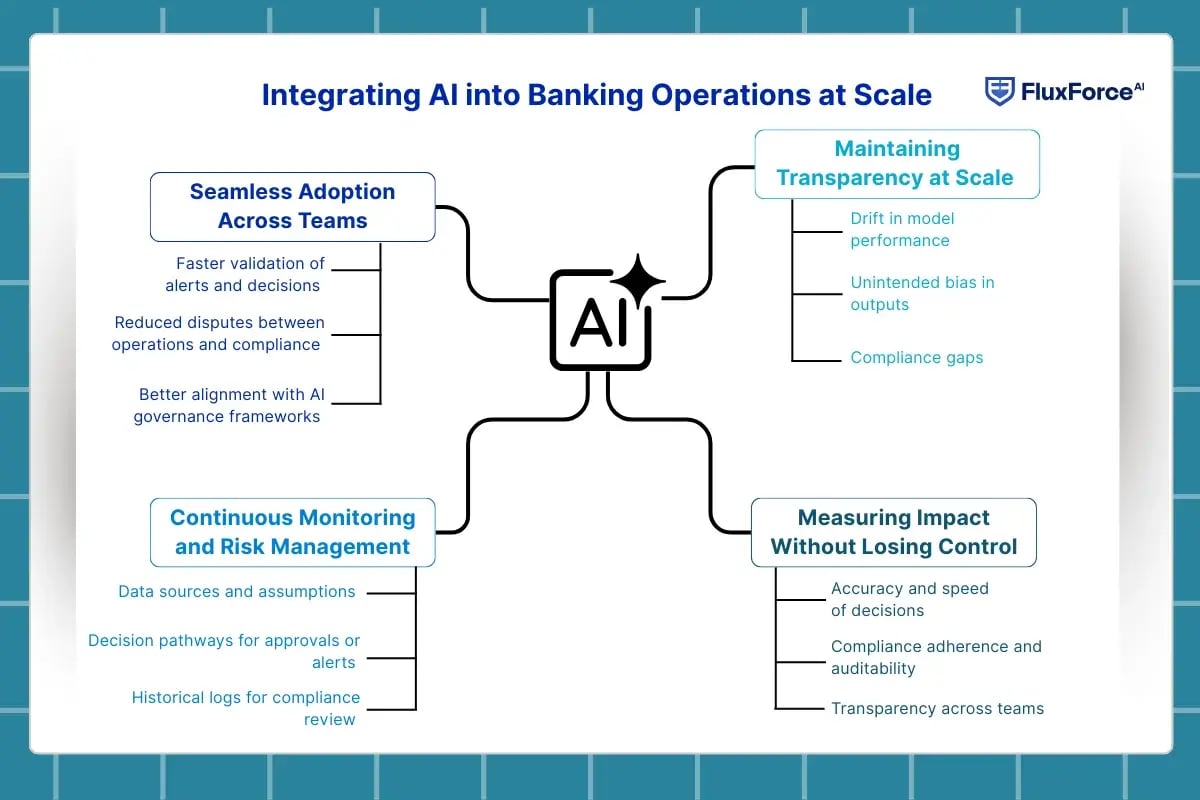
The future of AI in finance depends on systems that can scale without losing control or trust.
Seamless adoption across teams
Banks need collaboration across risk, compliance, data, and operations. Explainable AI in finance ensures that every department can understand and act on AI-driven decisions. When each team reads the same explanation for the same alert, validation moves faster, disputes between operations and compliance become fewer, and alignment with AI governance frameworks becomes a natural outcome of the workflow rather than a separate coordination effort. Absent that shared understanding, teams hesitate on automated outcomes, and operational friction compounds with volume.
Maintaining transparency at scale
As institutions increase the volume of AI-driven decisions, maintaining clarity is the harder problem. AI audit trails and dashboards provide visibility into data sources and assumptions, decision pathways for approvals or alerts, and historical logs for compliance review. Cloud-based AI ethics and governance solutions led the market with a 55% share in 2025, reflecting how institutions are building transparency infrastructure that scales with AI deployment rather than lagging behind it, according to Precedence Research's AI Ethics and Governance Solutions analysis.
Continuous monitoring and AI risk management
Scaling AI introduces risk when models aren't actively monitored between review cycles. Continuous AI model monitoring helps detect drift in model performance, unintended bias in outputs, and compliance gaps before they reach the audit stage. Regular checks and scenario testing strengthen AI risk management and maintain the operational confidence that volume-dependent institutions need.
Measuring impact without losing control
Operational scaling should deliver measurable benefits while governance holds. Institutions track accuracy and speed of decisions, compliance adherence and auditability, and transparency across teams. Integrated AI in banking enables operational efficiency and improved compliance. The combination only holds when explainability is embedded in the workflow rather than added as a reporting step after the fact.
Financial AI is shaping the future of finance
Stay ahead—explore innovative solutions now!

Conclusion
The global AI ethics and governance solutions market reached $1.90 billion in 2025 and is projected to reach $23.51 billion by 2035, according to Precedence Research, with BFSI as one of the dominant adopting sectors because financial regulators enforce explainability and audit documentation requirements earlier than other industries.
Banks and financial institutions face a specific version of this pressure. AI systems are making consequential decisions at scale. The governance infrastructure required to make those decisions defensible is still catching up. The institutions that close that gap now, using AI governance frameworks, explainable AI in finance, and AI audit trails that produce evidence continuously rather than on demand, are the ones that enter the next regulatory cycle with credibility intact.
FluxForce's Agentic OS for Regulated Industries is designed for this environment. It brings explainability, auditability, and governance into AI-driven financial operations from the point of deployment, so institutions don't need to retrofit controls after regulatory pressure arrives.


Share this article