.webp)








Listen To Our Podcast🎧
.png)
Introduction
AI models don't stay in one place. They move from development to testing to production, often across regions and cloud platforms, while the business impact of their decisions keeps growing. In that journey, traceability is the control that breaks first.
In many cloud AI deployments, explanations are generated as isolated technical reports with weak connections to decision provenance, governance actions, audit logs, and regulatory documentation, according to research published in December 2025 on XAI compliance engineering aligned with the EU AI Act and GDPR.
Without explainable AI, teams can't understand how a model in production is actually making decisions. Inputs change, features behave differently, configurations drift between environments. In multi-cloud deployments, that compounds fast. The model still runs. It's the governance chain that snaps.
Explainable machine learning changes that. It creates a continuous audit trail connecting model versions, data behavior, and predictions as the model moves through dev, test, and production. When a model trained in one cloud runs in another, XAI records what changed and confirms whether behavior is consistent with what was approved.
Cloud-based AI governance solutions held a 55% market share in 2025, according to Precedence Research. That number reflects something real: organizations are building explainability infrastructure that travels with models across environments. Teams now treat explainability as a deployment gate. A model doesn't progress until explanations confirm stable behavior and acceptable drift.

AI Observability and Explainable AI: Why Cloud Deployments Need Both to Stay Defensible
In cloud environments, AI models do not stay in one place. They are trained in one environment, tested in another, and deployed into production through automated pipelines. Along the way, configurations change, access rules differ, and data handling shifts. Without explainability, it becomes difficult to understand or defend how a decision was made.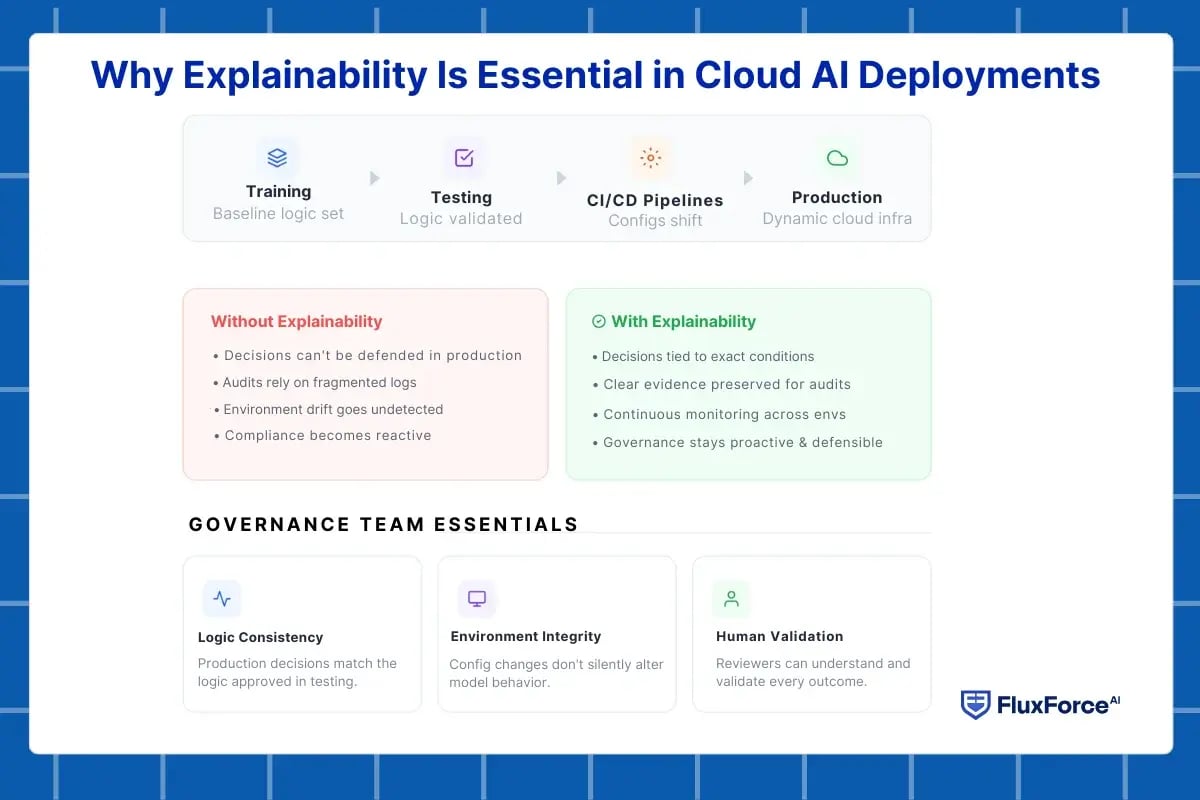
Explainability provides AI transparency by tying each decision to the exact conditions under which it occurred. AI observability extends this by continuously monitoring how those decisions evolve across environments, data changes, and infrastructure shifts. When a model produces an outcome in production, teams must be able to explain why that result happened in that environment, not just why it worked during testing. This is especially important for explainable AI in cloud deployments where infrastructure is dynamic by design.
Governance teams need clear answers on a few essentials:
- The production decision follows the logic approved in testing
- Environment-specific settings did not change model behavior
- A human reviewer can understand and validate the outcome
This is where AI model explainability and explainable machine learning become practical controls. They provide a consistent explanation layer that moves with the model across dev, test, and prod. This supports model traceability even as cloud resources scale or change.
Explainability also enables AI traceability across environments by preserving decision context and lineage. Without it, audits rely on fragmented logs instead of clear evidence. In XAI in cloud computing, explainability keeps cloud AI governance, oversight, and compliance defensible and manageable.
How to Ensure AI Traceability Across Dev, Test, and Production Cloud Environments ?
AI traceability often breaks not because of poor intent, but because cloud AI workflows are fragmented by design. Development, testing, and production environments are isolated for good reasons. Security, stability, and speed. The problem is that AI decisions must remain explainable across those boundaries, even when the environments themselves do not share context.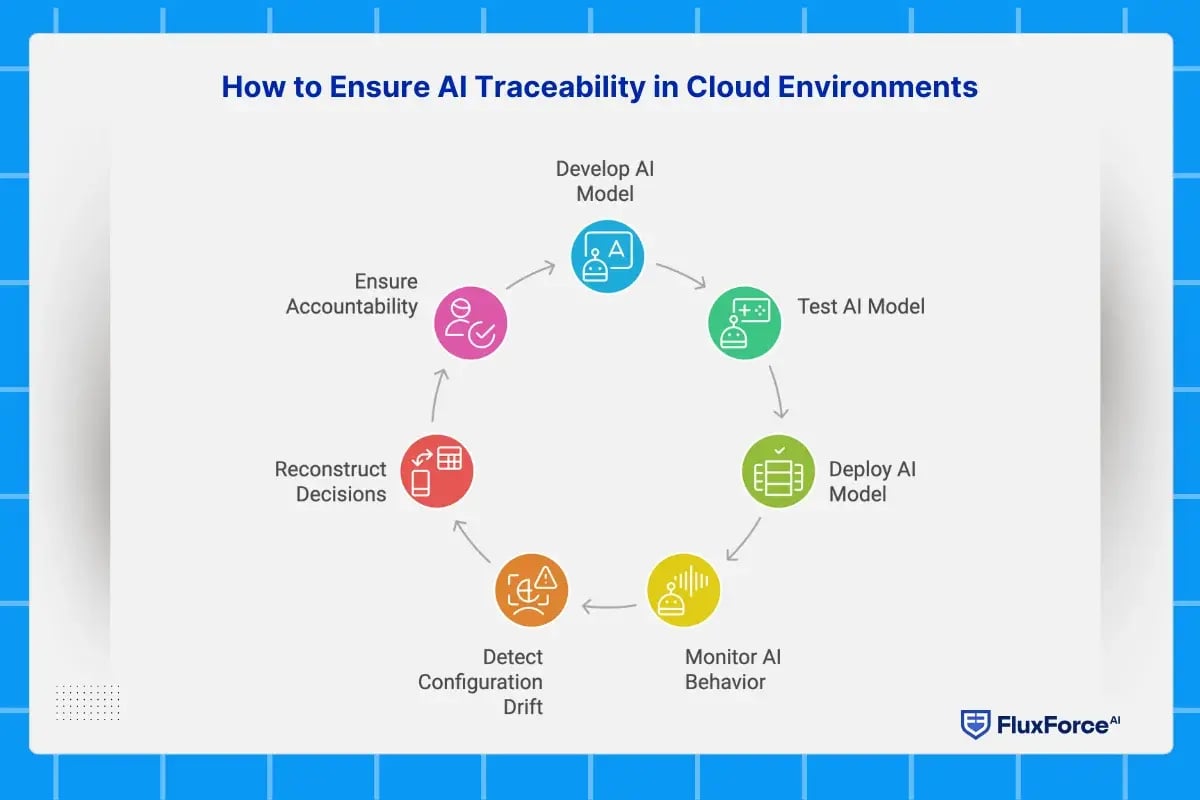
Without deliberate traceability controls, models move faster than governance can follow. Explainability is what allows organizations to reconstruct how a decision was made after the model has crossed environments, pipelines, and cloud accounts.
In practice, reconstruction depends on AI observability. Observability platforms capture model behavior, feature influence, and decision patterns continuously, making explainability usable at scale. Monitoring explanations in real time and detecting concept drift via changes in feature influence are now recognized as core components of AI model governance in production environments, according to EthicalXAI's 2025 enterprise XAI guide. This allows teams to detect subtle shifts caused by configuration drift before performance metrics degrade, so intervention happens while traceability is still intact rather than after it has broken.
Configuration Drift Across Environments
Configuration drift is one of the most common sources of traceability failure. A model approved in test may run with different feature flags, resource constraints, or access permissions in production. These differences rarely trigger alerts. The model still functions, but its behavior changes.
In regulated industries such as insurance, organizations are increasingly combining explainable AI with Zero Trust security controls to reduce environment-level risk and strengthen accountability across cloud deployments. Approaches outlined in Credential Abuse Defense: Zero Trust Security Architecture Strategy for CISOs in Insurance show how identity-centric controls help preserve AI traceability when models move between environments.
Version Fragmentation of Models and Data
In cloud environments, models, datasets, and feature pipelines evolve independently. When a decision is challenged, teams often cannot prove which version of each component was active at the time. This breaks model traceability and weakens the AI audit trail.
Explainability provides connective tissue. It links decisions back to specific model behavior and input influence, even when version records are incomplete.
Monitoring Without Decision Insight
Most cloud monitoring focuses on performance metrics. AI observability goes further by monitoring decision behavior, feature influence, and model reasoning in real time.
Without AI observability, explainability remains reactive. With it, AI transparency becomes continuous across test and production environments.
Fragmented Evidence Across Dev, Test, and Prod
Approval records, validation results, and runtime logs often live in separate systems. When audits or reviews occur, evidence must be reconstructed after the fact. Explainability reconnects these fragments by tying decisions back to approved logic, preserving AI traceability across environments when scrutiny increases.
AI Traceability in Multi-Cloud Environments: What Explainable AI for Multi-Cloud Deployments Actually Requires ?
In multi-cloud environments, AI traceability is often reduced to documentation and logs. Both are necessary. Neither is sufficient. Traceability exists only when a production decision can be reconstructed and explained across clouds, environments, and teams without relying on assumptions about what was active at the time. Explainable AI is positioned as a governance-aligned capability that supports model adoption, safe decision integration, and traceable organizational responsibility in environments where AI outputs directly shape policy-relevant business decisions, according to research published in December 2025 on XAI models for cloud-based business intelligence.
True AI traceability connects four elements: the model version, the data and features used, the execution context, and the resulting decision. If any one of these cannot be explained, traceability breaks. This is where explainable AI (XAI) becomes a structural control rather than a supporting capability.
Why Logs and Metadata Are Not Enough ?
Logs capture what happened. They rarely explain why it happened. In multi-cloud deployments, logs are fragmented across platforms, accounts, and services. Even when timestamps and version tags exist, they do not reveal how inputs and features influenced the outcome.
Explainable AI in cloud deployments address this gap by providing an interpretation layer that travels with the model. This layer makes decision behavior comparable across environments, even when infrastructure and execution paths differ.
Model traceability also depends on lineage. Models are retrained, fine-tuned, and redeployed across clouds. Explainability supports AI lineage tracking by showing how changes in data, features, or configurations affect decisions over time, not just where those changes occurred.
Most importantly, traceability must support human review. Auditors and risk teams need to understand why a decision occurred without reconstructing the entire cloud architecture. Explainable machine learning enables consistent, defensible explanations that can be reviewed across clouds.
In multi-cloud environments, traceability is not about knowing where a model runs. It is about being able to explain what the model did, why it did it, and under which conditions, regardless of the cloud.
Cloud AI Governance and Compliance: How Explainable AI Keeps Cloud AI Decisions Auditable After Deployment
In cloud deployments, AI decisions are almost never reviewed at the moment they happen. They are reviewed later, during an audit, a control failure, or a regulatory query. At that point, the model may have been retrained and the environment may no longer match what was originally approved. Governance only holds if the decision itself can still be explained.
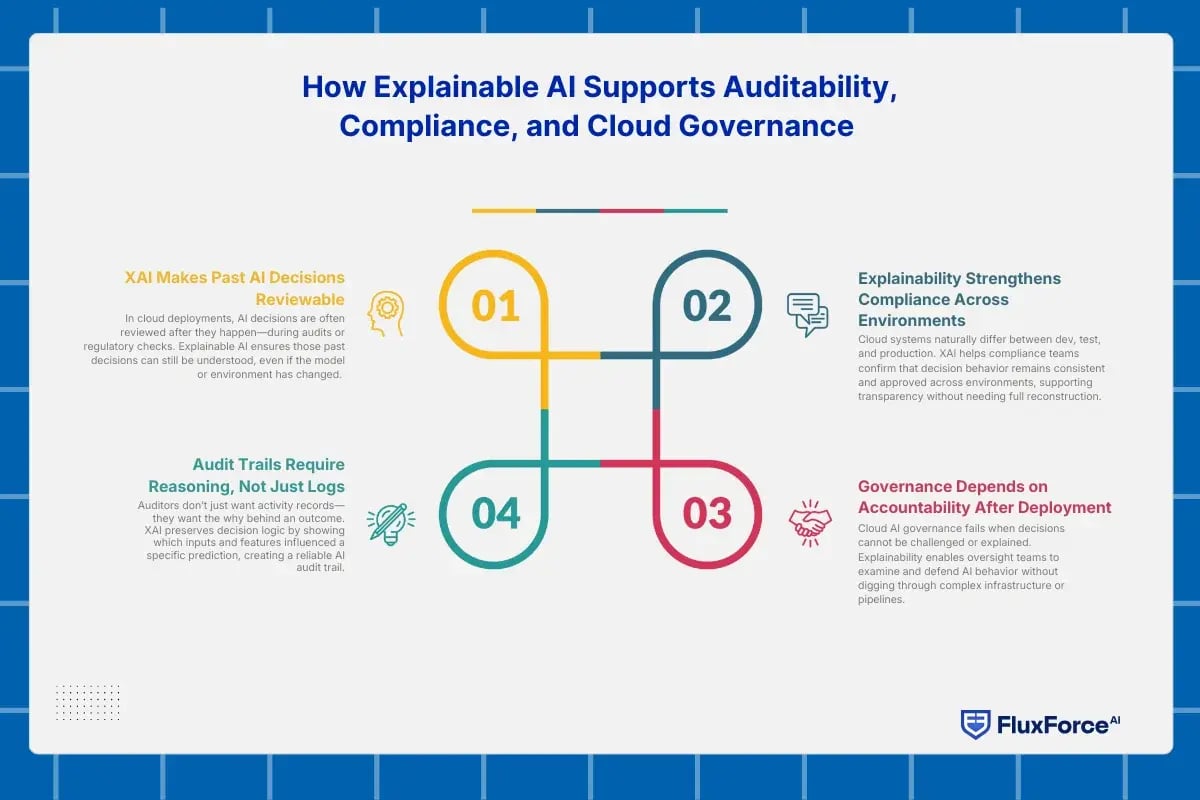
This is where explainable AI (XAI) matters. Not as a design choice, but as a way to make past decisions reviewable when the system has already moved on.
Making Decisions Reviewable After Deployment
Auditors do not ask how the model was built. They ask why a specific decision was made. Logs and performance metrics do not answer that question. They show activity, not reasoning.
Explainable machine learning preserves decision logic in a form that can be examined later. It creates an AI audit trail that allows reviewers to see which inputs and features influenced an outcome, even if the deployment has changed since then.
AI observability strengthens this audit trail. It preserves historical decision behavior and explanation patterns over time, allowing auditors to review not just isolated outcomes but consistent model behavior across deployments.
Supporting Compliance Across Cloud Environments
Differences between dev, test, and production are normal in cloud setups. What compliance teams need to know is whether those differences changed decision behavior in ways that weren't approved and whether they can prove it without rebuilding the original environment. Explainability outputs and technical traces should be routed into structured, audit-ready evidence throughout the AI lifecycle, enabling replay and verification while treating audit logs as security-critical assets subject to integrity protection, access control, and retention controls, according to the December 2025 XAI-Compliance-by-Design framework research published in MDPI Laws.
Explainability supports cloud AI compliance by allowing reviewers to compare decisions across environments using the same reasoning lens, maintaining AI transparency without relying on assumptions or environment reconstruction.
Keeping Cloud AI Governance Enforceable
Governance breaks when decisions cannot be challenged or reviewed. Cloud AI governance depends on human oversight that works after deployment, not just before it.
In XAI in cloud computing, explainability is what allows teams to hold models accountable without digging through pipelines, infrastructure, or code. It turns AI behavior into something governance teams can actually examine and defend.
Ensure transparency, compliance, and confidence across environments
—transform your cloud strategy today.
The Documentation Regulators Ask For
Running in the cloud does not change what has to be on file. It changes how hard that file is to assemble. SR 11-7 requires model documentation and validation before deployment, and the same five elements make up the standard documentation checklist under both SR 11-7 and EBA model risk guidelines. DORA adds operational resilience records covering AI systems, and Article 13 of the EU AI Act requires transparency for anything classed as high-risk.
Read together, EBA internal governance guidelines, OCC operational risk standards, and the EU AI Act's high-risk obligations move explainability out of the column where it differentiates a vendor and into the one where a supervisor assumes it is already there.
Deployment is only part of the problem. See the wider treatment of explainable AI in finance for how the same principles apply across lending, fraud, AML, and market risk.
Conclusion
Cloud environments change quickly. Models move across pipelines, accounts, and platforms. Configurations and data access change over time. What cannot change is the ability to explain why an AI decision was made.
This is why explainable AI (XAI) is essential in cloud deployments. It keeps AI traceability intact across dev, test, and production. Without explainability, teams are left with logs and assumptions. With it, decisions remain understandable even after systems change.
For organizations running AI in the cloud, performance is not the only concern. They must be able to reconstruct and defend decisions when questions arise. AI model explainability makes this possible by preserving decision logic independently of infrastructure.
In XAI in cloud computing, explainability supports what governance actually needs:
- Clear ownership of production decisions
- Audit trails that remain usable over time
- Human oversight after deployment
- Compliance reviews based on evidence
Cloud AI will continue to scale and change. Governance will only keep up if explainability is treated as a core requirement, not an afterthought.



Share this article