











Listen to our podcast 🎧
Introduction
AI is now embedded in critical decisions across regulated sectors, with adoption accelerating in financial services and healthcare, according to McKinsey’s State of AI Report (2024). This shift places CISOs under stronger pressure to show that every model supports regulatory compliance AI requirements and operates with clarity. Explainable AI gives security leaders the visibility needed to validate decisions and demonstrate alignment with responsible AI governance in regulated environments. This strengthens an AI risk management framework and improves AI auditability, since each part of the decision path remains available for inspection. Clear visibility also helps teams detect issues early and reduce exposure.
Across regulated industries, explainable machine learning and interpretable ML are becoming standard expectations. These practices support ethical AI implementation and enable compliance-driven AI adoption across the enterprise.
For CISOs, this clarity becomes a core part of a modern CISO AI strategy. It proves that AI systems operate in a controlled and trustworthy way in high-risk environments where AI transparency in compliance is no longer optional but required.
AI empowers CISOs to ensure compliance and transparency
Build key strategies with FluxForce AI.

Why CISOs need explainable AI in regulated environments ?
CISOs work in sectors where AI decisions are frequently reviewed by auditors, regulators, and internal governance teams. This makes explainable AI for CISOs essential because it allows leaders to show not only what a model decided but how it reached that outcome. Clear reasoning supports AI transparency in compliance and reduces the risk of decisions that cannot be defended.
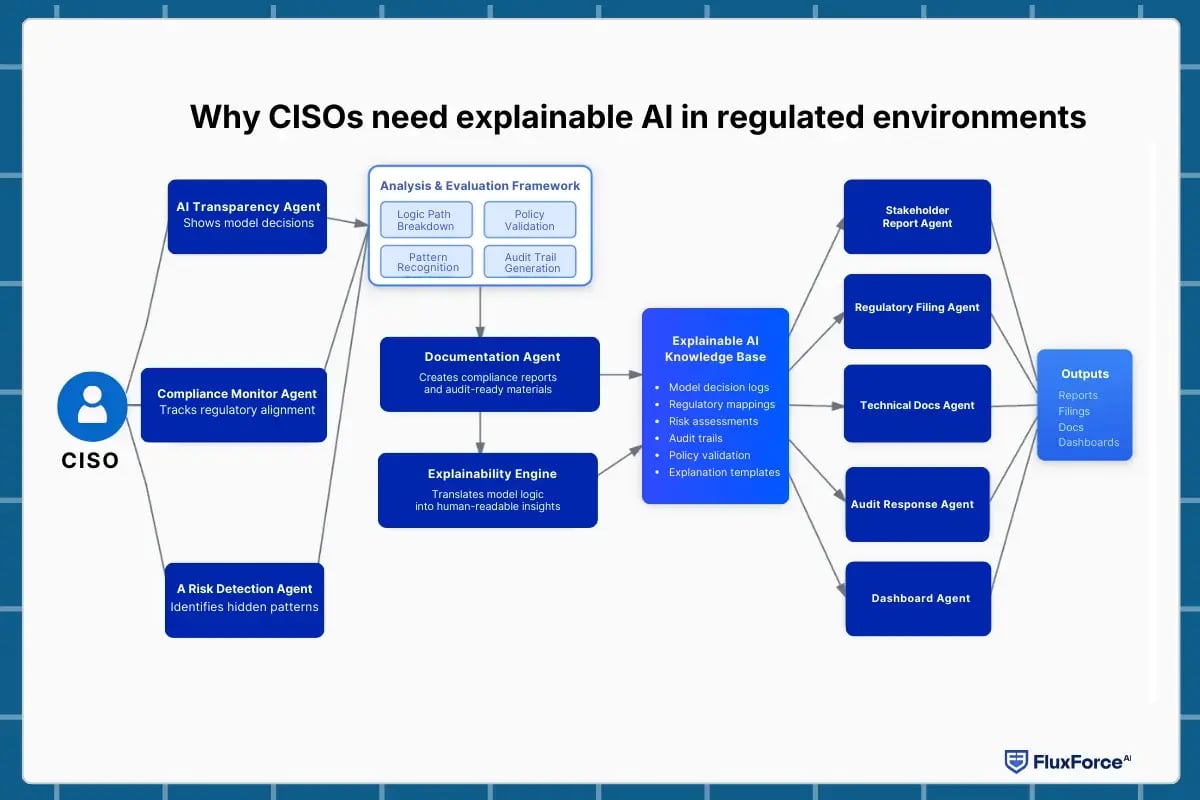
With explainable AI, security teams can break down each stage of a model’s logic. This strengthens AI oversight for enterprises because hidden logic paths or unstable patterns become visible before they create exposure. CISOs can confirm that models follow policy and avoid behavior that triggers regulatory concern.
In industries with strict regulatory requirements, strong AI governance for CISOs helps ensure systems stay aligned with established standards. This clarity is now a baseline for XAI in regulated industries, where unclear decisions often slow approvals and increase operational risk. Explainability gives CISOs the confidence to deploy AI without losing control of how the system behaves.
Core Elements of Explainable AI That Matter to CISOs
For CISOs, explainability is the difference between an AI system that can be defended during audits and one that creates risk exposure. These elements form the foundation of responsible AI governance in any regulated environment.
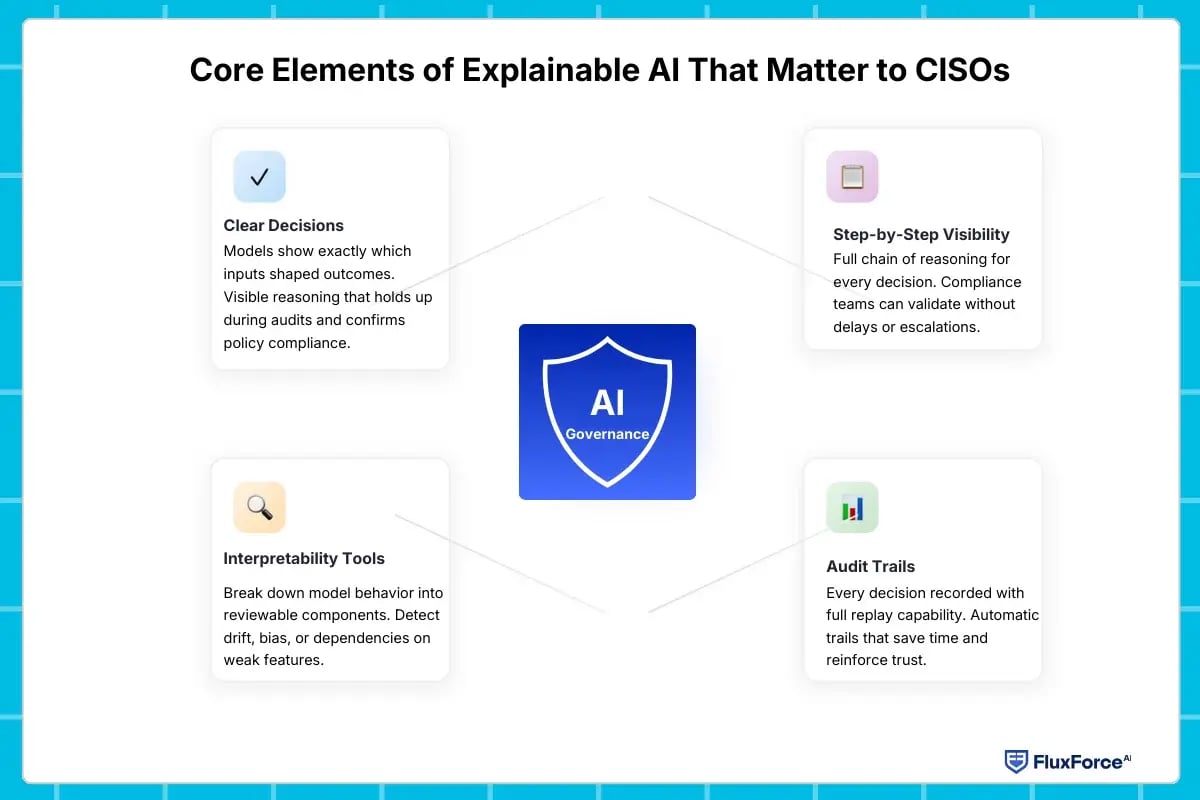
Clear decisions that hold up during audits
CISOs need models that show exactly which inputs shaped an outcome. When each step is traceable, compliance teams can validate decisions more efficiently and reduce unnecessary escalations. This level of model clarity is what auditors expect when they review high-impact decisions in areas such as lending, onboarding, insurance rating, or claims approvals.
Step-by-step visibility that proves compliance
Regulators expect explainable logic in every regulated decision. Strong AI transparency in compliance allows CISOs to present a full chain of reasoning instead of an opaque output. When each step is traceable, compliance teams can validate decisions more efficiently and reduce unnecessary escalations.
Interpretability tools that reveal hidden behaviour
Modern model interpretability tools help security leaders break down model behavior into simple, reviewable components. These tools make it easier to detect drift, bias, or heavy dependence on weak features. For example, a financial services firm used interpretability insights to identify when a fraud model relied too strongly on device fingerprints, causing unnecessary alerts across specific customer groups.
Audit trails that reduce investigation time
AI systems must remain ready for review long after deployment. Strong AI auditability ensures that every decision is recorded with enough detail to replay the logic behind it. This is crucial in regulated industries where an auditor may request past outputs months later. Automatic audit trails save CISOs from manual backtracking and reinforce trust in the system.
How CISOs can implement explainable AI in regulated environments ?
CISOs cannot depend on AI outputs without understanding how they were reached. Explainable AI for CISOs focuses on creating systems that are verifiable, auditable, and defensible. Visibility into every decision is essential to prevent regulatory breaches and operational errors.
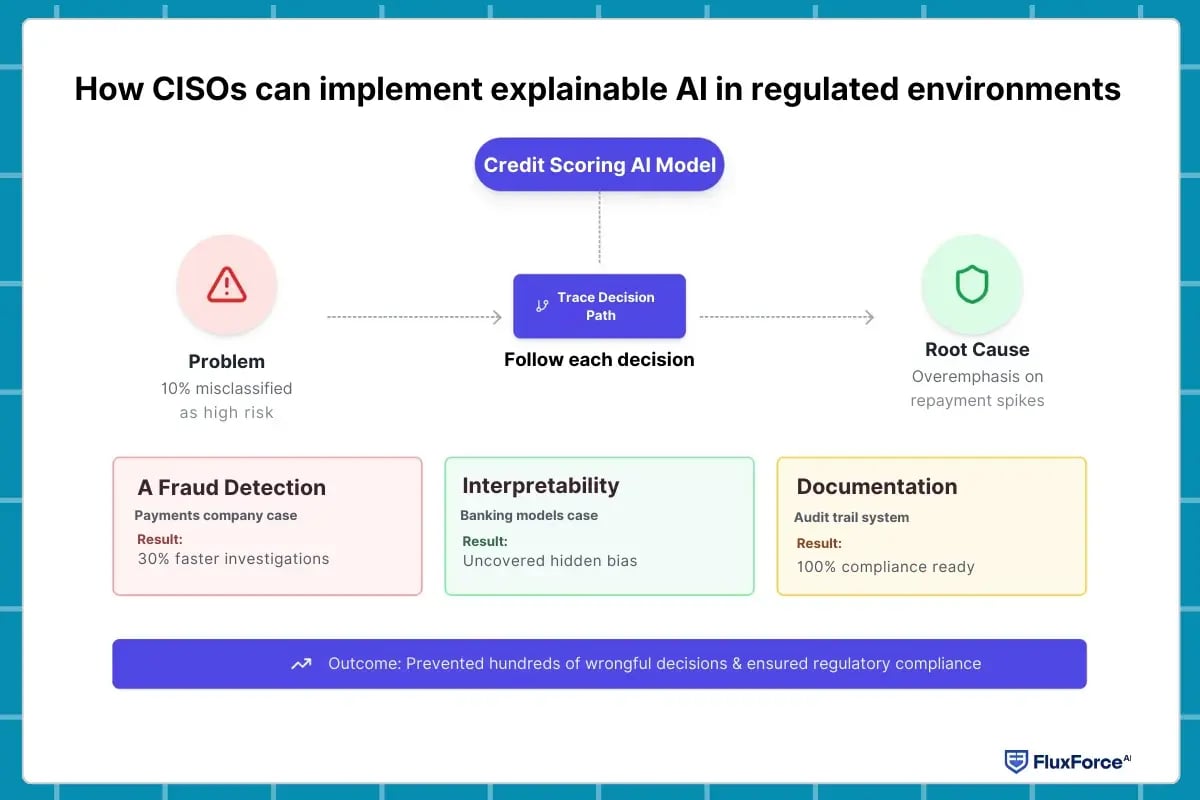
Trace every step of high-impact models
Consider a credit-scoring AI that misclassified 10 percent of applicants as high risk. By using transparent AI models, the CISO could follow each decision path, identify that the model overemphasized short-term repayment spikes, and recalibrate the system. This avoided hundreds of wrongful outcomes and reinforced confidence in AI decisions.
Embed explainability into fraud detection
A payments company faced hundreds of false fraud alerts daily. Applying AI model explainability techniques, analysts pinpointed which transaction features were generating false positives. Adjusting the system reduced investigation time by 30 percent while maintaining accuracy. Decision paths made AI transparency in compliance measurable and actionable.
Use interpretability tools to strengthen governance
Modern model interpretability tools allow teams to visualize how inputs influence outputs. A bank leveraged these tools to assess credit scoring and lending models, uncovering hidden bias toward specific customer segments. This strengthened AI oversight for enterprises and built trust with regulators during audits.
Document every action for compliance-driven adoption
Every AI decision, change, or review should be recorded. AI auditability ensures that auditors can reconstruct the reasoning behind high-impact decisions. Dashboards, decision maps, and reports should tie directly to governance policies. For CISOs, this level of documentation separates compliant systems from those that could raise regulatory red flags.
Applying operational insights to enterprise XAI governance
Once model-level explainability is in place, CISOs must turn these insights into enterprise-wide governance strategies. The goal is to make AI systems auditable, reliable, and compliant across all business units.
Establish a central XAI governance framework
Lessons from individual models should inform a structured framework that defines standards for model approval, documentation of decision paths, monitoring, and escalation procedures. This framework reinforces responsible AI governance and supports compliance-driven AI adoption throughout the organization.
Integrate decision paths into enterprise risk oversight
Insights from models used in credit, fraud, or operational risk should feed into enterprise risk management. CISOs can identify systemic vulnerabilities, detect bias patterns across models, and reduce regulatory exposure. Transparent AI models at the enterprise level help turn model-level explainability into actionable risk management.
Communicate XAI insights to leadership
Decision path visualizations and interpretability outputs should be summarized for executives and boards. Clear dashboards demonstrate trustworthy AI in regulated environments, validate bias mitigation efforts, and show that governance practices are in place. Explainable AI thus becomes a strategic tool for executive decision-making.
Embed explainability into policies and compliance practices
Operational insights should be codified into standards for documentation, audit readiness, and regular model reviews. Explainable AI for CISOs becomes a policy-driven process rather than an ad hoc exercise. This ensures that every AI deployment meets governance and regulatory expectations.
Maintain continuous oversight and accountability
CISOs should implement ongoing monitoring and review to maintain AI model explainability as models evolve. Cross-functional oversight, periodic updates, and integration with enterprise risk practices ensure that AI remains auditable, reliable, and aligned with regulatory standards over time.
AI empowers CISOs to enhance compliance and security
Build key strategies with FluxForce AI.
Conclusion
Explainable AI is now the baseline for secure and compliant AI adoption in enterprises. For CISOs this guide comes down to one message: visibility is the strongest form of control. When every model decision is traceable, auditable, and defensible—as detailed in Explainable AI in Finance: A Comprehensive Guide—AI becomes a reliable asset instead of an unseen risk. Building that foundation today prepares the organization for stricter regulations smarter adversaries and more automated business environments. This is not just a best practice it is the standard that will shape modern enterprise security in the years ahead.

Share this article