.webp)







Listen to our podcast 🎧
Introduction
Internal teams manage sensitive information, access trusted systems, and perform critical activities in every banking workflow. With each role they perform, fraud risk increases when user behaviour remains unchecked and process workarounds operate without logging, and that blind spot is exactly where AI fraud detection is built to help.
Senior Internal Audit Directors face significant challenges while identifying insider-driven misconduct because indicators remain scattered across systems and buried inside high-volume operational data.
According to a 2024 Association of Certified Fraud Examiners (ACFE) report, insider fraud accounts for 35% of all financial institution losses, with average losses exceeding $200,000 per case.
This blog explores how strategic integration of AI-powered fraud detection models can help internal audit teams identify insider threats proactively, strengthen governance, and build a predictive fraud oversight framework.
Key Insider Fraud Patterns That Demand AI-Led Oversight
Several insider-driven misconducts operate sequentially and below the thresholds of traditional rule-based systems. For banks, these activities become difficult to spot without AI-powered fraud detection or targeted insider fraud monitoring.
Common insider schemes that manual controls often miss are:
- Misusing access rights to enter systems or data they should not use.
- Changing workflows to skip approvals or edit official records.
- Small suspicious transactions that look normal but form a pattern over time.
- Reactivating old or dormant accounts for hidden transfers or data use.
- Increasing claims or expenses slightly over many cycles.
- Moving sensitive data in small, repeated steps to avoid attention.
Manually searching through long-term patterns and behaviour changes is ineffective for internal audit teams. Their risk becomes visible only when AI in internal audit correlates actions across time, systems, and behavioural baselines.
AI detects insider fraud in banks by evaluating the intention behind actions, not just the actions themselves. It automatically connects data points to identify micro-shifts in workflow patterns and behaviour. With AI-driven fraud monitoring, Internal Audit Directors enable a stronger, more predictive, and more controlled environment.
What AI Fraud Detection Adds to Insider Risk Programs
AI fraud detection is not a replacement for the audit team, it is a layer that reads far more signal than any person could track manually. Where a manual review samples a handful of transactions or logs, an AI fraud detection model scores every session, every override, and every access event against a baseline built from months of prior behaviour.
For internal audit directors, that means fewer false starts chasing coincidences and more confidence that a flagged case is worth the time it takes to investigate. The model does not replace judgment, it narrows the pool of activity that deserves judgment in the first place. That is why banks pair AI fraud detection with the existing control framework rather than swapping one for the other.
How AI Interprets User Behaviour and Flags High-Risk Insider Activities
AI strengthens insider fraud monitoring by reading user behaviour in a way traditional controls cannot. Instead of checking single events, AI studies patterns, context, and intent. This gives Internal Audit Directors a predictive view of risk, allowing earlier detection of misconduct.
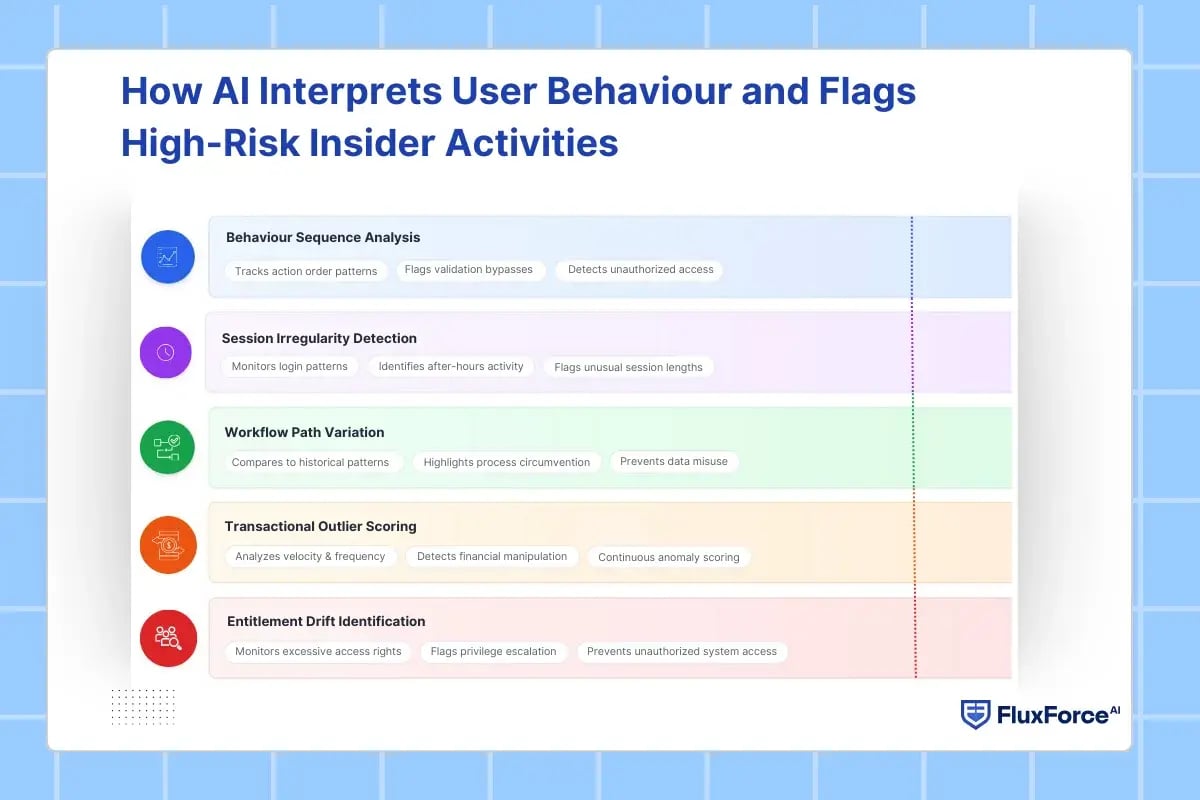
Behaviour Sequence Interpretation
Machine learning models evaluate the order of user actions. Slight deviations indicate misuse, such as skipping validation steps, switching modules unusually quickly, or navigating to restricted screens without operational need.
Internal audit teams can use these insights to:
- Focus on high-risk workflows.
- Identify hidden policy bypasses.
- Detect potential data tampering.
Session Irregularity Detection
AI assesses session behaviour: login times, duration, navigation depth, and unexpected jumps between modules. Repeated after-hours access, sudden spikes, or inconsistent session lengths signal risk.
Internal audit teams can:
- Prioritize anomalous behaviour reviews.
- Detect potential insider fraud early.
- Adjust monitoring thresholds based on role risk profiles.
Workflow Path Variation Analysis
Every user follows predictable daily paths. AI identifies deviations by comparing current activity with historical patterns. Significant divergence often highlights misconduct.
Internal audit teams gain intelligence to:
- Investigate unusual transaction flows.
- Detect process circumvention.
- Prevent unauthorized data access.
Transactional Outlier Scoring
AI detects outliers in velocity, frequency, and value. Continuous anomaly scoring highlights transactions outside normal ranges for specific user roles, the same velocity checks that catch bust-out fraud draining a credit line in its final weeks.
Internal audit teams can:
- Focus on small, repeated financial manipulations.
- Detect early-stage fraud in expense or payment processes.
Entitlement Drift Identification
Users often accumulate excessive access rights due to role changes, transfers, or system gaps. AI monitors entitlement changes and flags high-risk privilege drift.
Internal audit teams can:
- Proactively address misaligned roles.
- Prevent unauthorized access.
- Strengthen overall control environment.
Essential Data Signals for AI-driven Banking Fraud Detection
AI delivers value only when data sources are correct, consistent, and interconnected. Fraud monitoring requires signals from multiple layers because insiders rarely rely on a single method. The following data groups provide maximum value to internal audit directors:
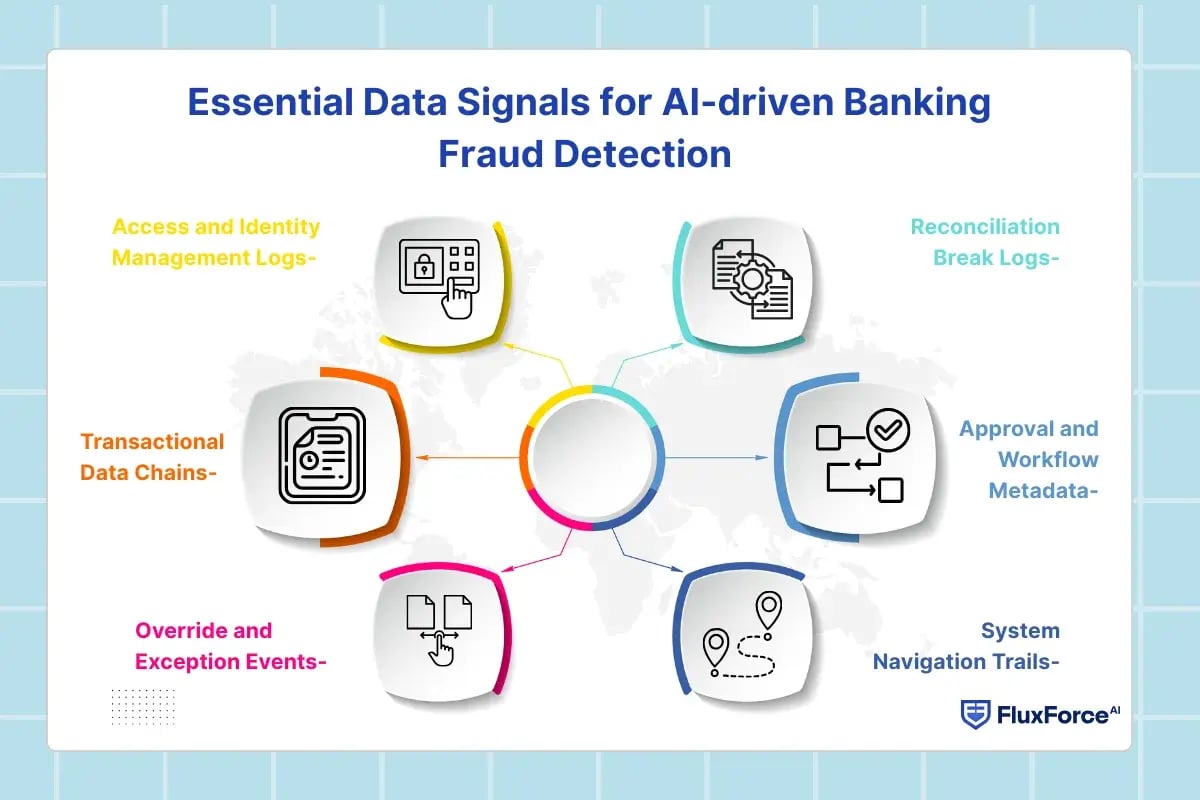
1. Access and Identity Management Logs- Access logs provide a record of every login attempt, password reset, privilege change, and session abnormality. AI identifies patterns associated with password sharing, credential misuse, or unauthorized access escalation.
2. Transactional Data Chains- Patterns across transactions reveal small deviations. AI correlates transaction timing, value distributions, account behaviour, and exception flags. Micro-frauds often surface through sequence analysis rather than individual entries.
3. Override and Exception Events- Exceptions allow users to bypass normal controls during operational pressure. Excessive use of overrides or unexplained exception approvals indicate suspicious intent. AI correlates override with user behaviour to expose misuse.
4. Reconciliation Break Logs- Unexplained reconciliation gaps or repeated break corrections hide many insider activities. Anomaly models evaluate break frequency, correction patterns, and responsible users to detect suspicious manipulation.
5. Approval and Workflow Metadata- Approval routing logs indicate process health. AI highlights approvals that bypass expected routing or show repeated involvement of specific individuals in high-risk workflows.
6. System Navigation Trails- Session navigation metadata helps AI interpret behaviour shifts, such as unexpected access to high-risk screens or repeated checks on sensitive records.
Detect insider fraud swiftly with AI-powered monitoring tailored for internal audit directors
start your prevention strategy now!
Proven AI techniques for insider threat detection in financial services
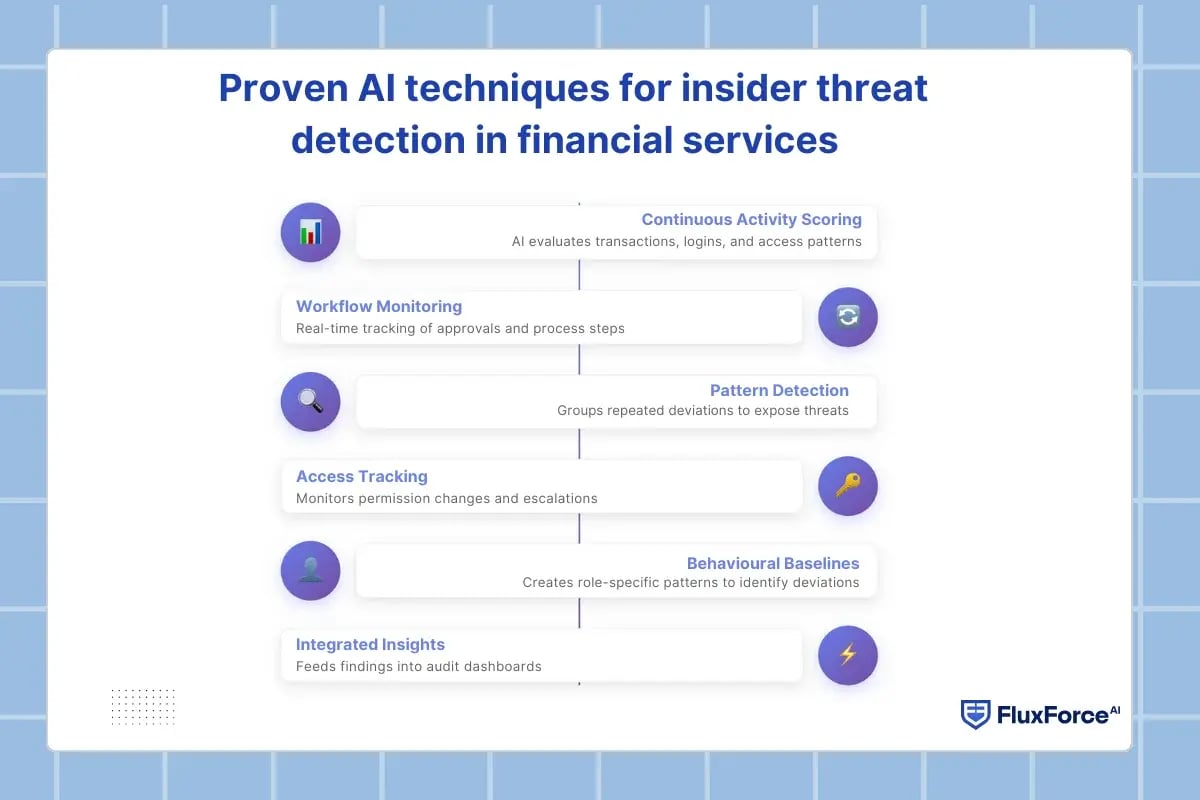
Enabling banking fraud prevention using AI means analysing transactions, user behaviour, access patterns, and workflows in a structured, recorded way to detect risks early. Here’s how internal audit directors can strategically use AI to prevent fraud.
Scoring user activities continuously
Start scoring user actions across transactions, logins, and system access. AI evaluates anomalies against historical patterns, highlighting unusual behaviour such as abnormal access sequences or unexpected transaction spikes, making early detection of insider risk possible.
Monitoring workflow deviations actively
Begin monitoring approvals, reconciliations, and process steps in real time. AI flags skipped steps, repeated overrides, or irregular sequences, helping auditors identify potential process misuse before it escalates into significant issues.
Detecting repeated anomaly patterns
Focus on identifying repeated deviations across users or accounts. AI groups similar unusual actions over time, exposing gradual or coordinated insider threats that traditional rule-based audits might miss.
Tracking access and privilege changes
Start tracking changes in system access, account permissions, and entitlements. AI highlights sudden increases or unusual combinations of privileges that could signal entitlement drift or misuse of sensitive systems.
Building behavioural baselines for roles
Begin creating baseline behaviour for each role. AI observes login times, transaction frequency, and workflow patterns to spot deviations that indicate potential insider fraud attempts.
Integrating AI insights into audit systems
Focus on feeding AI findings into audit dashboards or GRC platforms. Consolidated alerts, risk scores, and flagged patterns allow internal audit teams to investigate efficiently while keeping evidence and documentation audit ready.
Ensuring AI Remains Explainable, Verifiable, and Audit-Ready
Internal Audit Directors require transparent models to maintain credibility. This is the core of AI in Governance and Compliance (GRC).
Model Explainability: Models must provide clear explanations for each flagged anomaly. Techniques such as SHAP values and rule-based feature outputs help auditors understand why certain behaviour received high-risk scores. Final sign-off still belongs to a person, a principle our team lays out in Human in the Loop: Where People Should Still Sign Off on AI Decisions.
Validation and Testing Cycles: Audit teams require validation routines to check accuracy, false positives, drift, and stability. Model performance reviews align AI systems with audit policies and control frameworks.
Evidence Logging and Traceability: Every anomaly flagged by the system must produce a traceable evidence record. Audit teams then attach these logs to workpapers during reviews.
Threshold Governance: Audit leadership must define and periodically adjust thresholds for anomaly scoring. Threshold governance ensures consistency across business units and risk areas.
Policy Alignment and GRC Integration: AI outputs should feed into governance, risk, and compliance platforms. Integrated reporting supports risk committees and senior leadership with consistent insights.
Detect and prevent insider fraud with advanced AI-powered monitoring
Empower your internal audit strategy!
Conclusion
Insider fraud monitoring requires a structured approach and continuous vigilance. AI provides the tools to detect unusual behaviour, track access changes, and identify anomalies that might indicate insider threats. Transparent models, traceable evidence, and clear oversight ensure audit teams can act responsibly and maintain compliance. Implementing these techniques is an ongoing process that adapts as risks evolve.
By integrating AI into fraud detection frameworks, internal audit directors can strengthen controls, respond more quickly to potential misconduct, and ensure a safer and more secure operational environment for the organization. The same behavioural signals also expose external schemes like business email compromise payment fraud.
Share this article