.webp)




.png)



Listen to our podcast 🎧
-1-1.png)
Introduction
A 2024 Nilson Report suggests that rising digital payments could push global card fraud losses to $403.88 billion over the next ten years.
For banking leaders, this projection signals a growing challenge in detecting credit card fraud in the modern payment ecosystem. Traditional rule-based fraud detection systems have been used for years, but the struggle with detecting evolving fraud patterns has been evident.
According to data from the Federal Trade Commission, roughly 17–18% of U.S. consumers reported experiencing credit card fraud in 2023.
While rule-based systems help enforce transaction controls, they often generate excessive false positives. To tackle fraud that can occur within 2 seconds, banks still rely on systems that take hours to investigate.
Now, AI-powered card fraud analytics offers banks a more proactive approach. By auto-analysing transaction behaviour, device signals, and contextual data in real time, these systems can identify anomalies much faster.
This article explores how risk heads, by deploying predictive fraud detection models and AI-driven analytics, can strengthen fraud detection capabilities and future-proof banking systems against evolving fraud patterns.
Why Modern Card Fraud Detection is Challenging for Banks ?
Three major reasons why card fraud detection in banking still results in losses are:
- Heavy reliance on traditional rule-based systems that only flag configured patterns.
- Limited real-time monitoring across transactions, devices, and payment channels.
- Fraudsters adapting their tactics faster than institutions approve and deploy new defences.
Banks think their systems are effective at preventing fraud. However, when customers report unauthorized transactions or regulators question fraud controls, institutions struggle.
Here’s what older fraud detection systems are capable of when compared to modern fraud tactics:
How Traditional Systems Detect Fraud |
How Modern Fraudsters React |
|
Flagging transaction requests based on threshold breaches |
Splitting fraud into multiple small transactions below detection limits |
|
Detecting geo-location mismatches |
Using VPNs or location spoofing to mimic trusted regions |
|
Monitoring sudden spikes in transaction volume |
Gradually increasing transaction activity to appear normal |
|
Blocking transactions from flagged devices |
Switching devices or using emulators to bypass device checks |
Why Card-Related Frauds are Challenging for Banking Risk Heads
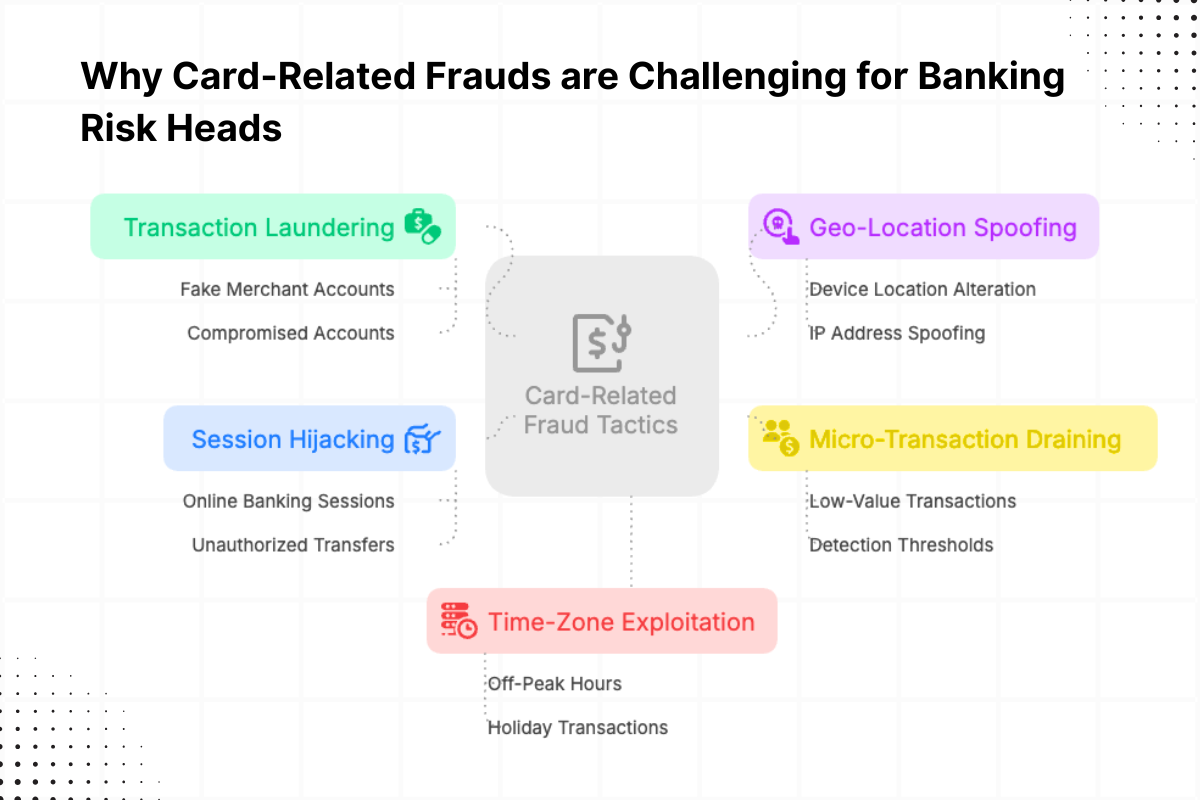
For banking safety managers, card-related fraud is difficult to mitigate as fraudsters continuously adapt their tactics and mimic legitimate transaction behaviour. They study how customers shop, spend, and interact with digital payment platforms, then design fraudulent patterns that appear legit.
With traditional legacy systems and limited real-time monitoring, banking risk heads often miss modern fraud patterns, such as:
- Transaction Laundering where fraudsters route illegal transactions through fake or compromised merchant accounts, disguising them as legitimate business payments.
- Geo-Location Spoofing where fraudsters alter device or IP location data to make transactions appear as if they originate from trusted or permitted regions.
- Micro-Transaction Draining where fraudsters execute multiple low-value transactions that remain below detection thresholds, allowing significant losses to accumulate unnoticed.
- Session Hijacking where fraudsters gain control of active online banking sessions to authorize transfers before authentication or session timeouts occur.
- Time-Zone Exploitation where fraudsters time fraudulent transactions during off-peak hours or holidays when monitoring resources are limited.
When these tactics succeed, banks face liquidity loss, operational delays, regulatory breaches, and severe reputational harm.
How AI Revamps Card Fraud Detection in Banks
AI in banking fraud detection helps move a few steps further to static rules. It introduces predictive and adaptive capabilities that help banks analyse credit card data more effectively and make preventive decisions.
Here’s what AI enables that traditional systems don’t:
1. Real-Time Transaction Risk Scoring
Fraud detection powered by AI evaluates every transaction in real time. It analyses signals such as transaction amount, device identity, location, spending behaviour, and merchant patterns. The system then assigns a dynamic risk score and instantly flags high-risk activity.
2. Behaviour-Based Fraud Detection
Instead of relying completely on rules, AI over time learns how customers normally use their cards. Tracking spending habits, purchase frequency, changing locations, device usage etc. Whenever behaviour shifts outside normal patterns, the system detects potential fraud immediately.
3. Detection of Emerging Fraud Patterns
Traditional rules only detect known fraud triggers. AI identifies hidden anomalies across millions of transactions. It exposes modern fraud tactics such as micro-transaction draining, AI-driven fraud attempts, spoofing activities, and more.
4. Continuous Fraud Model Learning
When fraud tactics evolve, AI adapts its detection logic automatically. Models retrain continuously and respond to emerging fraud patterns. This frees up risk teams to manually update hundreds of static rules.
5. Improved Signal-to-Noise Ratio for Fraud Teams
AI ranks transactions based on the amount of fraud risk it carries. With data-driven decisions, risk teams receive fewer low-value alerts and clearer indicators of suspicious activity.
According to a research by Mastercard in 2024, payment fraud has cost organizations on average $60 million. Leveraging AI-powered card analytics can help reduce that number by more than half.
Related Blogs:
- Human Analysts vs. AI Modules: Who Detects Fraud Faster and More Accurately
- Insider Fraud Monitoring: AI-Powered Fraud Detection Strategy for Internal Audit Directors
How AI and Analytics Help in Banking Fraud Prevention
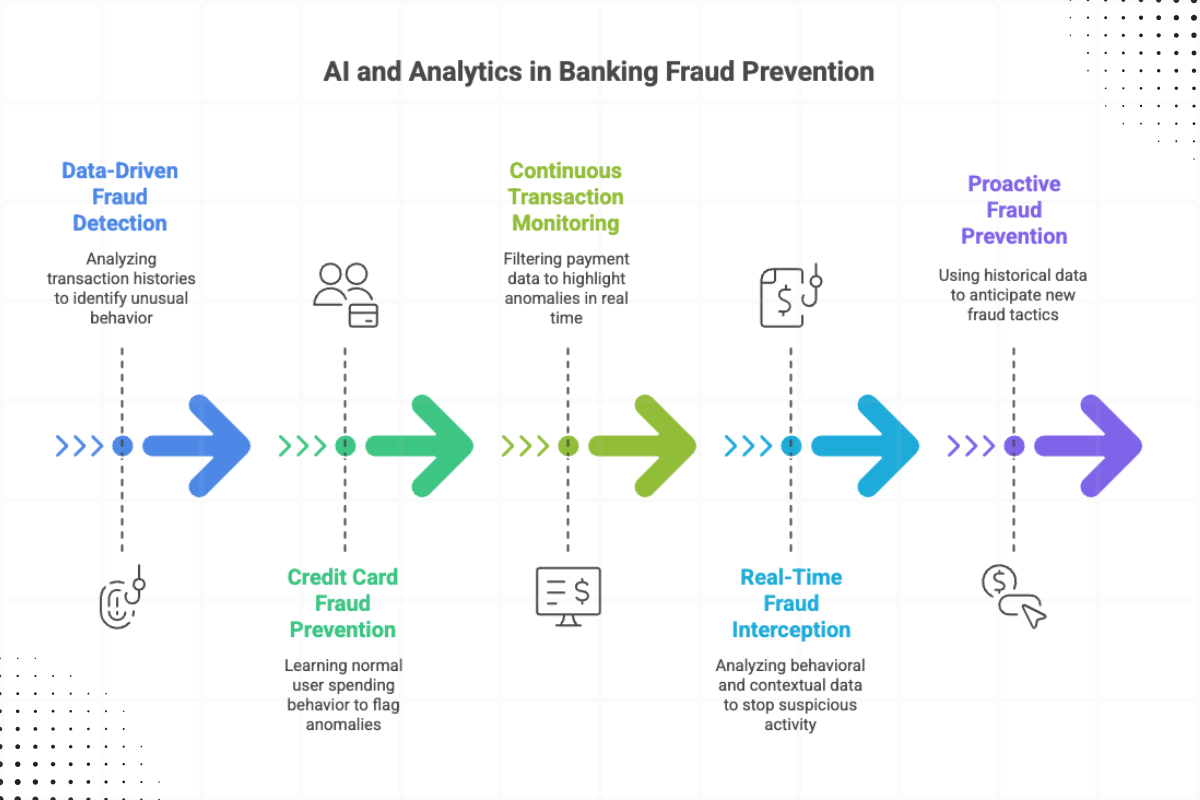 AI and analytics blend the power of intelligence and data to enhance banking fraud prevention. They analyse customer behaviour and process vast volumes of transaction data to detect anomalies and identify suspicious activity patterns in real time. Here’s what these technologies enable for financial institutions:
1. Data-Driven Fraud Detection
Fraud detection using data analytics in the banking industry involves analysing vast transaction histories to discover unusual behaviour. This allows banks to identify high-risk activities early, ultimately reducing losses and building stronger customer trust.
2. Credit Card Fraud Prevention
AI-powered credit card fraud detection in banking works by continuously learning normal user spending behaviour. When abnormal patterns emerge, like sudden large purchases in unusual locations, it instantly flags and stops suspicious transactions without unnecessary disruptions.
3. Continuous Transaction Monitoring
AI and automation technologies enable continuous credit card transaction monitoring for risk management teams. It filters millions of payment data points and highlights anomalies in real time so teams can focus on genuine threats rather than false alarms.
4. Real-Time Fraud Interception
With AI-powered solutions, fraud detection in the banking sector happens in real time. By analysing behavioural and contextual data instantly, AI ensures suspicious activity is stopped mid-transaction and fast-moving fraud is intercepted before it causes financial or reputational damage.
5. Proactive Fraud Prevention
Using historical data to detect fraud allows banks to anticipate new tactics before they occur. Predictive data analytics helps banks to recognise emerging fraud patterns, enabling proactive protection against evolving threats.
Core AI Technologies Used in Card Fraud Analytics
Modern card fraud detection combines several AI technologies that analyse different transaction and behavioural data points. The technologies below power the AI-driven fraud analytics systems used by banking risk teams today.
- Machine Learning for Transaction Patterns- ML models detect unusual behaviour across millions of transactions. Risk teams use this to catch subtle fraud, like repeated micro-transactions or sudden cross-border activity, before losses escalate.
- Predictive Risk Scoring- Leveraging predictive analytics for fraud detection calculates fraud likelihood for each transaction. Analysts focus on high-risk cases, reduce time spent on low-risk alerts, and act faster on potential threats.
- Cross-System Transaction Analytics- AI combines data from issuing banks, card networks, merchants, and payment gateways. Risk teams uncover linked fraud across channels and detect patterns that isolated systems cannot reveal.
- Real-Time Monitoring and Automated Alerts- AI evaluates every transaction for unusual device use, location changes, or spending spikes. The system immediately triggers alerts, step-up authentication, or review, keeping fraud from progressing.
- Adaptive Fraud Models- AI learns continuously from new transactions and detected fraud. Risk teams update their detection logic automatically, respond to emerging fraud tactics, and stay one step ahead of fraudsters.
.png?width=1200&height=628&name=hubspot%20blog%20(6).png)
Key AI-based Fraud Detection Tools for Financial Risk Teams
AI-powered tools and technologies help banking risk teams to detect, monitor, and prevent card fraud with scale and accuracy. Below are the most essential tools for modern banking fraud prevention:
1. Machine Learning Fraud Detection Models
Machine learning tools are known for their adaptive nature. They analyse historical and real-time credit card transaction data to identify fraud patterns that indicate fraud. These models continuously adapt to new schemes, enabling machine learning fraud detection for banking risk teams to catch complex fraudulent activities that traditional systems might miss.
2. Credit Card Data Analytics Platforms
These platforms centralize credit card transaction data from multiple sources. They provide actionable insights through fraud data analysis, enabling risk teams to detect abnormal spending patterns, prioritize alerts, and reduce operational overhead while maintaining high detection accuracy.
3. Fraud Detection Predictive Models
Predictive models use both historical and real-time data to anticipate emerging fraud patterns. This allows banking risk teams to simulate risk scenarios, allocate monitoring resources wisely, and take action before losses occur.
4. AI-Powered Real-Time Monitoring
Real-time monitoring tools continuously evaluate transactions as they occur. AI-powered credit card fraud detection in banking allows immediate identification of suspicious activity, giving risk teams the ability to intervene and prevent financial losses instantly.
Outcome of AI-Powered Card Fraud Analytics in Banking
AI-powered fraud analytics lets banks detect, investigate, and prevent complex fraud in ways legacy systems cannot.
Fewer False Positives, Fewer Blocked Customers
-
JPMorgan Chase's AI-driven AML system achieved a 95% reduction in false positives Ai after shifting from rule-based to behaviour-centric fraud detection. HSBC similarly recorded a 60% reduction in false positives through its collaboration with Google Cloud.
Fraud Teams Work Smarter, Not Just Harder
-
43% of financial professionals report increased efficiency within fraud teams, allowing experts to focus on higher-value, complex fraud cases, rather than routine alert triage.
Manual Reviews Largely Eliminated
-
80% of organizations reported that AI helped eliminate unnecessary manual reviews, freeing analyst capacity and dramatically accelerating response times across fraud investigation pipelines.
Investigations Resolved Significantly Faster
-
83% of surveyed organizations say AI has significantly sped up their process for fraud investigation and case resolution, compressing timelines that once took days into near-real-time decisions.
Banks Are Saving at Scale
-
42% of card issuers and 26% of acquirers have saved more than $5 million in fraud attempts over the past two years, according to Mastercard's 2025 payment fraud prevention report.
Detection Rates That Legacy Systems Cannot Match
-
Meta-analysis of 47 studies indicates that contemporary AI-powered fraud detection systems achieve detection rates of 87–94%. These results are well beyond what static, rule-based systems reliably deliver.
Challenges in AI-Based Fraud Detection in Banking
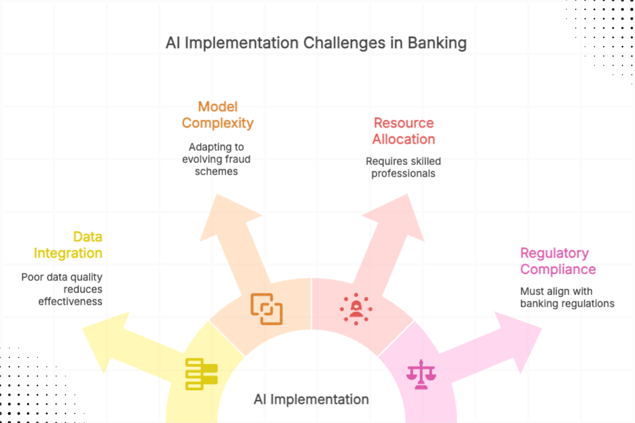
While AI enhances banking fraud detection capabilities, implementing and managing these technologies comes with some serious challenges. Risk teams must consider these:
-
Data Integration and Quality: Credit card fraud detection using data analytics relies on accurate, comprehensive data from multiple sources. Poor data quality or fragmented systems can reduce AI effectiveness, causing missed threats or false positives.
-
Complexity of Fraud Modelling: Creating fraud modelling frameworks that adapt to evolving schemes is complex and time-consuming. Banks must continuously update predictive models to address new tactics, such as geo-location spoofing and transaction laundering.
-
Resource Allocation and Expertise: Deploying AI-based fraud detection tools for financial risk teams requires skilled professionals. Training staff to interpret AI outputs and integrate insights into decision-making is critical for success.
-
Regulatory Compliance: AI-driven solutions must comply with local and international banking regulations. Failure to align data science fraud detection tools with compliance requirements can result in penalties or reputational damage.
What Risk Leaders Should Prioritize When Deploying AI Fraud Detection ?
Implementing AI for fraud detection requires a smart, structured approach. Risk leaders must work with a banking fraud prevention strategy that clearly defines how AI and analytics will be used. Here are six key steps to build an effective AI-based fraud detection roadmap in banking.
1. Define Clear Fraud Detection Objectives
Before deploying AI, the risk team must identify the fraud scenarios to prevent. This includes:
- Card-not-present fraud
- Account takeover
- Transaction laundering
Clear objectives make it easier to select the right AI tools and measure success.
2. Leverage Accurate Transaction and Customer Data
AI models depend on high-quality, comprehensive data. Risk teams should ensure:
- Historical transaction records
- Customer behaviour patterns
- Device and geolocation data
Poor or inconsistent data reduces detection accuracy and increases false positives.
3. Build an AI Detection Framework
Establish a framework that combines real-time monitoring with batch analysis:
- Real-time monitoring: Flags high-risk transactions instantly.
- Batch analysis: Identifies evolving fraud patterns over time.
This ensures immediate prevention and long-term insights.
4. Implement Risk Scoring and Alerts
Each transaction should receive a risk score based on AI predictions.
- High-risk scores trigger alerts for the fraud team.
- Prioritizes investigations efficiently.
- Reduces operational costs while maintaining customer experience.
5. Continuous Monitoring and AI Model Tuning
Fraud patterns evolve constantly. Risk teams must:
- Track detection accuracy and false positives.
- Adjust thresholds and retrain models as patterns shift.
- Document all changes to meet audit and compliance standards.
6. Use Pre-Built AI Fraud Detection Models
Pre-built models provide ready-to-use solutions for banks seeking faster deployment. Benefits include:
- Quick Integration: Works with existing systems without heavy IT changes.
- Adaptive Learning: Continuously updates based on new fraud patterns.
- Reduced False Positives: Advanced algorithms minimize unnecessary blocks.
- Compliance Ready: Includes PCI-DSS, PSD2, and other regulations.
- Operational Ease: Minimal setup; risk teams focus on investigations rather than coding.
AI-Powered Fraud Detection Implementation Guide for Bank Risk Leaders
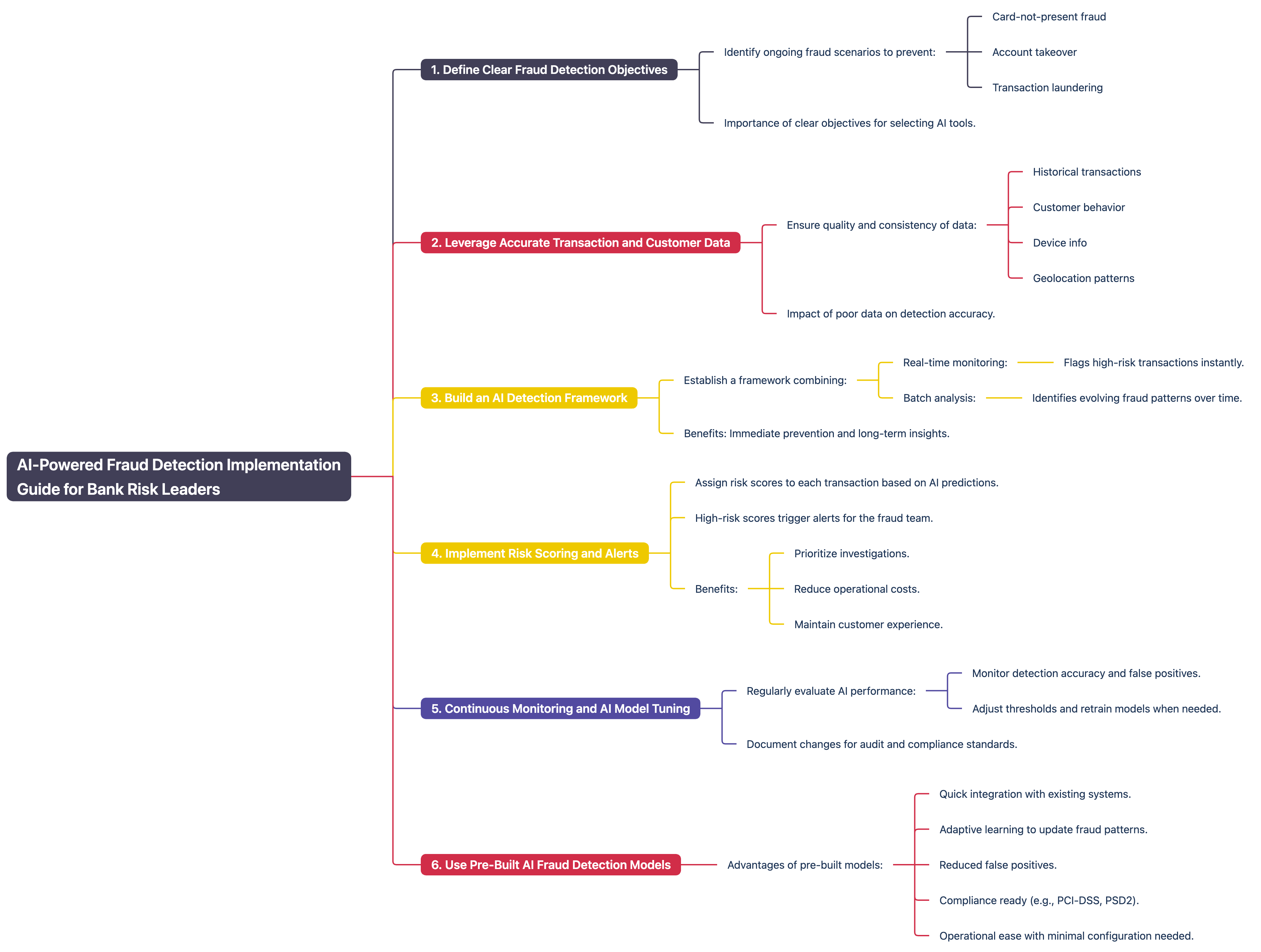
Implementing AI-Powered Fraud Detection requires a technical yet smart approach. Risk leaders must build a banking fraud prevention strategy on how they will use AI and analytics. Here are six key steps that define a roadmap to effective AI-based fraud detection in banking.
1. Define Clear Fraud Detection Objectives
Before implementing AI, the risk team should identify the ongoing fraud scenarios to prevent. This includes card-not-present fraud, account takeover, and transaction laundering. With clear objectives, selecting the right AI tool becomes easy.
2. Leverage Accurate Transaction and Customer Data
AI models need accurate and comprehensive data. The risk team should ensure quality and consistency of all kinds of data, which includes historical transactions, customer behaviour, device info, and geolocation patterns. Poor data can drastically reduce detection accuracy.
3. Build an AI Detection Framework
The risk team must establish a framework that combines real-time monitoring and batch analysis:
-
Real-time monitoring flags high-risk transactions instantly.
-
Batch analysis identifies evolving fraud patterns over time.
This ensures both immediate prevention and long-term insights.
4. Implement Risk Scoring and Alerts
Each transaction should receive a risk score based on AI predictions. High-risk scores trigger alerts for the fraud team. This helps the bank prioritize investigations and reduce operational costs while maintaining customer experience.
5. Continuous Monitoring and AI Model Tuning
Fraud evolves constantly. Risk teams must regularly evaluate AI performance:
-
Monitor detection accuracy and false positives.
-
Adjust thresholds and retrain models when fraud patterns shift.
-
Document changes to meet audit and compliance standards.
6. Use Pre-Built AI Fraud Detection Models
Pre-built AI models provide a ready-to-use solution for banks that want fast deployment. It offers:
-
Quick Integration: Works with existing banking systems without heavy IT changes.
-
Adaptive Learning: Continuously updates fraud patterns based on new transactions.
-
Reduced False Positives: Advanced algorithms reduce unnecessary transaction blocks.
-
Compliance Ready: Models include regulatory requirements like PCI-DSS and PSD2.
-
Operational Ease: Minimal configuration needed; risk teams can focus on investigations rather than coding.
Conclusion
The rise in credit card fraud requires a proactive approach. Banking risk teams should use predictive analytics, machine learning, and real-time transaction monitoring to detect suspicious activity before it escalates.
While implementing AI and analytics tools can be challenging, pre-built AI fraud detection models provide a practical solution. The right AI-based fraud detection tools for financial risk teams are those that have been tested.
FluxForce’s Aiden Flux brings real-time fraud scoring using ML models combined with hundreds of rules. With explainable alerts and plain-English summaries of flagged transactions, it helps risk teams quickly understand and respond to suspicious activity. With high detection accuracy and compliance with PCI-DSS and other regulations, it enables risk heads to prepare for modern fraud attacks.
Sources & Reports (External Links)
- Payment Card Fraud Losses Approach $34 Billion – Nilson Report via GlobeNewswire
- Card Fraud Losses Worldwide 2024 – Nilson Report
- FTC Consumer Sentinel Network Annual Data Book 2023
- Nationwide Fraud Losses Top $10 Billion in 2023 – FTC Press Release
- AI Is Helping Banks Save Millions by Transforming Payment Fraud Prevention – Mastercard
- On the Right Side of AI: Shaping the Future of Payment Fraud Prevention – Mastercard

Share this article