NOT BUILT — PHASE 3

AI Service Reliability That Predicts Outages Before They Happen

Sol Runnr — Senior AI Service Reliability Engineer

Your SRE team fights fires all day. Unplanned outages cost millions —in revenue, reputation, and regulatory penalties. Sol Runnr monitors every service health signal in real time, predicts degradation before  it cascades, and reduces unplanned outages by 70%. Target uptime: 99.99%. Deploy in 30 days. No migration.


23 Sol Runnr_Hero section_superhuman image (1)
profile

Devon Pulse

Senior AI Service Reliability Engineer

coming soon

99.99%

Service Uptime Target

70%

Unplanned Outage Reduction

<30s

Mean Time to Detect Degradation

100%

SLA Compliance Tracking

30 days

Deployment Timeline

Metrics from target production model. Based on financial services infrastructure patterns.
Trusted by Teams across Banking, Fintech, Insurance, and Global Trade
Logo 1 Logo 2 Logo 3 Logo 4 Logo 5 Logo 6 Logo 7 Logo 1 Logo 2 Logo 3 Logo 4 Logo 5 Logo 6 Logo 7
THE PROBLEM

The Problem Your SRE Team Faces Every Day

Your site reliability engineers respond to incidents after they happen. According to Gartner, the average cost of IT downtime for financial services organizations exceeds $5,600 per minute. Each unplanned outage triggers customer impact, regulatory scrutiny, and a post-mortem that reveals the warning signs were there all along.

Meanwhile, latency creeps up, error rates spike, and services degrade
silently until the cascade hits.


Reactive firefighting

SRE teams spend 60% or more of their time responding to incidents instead of preventing them. According to  the Uptime Institute, 70% of outages are preventable with better monitoring and early detection.


Latency blind spots

 Microservice architectures create hundreds of
  dependency chains. A latency spike in one service can cascade across
  the entire platform in minutes. Traditional threshold-based alerts
  miss gradual degradation until it becomes a customer-facing outage.


Compliance gaps

Regulators under DORA, PCI DSS, and ISO 27001 require documented evidence of operational resilience, incident response times, and SLA adherence. Manual reporting is slow, incomplete, and error-prone.

JOB DESCRIPTION 

What Sol Runnr Does — Job Description

Sol Runnr is a Senior AI Service Reliability Engineer that operates inside your infrastructure as a dedicated reliability specialist.

SOL RUNNR 

Senior AI Service Reliability Engineer  | FF-SRV

 Not Built (Phase 3)

Squad

Risk & Governance 

Reports To

Your CTO / VP Engineering / SRE Lead 

Works With

Existing observability, SIEM,and infrastructure systems

Deployed In

30 days (shadow mode first)

KEY RESPONSIBILITIES

01

Monitor uptime, latency, and service health across all
critical banking infrastructure  

02

Predict service degradation and outages before they impact customers using ML pattern analysis


03

Reduce unplanned outages by 70% through predictive alerting and early intervention

04

Track SLA compliance per service with regulatory-grade audit documentation  

05

Produce incident evidence chains for DORA, PCI DSS, and ISO 27001 compliance reporting  

AUTONOMY MODEL

Low risk —  Acts autonomously (restart services,scale resources, clear alerts)

Medium risk — HITL by default (configurable) 

High risk —  ALWAYS human review (non-negotiable)

  You configure the threshold per service

Kill switch : Disable instantly

PERFORMANCE METRICS

Measured Performance — Not Promises

These metrics are from Sol Runnr's target production model for regulated financial infrastructure.

99.99%
Service Uptime
target
70%
Unplanned Outage Reduction
fewer unplanned outages
<30 seconds
Mean Time To Detect Degradation
per incident
100%
SLA Compliance
per service tracked
High
Predictive Alert Accuracy
precision targeting
Real-time
Latency Anomaly Detection
continuous monitoring
All
Incident Correlation Accuracy
Automated root-cause mapping
100%
Audit Trail Coverage
every action logged

Model: Time-series anomaly detection with ensemble ML | Inputs: Uptime logs, latency metrics, service health, incident history, SLA definitions | Target validation: Phase 3 deployment

HOW IT WORKS

How AI Service Reliability Works with Sol Runnr

Sol Runnr connects to your existing observability stack as a sidecar — no data migration, no infrastructure changes. Here is how every service signal flows:

01

Ingest

Uptime logs, latency metrics, service health indicators, incident history, and SLA definitions flow into Sol Runnr via API integration with your existing monitoring tools — Prometheus, Datadog, Grafana, PagerDuty, or any observability platform.

02

Analyze

Every service health signal is analyzed continuously using ML models trained on historical outage patterns in financial services infrastructure. Sol Runnr identifies degradation trends, latency anomalies, error rate spikes, and resource saturation patterns that precede outages.


03

Predict

Based on the analysis, Sol Runnr generates predictive alerts:
  • Low risk → Triggers automated remediation (restart, scale, reroute)
  • Medium risk → Alerts SRE team with recommended actions (configurable)
  • High risk → Escalates immediately with full context (always)
Your team configures the threshold per service, per severity,
per action type.

04

Evidence

Every prediction, alert, and action produces:
  • A plain-English summary of what was detected and why it matters
  • Root-cause correlation mapping across dependent services
  • SLA impact assessment per affected service
  • An immutable, tamper-evident audit trail for regulators
Your compliance team gets the evidence trail. Your SRE team gets sleep.


Want to See This on Your Infrastructure?

Run Sol Runnr in shadow mode — 30 days, no risk, no migration. Compare his predictions against your actual incidents side by side.

COMPLIANCE & REGULATORY MAPPING

Regulatory Frameworks Supported

AI service reliability in regulated industries requires more than uptime — it requires provable operational resilience. Every prediction and action Sol Runnr makes is documented with regulatory-grade evidence.

DORA

DORA

Digital Operational Resilience Act, incident reporting and operational resilience requirements

PCI DSS

PCI DSS

Service availability and security monitoring

ISO 27001

ISO 27001

Information security management and incident response

SOC 2

SOC 2

Service availability and processing integrity controls

GDPR

GDPR

Data processing continuity and breach notification readiness

Basel III

Basel III

Operational risk management and resilience requirements

YOUR ANALYST'S VIEW

What Your SRE Team Sees

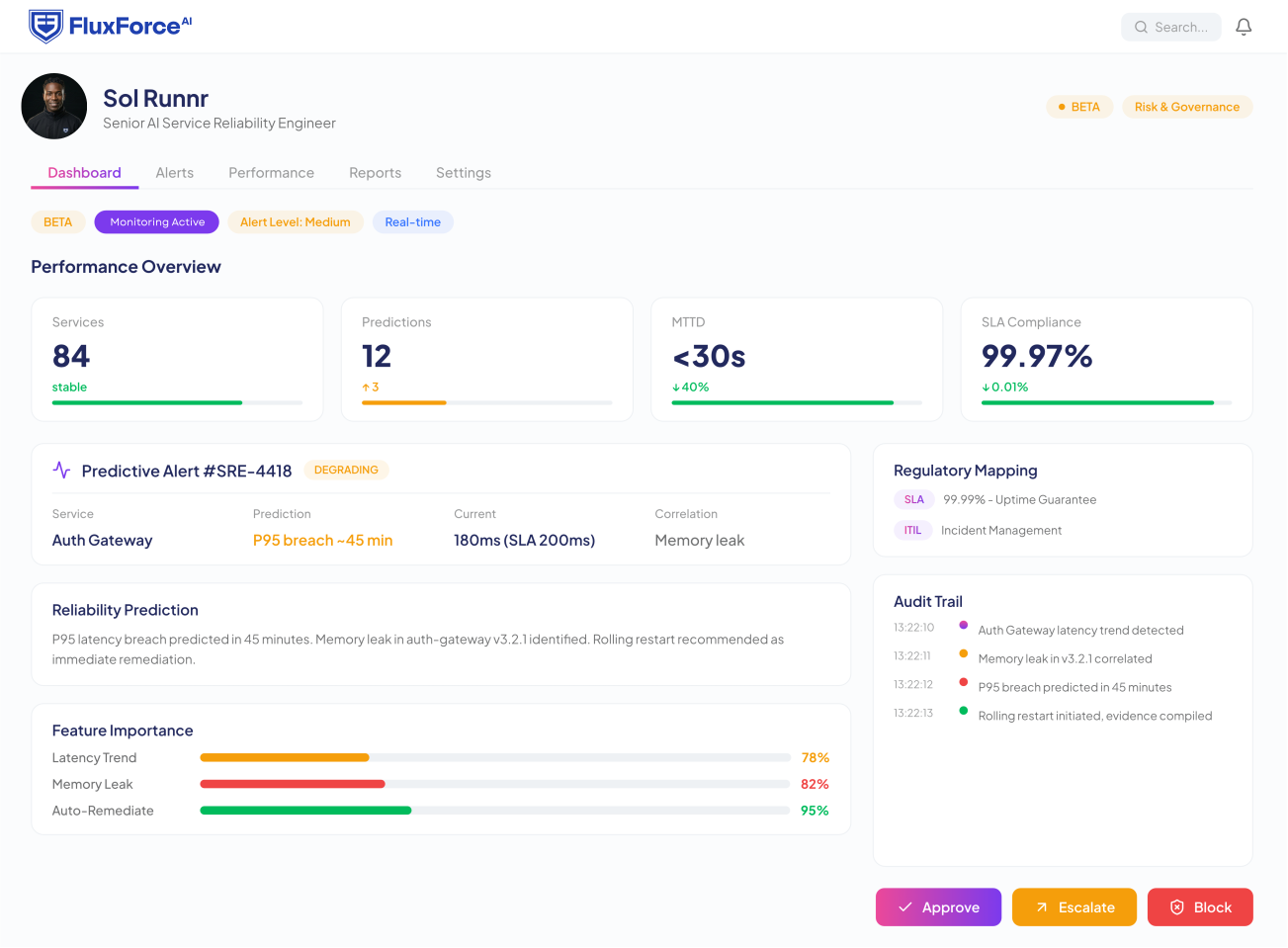
dash board1.22

Fewer surprises. Better sleep. Every prediction documented.

BEFORE vs AFTER  

BEFORE SOL RUNNR 

  • Reactive firefighting 
  • Hours to detect 
  • 20+ outages/quarter  
  • Manual SLA reporting  
  • Scattered logs

AFTER SOL RUNNR         

  •  Predictive alerts
  • <30 seconds MTTD
  • 6 or fewer/quarter
  • 100% automated  
  • Unified evidence

 ROI — AI SERVICE RELIABILITY vs HIRING vs LEGACY TOOLS

AI Service Reliability Cost Comparison — 2026

How does Sol Runnr compare to hiring SRE engineers or using legacy monitoring tools?

Criteria Hire 3 SRE Engineers Legacy Monitoring Stack Sol Runnr 
   Annual cost   $600K-$1.2M (salary + benefits) $150K-$500K (licenses + ops  $12K/year 
Deployment time  3-6 months (recruit + onboard 3-6 months (setup + tuning) 30 days 
Outage prediction Limited (pattern recognition) Threshold alerts only ML-based predictiv
Services monitored 10-20 per engineer  Varies by tooling Unlimited 
Compliance documentation Manual, quarterly  Partial logs  100% automated, continuous 
SLA tracking    Spreadsheet-based  Dashboard only Per-service, real-time, auditable 
   Scales with infrastructure   Hire more ($$)   Add licenses ($$)    Auto-scales
 Available 24/7   No (on-call rotation)   Yes (alerting only)   Yes (predict + respond)
  Learns from incidents   Yes (slowly)     No  Yes (continuous)


Key insight:According to Glassdoor, the average salary for a site reliability engineer in the United States is $140,000-$200,000 per year. A team of 3 SRE engineers costs $600K-$1.2M annually before benefits. Sol Runnr starts at  $1,000/month ($12,000/year) and monitors your entire infrastructure with predictive accuracy that improves over time.

WORKS BEST WITH

Agents That Work Best with AI Service Reliability

Sol Runnr delivers maximum impact when paired with these FluxForce SuperHumans:

Devon Pulse

Lead AI DevSecOps Pipeline Architect

Secures the CI/CD pipeline that deploys the services Sol  monitors

Learn now

Riya Intel

Director AI Governance & Model Risk

Monitors AI model drift and bias that could degrade service quality  Sol tracks 

Learn now

Theo Surge

Lead AI Transaction Surge Controller

Scales transaction processing capacity before Sol detects load pressure

Learn now
TRUST BUILDERS

 Built for Regulated Financial Infrastructure

Configurable Autonomy

Low risk: Sol acts autonomously (restart, scale, reroute).
Medium risk: HITL by default (configurable).
High risk: Always human review. You set the threshold per service, per severity, per action type.

Kill Switch

Disable Sol Runnr instantly. No system impact. No downtime. One click.

Shadow Mode

Run Sol Runnr on your live infrastructure for 30 days. Observation only — no actions, no changes. Validate prediction accuracy before going active.

Explainability

Every predictive alert includes a plain-English summary of what was detected, why it matters, and the recommended response. Root-cause correlation mapping shows exactly which service dependencies are involved.

Audit Trail

Every prediction, alert, and action logged with immutable,tamper-evident evidence chain. Regulation → service → evidence → action → outcome.

No Migration

Sidecar integration. Sol Runnr reads from your existing observability stack. Your infrastructure stays untouched.

Insights on AI Security,Compliance
& Financial Automation

Keep up with the latest AI trends, insights, and conversations.

Read Insights star
AI Insights star

Zero Trust banking: how CISOs secure core systems in 2026

AI Insights star

AML transaction monitoring: how AI cuts false positives by 60%

AI Insights star

Deepfake identity fraud: 5 detection gaps banks overlook

Questions? We Have Answers star

Frequently Asked
Questions

AI service reliability in financial services works by continuously monitoring uptime logs, latency metrics, service health data, and incident history across your entire infrastructure. Systems like Sol Runnr by FluxForce apply machine learning to detect patterns of degradation before they escalate into outages. Every prediction is documented with an audit trail that maps to regulatory frameworks like DORA, PCI DSS, and ISO 27001.
According to industry standards and regulatory expectations, critical banking services should target 99.99% uptime, which translates to less than 52.6 minutes of downtime per year. Sol Runnr by FluxForce helps financial institutions achieve and maintain this target through predictive degradation detection and automated incident response coordination.
Yes. Modern AI service reliability platforms use historical incident data, latency trends, error rate patterns, and resource utilization signals to predict outages before they impact customers. Sol Runnr monitors hundreds of service health signals in real time and generates predictive alerts, giving SRE teams time to intervene before degradation becomes a customer-facing outage.
AI service reliability reduces unplanned outages by detecting early warning signals — such as latency spikes, error rate increases, and resource saturation — that human operators often miss until they cascade into failures. According to the Uptime Institute, 70% of outages are preventable with better monitoring and early detection. Sol Runnr targets a 70% reduction in unplanned outages by catching degradation in its earliest stages.
AI service reliability uses configurable autonomy. Low-risk actions like restarting a non-critical service or scaling compute resources are handled autonomously. Medium-risk actions default to human-in-the-loop review but can be configured for autonomous response. High-risk actions affecting core banking services always require human approval — this is non-negotiable in regulated environments. The institution controls the threshold for every service and action type.
AI service reliability tracks service uptime percentage, mean time to detect degradation, unplanned outage frequency, SLA compliance per service, latency percentiles, error rates, resource utilization, and predictive alert accuracy. Sol Runnr by FluxForce provides real-time dashboards for all of these metrics with regulatory-grade audit trails for compliance reporting.
FluxForce pricing is customized based on transaction volume, regulatory requirements, and deployment model. Contact our team for a tailored quote.
AI Service Reliability - 99.99% Uptime. 30-Day Trial.