.webp)







Listen to our podcast 🎧

Introduction
CIOs in global banks manage identity and access across regions that rarely align. One regulator wants strict session controls. Another expects deeper audit trails. These demands sit on top of hybrid work, multiple clouds, and fast-moving operations. It creates a landscape where a single weak point can slow a payment run or trigger a compliance inquiry.
Public guidance from NIST stresses ongoing identity checks, and that view fits banking reality. Attackers prefer to compromise access rather than break networks. They often wait for an active session because it gives direct entry into payment systems and internal dashboards. This creates a straightforward but urgent question: how long can a bank trust a session once the user is authenticated?
This question sits at the center of risk ownership in modern banking environments. For a deeper risk-focused perspective, see Continuous User Verification: Zero Trust Security Architecture Strategy for Risk Heads in Banking. Banks once depended on network boundaries. That model struggles today. Staff move between office, remote, and mobile. Session tokens follow them. These changes create small cracks that attackers watch for. They know a firewall cannot detect unusual behavior inside a logged-in session.
This becomes visible during high-value operations. A stolen session can affect a SWIFT message, a treasury approval, or a branch system update. The threat hides inside normal activity. This is why is zero trust important for modern banking. The zero trust security model focuses on continuous validation, not a one-time login.
The case for watching sessions, not just identities
Banks are now shifting attention from login events to real user behavior. They need to see how a session evolves from the moment it starts. This is why continuous session monitoring for global banks is becoming a core expectation. It helps confirm that the right person remains behind the keyboard. It also gives CIOs early signs of drift, such as odd navigation paths or unusual timing patterns.
This brings up a deeper question. What signals tell a CIO that a session is no longer trustworthy even if the user originally passed MFA?
Continuous validation gives banks that clarity. It supports the identity-centric oversight regulators expect and reduces the blind spots that attackers exploit inside authenticated activity.
How AI Interprets User Behaviour and Flags High-Risk Insider Activities
Why banks need ongoing identity checks ?
In global banking, a login is only the starting point. Continuous authentication keeps validating identity throughout the session, so trust does not weaken after MFA. Banks use it because attackers often target active sessions, not firewalls. It forms the baseline for continuous session monitoring for global banks, which becomes a core part of the CIO’s Zero Trust strategy.
When MFA is not enough for high-value transactions ?
One-time MFA cannot protect long sessions used in SWIFT operations, treasury work, or trading desks. Attackers often wait until authentication is complete. They exploit session tokens and browser artifacts. This is why continuous risk-based authentication matters. It reacts to unusual behavior, odd navigation, or device changes in real time.
Adaptive controls that strengthen session security
Banks use adaptive authentication models to raise or lower scrutiny based on risk signals. Routine actions stay smooth. High-value actions trigger deeper checks. These signals feed directly into the Zero Trust layer that governs real-time session decisions. They help CIOs maintain identity confidence across borders and lay the foundation for fraud detection, behavioral analysis, and stronger session trust inside the broader zero trust strategy.
Why existing controls don’t meet continuous session monitoring needs ?
Most global banks still depend on older monitoring models that verify users only at login, rely on scattered identity systems, and provide inconsistent visibility across regions. These shortcomings directly block the execution of a continuous session monitoring zero trust strategy because risk cannot be evaluated in real time.
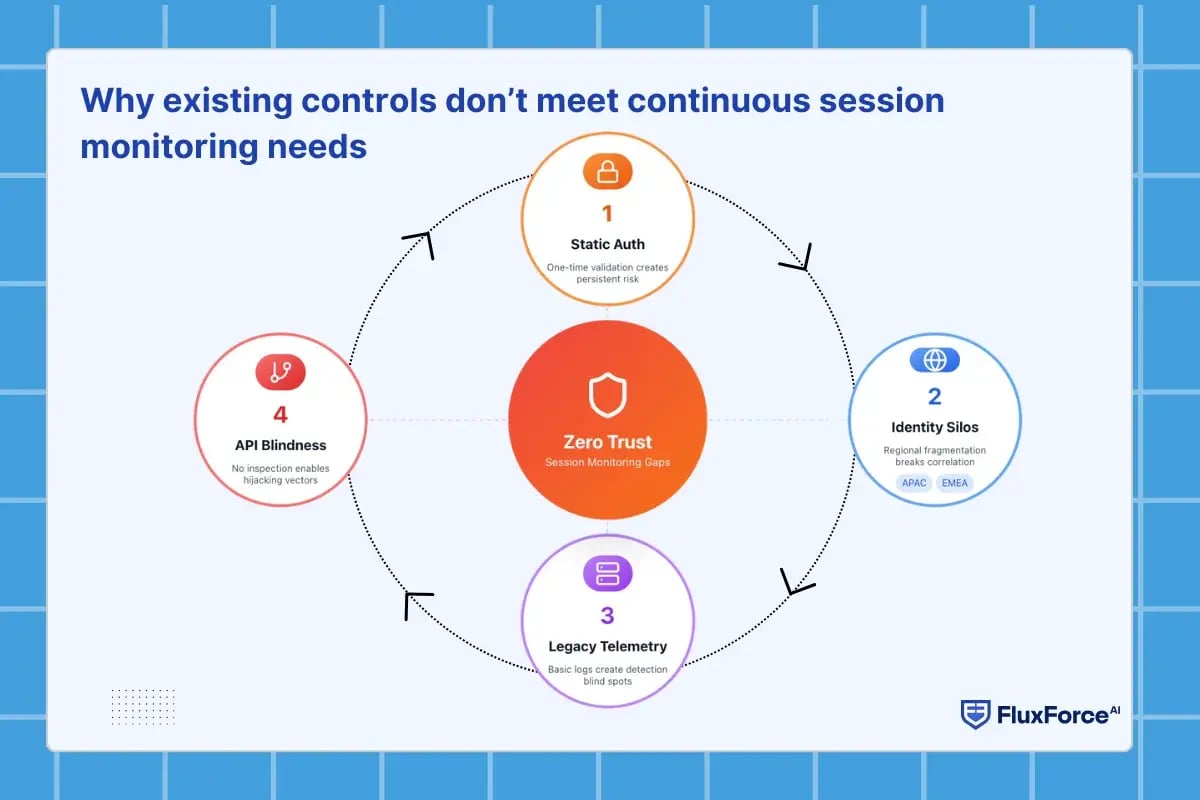
Core weaknesses that compromise session-level zero trust
1. Authentication that stops after login
Traditional IAM validates identity once, then assumes the user stays trustworthy. High-risk areas like trading desks, cross-border payments, and treasury operations require ongoing validation, not static trust.
2. Identity silos across regions and business units
Banks often maintain separate identity stores for APAC, EMEA and North America. This breaks end-to-end session correlation, a mandatory requirement for continuous monitoring and zero trust.
3. Legacy platforms with limited session telemetry
Mainframe systems, older trading applications, and custom-built banking modules generate only basic logs. Without fine-grained session signals, tools cannot detect behavioural drift, abnormal access paths, or subtle insider misuse.
4. API gateways without behavioural or risk controls
Older API layers simply pass requests without inspecting them for automation patterns, abnormal sequence flows or session hijacking attempts. This creates blind spots in workflows handling high-value customer and financial data.

Strategic impact on a zero trust session model
These limitations prevent CIOs from enforcing a continuous verification posture across their zero trust network. The result is measurable exposure across four dimensions:
- gaps in risk-based access decisions
- delayed detection of session anomalies
- inconsistent enforcement across channels
- higher exposure during privileged or high-value actions
Attackers specifically target these areas because they allow them to operate inside a “trusted” session without raising alerts.
The CIO strategy for continuous session monitoring
When we deployed continuous session monitoring across global banking operations, one truth stood out quickly: trust collapses the moment you treat a session as static. In a Zero Trust strategy, a session must evolve with the user, the workflow, the device, and the context. Anything less creates a blind spot wide enough for fraud, insider misuse, or session hijacking.

1. Treat session trust as a living control, not a login outcome
In practice, a login tells you almost nothing after the first few minutes.
What mattered in real operations was how the session behaved during high-value tasks—approving a SWIFT transfer, querying large treasury datasets, or running a cross-border compliance check.
So, we shifted from “authenticate, then trust” to “authenticate, then verify continuously.”
How can a CIO allow a session to stay trusted when the behaviour inside it no longer matches the person who logged in?
This mindset change allowed us to align continuous authentication with the bank’s enterprise risk model, not just its security stack.
2. Build behaviour-driven identity as the anchor of zero trust computing
On the trading floor, we saw that genuine users had repeatable patterns: typing rhythm, navigation flow, decision speed, window-switching habits. Attackers could imitate credentials, but they could not imitate behaviour. So we integrated behavioural biometrics with IAM, creating a unified trust model that supported continuous risk-based authentication across regions. This gave us a measurable way to distinguish legitimate activity from controlled or hijacked sessions.
3. Set governance rules before enabling analytics
The first challenge we faced was not technology. It was deciding which session signals could be collected in London, which could be processed in Singapore, and which could be stored centrally. Global banks cannot run unified analytics without clear governance.
Once governance was defined, zero trust policy enforcement for financial institutions became predictable, repeatable, and compliant with each jurisdiction’s privacy rules.
4. Use adaptive controls to protect high-value workflows
The turning point came when we mapped risk signals to micro-actions. If a trader’s behaviour drifted, we introduced a verification step. If a SWIFT operator’s session began showing unusual navigation, we moved the session to view-only mode until identity confidence recovered.
If a compliance analyst accessed data from an unrecognized location pattern, we issued a just-in-time prompt.
These adaptive controls protected essential operations without introducing friction. To understand how these controls are structured and implemented across banking operations, read Banking Access Controls: Zero Trust Security Architecture Strategy for Banking Ops Heads.
5. Make privileged session oversight part of core operations
When we integrated privileged session monitoring into daily operations, not just audits, the risk surface changed. Every privileged user had a live trust score. This made treasury desks, core banking admins, and vendor support far more transparent and far easier to govern under the zero trust network model.
6. Build an analytics loop that learns from real incidents
The strategy only reached full maturity when we created a feedback loop. Fraud patterns from APAC informed risk scoring in Europe. Behavioural anomalies in North America adjusted baselines in the Middle East. SOC insights refined our decision thresholds every month.
This loop turned continuous session monitoring from a control into a learning system that strengthened Zero Trust day by day.
Enhance security with continuous session monitoring.
Empower your internal audit strategy!
Conclusion
Global banking cannot rely on static controls when most credential abuse happens inside active sessions. Weak identity trust creates gaps that spill directly into trade-compliance errors, audit delays, and regulatory exposure. A Continuous Session Monitoring Zero Trust Strategy gives CIOs a unified path to stabilize identity behavior, reduce manual review work, and maintain consistent compliance across regions. According to IBM’s 2025 Cost of a Data Breach Report, organizations that extensively deploy security AI and automation — including real‑time identity validation, behavioral anomaly detection, and automated response — reduced their breach lifecycle by an average of 80 days and saved approximately $1.9 million per incident. Given the dominance of identity‑based attack vectors, these capabilities position continuous authentication and session‑level risk analysis as foundational controls for secure and compliant global banking operations.
With rising pressure on accuracy, speed, and risk governance, the direction is clear. Strengthening session trust is now central to strengthening the bank.


Share this article