.webp)





Listen To Our Podcast🎧
Introduction
79% of organizations experienced attempted or actual payments fraud in 2024, according to the AFP Payments Fraud and Control Survey Report. US finance teams faced at least 13 invoice fraud attempts per month in 2024, with the average loss per incident reaching $133,000, according to a Medius survey of US and UK finance teams.
Invoice tampering remains one of the most costly and persistent challenges in financial fraud detection. Unlike external cyberattacks, invoice fraud exploits the trust built into accounts payable workflows, the vendor looks familiar, the format matches previous invoices, and the amount falls within expected ranges. By the time the manipulation is detected, the payment has already cleared.
This is why AI fraud detection has become essential for enterprise finance teams. Manual reviews cannot scale against modern invoice fraud volumes. Legacy rule-based systems miss the subtle pattern shifts that AI catches. And AI in accounting environments that rely on black-box detection create a new problem: alerts arrive without explanation, compliance teams cannot justify decisions, and audit trails break down.
The Explainability Gap in AI Fraud Detection
However, detection alone is not enough. Many AI fraud detection tools operate as black boxes. They flag risk but fail to explain it. This creates friction for AI risk management. Without AI transparency and a clear AI audit trail, compliance breaks down.
Explainable AI addresses this gap. Through model explainability and XAI in finance, organizations can understand why an invoice was flagged and what triggered the alert. This strengthens payment fraud analytics, while supporting financial compliance automation.
Explainable AI for invoice tampering detection enables audit-ready AI systems. It improves AI-based invoice fraud detection, supports automated invoice validation, and aligns explainable AI compliance with regulatory needs.
In this blog, we explore how explainable AI transforms invoice fraud prevention without slowing finance operations.
Invoice Tampering Detection in AI Risk Management
Invoice tampering detection focuses on identifying unauthorized invoice changes before payment. These changes include altered totals, manipulated line items, modified bank details, and repeated submissions. In enterprise environments, these issues directly impact AI risk management and overall financial fraud detection.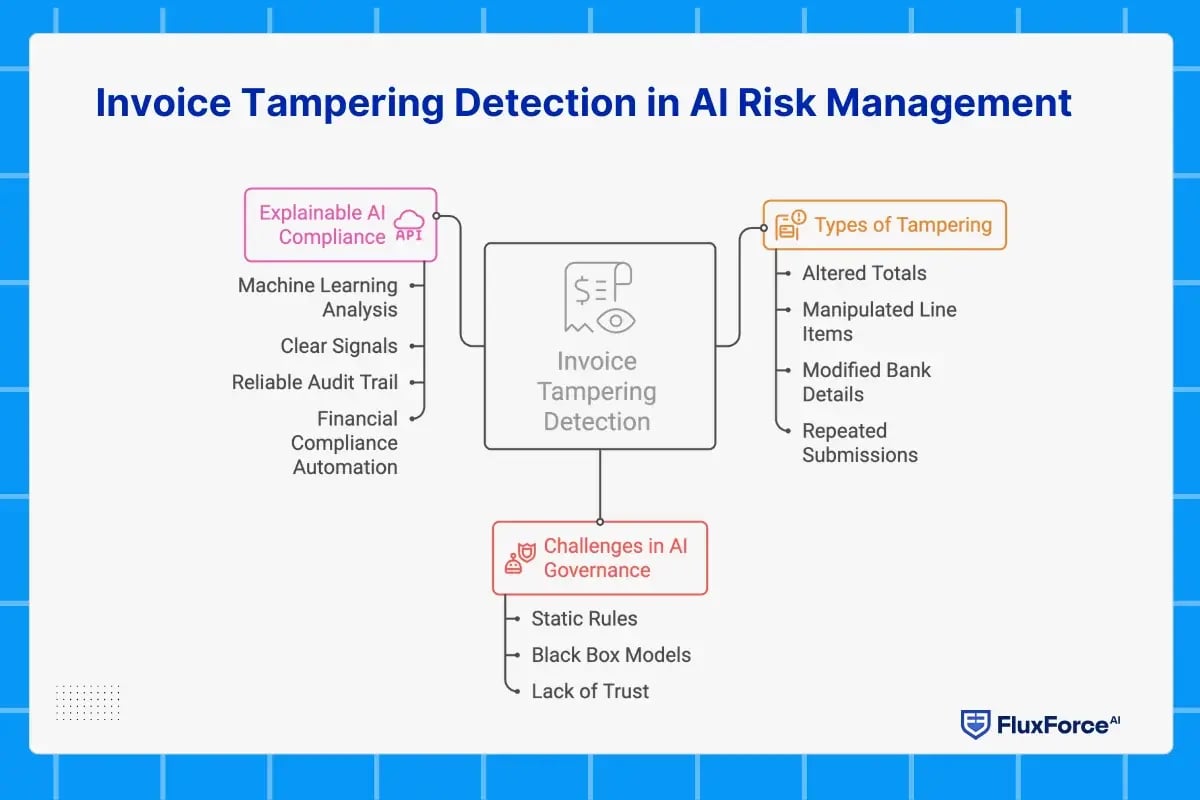
This type of fraud often bypasses manual reviews. The invoice looks valid. Vendor names appear familiar. Amounts fall within expected ranges. That is why invoice fraud detection using machine learning has become essential in AI in accounting systems.
Why Rule-Based Controls Fail AI Governance in Finance ?
Traditional controls rely on static rules and thresholds. They trigger alerts only when preset limits are crossed. This approach does not scale well and weakens AI governance in finance.
Early AI fraud detection models also create problems when they act as black boxes. Finance teams receive alerts without explanations. This limits trust and slows down response times. It also complicates internal reviews and regulatory reporting.
Without clear reasoning, fraud detection using AI cannot support enterprise-grade compliance.
Explainable AI Compliance in Invoice Tampering Detection
Modern AI-based invoice fraud detection uses machine learning to analyze invoice structure, vendor behavior, and transaction history. These systems enable invoice anomaly detection, duplicate invoice detection, and vendor fraud detection at scale.
What makes the difference is Explainable AI compliance. Each alert is supported by clear signals. This could include pricing deviations, unusual edits, or mismatched vendor data. These insights create a reliable AI audit trail.
Explainability strengthens financial compliance automation and supports audit-ready AI systems. It allows finance and compliance teams to act with confidence. This is critical for deploying AI fraud detection for enterprises.

How AI Detects Invoice Tampering in Real Accounts Payable Workflows ?
Most invoice fraud is not obvious. In real finance teams, tampered invoices often pass initial review because they look correct.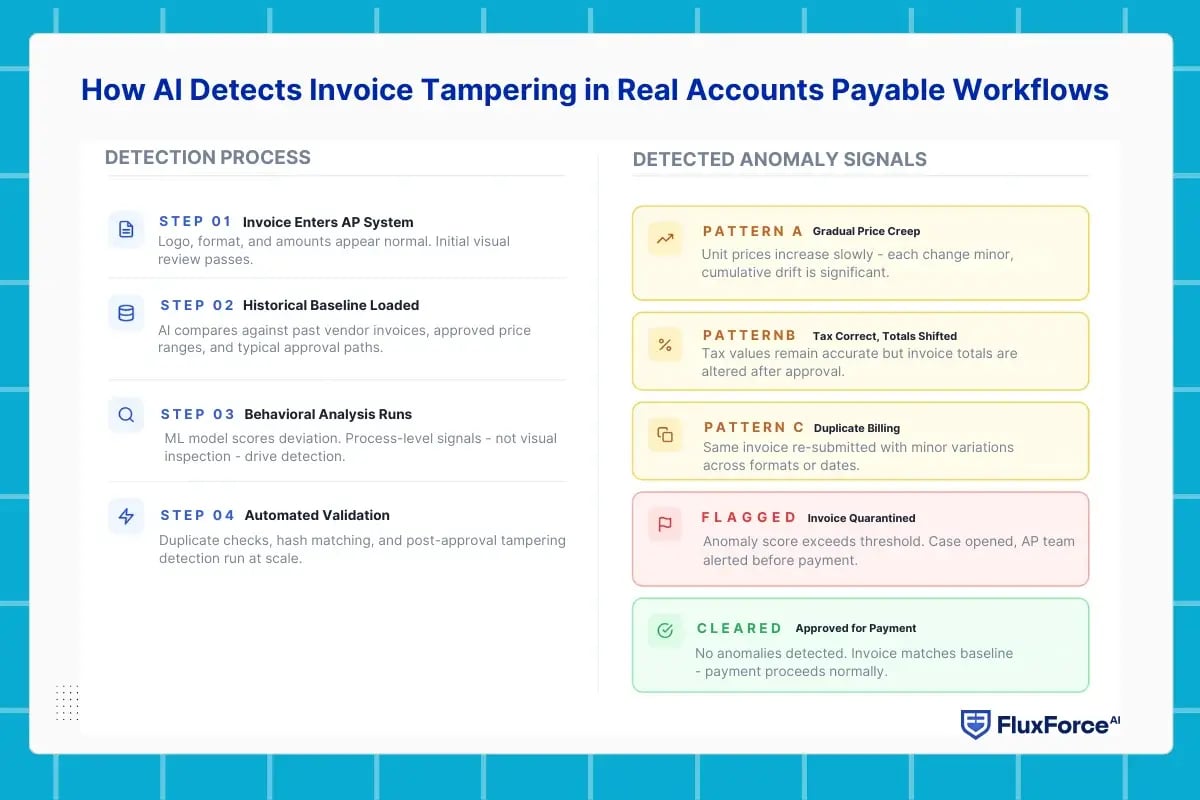
Logos match. Formats are familiar. Amounts appear reasonable.
This is why AI fraud detection focuses on process-level signals, not visual inspection alone. Effective invoice tampering detection starts by understanding how invoices normally move through accounts payable.
AI-Based Invoice Fraud Detection at the Transaction Level
Practical invoice fraud detection using machine learning analyzes invoice behavior across time. The system compares each invoice against historical invoices from the same vendor, approved price ranges and billing frequency, typical payment timelines and approval paths, and normal approval workflow sequences.
When an invoice deviates from these patterns, it triggers a transaction anomaly detection event but what separates machine learning from rule-based detection is the threshold: rules flag only known conditions, while machine learning invoice fraud detection identifies statistically abnormal patterns even when no explicit rule has been broken. A unit price that increases 3% across four consecutive invoices stays below any fixed threshold but represents a behavioral anomaly that ML models surface consistently.
Invoice Anomaly Detection Beyond Rule-Based Checks
Traditional rules fail when fraudsters stay within thresholds.
Invoice anomaly detection using AI identifies risk when:
- A unit price increases gradually across invoices
- Tax values remain correct but totals shift
- Line items change while vendor details stay the same
These patterns are hard to detect manually. AI models surface them consistently.
This is how fraud detection using AI scales without adding manual workload.
Duplicate and Manipulated Invoice Detection
One of the most common Account Payable fraud types is repeated billing.
Duplicate invoice detection uses:
- Content similarity checks
- Hash-based matching across file formats
- Vendor and amount correlation over time
AI also detects invoice manipulation when totals, bank details, or line items are altered after approval.
These capabilities support automated invoice validation in high-volume environments.
How Explainable AI Enables Accountable Decisions in Invoice Tampering Detection
Invoice tampering detection only creates value when finance teams can explain and justify their decisions. In banking and financial services, AI explainability is now the top issue raised in regulatory engagements which means unexplained invoice fraud decisions create direct regulatory exposure, according to IIF-EY's 2025 analysis.
In regulated environments, every blocked or approved invoice must be defensible. Explainable AI compliance means that the reasoning behind each fraud decision is captured automatically. AI governance in finance frameworks increasingly require this as a baseline expectation: decisions that affect financial transactions must be traceable, reviewable, and explainable to internal and external reviewers without requiring the compliance team to contact the data science team for interpretation.
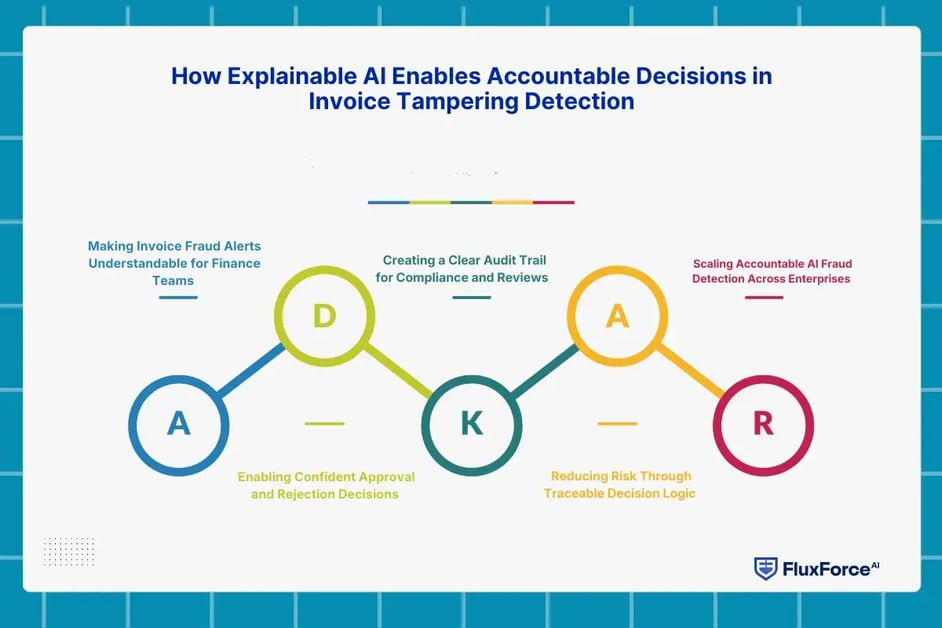
Making Invoice Fraud Alerts Understandable for Finance Teams
AI fraud detection systems often identify invoice manipulation through complex patterns. Without explanation, these alerts are difficult for humans to trust.
Explainable AI translates technical signals into clear reasons. It highlights exactly what triggered the alert, such as unusual price changes, altered vendor details, or mismatches with historical invoices. This clarity allows finance teams using AI in accounting to act with confidence rather than hesitation.
Enabling Confident Approval and Rejection Decisions
In invoice processing, every decision carries financial and regulatory impact.
Explainable AI supports accountable decisions by showing how each invoice deviates from normal behavior. Reviewers can see whether the issue relates to invoice anomaly detection, duplicate invoice detection, or potential vendor fraud detection. This reduces guesswork and ensures decisions are consistent and documented.
Creating a Clear Audit Trail for Compliance and Reviews
Auditors and regulators expect clear justification for payment decisions.
Explainable AI systems automatically generate an AI audit trail that records what was flagged, why it was flagged, and how the issue was resolved. This supports financial compliance automation and reduces the need for manual explanations during audits.
Such traceability is essential for organizations operating under strict AI governance in finance frameworks.
Reducing Risk Through Traceable Decision Logic
Unexplained AI decisions increase operational and regulatory risk.
Explainable AI strengthens AI risk management by ensuring that invoice tampering detection outcomes are traceable and reviewable. Risk teams can validate that detection logic aligns with internal controls and compliance policies.
This makes Explainable AI a key requirement for audit-ready AI systems.
Scaling Accountable AI Fraud Detection Across Enterprises
As enterprises scale invoice processing, accountability becomes harder to maintain.
Explainable AI enables AI fraud detection for enterprises by ensuring consistent, explainable decisions across regions, vendors, and teams. It allows organizations to expand AI-driven invoice tampering detection without sacrificing trust or compliance.
Making Invoice Tampering Detection Audit-Ready for Enterprises
Detecting invoice tampering is not enough for large finance teams. Every alert must withstand audits, internal reviews, and regulatory scrutiny. Explainable AI enables this level of accountability.
Explainable AI strengthens AI risk management by attaching clear reasoning to every invoice fraud detection alert. Signals such as unusual edits, pricing deviations, or abnormal vendor activity create a consistent AI audit trail. Compliance teams can review and validate decisions without technical dependency.
This transparency supports AI governance in finance by allowing organizations to define rules, thresholds, and escalation paths. As a result, AI fraud detection for enterprises operates within controlled and auditable boundaries.
Explainability also accelerates financial compliance automation. When invoice anomaly detection and duplicate invoice detection are explainable, audits become faster and less disruptive. This is what enables truly audit-ready AI systems in invoice tampering detection.
Conclusion
Invoice tampering is no longer a simple accounting error. It is a growing form of financial fraud that exploits scale, speed, and trust in Accounts Payable workflows.
90% of US companies were targeted by cyber fraud in 2024, with the use of generative AI tactics such as deepfakes and deepaudio increasing by 118%, driving invoice fraud sophistication to levels that manual AP controls and static rule-based systems cannot address, according to Trustpair's 2025 Fraud in the Cyber Era report.
Invoice fraud prevention software powered by explainable AI closes this gap by addressing both components of the modern AP fraud challenge: detection accuracy through machine learning that adapts to evolving fraud patterns, and decision accountability through explanation records that finance, compliance, and audit teams can use immediately without additional interpretation.
For enterprises, this combination transforms AI fraud detection from a reactive alert system into a governance-grade control. Every blocked payment has documented reasoning. Every approved invoice has a traceable decision record. Every audit inquiry produces structured evidence rather than manual reconstruction. Financial fraud detection powered by explainable AI is what makes accounts payable workflows both protected and defensible simultaneously.

Share this article