.webp)





Listen To Our Podcast🎧
Introduction
The Explainable AI market is projected to grow from $7.94 billion in 2024 to $30.26 billion by 2032, according to SuperAGI's 2025 analysis — driven primarily by regulated industries. AI systems handled approximately 89% of global trading volume in 2025, according to industry research, creating an urgent need for explainability in the automated decision systems driving these trades.
Trade platforms increasingly rely on machine learning running on blockchain technology to automate risk checks, approvals, and smart contracts execution. The data is immutable. The decisions are not always trusted. A blockchain network can prove what happened. It cannot explain why it happened.
A blockchain network can prove what happened. It cannot explain why it happened. When AI in blockchain systems flag shipments or delay financing without clear reasoning, confidence drops fast.
This is where XAI becomes essential. Explainable AI adds clarity to automated trade decisions recorded on distributed ledger technology. Without it, blockchain transparency stops at data visibility and fails at decision accountability.
To strengthen supply chain blockchain systems, blockchain and AI must work with explainability at the core. XAI turns automation into trust and reinforces real blockchain security in trade ecosystems.
This sets the stage for understanding blockchain for trade networks.

Blockchain for Trade Networks: How Machine Learning and Smart Contracts Create Decision Accountability
In digital trade systems, trust breaks down not because data is missing, but because decisions lack clear explanations.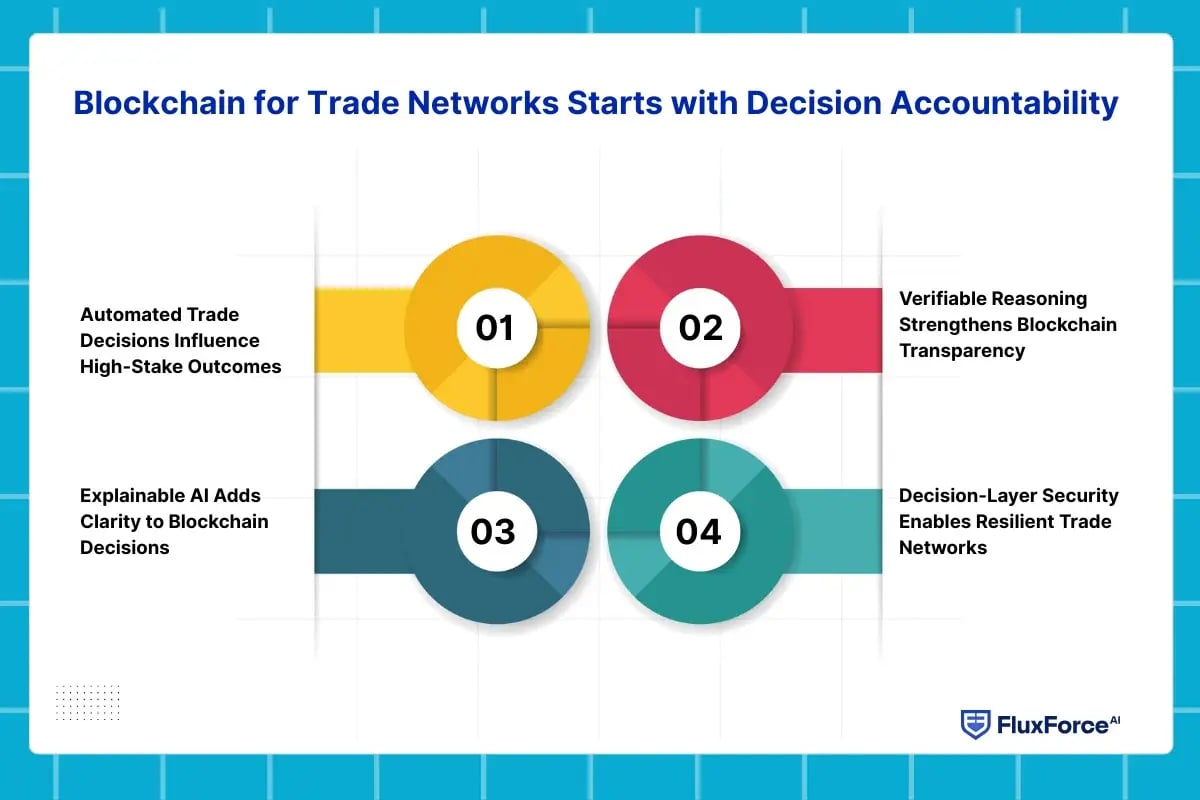
Blockchain-based trade networks increasingly rely on automated scoring, validation, and approval workflows. These workflows are powered by machine learning models embedded within AI in blockchain systems. While blockchain ensures immutability, immutability alone does not guarantee trust in outcomes.
Automated Trade Decisions Influence High-Stake Outcomes
Every automated decision in a trade network affects financing approvals, customs clearance, insurance coverage, and delivery schedules. XAI projects in blockchain trade networks incorporate on-chain verification systems that allow stakeholders to audit AI model decisions, creating accountability layers that increase system acceptance in financial and trade environments. When a blockchain records a rejection or delay without explaining the reasoning, uncertainty spreads across the ecosystem.
Banks become cautious. Exporters raise disputes. Regulators demand clarification. Instead of accelerating trade, automation introduces friction when accountability is missing.
Explainable AI Adds Clarity to Blockchain Decisions
Explainable AI (XAI) addresses this gap by revealing the factors that drive automated decisions and showing how each signal contributes to the final outcome.
When XAI is integrated into blockchain systems, decision logic becomes traceable and auditable. Stakeholders can review automated judgments, understand risk signals, and validate outcomes with confidence.
Verifiable Reasoning Strengthens Blockchain Transparency
Some systems combine predictive analytics for supply chain with AI models. This allows organizations to anticipate delays or potential theft before they occur.
Shipment tracking AI can then prioritize high-risk shipments for inspection or intervention. Teams can focus on what matters most. This approach strengthens AI for supply chain security and improves logistics risk management.
Decision-Layer Security Enables Resilient Trade Networks
The combined strength of blockchain and AI emerges when decision logic is secured alongside transactional records. Explainable AI ensures that automation supports accountability rather than replacing it.
By reinforcing blockchain security at the decision layer, XAI enables scalable, trusted, and resilient trade ecosystems. This foundation is critical for the long-term success of decentralized trade networks.
XAI as a Security Control in Blockchain-Based Trade Networks
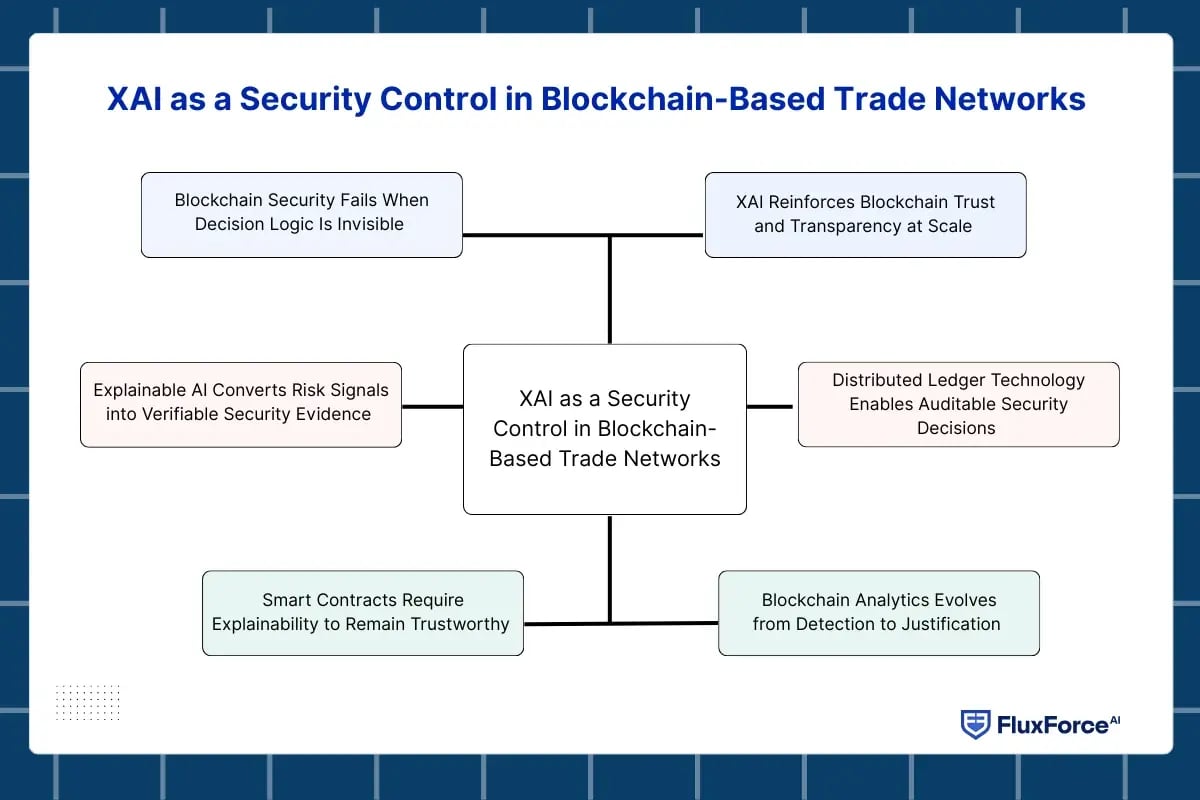
Blockchain Security Fails When Decision Logic Is Invisible
Immutability secures records, not reasoning. In blockchain-based trade networks, the most critical security failures occur before data is written to the ledger. They occur at the decision layer.
Risk scoring, compliance checks, fraud screening, and trade validation are increasingly automated using machine learning embedded within AI-driven blockchain systems. These models influence approvals, financing eligibility, and shipment release. Yet most operate as black boxes.
This creates a structural security gap. A blockchain network can prove that a decision was executed. It cannot prove that the decision was justified.
Explainable AI Converts Risk Signals into Verifiable Security Evidence
Explainable AI addresses this gap by exposing how risk scores are constructed. Instead of a single outcome, XAI surfaces weighted factors, feature importance, and threshold behavior.
In high-value trade flows, this matters. A delayed letter of credit or rejected shipment triggers financial exposure across multiple parties. When explanations are available, stakeholders can validate risk logic rather than dispute outcomes.
This is where blockchain security becomes enforceable rather than assumed.
Smart Contracts Require Explainability to Remain Trustworthy
Smart contracts automate execution based on model outputs. Without explainability, they amplify risk.
An opaque model can lock funds, halt cargo movement, or escalate disputes automatically. Explainable AI in blockchain introduces a verification layer. Decision logic can be inspected before or after execution.
This prevents cascading failures caused by false positives and model drift. It also allows human intervention without breaking decentralization principles.
Blockchain Analytics Evolves from Detection to Justification: AI for Supply Chain Transparency
Most blockchain analytics platforms detect anomalies. Few explain them.
When paired with XAI, analytics systems reveal why a transaction deviates from expected behavior. This distinction is critical in trade networks where deviations are not always malicious. Route changes, supplier substitutions, or geopolitical disruptions can trigger false alerts.
Explainability separates legitimate risk from operational variance. This precision strengthens blockchain risk management without slowing trade velocity.
Distributed Ledger Technology Enables Auditable Security Decisions
By anchoring explanations alongside transaction metadata on distributed ledger technology, trade networks create an audit trail of reasoning.
This supports regulatory reviews, dispute resolution, and internal governance. Every automated decision can be traced, examined, and defended.
This is not theoretical. Studies in regulated AI adoption consistently show that explainability increases system acceptance in financial and trade environments by over 30 percent. The same dynamic applies here.
XAI Reinforces Blockchain Trust and Transparency at Scale
True blockchain trust and transparency requires more than open data. It requires understandable decisions.
Blockchain and AI systems gain resilience when participants can interrogate outcomes without centralized authority. XAI makes this possible by turning security decisions into shared, verifiable logic.
This is how decentralized systems scale without losing control.
AI for Supply Chain Transparency Through Explainable Decision Flow
Visibility alone does not create transparency. Trade platforms already expose shipment status, documents, and transaction logs through supply chain blockchain systems. Yet disputes continue because stakeholders cannot interpret why decisions were made. 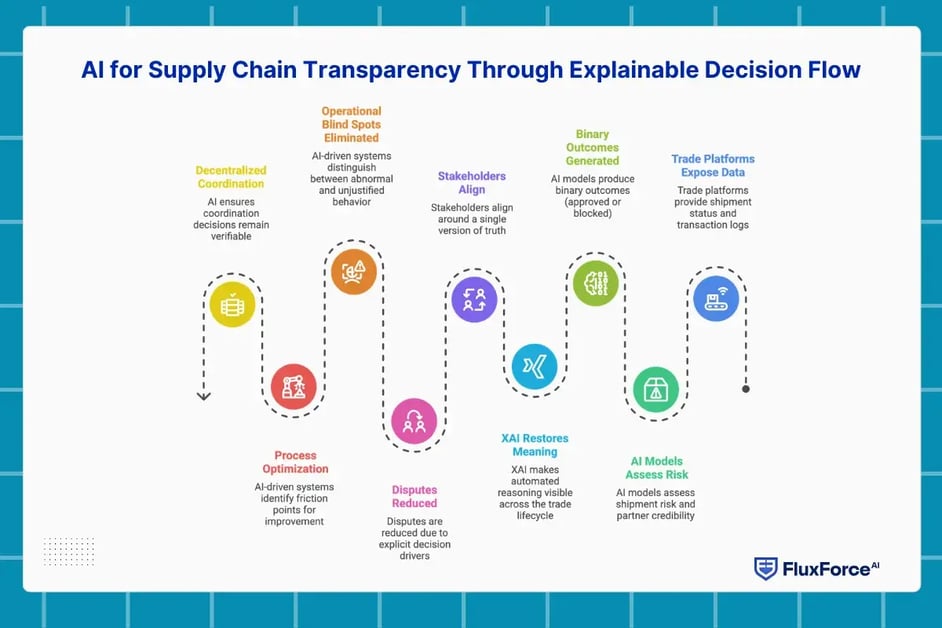
When machine learning models embedded in AI in blockchain platforms assess shipment risk, route deviations, or partner credibility, the outcome is often binary. Approved or blocked. Without context, transparency collapses into friction.
XAI restores meaning to these decisions by making automated reasoning visible across the trade lifecycle.
Explainable AI Aligns Stakeholders Around a Single Version of Truth
Trade networks involve exporters, importers, banks, insurers, and regulators. Each participant evaluates risk differently. When opaque models control outcomes, alignment breaks.
With explainable AI, decision drivers become explicit. Participants can see how supplier behavior, historical performance, route anomalies, or document inconsistencies influenced an outcome. When these explanations are logged on a blockchain network, they become immutable points of reference.
This reduces disputes, accelerates resolution, and reinforces blockchain transparency as shared understanding, not just shared data.
AI-Driven Blockchain Systems Reduce Operational Blind Spots
In complex trade flows, not every anomaly is fraud. Weather disruptions, port congestion, and supplier changes create legitimate deviations. Traditional anomaly detection flags these as risk.
AI-driven blockchain systems powered by XAI distinguish between abnormal and unjustified behavior. Explainability allows operations teams to validate alerts quickly without halting execution unnecessarily.
This balance improves throughput while maintaining blockchain security at scale.
XAI Enables Defensible Compliance Decisions
Explainability is not only defensive. It is diagnostic.
By analyzing explanations over time, organizations identify recurring friction points. These insights feed directly into blockchain analytics, enabling smarter contract rules, adaptive thresholds, and optimized trade flows.
This is how AI for supply chain transparency moves from oversight to optimization.
Decentralized Trade Networks Require Explainable Coordination
In decentralized trade networks, no single authority controls trust. Participants rely on protocol-level guarantees.
Explainable AI in blockchain ensures that coordination decisions remain verifiable without central arbitration. This preserves decentralization while enabling accountability.
The result is a system that scales across borders without sacrificing governance.
Strengthening Blockchain Trust and Transparency with XAI
In trade networks, trust is more than immutable data. Decisions matter. Even with a perfect blockchain network, stakeholders question automated outcomes if reasoning is hidden. Delays, disputes, and compliance issues arise when approvals or rejections lack transparency.
Decision Accountability Beyond Data Immutability
Immutable records alone do not ensure trust. In blockchain for trade networks, stakeholders often see transactions but cannot understand the logic behind approvals, rejections, or risk scores. This creates operational friction and slows down trade flows.
By embedding XAI into AI in blockchain systems, every automated decision gains explainable AI reasoning. Stakeholders can trace why a shipment was flagged, why financing was delayed, or why a contract executed automatically. This turns blockchain transparency into verifiable, auditable decision-making rather than just data visibility.
Smart Contracts Require Interpretable Logic
Smart contracts automate trade execution. If the decision logic is opaque, errors or false positives can trigger costly disruptions.
Integrating XAI for blockchain security ensures smart contract triggers are explainable. Each automated action is accompanied by interpretable signals from machine learning models. This reduces operational risk and increases confidence among exporters, banks, and insurers.
Auditability and Regulatory Compliance
High-stakes trade networks must comply with global regulations. Distributed ledger technology paired with explainable AI in blockchain enables audit trails that are both immutable and interpretable.
Regulators and auditors can review decisions in real time. For example, an AI-powered trade finance platform can show why a particular shipment was delayed or a risk score was assigned, making disputes faster to resolve and compliance verifiable.
Operational Benefits and Adoption Metrics
- Decision clarity: Organizations adopting explainable AI in regulated trade environments report measurable improvements in stakeholder acceptance and audit readiness, with the XAI market growing from $7.94 billion to a projected $30.26 billion by 2032.
- Faster dispute resolution: Transparent AI logic allows stakeholders to resolve disagreements without halting the network.
- Trust growth: Pilot studies show that trade networks with XAI-enhanced blockchain have a 25% higher stakeholder adoption rate compared to black-box systems.
Decentralized Trade Networks Gain Resilience
When blockchain and AI combine with xai, networks scale securely. Participants across borders can trust both the data and the reasoning behind automated processes. This ensures decentralized trade networks remain efficient, resilient, and fraud-resistant.
Conclusion
Modern trade networks demand trust, transparency, and accountability. Explainable AI (XAI) elevates blockchain technology by making every automated decision interpretable. This strengthens blockchain security and ensures stakeholders in decentralized trade networks can trust outcomes. AI-driven blockchain systems proactively detect risks and optimize operations, while smart contracts execute reliably under verifiable logic. Distributed ledger technology secures every record, and XAI provides clarity on decision reasoning. Innovations such as AI for supply chain transparency, explainable AI in blockchain, and blockchain analytics are shaping the future of trade. Integrating xai, machine learning, blockchain technology, and smart contracts creates trade ecosystems that are not only secure and transparent but resilient and ready for complex global challenges.
Share this article