.webp)








Listen To Our Podcast🎧

Introduction
Black-box AI systems quickly become a business liability when internal teams cannot explain why trade transactions are blocked or delayed. Even with advanced AI deployed across financial services, institutions have experienced losses up to $4.4 billion as per EY (with machine-generated predictions contributing 53%).
The problem is not model accuracy. It is the lack of defensible decision evidence when:
- Altered bills of lading or inflated invoices pass through.
- Regulators ask for justification.
- Customers challenge rejected documents.
- Internal risk teams review escalations.
In each case, unresolved explanations translate into longer resolution cycles and days of manual rework.
As AI in finance continues to receive larger platform investments, automation without accountability becomes unsustainable. Trade finance platforms now require interpretable machine learning in finance to ensure that every automated risk signal can be reviewed, validated, and defended across operations.

Why interpretability matters in AI for finance ?
Financial operations, from trade finance to corporate banking, carry regulatory, monetary, and reputational risks. Deploying AI in finance can help manage these risks at scale, but interpretability is what that ensures every automated decision can be defended and acted upon.
Without interpretable AI:
- Every alert needs deep investigation– Operations teams, on average, spend 15–30 minutes or more per false alert just to validate transactions that black box AI provides with no clear explanation.
- Teams waste time checking harmless cases– About 90% of flagged alerts are false positives, and staff must review each case carefully before clearing it.
- Regulators challenge unexplained decisions– Audit and compliance teams ask for documented reasoning for every automated decision, which increases review time and raises regulatory exposure.
- Customer disputes escalate– When clients question blocked or delayed transactions, internal teams fail to provide a clear explanation for why the system flagged them.
- Internal trust erodes– Risk and operations teams avoid relying on AI, defeating automation goals and forcing manual intervention.
How interpretable AI builds trust in financial decisions
AI becomes trustworthy when it delivers transparency and accountability. Interpretable machine learning models convert hidden technical decisions into insights that humans can understand and act. In short, it turns black-box AI into explainable AI (XAI) that demystifies automated decisions in finance operations.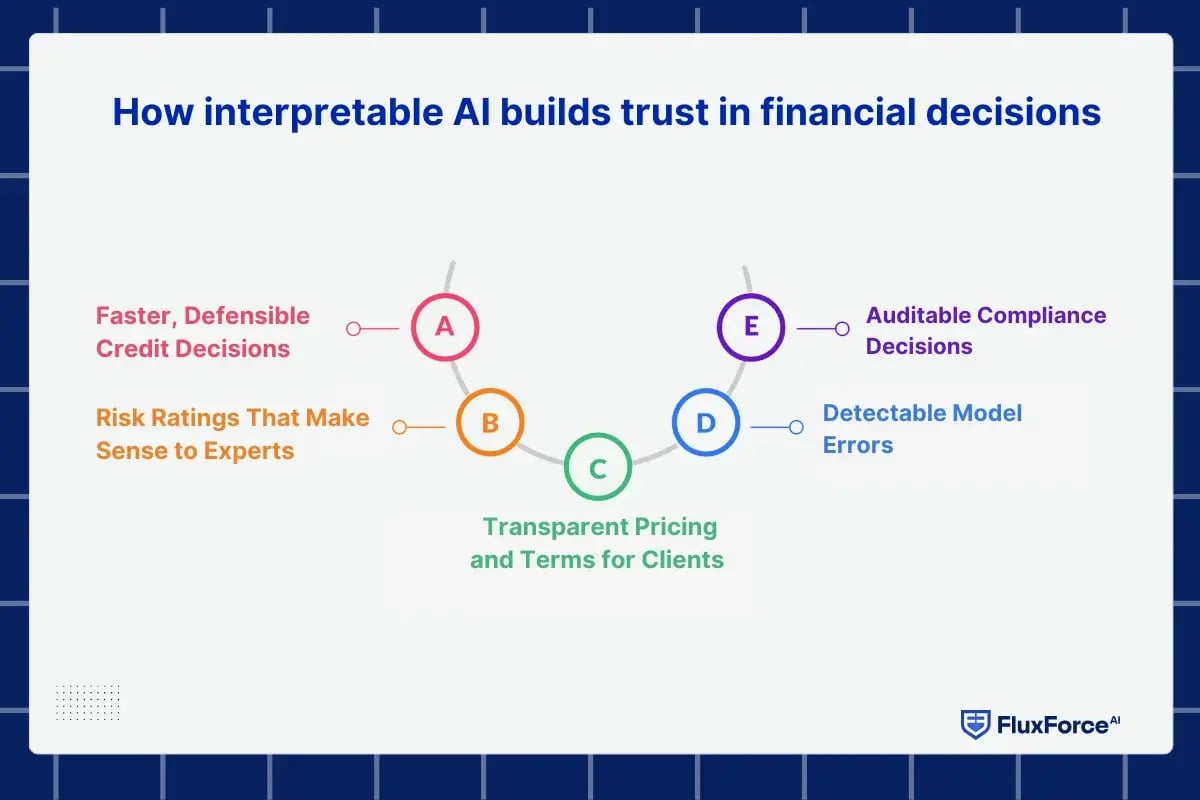
Here's how XAI strengthens trade finance trust:
1. Faster, Defensible Credit Decisions
Interpretable AI shows exactly why a letter of credit or transaction was flagged—whether due to late payments, shipment delays, weak buyer records, or country risk. Operations teams can explain these decisions clearly to clients, reducing disputes and ensuring trust in automated approvals.
2. Risk Ratings That Make Sense to Experts
With interpretable models, credit officers understand how each factor contributes to the risk score. From importer history to sector volatility and currency exposure, human teams can validate AI recommendations, combining machine insights with their own market expertise.
3. Transparent Pricing and Terms for Clients
AI models explain how fees, discount rates, or collateral requirements are determined for invoice factoring or supply chain finance. Clients see the rationale behind their terms, eliminating perceptions of arbitrary decisions and strengthening trust in the platform.
4. Detectable Model Errors
Transparent logic exposes when AI makes faulty assumptions or relies on outdated data. If the system penalizes a client due to misinterpreted shipping documentation or stale commodity prices, trade specialists immediately identify the flaw and correct it before it affects other decisions or client relationships.
5. Auditable Compliance Decisions
Every sanction screening, AML flag, or regulatory check generates clear documentation showing which transaction attributes triggered alerts. Compliance teams demonstrate to regulators exactly why certain shipments were held, approved, or escalated, proving adherence to legal requirements with concrete evidence rather than algorithmic opacity.
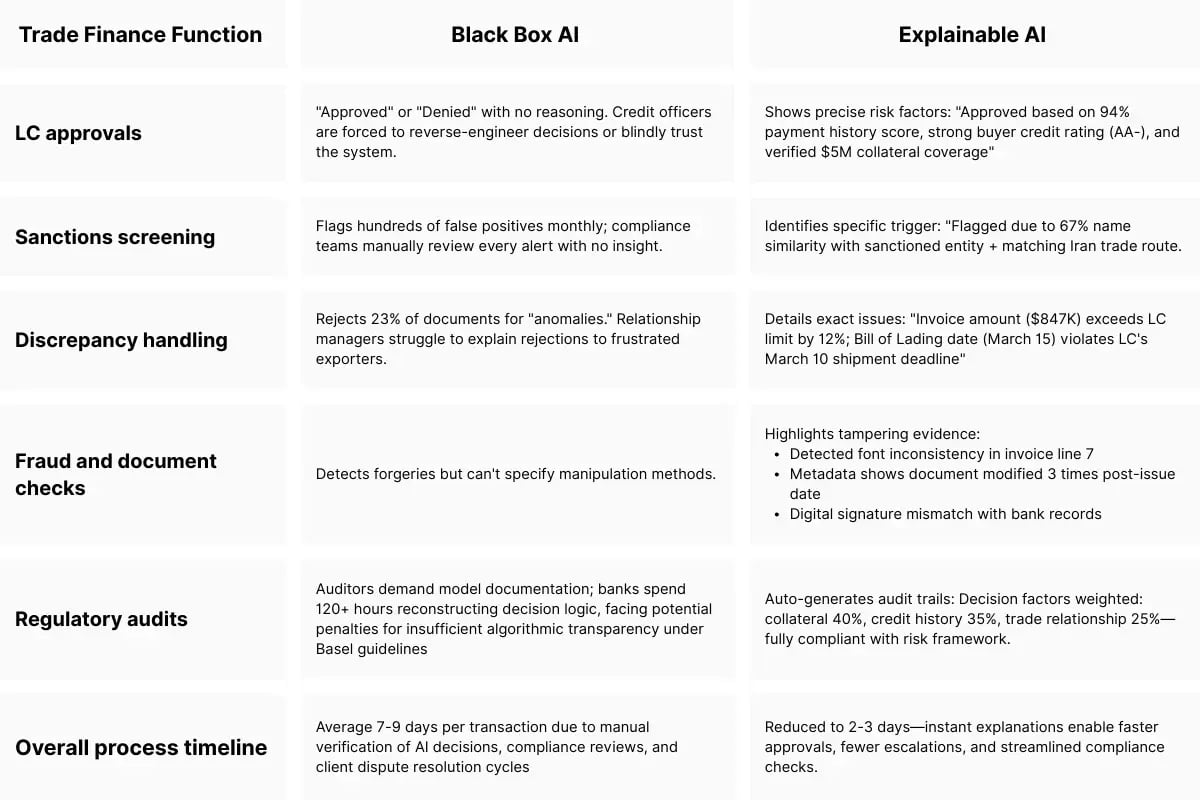
Explainable AI vs Black box AI: Solving Trade Finance Challenges
If AI cannot explain why it approved a $2M letter of credit or flagged a shipping document as fraudulent, financial institutions can never truly trust it with decisions.
When comparing explainable AI vs black box AI in trade financial services, here's what emerges:
Comprehensive benefits of Interpretable Machine Learning for trade finance platforms
Interpretable machine learning models deliver significant advantages across compliance, customer relations, and operational efficiency: 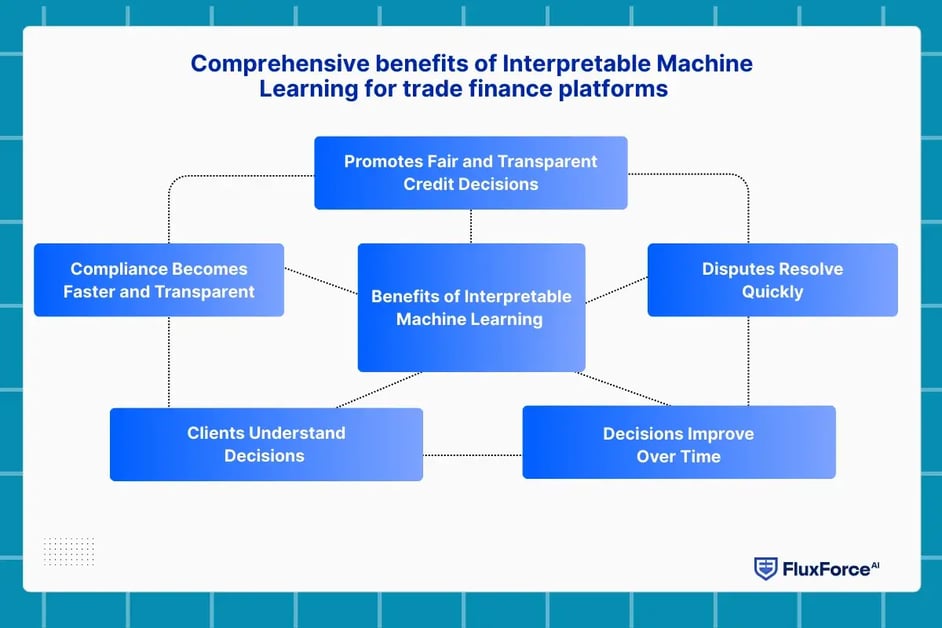
1. Promotes Fair and Transparent Credit Decisions
Interpretable AI ensures financing decisions are consistently fair by revealing which factors influence approvals and rejections. Platforms can audit processes to prevent unintended bias based on geography, company size, or industry, guaranteeing equitable access to trade credit for all exporters.
2. Compliance Becomes Faster and Transparent
Explainable AI generates clear, traceable documentation for every decision, allowing compliance teams to demonstrate how risk, sanctions, and lending thresholds were assessed. This capability reduces audit time, lowers examination costs, and strengthens regulatory confidence in trade finance platforms.
3. Clients Understand Decisions
When clients receive specific explanations for approvals, adjustments, or rejections, they know what steps to take to improve outcomes. This transparency transforms routine interactions into advisory opportunities, helping exporters improve processes.
4. Decisions Improve Over Time
Visible decision logic allows finance teams to identify and correct algorithmic errors quickly. When specialists spot models overweighting irrelevant factors or missing critical trade finance nuances, they refine training data and parameters
5. Disputes Resolve Quickly
Clear explanations make it easier to handle challenges to financing decisions. Teams can respond with concrete evidence for approvals or rejections, resolving conflicts faster and protecting client relationships without unnecessary delays.
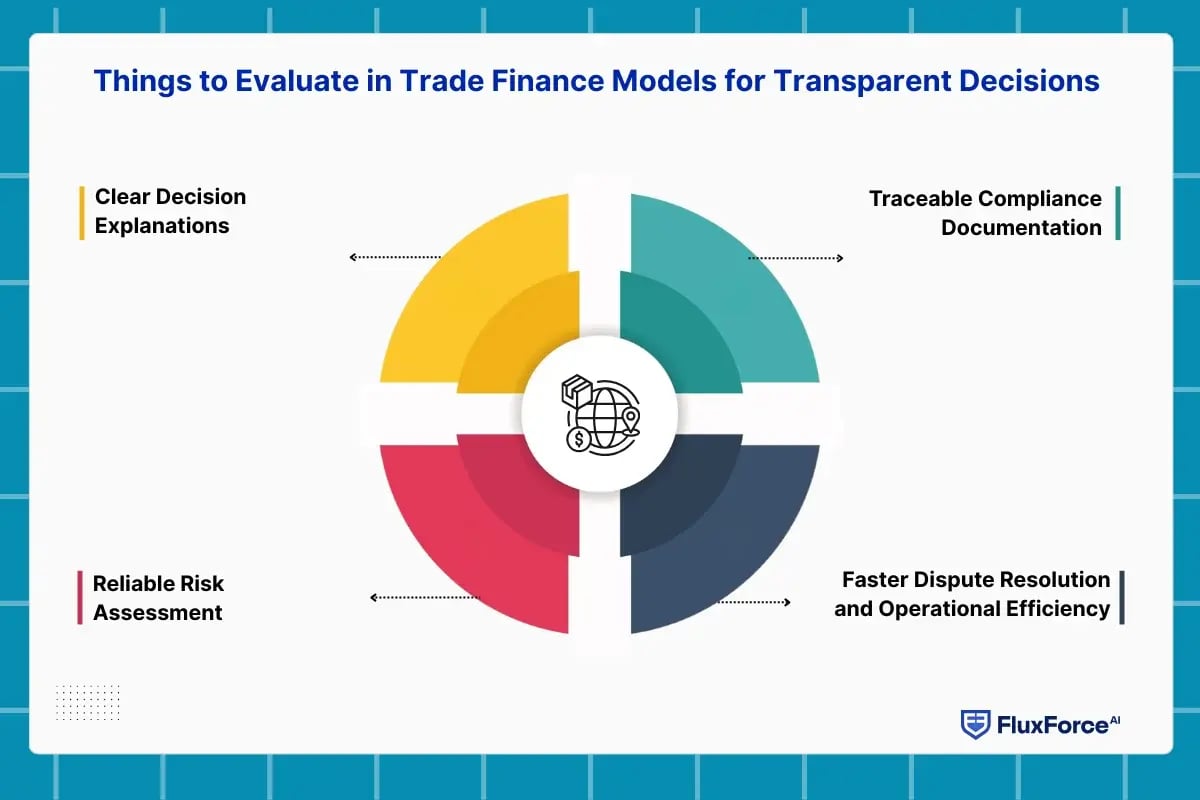
Things to Evaluate in Trade Finance Models for Transparent Decisions
1. Clear Decision Explanations
For ensuring the best trade finance decisions, select models that make every approval, rejection, or hold fully understandable. Teams should see exactly why a decision was made, allowing them to explain outcomes confidently to clients and regulators.
2. Reliable Risk Assessment
The platform should accurately measure credit and operational risks, taking into account factors like buyer history, shipment schedules, and country exposure. Transparent scoring helps teams validate decisions and reduce errors while maintaining consistent standards.
3. Traceable Compliance Documentation
Models must provide audit-ready records for every decision. Complete documentation allows compliance teams to respond quickly to regulators, demonstrating how risk thresholds, sanctions checks, and approvals were consistently applied across all transactions.
4. Faster Dispute Resolution and Operational Efficiency
Choose systems that support quick resolution of disputes and exceptions. When teams can access clear reasoning and data immediately, conflicts are handled efficiently, processing times are reduced, and client relationships remain strong.
Conclusion
Trade finance decisions carry regulatory obligations, contractual responsibilities, and potential customer disputes. When a transaction is flagged or an LC approval is delayed, teams must clearly explain why.
Without transparency, banks face resolution delays, escalations to compliance, and challenging discussions with regulators.
Interpretable models make every decision traceable, helping teams act confidently and meet regulatory standards. These models also improve operational efficiency, reduce errors, and strengthen trust with clients.
With interpretable machine learning in finance, now the bank:
- Follows regulations
- Can prove it acted responsibly
- Stays protected from compliance problems and fines



Share this article