.webp)




%20Detects%20Emerging%20Fraud%20Patterns%20Faster.webp)



Listen To Our Podcast🎧
%20Detects%20Emerging%20Fraud%20Patterns%20Faster%20%20(1).png)
Introduction
Fraud techniques, over time, have moved away from simple rule-based checks to small, fast-changing behaviour patterns. While organizations are investing heavily in AI-driven security to control fraud, fraudsters are making equal efforts to use AI to bypass modern defences.
According to data published by the Federal Trade Commission (FTC), reported fraud losses reached over $12.5 billion in 2024, with significant emerging patterns crafted using modern AI solutions.
The real challenge today is not just finding fraud, but recognizing when a new pattern is quietly forming. Most AI systems can observe activity across transactions and accounts. Very few can clearly show what has changed, how those changes connect, and why they indicate emerging risk.
Explainable AI helps organizations detect new fraud earlier by making behaviour changes visible and clearly explaining why an activity looks risky, instead of only producing a risk score.
As regulators such as the Financial Conduct Authority (FCA) and European Banking Authority (EBA) place increasing significance on transparency and accountability, explainable AI is becoming key to enterprise fraud intelligence.

Why detecting new fraud trends with AI is often delayed ?
Fraud is no longer predictable. In every quarter, new schemes emerge and in more advanced, hard-to-detect ways. Across global banks, the deployed models can flag anomalies based on historical data, which " do not clearly explain” why a transaction or account seems suspicious.
What most banking AI security models lack is:
1. Transparency in decision-making- AI often provides a risk score without clarifying the reasons behind it, leaving teams uncertain.
2. Contextual awareness- Models frequently analyse transactions in isolation, missing small behavioural shifts across accounts.
3. Real-time adaptability- Systems trained on past patterns may struggle to detect new, evolving fraud trends.
4. Actionable insights- Alerts rarely offer guidance, forcing analysts to reconstruct timelines manually.
5. Regulatory alignment- Black-box models fail to meet growing transparency requirements from regulators.
A recent survey highlights that 80% of banking professionals cited a lack of explanation as their core AI usage concern. The problem is not AI-powered systems, but explainability.
How does XAI identify fraud patterns early ?
Explainable AI (XAI) enables early fraud pattern identification by continuously monitoring transactions, accounts, and user behaviour while highlighting why specific activities appear suspicious.
This predictive insight lets teams identify subtle behaviour changes before fraud escalates. Here’s a breakdown of how explainable AI detects fraud before fraud causes significant damage:
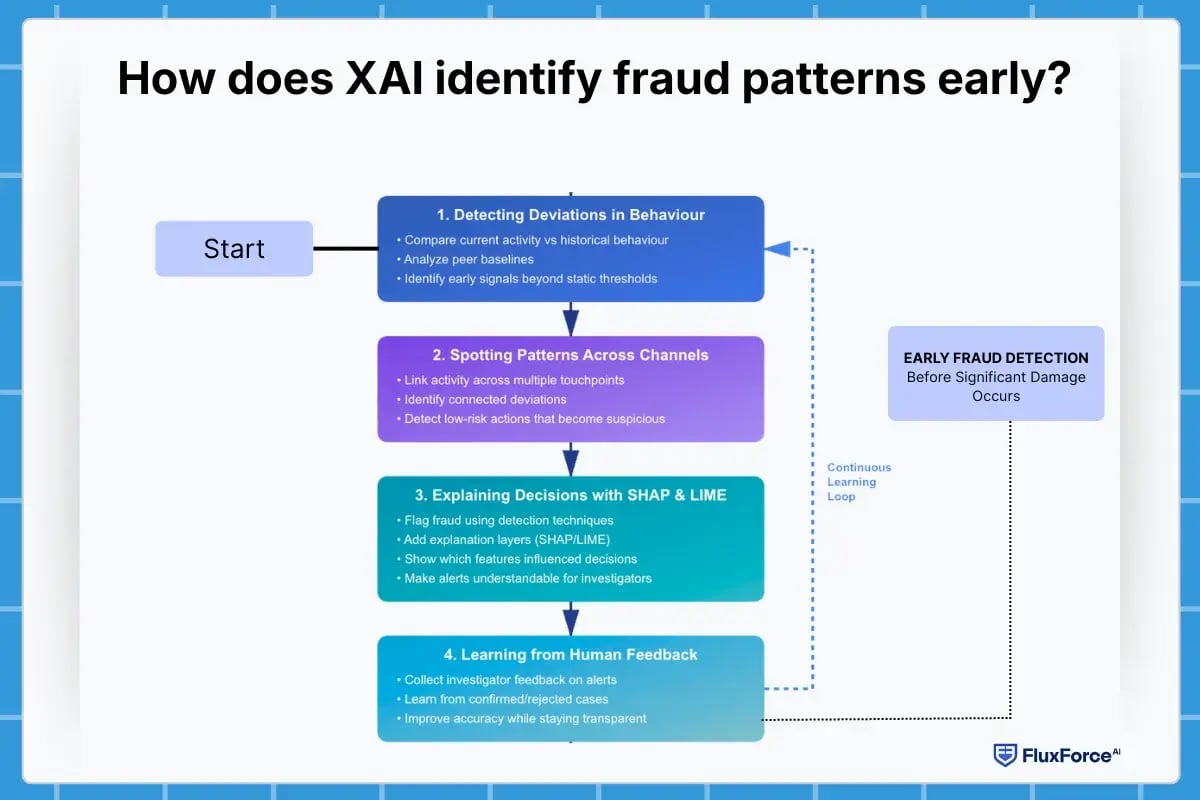
1. Detecting Deviations in Behaviour
XAI compares current activity against historical behaviour and peer baselines. Instead of relying on static thresholds, it highlights where behaviour has changed, helping teams identify early signals of emerging fraud.
2. Spotting Patterns Across Channels
Fraud rarely appears in a single transaction. XAI links activity across channels and touchpoints, identifying connected deviations that isolated systems miss, such as low-risk actions that become suspicious only when viewed together.
3. Explaining Decisions with SHAP and LIME
XAI flags fraud using standard detection techniques but adds explanation layers through SHAP (SHapley Additive exPlanations) and LIME (Local Interpretable Model-agnostic Explanations). These show which features influenced the decision, making alerts understandable and usable for investigators.
4. Learning from Human Feedback
XAI models improve through investigator feedback on flagged cases. When analysts confirm or reject alerts, the system learns which explanations mattered, improving accuracy while remaining transparent as fraud patterns evolve.
Explainable AI vs Traditional AI: Why Explainable AI is better for fraud detection
When it comes to countering sophisticated fraud in regulated banking environments, transparent AI models provide a clear advantage. Traditional AI focuses on detection accuracy, while explainable AI focuses on understanding change, which is critical when fraud patterns evolve quietly and rapidly.
The scenario below clarifies the difference between a black-box traditional AI system and an explainable AI system when responding to an emerging fraud attack.
How traditional AI responds
An emerging fraud attack targets a bank’s payment systems. A black-box AI model flags unusual transactions based on historical patterns.
- High-risk scores are generated across hundreds of transactions
- No visibility into why behaviour changed
- Analysts spend hours reconstructing timelines across systems
- False positives increase investigation load by 30–40%
- Decisions are difficult to justify during audits
Traditional AI detects anomalies, but the lack of explanation slows investigation and increases operational friction.
How explainable AI responds
The same fraud attack occurs, but an explainable AI system is in place.
- Behaviour shifts are flagged at the pattern level, not the transaction level
- Explanations show which features changed and how they connect
- Related activity across accounts is linked automatically
- Investigation time drops from hours to minutes
- Decisions are traceable, auditable, and regulator-ready
Explainable AI not only detects fraud but makes emerging patterns visible, enabling faster action and confident decision-making before fraud causes damage.
What Explainable AI offers for Financial Crime Prevention ?
Beyond identifying emerging fraud, explainable AI strengthens financial crime prevention by making decisions auditable, defensible, and regulator-ready. Here’s how explainability turns detection into sustained financial crime control:
1. Turning alerts into regulator-ready evidence
Explainable AI for regulatory reporting ensures every flagged activity comes with clear reasoning. Compliance teams can demonstrate why an action was taken, reducing dependence on manual explanations during regulatory reviews.
2. Making fraud detection audit-ready by design
Audit-ready AI fraud detection allows investigators and auditors to retrace decisions instantly. Instead of rebuilding timelines, teams can review documented logic, shorten audit cycles and reduce operational friction.
3. Keeping AI models aligned with compliance expectations
AI model interpretability for compliance enables continuous oversight of model behaviour. Explainable AI helps institutions validate fairness, consistency, and governance even as financial crime tactics evolve.
4. Connecting signals into clear financial crime narratives
Explainable analytics for financial crime links behavioural signals across accounts and channels. This visibility helps teams understand how risk develops over time, supporting early intervention before financial crime escalates.
Essential fraud detection strategies for CISOs, CROs, and risk leaders
While XAI provides the foundation for enterprise-grade fraud detection, institutional leaders must ensure key strategic controls are in place to translate detection into effective risk reduction. 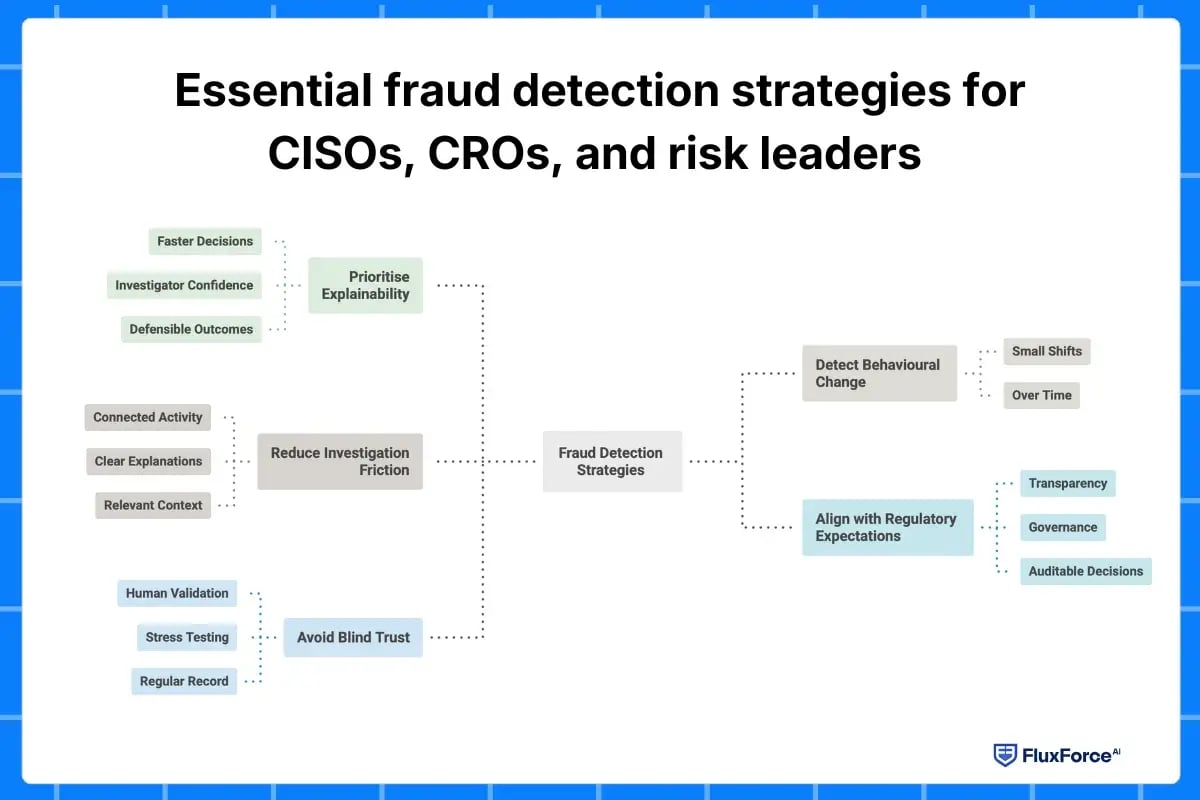
#1. Prioritise explainability over pure accuracy
High accuracy alone is insufficient in regulated environments. Leaders should ensure fraud systems explain why risk is flagged, enabling faster decisions, investigator confidence, and defensible outcomes during audits and regulatory reviews.
#2. Detect behavioural change, not just anomalies
Fraud increasingly emerges through small behavioural shifts. Detection strategies should focus on identifying how behaviour is changing over time, rather than reacting only to single anomalous transactions.
#3. Reduce investigation friction
Fraud tools must shorten investigation cycles, not add complexity. Systems should surface connected activity, clear explanations, and relevant context so teams avoid manually reconstructing timelines across accounts and channels.
#4. Align detection models with regulatory expectations
CISOs and CROs must ensure fraud models meet transparency and governance standards. Explainable, auditable decisions reduce regulatory risk and prevent compliance gaps as fraud tactics and models evolve.
#5. Avoid blind trust, even in Explainable AI
Explainability does not remove the need for oversight. Leaders should keep humans in the loop validation, stress testing, and a regular record of AI decisions to prevent over-reliance and false confidence in automated outcomes.
Conclusion
Leveraging transparent AI models for fraud detection enables organizations to act proactively against financial crime. Traditional systems rely on past patterns and often react too late when behaviour shifts subtly.
Explainable AI continuously monitors transactions, accounts, and user behaviour, showing not just anomalies but why activities appear suspicious. By connecting signals across accounts and channels, it provides clear, actionable insights for investigators.
With justification for every decision, XAI allows teams to detect emerging fraud patterns quickly, respond effectively, and drive awareness across the organization.

Share this article