.webp)







Listen to our podcast 🎧
Introduction
Cybersecurity investments in the logistics industry are projected to grow at a 12.1% CAGR, reaching nearly USD 37.26 billion by 2037. This growth shows how important it has become to protect operational data as logistics systems move increasingly toward digital tools, automated processes, and connected supply chain platforms.
AI is now used more often to strengthen data accuracy, monitor unusual changes, and keep supply chain records consistent. Yet many organizations still do not have clear methods to manage these tools or ensure that the data moving through their systems remains secure and unchanged.
This article explains practical AI-based security approaches for logistics risk officers, focusing on keeping shipment records trustworthy, preventing data tampering, and protecting sensitive logistics information from disruptions that affect daily operations.
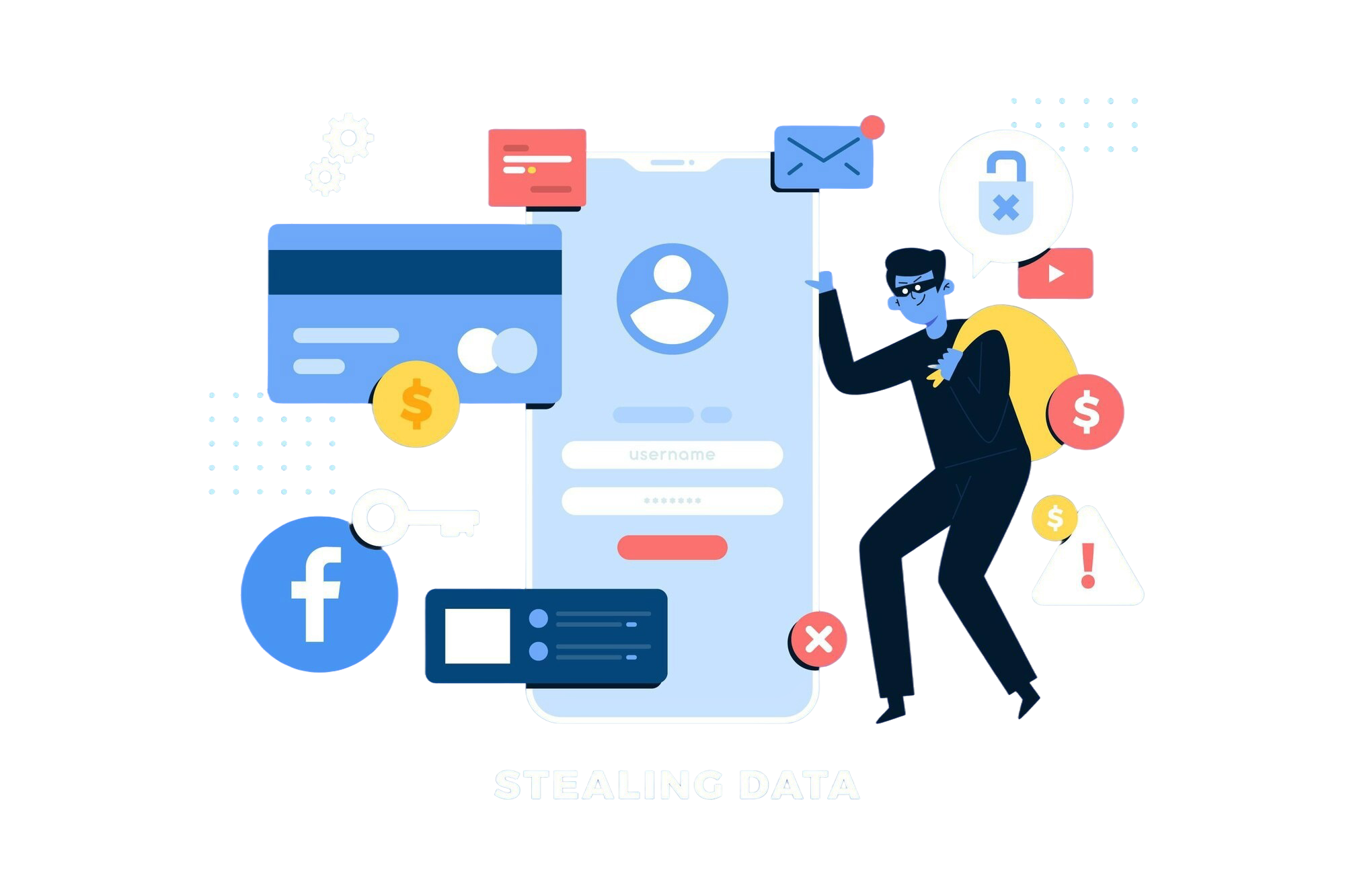
How AI prevents data tampering in logistics ?
AI strengthens record accuracy by checking every data change, comparing it against trusted baselines, and raising alerts when values fall outside expected patterns. This creates early visibility and prevents manipulated information from entering operational workflows.
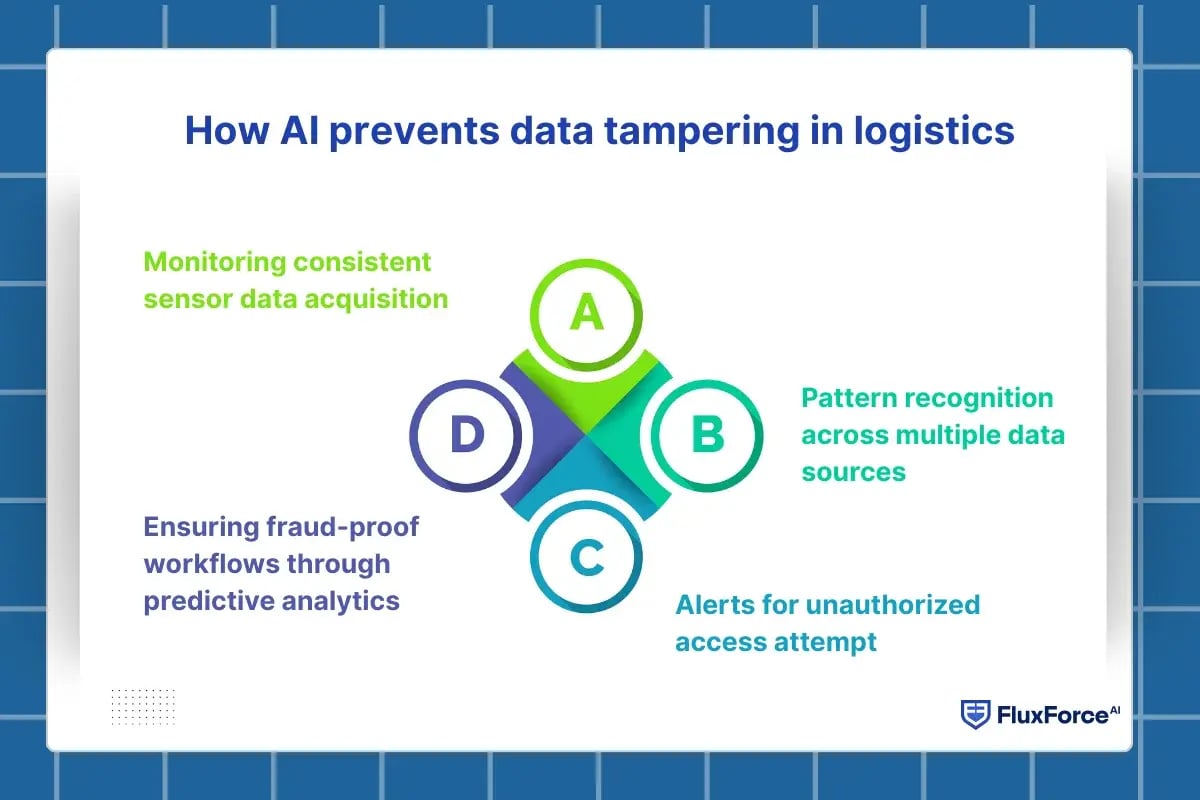
Monitoring consistent sensor data acquisition- AI tracks every data point generated by IoT devices, fleet units, scanners, and warehouse systems. The system spots missing values, unusual jumps, and inconsistent sensor updates within seconds. Early detection prevents corrupted data from entering official records.
Pattern recognition across multiple data sources- AI compares shipment information across manifests, customs files, billing entries, and scan histories. Even small deviations in quantities, timestamps, or routing paths get identified early, stopping tampered values before they spread across connected systems.
Alerts for unauthorized access attempts- AI observes login patterns, file access behaviour, and query activity across logistics systems. Attempts that fall outside standard activity create immediate alerts, allowing teams to block suspicious access before data gets altered.
Ensuring fraud-proof workflows through predictive analytics- AI screens all incoming data before using it for forecasting. Manipulated values never reach planning tools, keeping route optimization, demand projections, and risk models accurate and free from falsified inputs.
Key technologies that support logistics data security
Modern supply chains require multiple security layers that create strong barriers against manipulation. Core technologies that deliver authenticity, transparency, and protection include:
1. Blockchain networks for immutable records
Blockchain records every shipment milestone in permanent ledgers. Once added, entries cannot be modified or removed. Smart contracts automate actions at each checkpoint, removing manual intervention points where manipulation normally occurs.
2. Encrypted data pipelines between partners
AI manages encrypted communication flows between carriers, warehouses, customs partners, and client systems. End-to-end encryption and digital signatures ensure only verified parties can read or update logistics details. Protected pipelines stop attackers from altering information during transit.
3. Real-time integrity monitoring systems
Integrity engines use cryptographic hashes to verify that stored files remain unchanged. AI checks each update against previous file versions and flags any mismatch. Continuous validation strengthens record accuracy across cloud and on-premises systems.
4. AI-powered anomaly detection platforms
Unsupervised AI models track shipment behaviour, device inputs, transaction logs, and access requests. Multi-model detection improves accuracy by comparing statistical, behavioural, and rule-based insights. Adaptive thresholds reduce false alarms and catch new attack patterns quickly.
AI-driven Security Strategies for Logistics Risk Officers
Maersk involved in a major NotPetya incident that halted global operations and produced losses measured in hundreds of millions of dollars. The attack destroyed critical systems, blocked container movements, and forced manual workarounds for weeks.
For risk leaders, it is essential to implement strategic measures that:
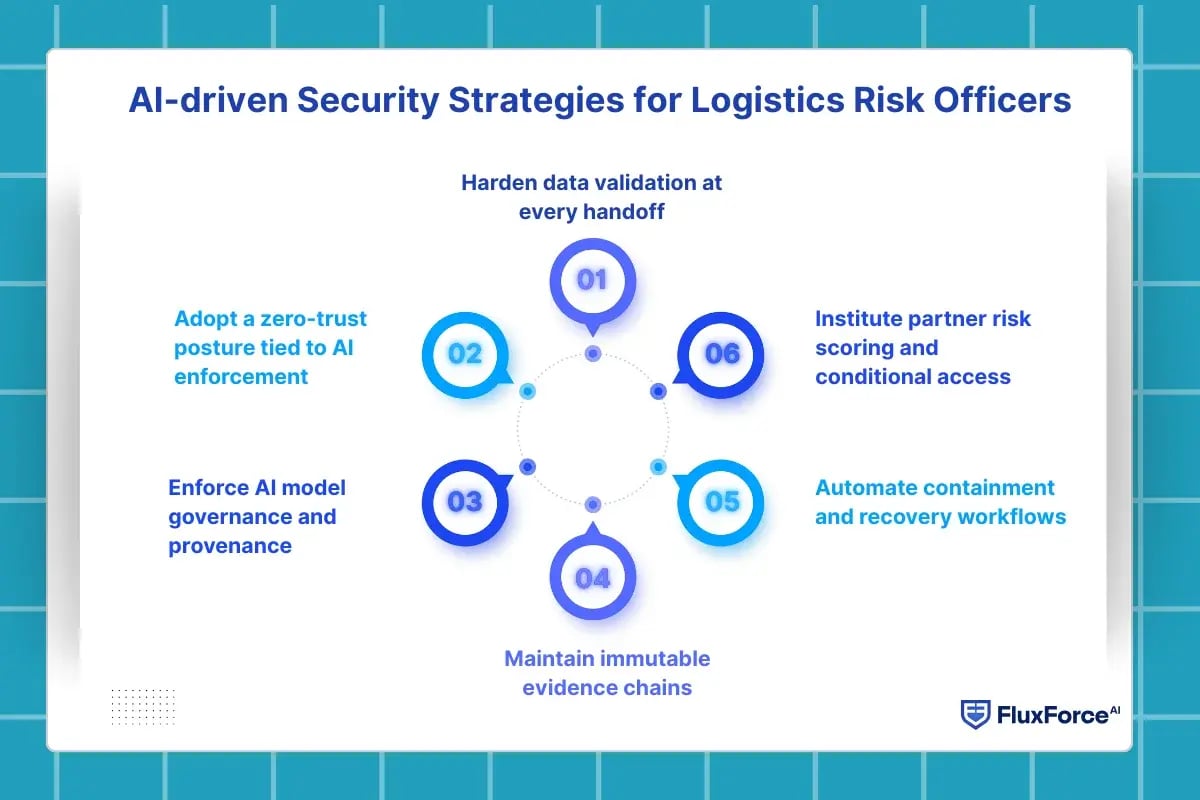
1. Harden data validation at every handoff.
Deploy AI checkpoints that verify sensor readings, manifest entries, and customs documents before systems accept changes. Validation prevents tampered values from propagating through planning and billing systems.
2. Adopt a zero-trust posture tied to AI enforcement.
Combine continuous authentication, micro-segmentation, and AI-driven behavioural baselines so devices and users gain access only after automated verification.
3. Enforce AI model governance and provenance.
Track training datasets, model versions, and retraining events. Validate inputs used for model updates to prevent model poisoning and preserve detection accuracy.
4. Institute partner risk scoring and conditional access.
Use AI to score third-party security posture and apply conditional data access rules. Block or quarantine data from low-scoring partners until independent verification occurs.
5. Automate containment and recovery workflows.
Predefine AI-triggered playbooks that isolate affected segments, roll back to verified snapshots, and redirect critical workflows to manual safe paths while forensic capture runs.
6. Maintain immutable evidence chains.
Record transaction hashes, device attestations, and audit logs in tamper-evident storage so investigators can trace root cause without gaps.
New Cyber Threats in Logistics After AI Adoption
AI strengthens logistics defences, but it also introduces new risks as attackers learn to exploit intelligent systems and automated decision pipelines. Logistics networks must prepare for these emerging AI-age threats:
- Adversarial Inputs: Attackers insert subtle distortions into sensor data or documentation to confuse AI engines, causing incorrect routing, false approvals, or invalid damage assessments.
- Model Poisoning: Manipulated training data weakens detection accuracy over time, allowing tampered entries or abnormal sensor values to bypass security checks.
- Identity Spoofing: Cybercriminals imitate scanners, IoT devices, or fleet sensors to inject fake location updates, temperature readings, or cargo conditions into shared systems.
- Deepfake Documentation: AI-generated images, signatures, and delivery proofs imitate real documents and trick automated verification processes.
- Partner-Origin Intrusions: Attackers exploit weak partner systems to push manipulated data into shared supply chain workflows, expanding the risk beyond internal systems.
Best Practices to Build Tamper-Proof Supply Chain Data in 2026
For ensuring resilient operations that resist emerging cyberattacks, risk leaders must align architecture, governance, partner controls, and human readiness around tamper-proof principles.
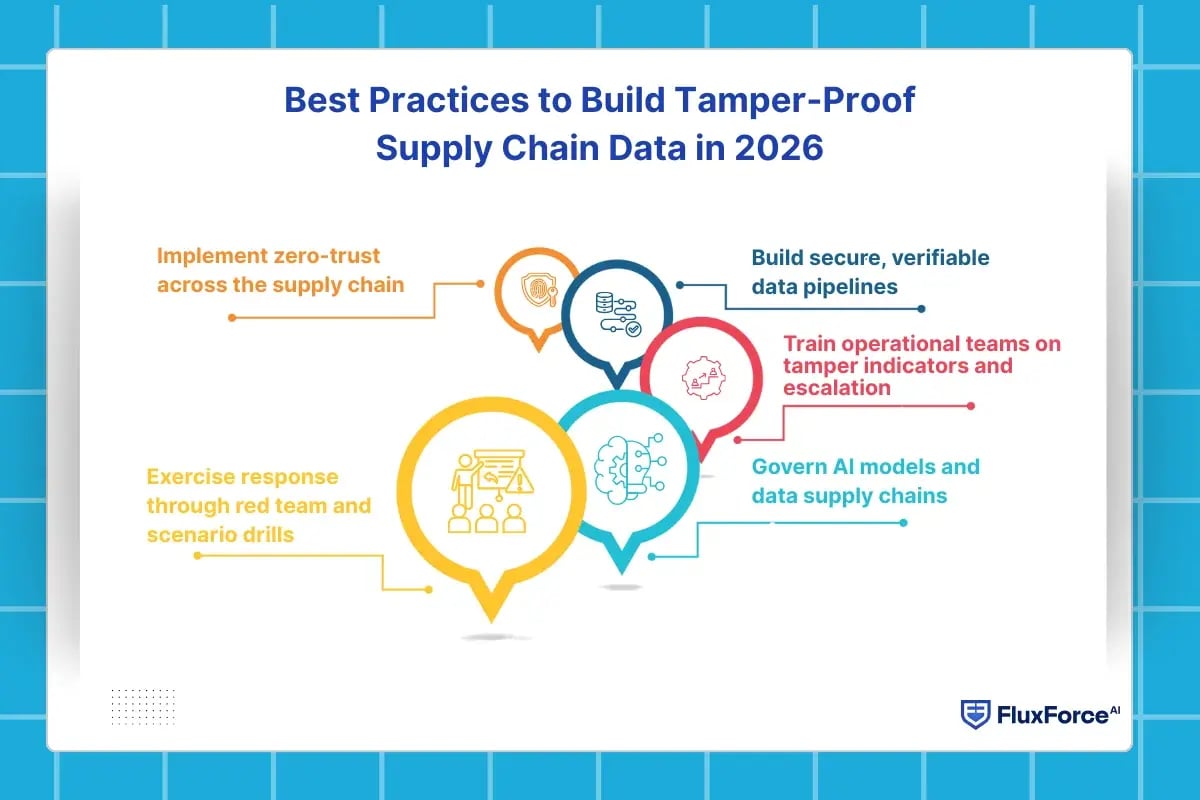
- Implement zero-trust across the supply chain: Authenticate every transaction and device continuously. Segment networks so breaches cannot reach core logistics databases.
- Build secure, verifiable data pipelines: Encrypt end-to-end, sign messages with digital signatures, and verify payload integrity before ingestion into operational systems.
- Train operational teams on tamper indicators and escalation: Run periodic tabletop exercises and phishing simulations that include data-manipulation scenarios. Ensure staff know rapid containment steps.
- Govern AI models and data supply chains: Maintain auditable lineage for training data and enforce staged deployment with shadow testing. Schedule frequent adversarial tests and rollback plans.
- Exercise response through red team and scenario drills: Simulate model poisoning, device spoofing, and partner-origin intrusion. Validate detection, isolation, and recovery procedures under operational load.
Conclusion
AI supports logistics teams by checking data at every step. These checks confirm that records stay unchanged as shipments move through different systems. Risk officers see irregular activity early and respond before it disrupts operations. Encrypted transfers protect sensitive updates from tampering. Verified logs give a clear view of every change. Automated alerts point to errors that may impact time-critical decisions.
Strong data integrity helps teams work with accurate information during route shifts, delays, or compliance checks. Clean records also strengthen coordination with partners across the supply chain. As AI becomes part of daily logistics work, protection at each data touchpoint becomes essential for steady movement, accurate reporting, and stable operations across global networks.
Share this article