.webp)







Listen to our podcast 🎧
Introduction
AI-powered security has quickly become a mandate across industries, and global shipping is one of the sectors benefiting the most from AI solutions. Vulnerabilities in cargo handling and maritime logistics, which used to expose companies to costly theft and regulatory non-compliance, can now be reduced by over 30% through AI-driven monitoring and predictive analytics.
For shipping security executives, protecting cargo during international transit ethically and efficiently requires strategic use of AI tools, including real-time monitoring, automated tamper detection, and predictive risk scoring.
This detailed analysis presents essential approaches for using AI cargo tamper analytics, predictive models, and automated monitoring to help shipping security heads identify threats early and strengthen operational resilience across global logistics networks.

Why leveraging intelligent threat detection for maritime logistics is essential ?
Once cargo leaves ports, most security teams often depend on manual surveillance from CCTV or delayed reporting. Relying on this approach means tampering can go unnoticed, causing losses and compliance issues across long shipping routes.
Key reasons to adopt intelligent detection models in 2026 include:
- Tampering is rising during transit- Criminal groups now target containers mid-route. Without intelligent alerts, security teams have no way to identify or stop the breach when it happens.
- More parties handle cargo today- Cargo changes control multiple times. Intelligent threat detection is needed to track responsibility and expose unauthorized interactions in real time.
- Compliance pressure has increased- Authorities expect traceable cargo integrity. Without intelligent data trails, audits fail and shipments get delayed for manual checks.
- Delays in updates cause higher losses- Manual reporting shows threats after unloading. Intelligent threat detection gives faster awareness so security heads can act before the situation worsens.
How AI protects global shipping operations ?
AI solutions, through real-time analytics and intelligent monitoring systems, enable a comprehensive supply chain threat detection across vessels, ports, and shipping routes. They reduce surveillance gaps, prevent unnoticed tampering, and safeguard cargo integrity throughout the journey from departure to delivery.
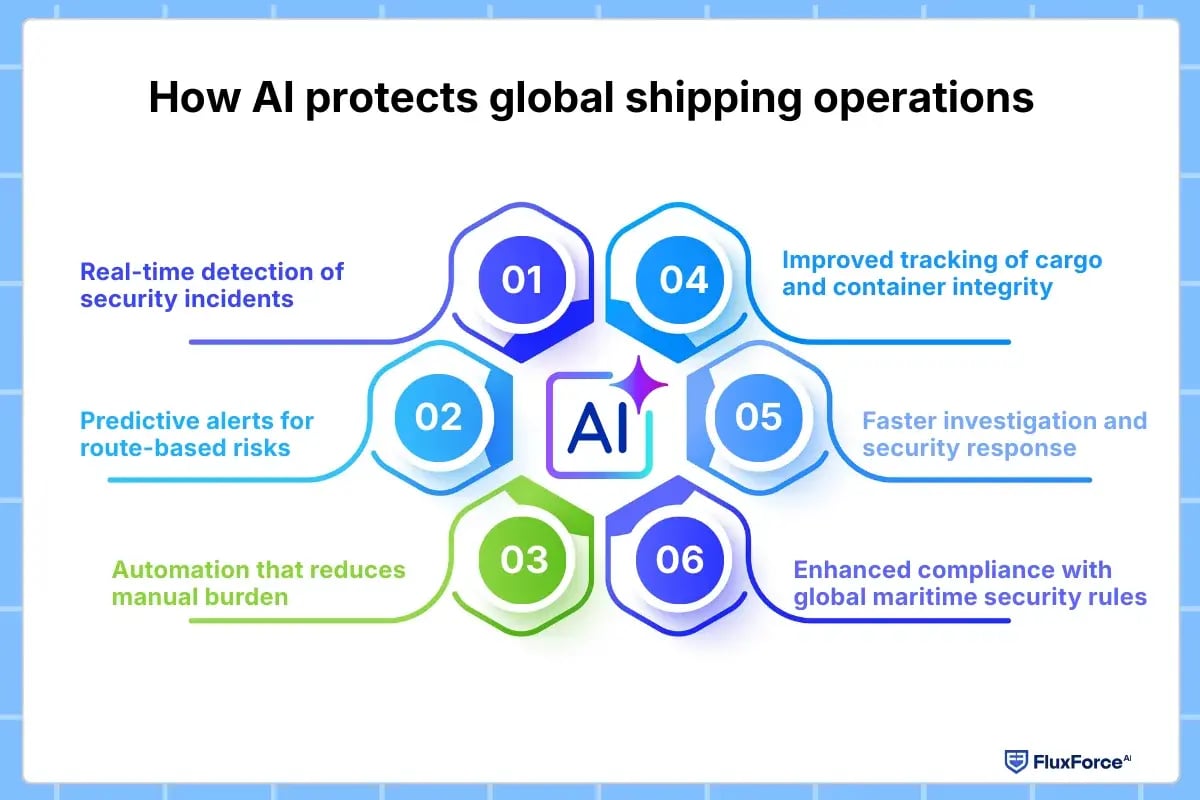
1. Real-time detection of security incidents
AI constantly analyses CCTV feeds, radar inputs, and onboard sensors to detect unauthorized access, suspicious movements, and container breaches the moment they occur. This eliminates delays caused by manual monitoring, helping security teams stop threats in progress and protect valuable shipments even in remote maritime zones.
2. Predictive alerts for route-based risks
Machine learning models evaluate historical attacks, piracy hotspots, weather disruptions, and geopolitical tensions to predict where risks are likely to occur. These proactive alerts help shipping operators adjust routes early, preventing security incidents, avoiding costly delays, and ensuring safer cargo passage through high-risk shipping corridors worldwide.
3. Automation that reduces manual burden
AI automates threat identification, tracking, and reporting tasks that traditionally require large surveillance teams. This reduces human fatigue and oversight errors, strengthens operational efficiency, and ensures every potential security event is captured, analysed, and escalated immediately — without waiting for manual review or delayed communications at sea.
4. Improved tracking of cargo and container integrity
Smart IoT sensors and AI-driven analytics monitor container doors, seal status, internal conditions, and sudden route deviations. Any change triggers an instant alert to command centres, helping prevent smuggling, hidden tampering, and loss of goods while maintaining transparent control across long, unmonitored ocean routes.
5. Faster investigation and security response
AI classifies threats based on risk severity, aggregates contextual data, and provides clear dashboards for informed decision-making. Security teams can quickly understand what happened, where, and why — enabling a rapid response, minimizing operational downtime, and reducing potential financial and reputational damage to shipping companies.
6. Enhanced compliance with global maritime security rules
AI continuously logs incidents, stores surveillance evidence securely, and aligns operations with international compliance frameworks such as ISPS. This reduces the chance of penalties, helps insurers validate security claims faster, and proves that cargo remained protected through every checkpoint and jurisdictional boundary.
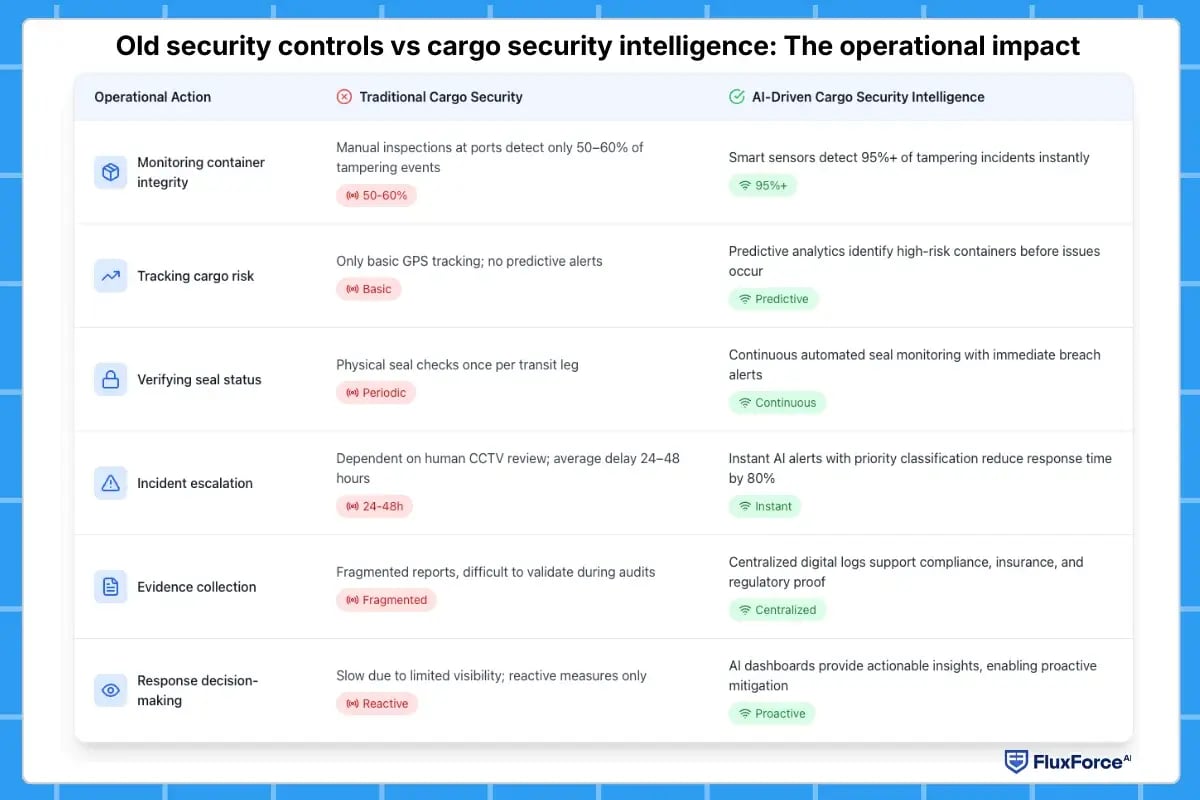
Old security controls vs cargo security intelligence: The operational impact
The approaches of both traditional security methods and AI-driven cargo security intelligence differ significantly in monitoring, detection, and response. While manual processes rely on periodic checks, AI solutions provide more predictive control.
Key AI-driven cargo tampering prevention solutions
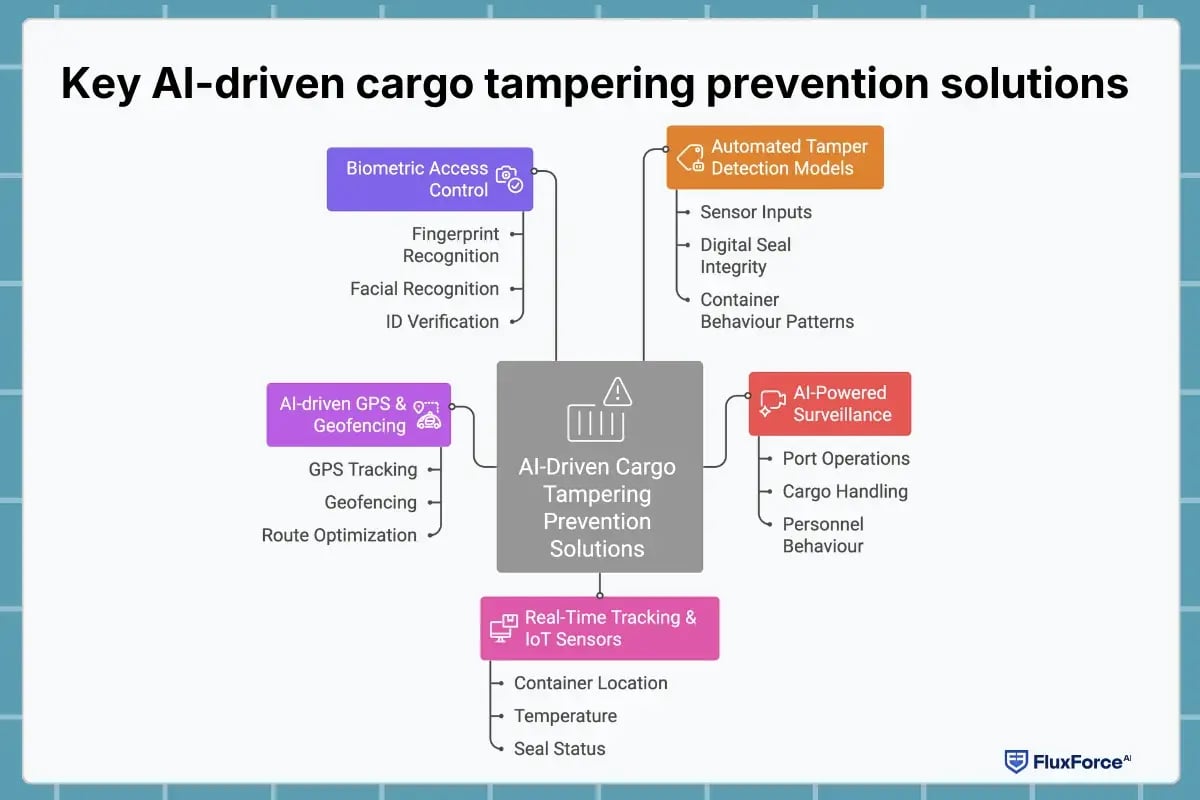
From ensuring consistent monitoring of container behaviour to automated detection of potential tampering, several AI solutions support secure cargo handling. Here are some of the essential solutions:
1. Automated Tamper Detection Models
Advanced AI models analyse sensor inputs, digital seal integrity, and container behaviour patterns to immediately detect unusual activities. These systems flag potential tampering in real-time, reducing losses by up to 30% compared with manual checks.
2. AI-Powered Surveillance and Behavioural Analysis
Machine-learning algorithms monitor port operations, cargo handling, and personnel behaviour to identify suspicious patterns. Behavioural anomalies, such as repeated unauthorized access attempts, trigger immediate alerts, ensuring swift intervention before incidents escalate.
3. Real-Time Tracking & IoT Sensors
Smart IoT sensors continuously track container location, temperature, and seal status. AI analyses this data to detect deviations or unauthorized opening, providing security heads with live insights and preventing unnoticed tampering along long shipping routes.
4. AI-driven GPS, Geofencing, and Route Optimization
AI integrates GPS tracking with geofencing to define safe corridors for cargo transit. Deviations trigger instant alerts, while predictive route optimization avoids high-risk areas, reducing exposure to theft and tampering during international shipping.
5. Biometric Access Control
Integrating AI with biometric systems ensures only authorized personnel can access containers. Fingerprint, facial recognition, and ID verification reduce insider threats and provide a verifiable record for compliance and audits.
Essential analytics to measure for ensuring maritime security with AI
AI can detect tampering in real time, but its accuracy depends on the quality of intelligence it receives and learns from. Shipping security heads must measure analytics that improve model performance, reduce errors, and guide faster action. These indicators make AI smarter with every movement of cargo:
1. Track false-positive vs. true-positive alerts
Track how many alerts correctly indicate tampering and how many are incorrect. A lower false-positive count helps AI refine threat detection and reduce alert fatigue that slows decision-making.
2. Measure sensor data confidence levels
Measure the confidence score that AI assigns to each sensor reading. A drop in confidence signals calibration needs and prevents AI from relying on weak data that could hide tampering activities.
3. Analyse time-based manipulation patterns
Analyse when tampering attempts usually occur, such as night hours or port waiting time. Feeding this timing data into AI improves prediction and resource placement where risk is highest.
4. Evaluate cross-system data correlation success
Evaluate how well AI connects data from seals, cameras, and tracking logs. Strong correlation prevents attackers from bypassing detection by targeting a single system.
Executive-level security guide for tamper-proof shipping operations
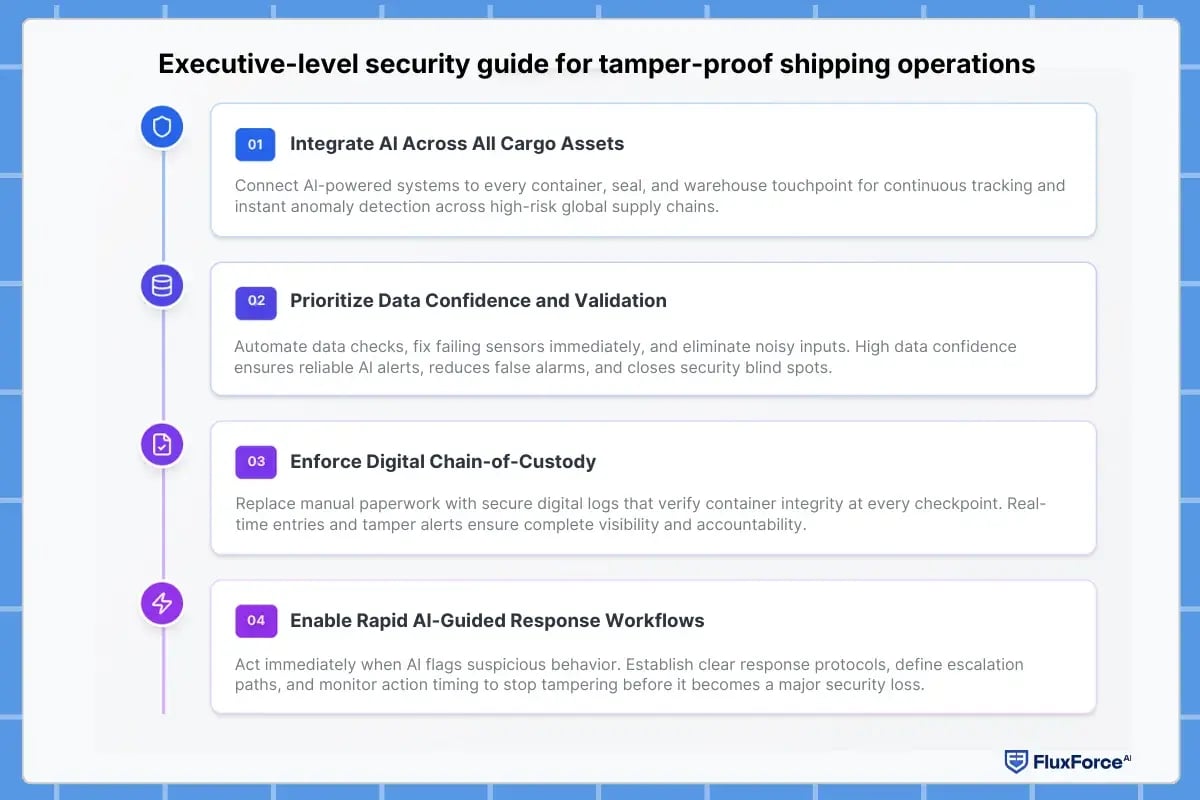
1. Integrate AI across all cargo assets
Ensure AI-powered systems connect to every container, seal, and warehouse touchpoint. Continuous tracking and verification of every movement allows instant detection of anomalies and supports faster risk-based decisions across high-risk global supply chains.
2. Prioritize data confidence and validation
Security leaders must ensure AI receives accurate signals at all times. Automate data checks, fix failing sensors without delay, and remove noisy inputs from the network. When data confidence stays high, AI alerts become fully reliable, false alarms drop, and attackers lose the chance to exploit blind spots or weak readings in the system.
3. Enforce digital chain-of-custody
Every handoff must be recorded and verified instantly. Replace manual paperwork with secure digital logs that confirm container integrity at each checkpoint. Real-time entries, access approvals, and tamper alerts ensure no step in the journey is hidden. This gives leaders faster investigation control and prevents delays in compliance or partner accountability.
4. Enable rapid AI-guided response workflows
Teams must act the moment AI flags suspicious behaviour. Establish clear response rules, define who escalates what, and monitor how quickly actions are taken after each alert. When everyone knows their role and timing expectations, small tampering attempts are stopped before they turn into serious security losses.
Conclusion
Global cargo shipping security is not only about integrating systems but also about leveraging analytics to maintain a continuous view of container integrity and port security. As international trade grows and regulatory requirements tighten, organizations need instant, reliable security solutions. FluxForce AI provides pre-built security agents specifically designed for high-risk supply chains. By analysing multiple AI data sources, these agents deliver centralized monitoring, autonomous alerts, and automated reporting. For organizations, our agents ensure cargo is protected, operational risks are reduced, and regulatory compliance is maintained while preserving trust across global logistics networks.
Share this article